
In an increasingly competitive global talent landscape, the phenomenon of candidate renege—where an accepted job offer is subsequently withdrawn by the candidate—poses a significant and costly challenge for organizations across all sectors. Historically, recruitment and human resources departments have grappled with a largely reactive approach, often discovering a candidate’s decision to renege only after the fact, when communication ceases, or a formal withdrawal is issued. This belated awareness frequently leaves teams scrambling to backfill critical positions, incurring substantial financial, operational, and reputational damage. A paradigm shift is underway, however, advocating for the treatment of candidate engagement signals as crucial leading indicators, enabling organizations to proactively identify and address potential withdrawals before they materialize.
The Silent Drain: Understanding the Cost of Candidate Renege
The impact of a candidate renege extends far beyond the immediate inconvenience of a vacant role. Estimates suggest that the cost of a single renege can range from 30% to 200% of the position’s annual salary, encompassing lost productivity, additional recruitment fees, extended time-to-fill, and diminished team morale. According to a 2023 industry report by the Talent Acquisition Institute, approximately 15% of candidates across various industries renege on job offers annually, with this figure rising to nearly 25% in highly competitive sectors such as technology and specialized healthcare. This attrition disrupts project timelines, places undue strain on existing employees, and can even delay strategic initiatives. Moreover, a high renege rate can subtly erode an organization’s employer brand, signaling potential issues in the candidate experience or internal culture to the wider talent pool. The underlying issue, as identified by leading talent management experts, is often a fundamental lack of a structured process to monitor and interpret candidate sentiment during the critical pre-start period. By the time a candidate goes quiet, indicating disengagement, their decision to withdraw may already be firmly established, making intervention exceedingly difficult.
A New Era of Predictive Talent Management: The Engagement Health Scorecard
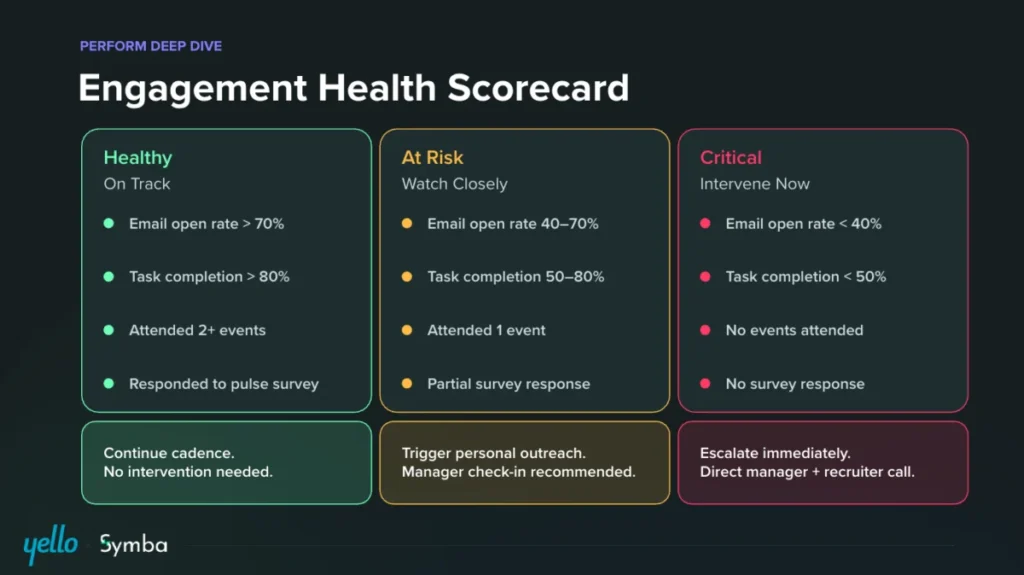
To counter this pervasive challenge, forward-thinking organizations are adopting sophisticated, data-driven methodologies, epitomized by the "Engagement Health Scorecard." This innovative framework categorizes candidates into distinct groups based on their behavior and interaction patterns during the pre-start phase, enabling talent acquisition teams to implement targeted, timely interventions. The core principle is simple yet powerful: continuous monitoring of engagement signals provides predictive insights, allowing for proactive risk mitigation rather than reactive damage control.
The pre-start period, often overlooked beyond offer acceptance and background checks, is a crucial window for maintaining candidate enthusiasm and commitment. It’s during this phase that candidates are most susceptible to competing offers, personal uncertainties, or a perceived lack of connection with their future employer. The Engagement Health Scorecard transforms this vulnerability into an opportunity for strategic engagement.
Deconstructing Engagement Tiers: Signals and Strategic Responses
The scorecard typically classifies candidates into three primary categories: Healthy, At-Risk, and Critical, each defined by specific engagement metrics and necessitating distinct strategic responses.
1. Healthy Candidates: Sustaining Momentum and Reinforcing Commitment
- Behavioral Indicators: Candidates in the "Healthy" category demonstrate robust engagement, characterized by email open rates consistently above 70%, diligent completion of pre-onboarding tasks (e.g., paperwork, profile setup), active attendance at multiple pre-start events (e.g., virtual meet-and-greets, informational webinars), and prompt, comprehensive responses to surveys designed to gauge sentiment or gather logistical information. These individuals are actively participating in their transition, signaling strong enthusiasm and commitment.
- Strategic Response: For healthy candidates, the recommended action is to "continue the cadence and stay the course." This involves maintaining a consistent, positive communication flow without overwhelming the candidate. It includes regular, personalized updates, sharing exciting news about the team or company, and ensuring all pre-onboarding information is clear and accessible. The goal is to reinforce their positive decision, build anticipation, and deepen their connection with the organization. This sustained engagement ensures that the initial excitement of accepting the offer is nurtured, reducing the likelihood of external influences swaying their decision. An industry survey by LinkedIn in 2022 highlighted that candidates who felt "highly engaged" during the pre-boarding phase were 87% more likely to remain with the company for at least two years.
2. At-Risk Candidates: Early Intervention and Personalized Outreach
- Behavioral Indicators: "At-Risk" candidates exhibit a noticeable decline in engagement. Their email open rates typically fall within the 40-70% range, attendance at optional pre-start events is limited or sporadic, and survey responses might be incomplete or delayed. While not entirely disengaged, their behavior suggests waning enthusiasm or potential distractions. This is a critical juncture where timely intervention can often reverse the trend.
- Strategic Response: These candidates require "personal outreach within 48 hours." The immediacy of the response is paramount. This is not a moment for automated messages but for genuine human connection. Recommended actions include a direct message from the program manager, offering to answer any questions or address concerns; an invitation to the next event that feels individually tailored rather than a mass distribution; and crucially, a proactive check-in from the hiring manager. The hiring manager’s personal involvement can significantly impact a candidate’s perception of their future role and team, demonstrating the organization’s commitment to their success. Such personalized attention can often quickly turn around a wavering candidate, addressing nascent doubts before they solidify. According to a study by Glassdoor, 76% of job seekers consider an organization’s communication during the hiring process as a direct reflection of how they value their employees.
3. Critical Candidates: Immediate Escalation and Root Cause Analysis
- Behavioral Indicators: "Critical" candidates display almost no engagement. Their email open rates plummet below 40%, they show no attendance at any pre-start events, provide no survey responses, and exhibit a complete lack of activity for three or more weeks. This level of disengagement is a strong precursor to a renege and demands urgent, high-level attention.
- Strategic Response: These situations require "immediate escalation." The standard protocol includes a direct, personal call from the hiring manager to understand the situation; a sensitive, personal touchpoint from the recruiter to open a channel for honest communication; and a real, empathetic conversation about what might be occurring. Often, the root cause is a competing offer from another organization, a significant personal circumstance that has arisen, or simple uncertainty about the role, the team, or the company culture. Catching these issues in time allows the organization to potentially address concerns, negotiate, or offer support, often salvaging the candidate. Data from a recent Korn Ferry report indicates that candidates are 70% more likely to reconsider a withdrawal if a senior leader reaches out directly to address their concerns with empathy and genuine interest.
The Data Advantage: Continuous Monitoring and Strategic Insight
The fundamental differentiator between organizations that successfully retain candidates and those perpetually scrambling to backfill positions lies in their approach to data. The first group embeds continuous data analysis into their talent acquisition strategy, constantly monitoring engagement metrics and proactively interpreting trends. They do not wait for a formal renege email; they anticipate it by recognizing the early warning signs. This continuous data stream allows for ongoing refinement of the pre-boarding process, identifying common points of disengagement and adapting strategies accordingly.
"The shift from a reactive to a predictive model in talent acquisition is not merely an operational improvement; it’s a strategic imperative," states Dr. Evelyn Reed, a leading industry analyst specializing in workforce dynamics. "Organizations that leverage engagement data effectively are not only reducing their renege rates but are also building stronger, more resilient talent pipelines and enhancing their employer brand through superior candidate experience."
Broader Implications for Talent Strategy and Organizational Resilience
The implementation of an Engagement Health Scorecard extends its benefits far beyond merely preventing reneges. It contributes significantly to several key areas of talent strategy:
- Enhanced Candidate Experience: Proactive engagement demonstrates an organization’s commitment and care, fostering a positive perception that begins even before day one. This positive experience can lead to better word-of-mouth referrals and a stronger employer brand.
- Operational Efficiency and Cost Savings: By reducing reneges, organizations significantly cut down on the costly and time-consuming process of reopening requisitions, re-interviewing, and extending new offers. This frees up recruiter time and resources for strategic initiatives rather than crisis management.
- Improved Onboarding Success: Candidates who feel engaged and supported during the pre-start phase are more likely to have a smoother and more successful transition into their new role, leading to higher early retention rates and faster time-to-productivity.
- Data-Driven Process Improvement: The continuous collection and analysis of engagement data provide invaluable insights into the effectiveness of recruitment and pre-boarding processes. This allows for iterative improvements, ensuring that the organization’s talent acquisition strategy remains agile and responsive to market dynamics.
- Organizational Resilience: A robust system for candidate engagement builds a more stable and predictable workforce, reducing volatility and enabling more reliable long-term strategic planning.
"In today’s dynamic labor market, every candidate interaction is an opportunity to solidify commitment or risk losing valuable talent," notes Marcus Thorne, VP of Talent Acquisition at a prominent tech firm. "Our investment in predictive engagement tools has not only drastically cut our renege rate but has also transformed our entire pre-boarding experience, making it a competitive advantage."
The KEEP Playbook: A Comprehensive Implementation Guide
For organizations looking to implement or refine their candidate engagement strategies, comprehensive resources are available. "The KEEP Playbook," for instance, offers a detailed blueprint for building a robust pre-start engagement program. It includes a full engagement health scorecard with clearly defined thresholds for each tier (Healthy, At-Risk, Critical) and recommended actions. Furthermore, it provides a step-by-step intervention playbook, equipping teams with practical strategies for addressing disengagement at various stages. Beyond individual candidate management, the playbook also incorporates a post-cycle review template, enabling continuous improvement through systematic analysis of program effectiveness after each recruitment cycle. This holistic approach ensures that talent acquisition teams can learn from their experiences, adapt their strategies, and consistently enhance their ability to retain top talent.
In conclusion, the era of passively awaiting a candidate’s decision is rapidly receding. Modern talent acquisition demands a proactive, data-informed strategy that treats engagement signals as critical predictive indicators. By systematically monitoring candidate health, implementing timely and personalized interventions, and continuously refining their processes, organizations can significantly mitigate the pervasive challenge of candidate renege, fostering a more stable workforce and strengthening their strategic position in the competitive talent marketplace. The ability to look at data continuously, rather than just reacting to a withdrawal, is the hallmark of successful talent retention in the 21st century.






