
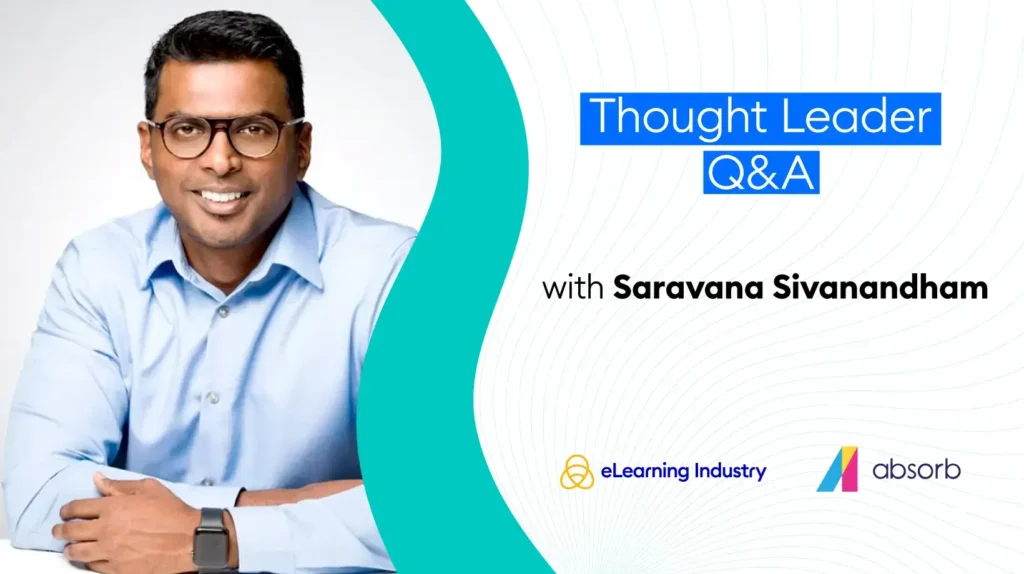
The global corporate learning and development (L&D) landscape is undergoing a fundamental transformation as organizations move away from traditional metrics of engagement and toward a rigorous focus on measurable business performance. For decades, the industry has struggled to bridge the gap between educational activity and tangible financial results. However, the emergence of generative artificial intelligence and agentic systems is now providing the technical "plumbing" necessary to link learning directly to the systems where work occurs. Saravana Sivanandham, Chief Product and Marketing Officer at Absorb Software, suggests that the industry is at a critical juncture where the promise of proven business impact is finally becoming a reality.
The Pivot from Participation to Performance
Historically, the success of corporate training programs was measured through "vanity metrics"—completion rates, quiz scores, and learner satisfaction surveys. While these figures indicated participation, they rarely correlated with actual shifts in productivity, revenue, or employee retention. The primary obstacle was not a lack of ambition but a lack of integration. Learning management systems (LMS) existed as silos, unable to observe the daily workflows of employees.
According to Sivanandham, the gap between learning and impact is "genuinely closable" for the first time due to three technological shifts: the ability to access data where work happens, the capacity to reason over that data using generative AI, and the mechanism to loop results back into business outcomes. This shift requires a disciplined focus on outcomes that the enterprise already prioritizes, such as sales win rates, customer support resolution times, and employee ramp-up periods. Without this focus, AI risks simply "industrializing" old, ineffective metrics at a faster pace.
Historical Context: From Manual Tracking to Digital Silos
To understand the current AI revolution in L&D, it is necessary to examine the chronology of the industry’s evolution. In the early 2000s, the transition from physical classrooms to digital LMS platforms focused on compliance and centralization. The introduction of standards like SCORM (Sharable Content Object Reference Model) allowed for basic tracking of course completions.
By the mid-2010s, the "Learning Experience Platform" (LXP) emerged, emphasizing user engagement and personalized content recommendations. Despite these advancements, the underlying problem persisted: learning remained a peripheral activity. The data generated by these systems was rarely reconciled with the data in Customer Relationship Management (CRM) tools or Enterprise Resource Planning (ERP) systems.
The current era, beginning roughly in 2023 with the explosion of Large Language Models (LLMs), represents the third major wave. This era is defined by "agentic" learning—systems that do not just provide content but actively diagnose capability gaps by analyzing real-world work data and delivering targeted interventions in real-time.
The Technological Breakthrough: Agentic AI and Closed-Loop Systems
The core of the modern L&D strategy lies in moving beyond "AI-powered" labels toward "AI-native" architectures. Sivanandham identifies a three-tier hierarchy of AI implementation in the learning sector. The first tier consists of basic AI features, such as automated content generation or chatbots that answer frequently asked questions. While helpful for efficiency, these do not fundamentally change the relationship between learning and performance.
The second tier involves AI-assisted systems that provide recommendations to human administrators. The third and most advanced tier is "agentic" or "AI-native" learning. In this model, AI agents use technologies like Model Context Protocol (MCP) and Agent-to-Agent (A2A) communication to observe work in systems such as Salesforce, Zendesk, or GitHub. By analyzing conversations, code, and support tickets, these agents can identify exactly where a performance gap exists.
For example, if a sales representative is struggling to handle objections during the "discovery" phase of a deal, an agentic system can detect this trend in the CRM and automatically deliver a specific micro-learning module or coaching tip. The system then "reads back" the subsequent sales data to see if the win rate improved. This creates a closed-loop system where learning is an automated response to performance data, rather than a scheduled event.
Data-Driven Performance and Proprietary Insights
A significant challenge for enterprises today is distinguishing between genuine AI innovation and "wrappers" on public models. Sivanandham argues that the competitive advantage in AI does not come from the models themselves—as most vendors use similar foundational technologies—but from the data they access.
The most effective systems are grounded in two types of data:
- Proprietary Learning Data: Historical records of what specific interventions led to successful skill acquisition within a particular organization.
- Live Business Context: Real-time data from the systems of record where work is performed.
Recent industry data supports this shift toward data-integrated learning. According to research from LinkedIn’s 2024 Workplace Learning Report, 90% of organizations are concerned about employee retention, and "providing learning opportunities" is the number one strategy to improve it. However, the report also notes that L&D leaders are under increasing pressure to demonstrate ROI to the C-suite. By grounding AI in proprietary business data, L&D departments can move from defending their budgets to proving their contribution to the bottom line.
Addressing the Fragmented Ecosystem of Corporate Tools
One of the greatest barriers to proving learning impact is the "patchwork" nature of corporate technology. Many large enterprises currently manage four or more disconnected learning systems—one for internal employees, another for customer education, a third for partner enablement, and a separate platform for compliance.
This fragmentation creates data silos that make it impossible to build a cohesive picture of workforce capability. A unified model, according to Sivanandham, involves a single platform for all audiences with a shared intelligence layer. This layer must also reach beyond formal course catalogs to index knowledge where it actually lives, such as SharePoint, Confluence, Google Drive, and recorded meetings.
By consolidating these systems, organizations can begin to see cross-functional impacts. They can measure, for instance, how customer education programs directly influence subscription renewal rates, or how partner training affects channel revenue. This holistic view is what transforms a learning system into a "system of intelligence."
Official Responses and the CFO’s Perspective
The shift toward outcome-based learning is increasingly driven by the finance department. Historically, Chief Financial Officers (CFOs) have viewed L&D as a "discretionary cost center." In a tightening economic environment, the demand for "CFO-ready" language is paramount.
Sivanandham notes that customers are no longer asking for "skills taxonomies"—which he describes as theoretical exercises that often decay before they are finished. Instead, they are asking for "proof of readiness." The question has shifted from "Do our people have these skills?" to "Can our people do the job, and can you prove it?"
The launch of Absorb Aura, an agentic learning system, is a direct response to this demand. By functioning as a system of record for capability and a system of action for interventions, it allows L&D teams to report on metrics like "time to productivity" for new hires and "revenue per employee." When L&D can demonstrate that a specific training intervention reduced employee ramp time by 20%, they secure a seat at the strategic table.
Broader Impact and Implications for the Future Workforce
Looking ahead three to five years, the integration of AI into learning is expected to produce two major shifts in the global workforce.
First, the "speed of capability" will become a primary competitive advantage. As AI increases the general productivity of all workers, the differentiator between companies will be how quickly their human talent can adapt to new tools and market conditions. Learning will move from the periphery of the enterprise to the center of its performance strategy.
Second, AI enables the realization of "one-to-one coaching" at scale. Educational psychology has long recognized the "Bloom’s 2 Sigma Problem," which states that students tutored one-on-one perform significantly better than those in a classroom. Until now, providing a personal coach for every employee was financially impossible. AI agents remove this constraint, offering every learner a personalized mentor that understands their specific role, their current performance gaps, and the organization’s broader goals.
Conclusion: The Shift from Tools to Outcomes
The transition to AI-native learning represents more than just a technological upgrade; it is a fundamental redefinition of the role of L&D within the modern corporation. By leveraging agentic systems to bridge the "plumbing gap" between education and work, organizations can finally move past the era of vanity metrics.
As the industry moves forward, the success of these platforms will be judged not by the sophistication of their chatbots, but by their ability to move the needle on the numbers that matter to the business. In this new paradigm, learning is no longer a background function—it is the engine of organizational growth and the most human application of artificial intelligence in the modern workplace. Organizations that embrace this shift toward ambient, context-aware, and outcome-driven learning will be best positioned to navigate the complexities of the AI-driven economy.






