
In a move poised to redefine the landscape of human resources and organizational design, software giant Atlassian, renowned for its collaboration tools like Jira and Confluence, is actively recruiting for an innovative new HR leadership position: a Director of Capacity Planning. This strategic role is designed to develop the fundamental frameworks that will guide leaders in intelligently allocating tasks between human employees and artificial intelligence agents, thereby orchestrating an optimal blend of human ingenuity and machine capability within the enterprise. This pioneering initiative underscores a growing recognition across industries that the future workforce will be inherently hybrid, demanding sophisticated strategies to manage both human talent and burgeoning AI resources as integrated components of organizational capacity.
The Genesis of a Hybrid Workforce Strategy
This groundbreaking HR role emerges from a forward-thinking vision articulated by Atlassian’s leadership, particularly by Alicia Lenart, Vice President of HR Business Partners, and Avani Prabhakar, the company’s Chief People and AI Enablement Officer. Lenart, in an exclusive interview with HR Executive, elucidated the philosophical shift driving this new approach: "We really think one of the shifts that’s going to happen with AI is we’re going to move away from just looking at headcount to really looking at how do you look at or architect capacity." She further clarified this evolving definition of capacity, stating, "Capacity is two things, right? It’s the human folks that you have, but it’s also the agents that you have." This statement encapsulates Atlassian’s proactive stance on integrating AI not merely as a tool, but as an active participant in the organizational workforce, necessitating a holistic planning approach.
The strategic importance of this new direction is further highlighted by the organizational structure Atlassian has adopted. Avani Prabhakar, who holds the dual title of Chief People and AI Enablement Officer, leads a combined people team and internal IT organization. This integration is rooted in the belief that those responsible for developing internal tooling should work in close proximity to those overseeing how work is executed across the company. Lenart emphasizes that the executive leading AI enablement must possess a strong understanding of human dynamics, asserting that technological investment without human adoption is destined to falter. "You can buy all the tools you want, you can spend all the money, but if you don’t drive the people side of the transformation, then really you’re going to be left saying, ‘Where is the value?’" she cautioned, highlighting the critical interdependence of technology and human engagement for successful AI integration.
Prabhakar further cemented Atlassian’s commitment to this future-forward HR model in June when she published a set of five HR beliefs, outlining the company’s 12-month strategic bets on the function’s evolution. Among these foundational principles is the necessity for this dedicated capacity planning hire, signaling a top-down endorsement of this innovative approach to workforce management.
The Director of Capacity Planning: An Infrastructure Role for the AI Era
The newly conceived Director of Capacity Planning role is not intended to micromanage individual tasks but rather to establish the essential infrastructure for a hybrid workforce. Lenart explained that the individual in this position will be responsible for setting up the requisite tools, systems, and agent libraries that render overall capacity transparent and actionable. This infrastructure will empower leaders and managers, who possess the deepest understanding of their specific work domains, to make informed decisions about team composition and task delegation. "Who knows the work best? It’s the leaders and the managers in that space," Lenart affirmed, emphasizing that autonomy in decision-making will remain decentralized.
While the initial focus is on establishing this foundational role, Lenart does not foresee a vast expansion into a "fleet" of such planners. Instead, she envisions a more specialized model, potentially with one capacity planner assigned per major function, each serving as a "craft expert" deeply familiar with the nuances of their specific operational area. This localized expertise is deemed crucial, as "You really need to be close to the work," she noted, ensuring that capacity planning is grounded in practical realities rather than abstract theory. This approach suggests a blend of centralized framework development with decentralized, context-specific application.
Atlassian’s Phased Approach to AI Adoption: From Individual Engagement to Team Workflows
Atlassian’s journey toward an AI-integrated workforce commenced approximately 24 months ago with a deliberate push for individual employee engagement with AI tools. The company adopted an "open-by-design" philosophy, actively encouraging employees across all functions to experiment with building AI agents, regardless of the initial polish or perfection of the outcomes. This culture of open exploration has yielded significant results, with Lenart reporting that roughly 90% of Atlassian employees now utilize AI on a daily basis. This high adoption rate speaks volumes about the efficacy of a non-mandated, curiosity-driven approach.

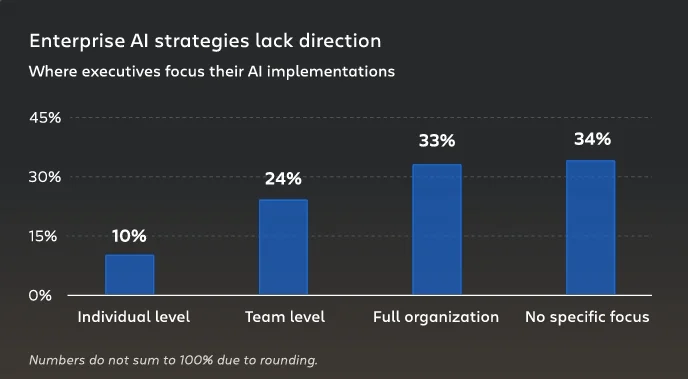
Building on this successful foundation of individual AI adoption, the current fiscal year marks a strategic pivot towards optimizing AI integration within team-based workflows. This shift aligns with broader industry insights and Atlassian’s own extensive research. The company’s comprehensive State of Teams 2026 report—a seminal study based on surveys of over 12,000 knowledge workers and 172 Fortune 1000 executives—reveals a significant gap in enterprise AI implementation. The report found that only 24% of executives prioritize AI implementations at the team level, despite knowledge workers dedicating an estimated 80% of their time to collaborative activities.
The report also quantified the substantial economic impact of coordination problems, labeling it the "fragmentation tax," which is estimated to cost Fortune 500 companies a staggering $161 billion annually. This "tax" highlights the inefficiencies stemming from disjointed workflows and poor collaboration, issues that well-integrated AI could potentially mitigate. Furthermore, the study identified that a mere 14% of teams have successfully implemented the three critical practices that distinguish top performers: robust data context, redesigned workflows, and a culture conducive to experimentation.
Lenart underscored the often-overlooked prerequisite for effective AI integration: the data layer. She termed it the "unglamorous prerequisite," emphasizing that "AI can’t use what it can’t see. If you don’t have open ways of working, if you don’t have things written down, then really AI is only going to be so successful." This highlights that simply deploying AI tools atop fragmented or poorly documented knowledge bases will be ineffective, or even detrimental. The foundational quality of data and information architecture is paramount.
Regarding workflow optimization, Atlassian advocates for a pragmatic, iterative approach. Lenart advises against the temptation to automate every process simultaneously. Instead, the strategy involves identifying specific processes with significant friction points, automating select components, and incrementally building upon those successes. The emphasis is on fundamentally redesigning workflows with AI in mind, rather than merely "slapping AI on top" of existing, potentially inefficient processes. As an example, Atlassian’s own people team initiated its AI journey by focusing on three core workflows that touch every employee, demonstrating a practical application of this principle.
A Culture of Empowerment, Not Mandates: Atlassian’s Distinctive AI Philosophy
In an era where many organizations are increasingly adopting mandatory AI usage policies—with one report indicating that 86% of C-suite executives view AI use as effectively required—Atlassian maintains a distinctive and more nuanced philosophy. "We do not believe in mandates about AI adoption at Atlassian because that produces a fear-based culture," Lenart firmly stated. She elaborated on the counterproductive nature of such mandates: "What you generally get is people opening the tool and they perform compliance, but then you look, and you’re like, where is all that value?" This stance underscores Atlassian’s commitment to fostering genuine engagement and innovation rather than mere superficial adherence.
Furthermore, while some employers are beginning to incorporate AI usage into performance expectations, a tempting approach for boards seeking returns on substantial AI investments, Atlassian argues against this practice. Lenart contended that such mandates ultimately backfire, leading to an artificial inflation of usage numbers while simultaneously stifling innovation and diminishing employee engagement.
Crucially, Atlassian does leverage AI to streamline its own performance review cycle, assisting employees in drafting self-assessments, compiling context for peer feedback, and preparing for manager conversations. However, the ultimate judgment regarding performance outcomes remains firmly in human hands, and employees are not compelled to use AI in this process. "We firmly believe that the manager should still make the decision around someone’s performance outcome," Lenart asserted, preserving the critical human element in sensitive evaluation processes.
To foster genuine AI adoption and literacy, Atlassian has experimented with "AI days"—dedicated, protected calendar time allocated for various functions to engage with and explore AI tools. This initiative serves as a clear signal from leadership that such exploration is not only permissible but actively encouraged and valued. Moreover, Atlassian’s leaders actively model AI usage, crucially including instances of failure. "They have to actually show the team that sometimes it doesn’t work. Sometimes it does," Lenart explained. This transparency helps demystify AI, normalize experimentation, and builds trust, counteracting the cynicism that arises when managers preach AI adoption without demonstrating their own engagement.
HR Leading the Charge: Internal Transformation First
For HR leaders grappling with the challenge of demonstrating tangible progress in AI integration without resorting to inflated productivity claims, Lenart offers two critical recommendations. Her primary advice is for HR to lead by example, initiating the transformation within its own function before advocating for it across the broader organization. "Going in and driving it with your team first and yourself and then showing those success stories is the way to go," she suggested. This approach builds credibility and provides internal case studies for wider adoption.

Her second, equally vital tip is to "don’t boil the ocean." Instead of attempting a wholesale overhaul, she recommends identifying high-value use cases and strategically targeting areas where "champions" or early adopters already exist. She likens this to "knocking on the open doors," maximizing impact by leveraging existing enthusiasm and readiness.
Atlassian’s experience with its non-technical teams illustrates this principle. When the people team proactively embraced AI early on, other non-technical functions observed their successes and expressed interest in replicating them. Lenart, who studied psychology and identifies as non-technical, acknowledged that engaging non-technical employees remains a significant challenge. Her advice includes meeting individuals at their current skill level ("this is where you click"), dedicating recurring time for AI engagement (whether 15 minutes daily or an hour weekly) to account for the tools’ rapid evolution, and fostering peer support through "accountability buddies."
The "Spicy Bet": Reshaping Talent Frameworks for a Fluid Future
Among the published HR beliefs, Lenart highlighted a particularly "spicy bet": the assertion that traditional talent frameworks, including performance rubrics, hiring criteria, job architecture, and compensation models, are too rigid to withstand the impending shifts driven by AI. She anticipates a fundamental movement towards more fluid skills, dynamic teams, and adaptable career pathways. Her counsel is to approach this transformation incrementally, altering one program at a time rather than attempting a simultaneous overhaul of all frameworks.
Atlassian is commencing this journey with performance management, but Lenart expressed particular excitement about the implications for compensation. Historically, companies have paid premiums for specific job families based on market scarcity of skills. With AI rapidly redrawing the lines of which skills are scarce and which are augmented or automated, traditional compensation structures face significant disruption. "As soon as you touch compensation, it’s a hot topic," she acknowledged, recognizing the inherent sensitivities. "You’ve got to be really careful. But that’s where I’m most excited to get started." This indicates a willingness to confront one of the most complex and impactful areas of HR transformation.
Broader Industry Implications and the Future of Work
Atlassian’s proactive establishment of a Director of Capacity Planning signals a critical inflection point for the broader HR profession and enterprise strategy. This move elevates HR beyond traditional administrative functions, positioning it as a strategic partner in navigating the complex interplay between human and artificial intelligence. Industry analysts suggest that other forward-thinking organizations, particularly those heavily invested in AI, will likely monitor Atlassian’s progress closely and may soon follow suit, initiating similar roles or integrating these responsibilities into existing workforce planning functions.
The implications extend to organizational design, where the lines between human and machine tasks will continue to blur, necessitating new team structures and collaboration models. For talent management, this paradigm shift demands a fundamental re-evaluation of recruitment strategies (focusing on AI literacy and adaptability), training and reskilling programs (to equip employees for augmented roles), and performance management systems (to measure contributions in a hybrid environment). The "spicy bet" on compensation further underscores the need for agile, skills-based reward systems that can respond to the dynamic valuation of human capabilities in an AI-driven economy.
However, this transformation also presents challenges. Ethical considerations surrounding algorithmic bias, data privacy, and the potential for job displacement will require careful navigation. While Atlassian’s non-mandate approach seeks to mitigate fear and foster engagement, the broader societal impact of AI on labor markets remains a significant area of discussion. The demand for robust data governance and transparent AI systems will become increasingly paramount.
Ultimately, Atlassian’s pioneering role is not just about adopting new technology; it’s about reimagining the fundamental architecture of work itself. By explicitly recognizing AI agents as integral components of organizational capacity and dedicating a senior HR role to their strategic orchestration alongside human talent, Atlassian is setting a precedent for a future where human ingenuity and artificial intelligence collaborate seamlessly, driving unprecedented levels of productivity and innovation. This bold step positions Atlassian at the forefront of the evolving human-machine frontier, offering a blueprint for other enterprises striving to thrive in the age of abundant intelligence.








