The modern workplace is undergoing a profound transformation, with employee engagement and retention becoming critical determinants of organizational success. In this evolving landscape, recognition has emerged as a powerful tool, capable of shifting workplace dynamics from mere task completion to purposeful achievement. Recent findings from the Achievers’ State of Employee Recognition Report underscore this impact, revealing that a staggering 91% of employees would exert greater effort if they felt genuinely valued. This statistic highlights the immense, yet often untapped, potential of meaningful recognition. However, many organizations still grapple with recognition programs that are well-intentioned but lack the strategic framework necessary for tangible impact, often relying on vague aspirations rather than measurable outcomes. To truly harness the power of appreciation, companies must move beyond anecdotal "feel-good" moments and embrace a data-driven approach, defining clear, measurable criteria for employee recognition. This strategic shift ensures that recognition not only resonates with employees but also demonstrably contributes to performance, reinforces core values, and bolsters overall engagement.
The Evolution of Employee Recognition: From Ad-Hoc to Strategic Imperative
Historically, employee recognition often manifested as annual awards, service anniversaries, or occasional monetary bonuses, typically managed through top-down initiatives. These traditional methods, while appreciated, often lacked consistency, immediacy, and alignment with daily contributions, limiting their overall impact. The turn of the millennium, coupled with rapid technological advancements and shifting workforce demographics, ushered in a new era. Millennials and Generation Z, now constituting a significant portion of the global workforce, prioritize purpose, feedback, and a sense of belonging in their professional lives. This generational shift, alongside increasingly competitive talent markets, has compelled organizations to rethink their approach to employee engagement.
Over the past decade, the focus has shifted towards continuous, real-time recognition that is integrated into daily workflows. This evolution is not merely a trend but a strategic response to observable business challenges, including high employee turnover, declining productivity, and difficulties in fostering a cohesive company culture. Companies began to understand that a truly effective recognition program is not just a perk but a fundamental component of a healthy employee experience and a robust talent strategy. This transition from an ad-hoc, reactive approach to a proactive, strategic one underscores the imperative for measurable criteria. Without defined metrics, even the most heartfelt gestures risk becoming ephemeral, failing to generate sustained behavioral change or quantifiable business results. The challenge, therefore, lies in establishing a framework where recognition is not just given, but also tracked, analyzed, and optimized to ensure its efficacy and return on investment.
Defining Measurable Criteria for Impactful Recognition Programs
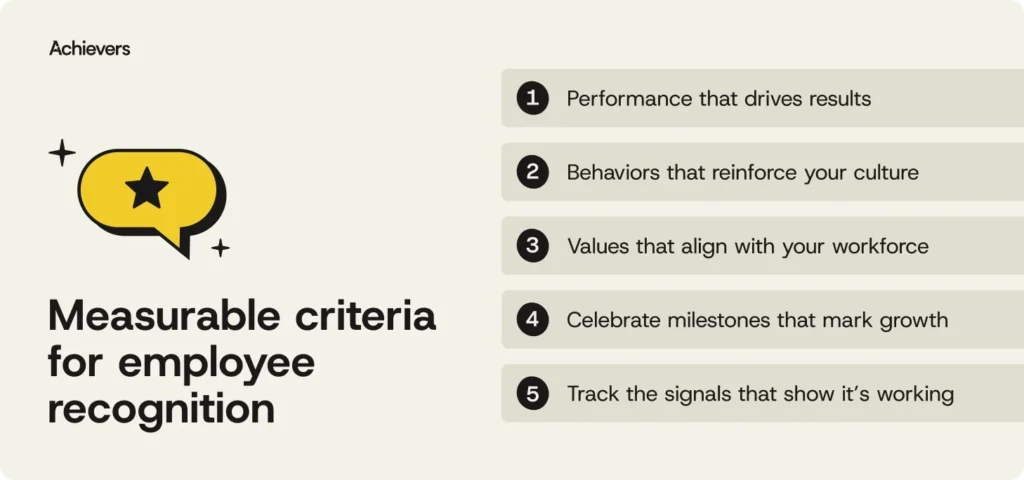
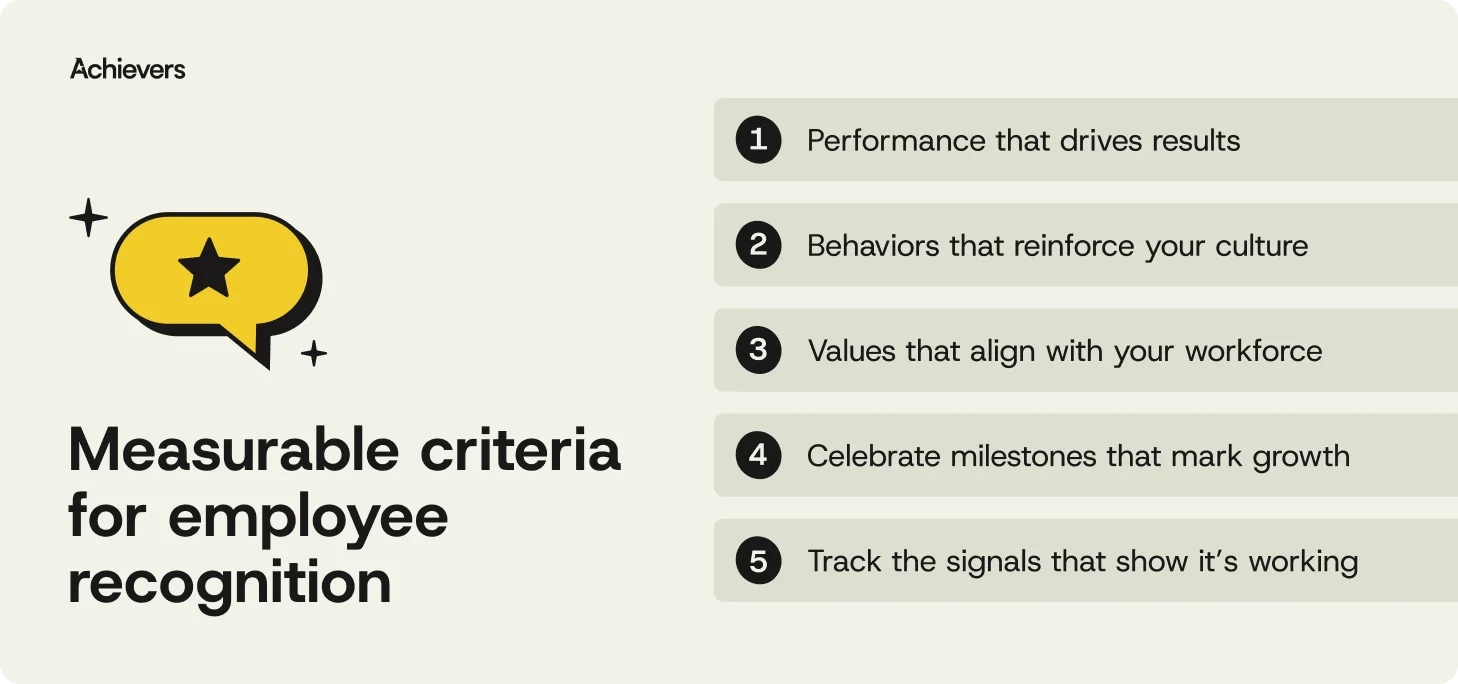
To build a recognition culture that is both enduring and scalable, organizations must articulate what "good" looks like. This involves identifying specific, observable behaviors and outcomes that warrant recognition, thereby reinforcing desired actions and demonstrating their impact on the business. Here are five core measurable criteria that elevate recognition from a mere gesture to an actionable strategy:
-
Performance That Drives Results:
Recognition tied to measurable performance metrics is arguably the most straightforward way to reinforce desired outcomes. It moves beyond subjective praise to celebrate concrete achievements that directly advance business objectives. This criterion encourages a culture where high performance is not only expected but also consistently acknowledged, setting clear benchmarks for success across the organization. For instance, recognizing a sales team for exceeding quarterly targets, an engineering team for delivering a complex project ahead of schedule, or a customer service representative for consistently achieving high customer satisfaction scores (CSAT) directly reinforces behaviors critical to the company’s bottom line.- What to Measure: Key Performance Indicators (KPIs) such as sales quotas achieved, project completion rates, customer retention improvements, efficiency gains, error reduction percentages, and specific output metrics relevant to individual roles. For example, a content team member recognized for increasing web traffic by 20% through their articles, or a manufacturing employee celebrated for reducing waste by 15%. This type of recognition not only rewards output but also highlights the quality and impact of work, making it a powerful motivator for continuous improvement.
-
Behaviors That Reinforce Your Culture:
While outcomes are vital, the "how" often matters as much as the "what." Behavioral recognition focuses on the everyday actions that subtly, yet powerfully, shape an organization’s culture. These are the moments where employees embody company values, demonstrate leadership, or go the extra mile to support colleagues, even if these actions don’t immediately translate into a quantifiable business metric. Recognizing an employee who consistently steps up to mentor new team members, leads with curiosity in problem-solving, or maintains composure and empathy during high-pressure situations, helps to embed these desired cultural traits throughout the organization. Such recognition communicates that the journey and the approach are as valued as the destination.- What to Measure: Observable actions aligned with core values, such as demonstrating collaboration, fostering innovation, showing resilience, actively listening, providing constructive feedback, or embodying principles of diversity and inclusion. For example, an employee recognized for proactively assisting a colleague with a challenging task, demonstrating teamwork, or for championing a new, more efficient process, showcasing initiative. These behaviors, while sometimes harder to quantify, are crucial for a healthy, productive work environment and can be tracked through peer nominations, manager observations, and alignment with documented cultural tenets.
-
Values That Align With Your Workforce:
Recognition gains significant depth when explicitly linked to an organization’s core values. This connection transforms appreciation into a powerful mechanism for articulating not just what matters, but why it matters. By celebrating employees who exemplify integrity, innovation, customer-centricity, or inclusivity, companies reinforce their identity and mission. For instance, acknowledging an employee who made an ethical decision in a difficult situation, or one who passionately advocated for an underrepresented voice during a team discussion, strengthens the cultural fabric from within. This type of recognition helps employees understand how their daily actions contribute to the broader purpose and ethical framework of the organization.
- What to Measure: Instances where employees demonstrably embody specific company values in their decision-making, interactions, or project execution. This can be tracked through anecdotal evidence shared during recognition moments, peer-to-peer nominations specifying value alignment, and manager observations. Regularly surveying employees about their perception of how values are lived within the organization can also provide valuable insights into the program’s effectiveness in reinforcing these principles.
-
Celebrating Milestones That Mark Growth:
Milestones, ranging from career anniversaries to significant personal achievements, are opportunities to acknowledge an employee’s journey and commitment. While often expected, when handled thoughtfully, these moments transcend mere calendar events. They are opportunities for an organization to communicate, "We see your dedication, we value your contributions, and we are grateful you are part of our team." Celebrating career achievements, such as promotions, successful project completions, or significant professional development accomplishments, reinforces loyalty and growth. Additionally, acknowledging personal life events (with appropriate privacy considerations) such as marriages or the birth of a child, fosters a sense of belonging and demonstrates that the company values the whole person, not just their professional output.- What to Measure: Career anniversaries, successful project completion, attainment of new certifications or skills, promotions, team formation anniversaries, and other significant personal milestones. Tracking the frequency and type of milestone recognition across the organization ensures that all employees feel valued for their tenure and personal growth, contributing to long-term retention and a positive employee experience.
-
Tracking the Signals That Show It’s Working:
The true power of recognition lies not just in its intention but in its measurable impact. An effective recognition program requires robust tracking to determine if it is reaching the right individuals, occurring with sufficient frequency, and genuinely driving desired outcomes. This moves beyond simple distribution counts to real-time signals that indicate the program’s vitality and influence. Without a data-driven approach, recognition programs risk becoming dormant or ineffective, failing to justify the investment in time and resources.- What to Measure:
- Recognition Participation Rates: The percentage of employees giving and receiving recognition, and the frequency of these interactions.
- Distribution Across Teams and Levels: Ensuring recognition is not concentrated in specific departments or seniority levels, indicating widespread adoption.
- Correlation with Engagement Scores: Analyzing shifts in employee engagement survey results (e.g., eNPS, pulse surveys) alongside recognition activity to identify causal links.
- Impact on Retention and Performance: Tracking changes in turnover rates, especially among highly recognized employees, and correlating recognition with improvements in individual or team performance metrics.
- Qualitative Feedback: Gathering testimonials and conducting interviews to understand the perceived value and impact of recognition from employees and managers.
- What to Measure:
How to Track Recognition Effectiveness
Tracking the effectiveness of employee recognition requires a dual focus on both participation and observable impact over time. The goal extends beyond merely counting recognition instances to understanding how these moments influence broader organizational health and performance. Organizations should consistently monitor several key indicators:
- Frequency and Reach: How often are employees and managers engaging in recognition? Is it a regular occurrence, or sporadic? Is recognition distributed evenly across various teams, roles, and geographical locations, or are there ‘recognition deserts’ within the organization? A healthy program sees widespread, consistent participation.
- Correlation with Engagement Metrics: Analyze recognition activity against established employee engagement survey scores or sentiment data. Do teams with higher recognition frequency also report higher morale, job satisfaction, and a stronger sense of belonging? Tools that integrate recognition platforms with engagement surveys can provide powerful insights into these correlations.
- Impact on Business Outcomes: Observe shifts in key business metrics. Are turnover rates lower among recognized employees or within highly recognized teams? Are performance outcomes, such as productivity, innovation, or customer satisfaction, demonstrably improving in areas with robust recognition practices? This data provides concrete evidence of the program’s value.
- Alignment with Values and Behaviors: Regularly review the content of recognition messages. Do they consistently reference desired behaviors and core company values? This ensures that the program is reinforcing the right cultural elements rather than just being a generic "pat on the back."
By tracking these metrics consistently and looking for patterns over time, organizations can discern whether their recognition initiatives are truly making a difference. When recognition is frequent, aligned with strategic goals, and widely adopted, it transforms into a powerful force capable of driving meaningful business results.
Measuring the Success of Employee Rewards Initiatives
Beyond recognition, employee rewards initiatives, often tied to points or monetary incentives, also require rigorous measurement to ensure they translate into desired behavioral changes and measurable outcomes such as increased engagement, improved retention, and enhanced performance. Simply tracking the number of rewards distributed is insufficient; the focus must be on the results these rewards generate.
-
Reward Distribution and Usage: This metric tracks how often various rewards—points, monetary bonuses, or non-monetary incentives—are issued across the organization. It helps to answer fundamental questions: Are rewards being used consistently, or are they concentrated in specific teams or roles? Uneven distribution can signal flaws in program design, manager bias, or accessibility issues. Furthermore, monitoring reward redemption behavior—how often employees utilize their earned rewards—provides critical insights into the perceived value and relevance of the rewards themselves. High redemption rates suggest rewards are meaningful; low rates may indicate a mismatch with employee preferences or a lack of awareness.
-
Reward Participation and Adoption: This measures the number of employees actively earning and redeeming rewards. Adoption patterns reveal whether rewards are seamlessly integrated into daily workflows or if they are viewed as occasional, disconnected perks. Consistent usage across teams is a strong indicator that the reward system is accessible, understood, and aligned with how employees work. Conversely, low participation or uneven adoption may point to program friction, insufficient awareness campaigns, or rewards that do not genuinely resonate with staff interests or needs.
-
Alignment Between Rewards and Behaviors: A crucial measure of success is the degree to which rewards are directly tied to the specific behaviors and outcomes the organization aims to reinforce. This involves tracking:
- Specific actions or achievements that trigger rewards.
- The frequency of rewards for desired behaviors.
- The perceived fairness and transparency of the reward system.
Recent data, even from projected insights like the 2026 Achievers’ State of Recognition Report, suggests that small, frequent monetary rewards tied to specific recognition moments can be highly motivating, with 41% of surveyed employees indicating this preference. This highlights that rewards, when clearly connected to actions, serve as powerful signals of what employers value. When employees understand the direct link between their efforts and the rewards received, it creates a clear feedback loop that encourages the repetition of desired behaviors.
-
Impact on Engagement and Experience: Rewards are most effective when they reinforce an employee’s sense of being recognized and valued, thereby contributing to overall engagement. To measure this, organizations must correlate reward activity with engagement data. For instance, do employees who receive rewards more frequently report higher levels of connection, motivation, or job satisfaction in engagement surveys? This analysis helps establish whether rewards are positively influencing the employee experience and fostering a more committed workforce.
-
Program-Level ROI: Ultimately, the success of any rewards initiative is measured by its contribution to broader business outcomes. This includes quantifiable improvements in engagement scores (eNPS), enhanced productivity and performance, reduced turnover rates, and even positive impacts on recruitment efforts and employer brand. Calculating the return on investment for reward programs involves analyzing the costs associated with the program against the benefits gained, such as savings from reduced attrition or increased revenue from improved performance. For example, if a recognition program reduces voluntary turnover by 5%, the cost savings in recruitment and onboarding alone can represent a significant ROI, demonstrating the program’s strategic value.
Technological Enablers: The Achievers Manager Toolkit and Beyond
Defining measurable criteria for employee recognition is a vital first step, but empowering managers to effectively track and act on these criteria is equally crucial. This is where advanced HR technology, such as the Achievers Manager Toolkit, plays a transformative role. Such toolkits bridge the gap between strategic intent and practical execution by embedding real-time insights, automated reminders, and recognition prompts directly into managers’ workflows. This ensures that leaders can consistently connect employee goals, behaviors, and appreciation.
With comprehensive manager toolkits, leaders gain the ability to:
- Access real-time dashboards showing team recognition activity, participation rates, and sentiment trends.
- Receive automated nudges for recognizing milestones, recent achievements, or employees who haven’t received recognition in a while.
- Identify top performers and those who might need additional support or recognition.
- Align recognition with specific company values or goals through guided prompts.
- Track the impact of their recognition efforts on team engagement and performance metrics.
The result is more intentional, consistent recognition practices across the organization. This creates a clearer, more direct line between everyday employee actions and their impact on business objectives, fostering a culture of continuous appreciation and accountability. HR technology providers are increasingly focusing on intuitive interfaces that empower managers to become better leaders, integrating these tools seamlessly into broader HR information systems to provide a holistic view of employee engagement and performance.
Building Recognition That’s Measurable, Meaningful, and Built to Last
Recognition should never be an afterthought in organizational strategy; it is a fundamental pillar for demonstrating employee value, reinforcing desired behaviors, and cultivating a resilient, high-performing culture. However, the most effective recognition transcends mere heartfelt gestures; it is meticulously trackable and strategically managed. By establishing clear, measurable criteria, organizations can move beyond subjective appreciation to an objective, impactful system.
When companies clearly define what merits recognition and equip their workforce with the necessary tools to celebrate it, recognition evolves from isolated moments into an ingrained habit, a core strategic element, and a powerful culture-shaping force. Platforms like Achievers are designed to eliminate the guesswork from appreciation, offering smart insights, contextual nudges for busy managers, and intuitive tools that make recognition easy, personal, and measurable from inception. This systematic approach ensures that recognition is not only authentic but also accountable, driving a virtuous cycle where great work becomes the norm, not the exception, ultimately contributing to sustained organizational success and a thriving employee ecosystem.