
The U.S. Equal Employment Opportunity Commission (EEOC) concluded its 2025 fiscal year on September 30, recording one of the lowest levels of litigation activity in its 60-year history. Despite entering the year with a robust budget and a significant pipeline of workplace discrimination charges, the Commission filed only 93 merit lawsuits over the past 12 months. This figure represents a ten-year low and stands in stark contrast to previous decades when the agency frequently initiated between 150 and 300 lawsuits annually. The downturn in activity is largely attributed to a series of unprecedented leadership changes, the loss of a governing quorum, and a fundamental shift in enforcement priorities following the inauguration of the Trump administration in January 2025.
A Year of Institutional Transition and Leadership Volatility
The fiscal year began under the momentum of the Biden administration, which had installed a Democratic majority of Commissioners and a proactive General Counsel, Karla Gilbride. In FY 2023, the EEOC had reached a five-year high with 144 merit lawsuits, leading many observers to expect a continued surge in 2025. However, the political transition following the November 2024 election triggered a rapid and legally complex reorganization of the agency’s top ranks.
In late January 2025, President Trump elevated Commissioner Andrea Lucas to the position of Acting Chair. In a move that tested the constitutional limits of presidential power over independent agencies, the administration terminated General Counsel Karla Gilbride and removed Commissioners Charlotte Burrows and Jocelyn Samuels, despite both having years remaining on their appointed terms. This left the EEOC with only two commissioners—Acting Chair Lucas and Commissioner Kalpana Kotagal—effectively stripping the body of the three-member quorum required to authorize major systemic litigation or settle high-stakes disputes.
While a Trump-appointed nominee currently awaits Senate confirmation to restore the quorum, the agency has operated for much of the year under a delegation of authority that allows the General Counsel’s office to file only "routine" cases. This administrative bottleneck is a primary driver behind the historic low in total filings for FY 2025.
Chronology of FY 2025 Litigation Activity
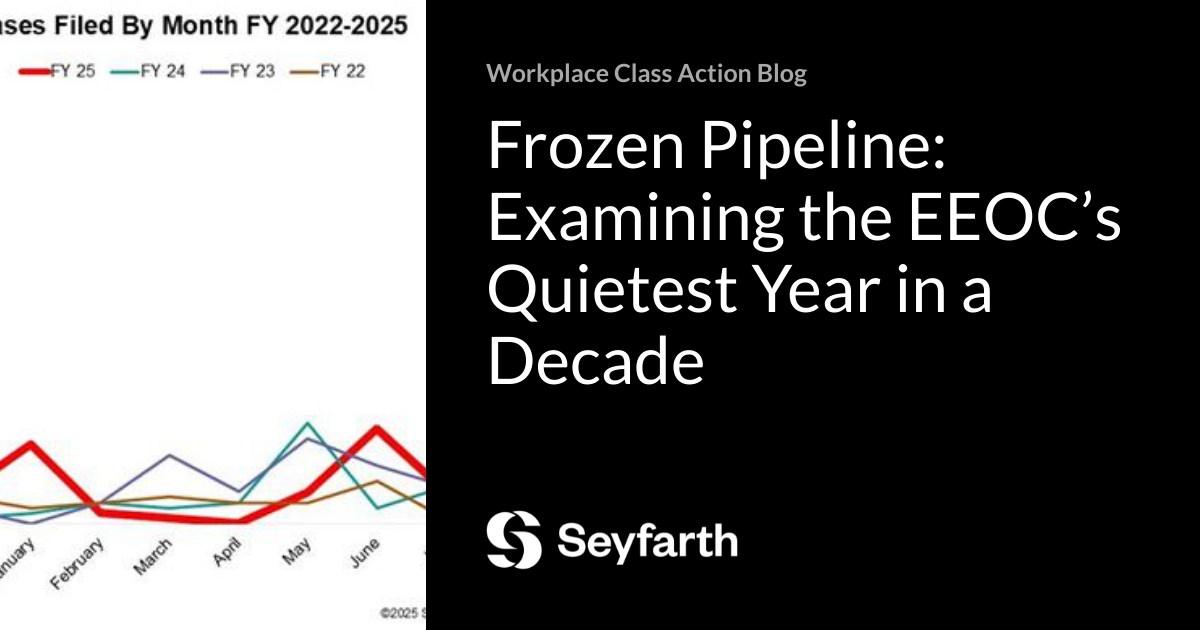
The timing of EEOC filings in FY 2025 deviated significantly from historical norms, reflecting the internal pressures of a transition year. Traditionally, the EEOC sees a massive surge in filings during the final month of the fiscal year as regional offices rush to meet annual targets.
- October 2024 – January 2025: The agency hit the ground running with 24 lawsuits filed in the first four months. January alone saw 15 filings, a spike interpreted by legal analysts as an effort by outgoing personnel to move cases into the court system before the change in administration.
- February 2025 – May 2025: Following the leadership purge, litigation activity slowed to a crawl as the new Acting Chair began a review of the agency’s docket and policy goals.
- June 2025: A brief resurgence occurred with 18 lawsuits filed, marking a five-year high for the month of June.
- September 2025: The traditional "September Surge" was notably muted. The EEOC filed 35 lawsuits in the final month of the year, a sharp decline from the 56 filed in September 2024 and the 71 filed in September 2023.
Regional Trends: The Rise of the Midwest and the Silence of the West
Geographic analysis of the 93 filings reveals a shift in where the EEOC is most active. The Chicago District Office reclaimed its position as the most litigious region, leading the nation with 11 merit lawsuits. Other active regions included Philadelphia, Indianapolis, and Houston, each recording eight filings.
Conversely, major coastal districts that were once hotbeds of EEOC activity remained uncharacteristically quiet. The Los Angeles, New York, and San Francisco offices—which during the Obama administration collectively filed dozens of cases per year—lodged only four, six, and three lawsuits, respectively. This multi-year trend suggests a continuing de-emphasis on high-profile litigation in traditional Democratic strongholds, with enforcement efforts shifting toward the industrial Midwest and the South.

Shifting Substantive Priorities: Religious Freedom and "Biological Truth"
While the volume of cases decreased, the nature of the claims asserted in FY 2025 provides a clear roadmap of the current administration’s ideological focus. The EEOC has pivoted away from several Biden-era priorities, most notably in the realm of LGBTQ+ rights and traditional race-based discrimination.
The Surge in Religious Discrimination Claims
One of the most significant developments in FY 2025 was the rise of religious discrimination litigation. The Commission filed 11 lawsuits asserting religious discrimination or failure to accommodate religious beliefs under Title VII. This trend follows a staggering 600% increase in religious discrimination charges filed during the COVID-19 pandemic, many related to vaccine mandates. Acting Chair Lucas has explicitly stated that under her leadership, the EEOC will ensure that "workers are not forced to choose between their paycheck and their faith," signaling a departure from what she characterized as "woke policies" of the previous administration.
Pregnancy and Sex-Based Discrimination
The EEOC maintained a strong focus on sex-based claims, filing 37 cases related to sex or pregnancy. This includes 10 lawsuits filed under the Pregnancy Discrimination Act and the newly enacted Pregnant Workers’ Fairness Act (PWFA). Legal experts note that while the current leadership is protective of biological women in the workplace, it has concurrently narrowed the definition of sex-based protections.
The Retreat from LGBTQ+ Advocacy
In a stark reversal of previous policy, the EEOC essentially abandoned its pursuit of gender identity-related litigation. Following a January 2025 Executive Order titled "Defending Women From Gender Ideology Extremism," the EEOC moved to dismiss two active lawsuits concerning transgender workers: EEOC v. Starboard Group, Inc. and EEOC v. Brik Enterprises, Inc. Acting Chair Lucas issued a formal statement asserting that "biological sex is real" and that it is not harassment for employers or employees to use pronouns that align with biological realities.

Record Lows in Race and National Origin Filings
Perhaps the most surprising statistic from FY 2025 is the near-total disappearance of traditional race and national origin discrimination lawsuits. The Commission filed only three such lawsuits this year, compared to 27 just two years ago. Notably, two of the three filings involved theories of "reverse discrimination." For example, EEOC v. Leopalace Guam Corp. alleged discrimination against non-Japanese workers, while EEOC v. Seward and Son Planting Co. involved claims that an employer preferred non-American workers over Black American citizens.
Disability Discrimination Remains a Constant
Despite the ideological shifts elsewhere, the Americans with Disabilities Act (ADA) remained a primary tool for EEOC enforcement. The Commission filed 34 disability-related lawsuits in FY 2025. There was a continued emphasis on "invisible disabilities," with several cases focusing on employers’ failure to accommodate mental health conditions such as PTSD, anxiety, and depression, as well as vision and hearing impairments.
Implications for Employers and the Private Bar
The historically low litigation numbers in FY 2025 should not be interpreted by employers as a signal to relax compliance efforts. Instead, the data suggests a more targeted and ideologically driven enforcement environment.
- The Quorum Constraint: The current inability of the EEOC to file systemic or "pattern or practice" lawsuits due to the lack of a quorum means that the agency is currently limited to smaller, individual-focused cases. However, once a quorum is restored, there is a high likelihood of a "catch-up" period where larger cases that have been held in abeyance are finally authorized.
- Industry Focus: Analysis of FY 2025 filings shows that nearly 20% of the EEOC’s merit lawsuits targeted the healthcare industry. Other sectors, including retail and hospitality, also saw consistent activity. Small to mid-sized regional businesses were targeted as frequently as major corporations.
- The Private Plaintiffs’ Bar: Historically, when the EEOC pulls back from certain types of litigation—such as race-based or LGBTQ+ claims—the private plaintiffs’ bar steps in to fill the void. Employers may face an increase in private class-action lawsuits in the areas the EEOC is currently ignoring.
- Compliance with Religious Accommodations: With the EEOC’s stated commitment to protecting religious freedom, companies should review their accommodation policies, particularly regarding scheduling, dress codes, and expression of faith, to avoid becoming a target for the Commission’s new enforcement agenda.
As the EEOC enters FY 2026, the restoration of a quorum and the potential confirmation of a permanent General Counsel will likely dictate whether litigation levels return to historical averages or if the current "sluggish" pace becomes the new baseline for federal workplace enforcement. For now, the 2025 data marks a definitive end to the aggressive, systemic-focused era of the previous administration, replaced by a narrower, more traditionalist approach to civil rights in the American workplace.








