
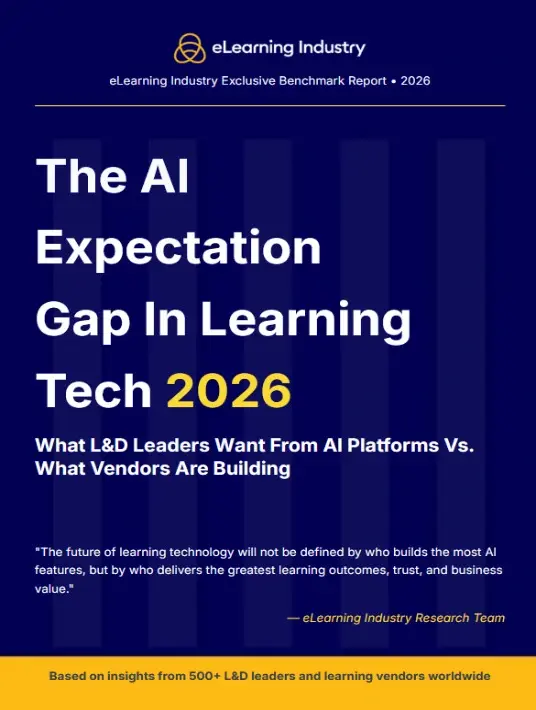
The global learning and development (L&D) landscape is currently navigating a period of profound technological disruption, marked by a significant divergence between the supply of artificial intelligence (AI) features and the practical demands of corporate buyers. According to the latest benchmark report released by eLearning Industry, which surveyed more than 500 stakeholders across the L&D ecosystem, a distinct "expectation gap" has emerged. While software vendors are aggressively integrating generative AI and predictive analytics into their product roadmaps to maintain a competitive edge, L&D practitioners—the primary buyers of these technologies—remain focused on fundamental outcomes, such as measurable business impact, data privacy, and user engagement.
This misalignment suggests that the learning technology market is currently in a state of "innovation overreach," where the technical capabilities of platforms are outstripping the organizational readiness and strategic priorities of the companies intended to use them. The report highlights that while 2025 was a year of experimentation, 2026 has become the year of accountability, with buyers demanding evidence that AI investments translate into tangible workforce performance improvements.
The Evolution of AI in Learning: A Chronological Context
To understand the current expectation gap, it is necessary to examine the trajectory of learning technology over the past decade. The industry has moved through several distinct phases of digital transformation, each setting the stage for the current AI-driven era.
From 2010 to 2018, the market was dominated by the transition from traditional Learning Management Systems (LMS) to Learning Experience Platforms (LXP). This era focused on "Netflix-style" content curation and social learning. However, the data generated by these systems remained largely siloed and underutilized.
The period between 2020 and 2022, accelerated by the global pandemic, forced organizations to adopt digital-first learning strategies. This shift created a massive influx of data and a desperate need for automation to manage the scale of remote training. In late 2022, the public release of large language models (LLMs) like GPT-3.5 and GPT-4 triggered a "gold rush" in the learning tech sector. Vendors began integrating AI-driven content authoring tools, automated translation, and basic chatbots almost overnight.
By 2024, the market entered a phase of "feature saturation." Every major LMS and LXP provider claimed to be "AI-powered." However, as the eLearning Industry report indicates, the rapid pace of development in 2025 and early 2026 has led to a disconnect. Vendors are now focused on autonomous "AI agents" and deep-fake video generation for training, whereas buyers are still grappling with the ethical implications, data security, and the basic ROI of the first generation of AI tools they implemented.
Dissecting the Data: The Vendor-Buyer Divide
The survey data from over 500 participants reveals a stark contrast in priorities. When asked to rank the most important AI capabilities, learning technology vendors placed "Automated Content Generation" and "Personalized Learning Paths" at the top of their list. In contrast, L&D buyers prioritized "Skill Gap Analytics" and "Integration with Productivity Tools" (such as Slack, Microsoft Teams, and CRM systems).
The data suggests that vendors view AI primarily as a tool for efficiency—reducing the time it takes to create a course or curate a library. Buyers, however, view AI as a strategic bridge. They are less concerned with how quickly a course is built and more concerned with whether the AI can identify which employees need specific skills to prevent operational bottlenecks.
Key data points from the benchmark report include:
- Prioritization Disparity: 72% of vendors are currently developing or have deployed generative AI content tools, yet only 38% of L&D buyers listed this as a "top three" requirement for their next platform purchase.
- The ROI Hurdle: 65% of L&D leaders stated they are under pressure from executive leadership to prove the ROI of AI-enhanced learning, but only 22% of vendors provide advanced "impact analytics" that connect learning data to business KPIs.
- Privacy Concerns: 80% of buyers expressed "high concern" regarding how their proprietary corporate data is used to train vendor-owned AI models, while only 45% of vendors have published transparent data-governance frameworks specifically for AI.
Official Responses and Market Reactions
Industry analysts and Chief Learning Officers (CLOs) have begun to weigh in on these findings, suggesting that the "hype cycle" is giving way to a more pragmatic procurement environment. Many organizations are now implementing "AI pauses," where they refuse to upgrade to new versions of software until vendors can prove that the AI features do not introduce security vulnerabilities or hallucinations in critical compliance training.

Inferred reactions from vendor-side product managers suggest a defensive posture. The common sentiment among developers is that they must build these features now to future-proof their platforms, even if the current demand is tepid. "If we don’t have a robust AI roadmap, we lose the ‘RFPs’ (Request for Proposals) before we even get to the demo stage," noted one anonymous vendor executive in the report’s qualitative section. "Even if the buyer doesn’t use the feature on day one, they want to know it’s there for day 500."
Conversely, L&D buyers are expressing a sense of "tool fatigue." The report highlights that the average enterprise now uses between 15 and 25 different SaaS applications for HR and learning. Adding another layer of complex AI functionality without seamless integration into the existing workflow is seen as a hindrance rather than a help.
Strategic Implications for the L&D Market
The existence of this expectation gap has several long-term implications for both sides of the market. For vendors, the "arms race" to add AI features may lead to a consolidation of the market. Smaller providers who cannot afford the massive compute costs and R&D required for sophisticated AI may be acquired by larger entities or forced into niche specializations.
For L&D buyers, the gap necessitates a new level of "AI literacy." Procurement teams can no longer rely on traditional checklists. They must now evaluate the "AI stack" of a vendor, asking questions about model transparency, bias mitigation, and the "human-in-the-loop" protocols that ensure AI-generated content remains accurate and culturally sensitive.
Furthermore, the report suggests a shift in the role of the L&D professional. As AI takes over the administrative tasks of content tagging and scheduling, L&D leaders must transition into "Learning Architects" and "Data Translators." Their value will increasingly lie in their ability to interpret the analytics provided by AI and use those insights to drive organizational change, rather than managing the logistics of a training calendar.
Analysis: Closing the Gap
To bridge the AI expectation gap, the report suggests a move toward "Outcome-Based AI." Vendors must pivot from selling features to selling solutions. This involves moving beyond the "what" of AI (e.g., "We have a chatbot") to the "so what" (e.g., "Our chatbot reduces time-to-proficiency for new hires by 15%").
For buyers, the strategy should involve "Incremental Implementation." Rather than attempting a wholesale transformation of their learning ecosystem, organizations are encouraged to identify specific use cases—such as automated translation for global workforces or personalized coaching for mid-level managers—where AI can provide immediate, measurable value.
The eLearning Industry benchmark report serves as a critical diagnostic tool for a market at a crossroads. It identifies that the technology is ready, but the strategy is lagging. As we move further into 2026, the winners in the learning technology space will not necessarily be the ones with the most advanced algorithms, but the ones who can most effectively align those algorithms with the human and business needs of the modern enterprise.
Conclusion and Future Outlook
The AI Expectation Gap In Learning Tech 2026 report clarifies that while the potential for AI to revolutionize learning is undeniable, the path to implementation is fraught with a mismatch in priorities. Vendors are currently building for the future of the technology, while buyers are purchasing for the reality of their organizations.
As the market matures, we can expect a "Great Alignment" where vendors begin to prioritize the "grounded" features buyers are asking for—security, integration, and ROI analytics. In the meantime, L&D leaders must remain vigilant, ensuring that their investments in AI are driven by pedagogical and business goals rather than the mere novelty of the technology. The full report, which includes detailed competitor benchmarks and strategic roadmaps, provides a necessary blueprint for navigating this complex transition, offering a data-backed look at where the market truly stands and where it must go to fulfill the promise of AI-driven learning.






