
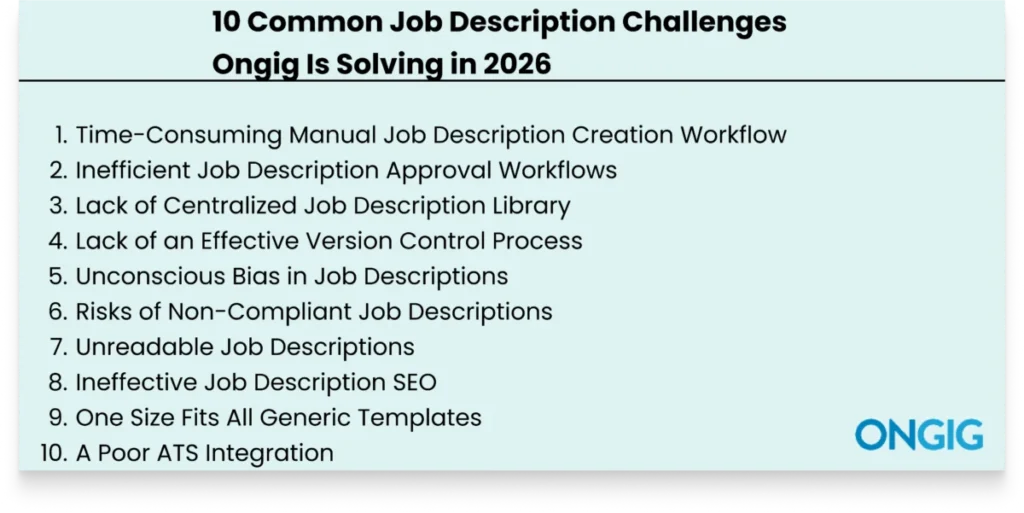
The landscape of talent acquisition in 2026 has been dramatically reshaped by technological advancements and an intensified focus on diversity, equity, and inclusion (DEI), alongside rigorous compliance standards. Yet, despite these innovations, many organizations continue to grapple with archaic, manual processes for creating and managing job descriptions (JDs). This persistence of outdated methods leads to significant inefficiencies, legal vulnerabilities, and a suboptimal candidate experience, ultimately hindering the ability to attract top talent. It is within this context that Ongig has emerged as a pivotal solution, leveraging artificial intelligence (AI) and automation to systematically dismantle ten prevalent job description challenges that plagued recruitment teams for years. The shift from the cumbersome workflows of 2010 to the streamlined, intelligent systems of today represents a fundamental paradigm change in how companies approach the crucial first touchpoint with potential hires: the job description itself.
The Evolving Landscape of Talent Acquisition and the JD’s Central Role
For decades, job descriptions were often an afterthought, hastily cobbled together from old templates or manager inputs. However, as the global talent market grew more competitive and legal frameworks around employment became more stringent, the JD evolved from a simple list of duties into a critical strategic document. By 2026, a job description is not merely an announcement of an open role; it is a powerful branding tool, a legal safeguard, and the initial filter for attracting a diverse and qualified applicant pool. The challenges faced by JD teams are multifaceted, ranging from the sheer volume of content creation to the subtle nuances of inclusive language and search engine optimization (SEO). Industry analysts point to a clear divergence: organizations that have embraced intelligent automation for JDs are demonstrably outperforming those clinging to manual processes. "The era of copy-pasting and manual reviews for job descriptions is definitively over," states Dr. Evelyn Reed, a leading HR technology futurist. "Companies that fail to modernize their JD workflows by 2026 risk significant competitive disadvantages in talent acquisition, from increased time-to-hire to costly compliance penalties." This evolving environment underscores the urgent need for comprehensive solutions like Ongig.
Confronting Inefficiency: The Manual Workflow Dilemma
One of the most pervasive issues facing recruitment teams has been the time-consuming nature of manual job description creation. Starting each JD from scratch, or endlessly sifting through shared drives and Google Docs for relevant fragments, introduces a profound level of inefficiency and disorganization. This manual burden not only consumes valuable HR bandwidth but also leads to inconsistent quality across job postings. Studies from early 2020s indicated that HR professionals spent an average of 4-6 hours per week solely on drafting and refining job descriptions, a figure projected to climb further by 2026 given the increased demands for detail and compliance. This wasted time directly impacts time-to-hire metrics and the overall cost of recruitment.
Ongig addresses this fundamental inefficiency with its Automated Builder. The platform allows users to simply input a job title, such as "Web Developer," and then, leveraging AI, generates a comprehensive JD draft based on industry best practices and customized organizational templates. This process significantly reduces the initial drafting time, transforming what could be hours of work into mere minutes. Users can then select desired sections, customize content, and receive real-time suggestions for improvement. This streamlined approach ensures consistency in structure and tone while freeing up recruiters to focus on more strategic candidate engagement. "The ability to generate a high-quality draft in minutes, rather than hours, has been a game-changer for our recruitment team," notes Sarah Chen, Talent Acquisition Manager at a multinational tech firm. "It allows us to open requisitions faster and dedicate more energy to candidate experience rather than administrative tasks."
Streamlining Approvals and Centralizing Knowledge
Beyond initial creation, the journey of a job description often involves multiple layers of review and approval, a process frequently plagued by delays and a lack of transparency. Inefficient approval workflows can extend the time-to-publish by days or even weeks, leading to missed deadlines and the loss of prime candidates to competitors. These bottlenecks often manifest as endless email chains, informal nudges, and confusion over who holds the final authority. Compounding this issue is the widespread lack of a centralized repository for job descriptions. Information scatter across various digital locations – from individual desktops to departmental shared drives – creates a fragmented and inconsistent approach to JD management. This disorganization results in duplicated efforts, the use of outdated information, and an inability to track changes or performance effectively.
Ongig provides a robust solution to these intertwined challenges through its controlled approval workflows and a live, cloud-based library. The platform allows organizations to define multi-step approval processes (e.g., Edit > Review > Approve), ensuring that each JD passes through the necessary stakeholders in a structured manner. Automated notifications and clear status indicators eliminate guesswork and minimize delays. Concurrently, the centralized cloud library acts as a single source of truth for all job descriptions, past and present. This repository is fully searchable, enabling teams to quickly find, adapt, and track JDs. It stores all versions, feedback, and performance data, preventing information silos and fostering consistency. "Before Ongig, our JD approval process was a black hole," says David Kim, HR Operations Lead. "Now, we have full visibility, and our historical JDs are easily accessible, saving countless hours and ensuring compliance." The seamless integration of version control within this centralized system further enhances efficiency, providing a clear audit trail of all modifications.
Ensuring Fairness and Compliance: The Ethical Imperative
In an era defined by increasing awareness of social equity and stricter labor laws, unconscious bias and compliance risks within job descriptions have become paramount concerns. Unconscious bias, often subtle and unintentional, can manifest in language that subtly discriminates against candidates based on age, gender, race, disability, or other protected characteristics. Phrases like "digital native" or "energetic team player" can inadvertently deter older applicants or those with certain disabilities. The proliferation of such language limits talent pools and perpetuates homogeneity within organizations, running counter to modern DEI objectives. Beyond bias, poorly written JDs also pose significant compliance liabilities, leading to potential lawsuits for discriminatory recruitment practices, misclassification of workers, or violations of pay transparency laws which have become mandatory in many jurisdictions by 2026. The financial and reputational costs of non-compliance can be substantial, with fines ranging from tens of thousands to millions of dollars depending on the severity and scale of the violation.
Ongig tackles these critical issues head-on with automated bias detection and robust compliance checks. The platform is designed to flag over 12 types of unconscious bias, including those related to gender, age, mental health, race, and even school affiliation. It offers real-time suggestions for neutral alternatives, guiding users towards inclusive language. Furthermore, Ongig incorporates built-in pay transparency checks, alerting users if a JD lacks the legally mandated salary ranges for its region. It also identifies dismissive language or potentially misclassifying terms that could lead to legal disputes. "Our commitment to diversity begins with how we invite candidates," explains Dr. Lena Gupta, Chief Diversity Officer. "Ongig’s bias detection capabilities are indispensable in ensuring our job descriptions reflect our values and comply with evolving anti-discrimination laws, helping us attract a truly diverse workforce." This proactive approach significantly reduces legal exposure and enhances an organization’s employer brand as an equitable and inclusive workplace.
Optimizing Candidate Experience and Reach
Even the most compliant and unbiased job description falls short if it fails to engage its target audience or cannot be found by them. Unreadable job descriptions, characterized by excessive jargon, overly long sentences, poor formatting, and the superfluous use of adverbs, actively deter candidates. In a competitive market where applicants spend mere minutes scanning a JD, clarity and conciseness are paramount. A difficult-to-read JD leads to high bounce rates and a diminished applicant pool. Simultaneously, ineffective Job Description SEO means that even well-crafted JDs may never reach the right candidates. Without proper keyword optimization, mobile-friendliness, and structured data, job postings can get lost in the vast sea of online job boards and search engines. Finally, the reliance on "one-size-fits-all" generic templates stifles creativity and prevents organizations from crafting JDs that truly reflect the unique culture and specific requirements of each role, leading to bland and uninspiring content.
Ongig comprehensively addresses these challenges to optimize both candidate experience and recruitment reach. Its platform includes live suggestions for improving JD readability, recommending optimal length, identifying and replacing complex words or jargon, and advising on effective formatting. For instance, it flags multi-syllable words and suggests simpler alternatives (e.g., replacing "is responsible for" with "handles") and highlights unnecessary adverbs that dilute the message, aiming for a Flesch-Kincaid reading ease score that appeals to a broader audience. For SEO, Ongig analyzes keyword density, suggests relevant terms based on industry trends, and ensures the JD is structured for maximum visibility across various job boards and search engines, including mobile optimization. Moreover, instead of generic templates, Ongig offers smart, customizable templates that can be tailored to specific roles and organizational branding, while allowing for locked sections to maintain core company messaging. "Our applications increased by 15% after we started optimizing JDs for readability and SEO with Ongig," states Mark Johnson, Recruitment Marketing Specialist. "Candidates are not just finding us; they’re understanding us better."
Seamless Integration for a Unified HR Ecosystem
The modern HR technology stack is complex, typically involving an Applicant Tracking System (ATS), HRIS, and various other talent management tools. A significant hurdle for JD management has been the poor integration, or complete lack thereof, between JD creation platforms and core ATS solutions. This often results in data silos, requiring manual copy-pasting of JDs into the ATS, which is prone to errors, delays, and inconsistencies. This fragmented process translates into a slow time-to-post, frustrated recruitment teams, and a disjointed data flow across the recruitment lifecycle.
Ongig solves this by prioritizing advanced ATS integration. The platform offers API-level connectivity with most major ATS tools, enabling seamless, automated push-to-ATS functionality. Once a JD is finalized and approved within Ongig, it can be published directly to the ATS with a single click, eliminating manual transfers and ensuring data accuracy. This efficient connection allows for automatic updates, centralized data tracking, and a holistic view of the recruitment pipeline. "The integration with our ATS has been crucial," confirms Elena Rodriguez, HR Technology Consultant. "It ensures data integrity, speeds up our posting process, and allows our systems to ‘talk’ to each other, creating a truly unified recruitment ecosystem." This robust integration streamlines the entire JD workflow, from initial draft to final publication and beyond, enhancing overall operational efficiency for HR and recruitment teams.
The Broader Impact: Reshaping Talent Acquisition for 2026 and Beyond
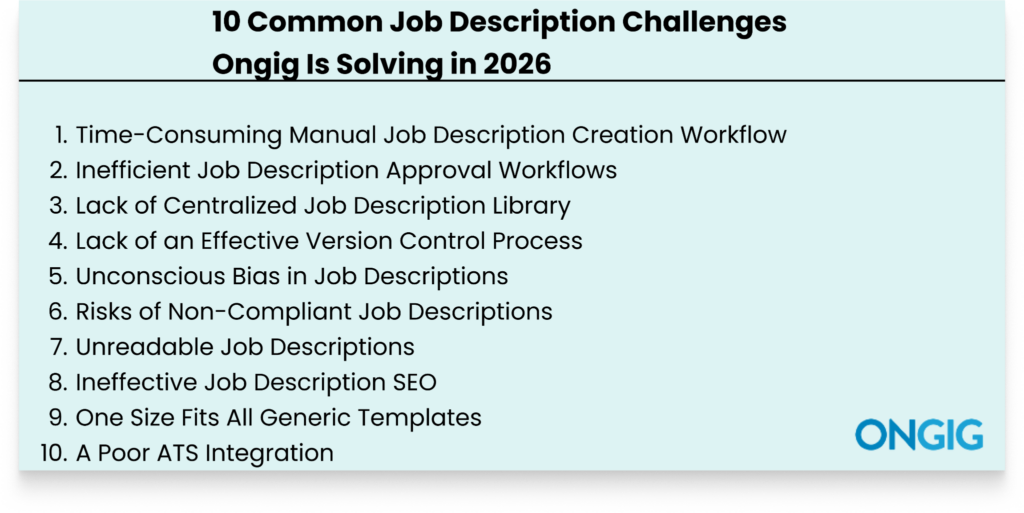
The comprehensive solutions offered by Ongig collectively redefine the approach to job description management in 2026. By tackling time-consuming manual workflows, inefficient approvals, scattered information, lack of version control, unconscious bias, compliance risks, unreadability, poor SEO, generic templates, and weak ATS integration, Ongig empowers organizations to create superior job descriptions that are fast, fair, compliant, engaging, and highly discoverable. The overarching impact is profound: faster time-to-hire, access to a broader and more diverse talent pool, reduced legal exposure, enhanced candidate experience, and a stronger employer brand. HR professionals are liberated from administrative drudgery, enabling them to focus on strategic initiatives that drive organizational growth.
As the competitive landscape for talent intensifies, platforms like Ongig are not merely tools; they are strategic partners in building the workforce of the future. The ability to craft impactful, inclusive, and legally sound job descriptions efficiently sets a new standard for excellence in talent acquisition, ensuring that companies can attract, engage, and retain the diverse expertise required to thrive in 2026 and the years to come.






