
The PCORI fee applies to "specified health insurance policies" and "applicable self-insured health plans." For fully insured plans, the responsibility for calculating and remitting the fee lies with the insurance carrier, often resulting in the cost being baked into the employer’s premiums. However, for organizations that utilize self-insured models—such as the Individual Coverage HRA (ICHRA), the Qualified Small Employer HRA (QSEHRA), or the Group Coverage HRA (GCHRA)—the legal obligation to report and pay the fee falls directly on the employer.
The Origins and Purpose of the PCORI Fee
The Patient-Centered Outcomes Research Institute was established as an independent, non-profit organization under the Patient Protection and Affordable Care Act of 2010. Its primary mission is to fund research that offers evidence-based information to assist patients, caregivers, and clinicians in making informed healthcare decisions. Unlike traditional medical research that focuses on the biological mechanisms of disease, PCORI-funded studies emphasize "comparative clinical effectiveness research." This research compares different medical treatments and strategies to determine which work best for specific patient populations under real-world conditions.
By law, the PCORI Trust Fund is financed by three sources: annual appropriations from the general fund of the Treasury, transfers from the Medicare Trust Funds, and the fees paid by health insurance issuers and self-insured plan sponsors. Since its inception, the institute has approved billions of dollars in funding for hundreds of studies, covering topics from mental health interventions to the management of chronic conditions like diabetes and heart disease.
Regulatory Timeline and the 2020 Extension
The history of the PCORI fee is marked by a significant legislative pivot. When the ACA was first enacted, the PCORI fee was scheduled to apply only to plan years ending after September 30, 2012, and before October 1, 2019. As the 2019 expiration date approached, many in the benefits industry anticipated the fee would vanish.

However, the Further Consolidated Appropriations Act of 2020, signed into law in late 2019, included a provision that extended the PCORI fee for an additional ten years. Under current law, the fee will remain in effect for plan years ending through September 30, 2029. This extension ensured continued funding for the institute but also meant that employers who had moved toward self-insured models or HRAs had to maintain their internal compliance structures to handle the annual July filing.
Determining Liability: Who Must File Form 720?
Understanding whether an organization owes the PCORI fee requires a close look at the structure of the health benefits provided. The general rule is that the "plan sponsor"—usually the employer—is responsible for the fee if the plan is self-insured.
Self-Insured Health Plans
This category includes any plan where the employer assumes the financial risk for providing healthcare benefits to its employees. Traditional self-insured medical plans are the most common examples, but the definition extends to many modern reimbursement models.
Health Reimbursement Arrangements (HRAs)
Because HRAs are considered self-insured group health plans, they are subject to PCORI fees. This includes:
- Individual Coverage HRA (ICHRA): Employers reimburse employees for individual health insurance premiums and other medical expenses.
- Qualified Small Employer HRA (QSEHRA): Designed for businesses with fewer than 50 full-time employees that do not offer a group medical plan.
- Group Coverage HRA (GCHRA): Also known as an "integrated HRA," this is offered alongside a traditional group health plan.
A critical nuance exists for Integrated HRAs. If an employer provides both a self-insured medical plan and an HRA, and both have the same plan year, they can be treated as a single plan, requiring only one fee per covered life. However, if an employer offers a fully insured group medical plan alongside a GCHRA, the employer is responsible for the PCORI fee for the HRA, while the insurer pays the fee for the medical plan.

Exemptions from PCORI Fees
Not all benefits trigger the fee. "Excepted benefits" are generally exempt. These include:
- Standalone dental and vision plans.
- Health Savings Accounts (HSAs).
- Health Flexible Spending Accounts (FSAs), provided they meet certain "excepted benefit" criteria (e.g., the employer offers other group coverage and the FSA is not the primary medical benefit).
- Plans that primarily cover employees working outside the United States.
The 2026 Fee Structure and Inflation Adjustments
The Internal Revenue Service (IRS) adjusts the PCORI fee annually based on the percentage increase in the projected per capita amount of National Health Expenditures. For the current filing cycle in July 2026, the fees are determined by the date the plan year ended in 2025.
For plan years that ended between October 1, 2024, and September 30, 2025, the fee is set at $3.47 per covered life. For plan years ending on or after October 1, 2025, and before October 1, 2026, the fee increases to $3.84 per covered life.
2025-2026 Fee Schedule Breakdown
- Plan Years ending Jan – Sept 2025: $3.47 per covered life.
- Plan Years ending Oct – Dec 2025: $3.84 per covered life.
This means a company running a standard calendar-year HRA (January 1 to December 31, 2025) will pay the $3.84 rate when they file by July 31, 2026.
Calculation Methodologies: Counting "Covered Lives"
The IRS provides three main methods for plan sponsors to calculate the average number of lives covered under their plan. Consistency is key; a sponsor must use the same method for all plans of the same type for a single plan year.
1. The Actual Count Method
The sponsor adds the total of covered lives (employees and, in some cases, dependents) for each day of the plan year and divides that sum by the number of days in the plan year. This is the most accurate but also the most administratively burdensome method.
2. The Snapshot Method
The sponsor chooses a date in each quarter of the year (or more frequent dates) and counts the covered lives on those specific dates. The total is then divided by the number of dates used. The dates must be consistent across quarters (e.g., the first day of each quarter).
3. The Form 5500 Method
For sponsors who file a Form 5500, they can use the participant counts reported on that form. This is often the simplest method for larger employers, though it requires that the Form 5500 be filed before the PCORI fee is due.
For HRAs, a special rule applies: the employer only needs to count the employee (the "participant"). Spouses and dependents covered by the HRA do not need to be counted as separate "lives" for the HRA-specific PCORI calculation, unlike traditional self-insured medical plans where every family member is counted.
Filing Mechanics: IRS Form 720
The PCORI fee is reported on IRS Form 720, the Quarterly Federal Excise Tax Return. Although Form 720 is generally a quarterly return, for PCORI purposes, it is filed annually.
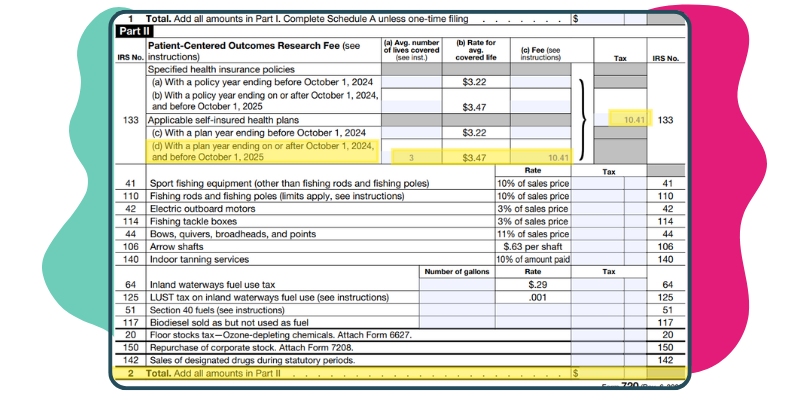
Employers must navigate to Part II of the form. Line 133 is dedicated specifically to the Patient-Centered Outcomes Research fee.
- Line 133(c): For plan years ending before October 1.
- Line 133(d): For plan years ending on or after October 1.
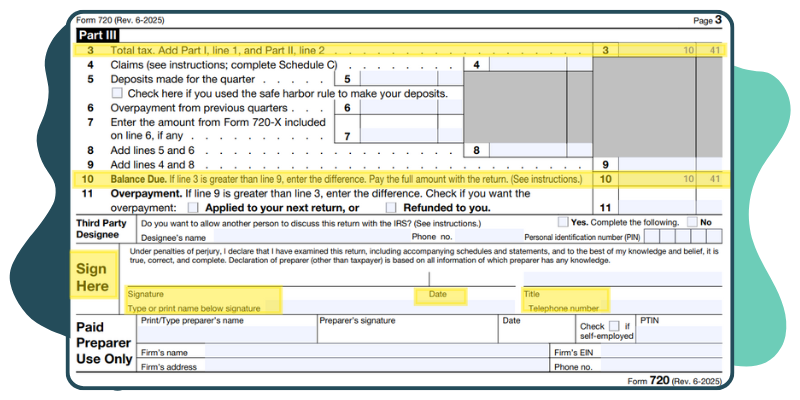
The form requires the employer to state the average number of lives covered and multiply that by the applicable rate ($3.47 or $3.84). The total is then carried over to Part III to determine the final balance due. Payment must be submitted with the form, typically accompanied by Form 720-V (a payment voucher), and mailed to the IRS center in Ogden, Utah.
Expert Perspectives on Compliance and Enforcement
Financial experts emphasize that while the dollar amount per employee is relatively low, the cost of non-compliance can be high. David Blain, CEO of BlueSky Wealth Advisors, notes that the administrative burden often outweighs the tax itself. "We have seen scenarios where entities miscalculated their covered lives or missed the fee payment deadline," Blain stated. "Both situations led to complications during their annual audits and an increase in administrative burden to rectify the oversight."
If an employer fails to file or pay the PCORI fee, they are subject to penalties under Internal Revenue Code §6651. The penalty for failing to file a return is 5% of the tax due for each month or part of a month the return is late, capped at 25%. Additionally, interest is charged on any unpaid tax from the due date until the date of payment.
Industry analysts suggest that the IRS has become more adept at identifying missing PCORI filings by cross-referencing HRA and medical plan data provided on other ACA-related forms, such as the 1094-C and 1095-C. Consequently, the "under the radar" approach is increasingly risky for small to mid-sized enterprises.

The Broader Impact on Small Business Strategy
The persistence of the PCORI fee is a reminder of the ongoing regulatory requirements associated with the Affordable Care Act. For small businesses, the choice to move away from traditional group health insurance toward HRAs (like ICHRA or QSEHRA) offers significant cost predictability and employee choice. However, it shifts the compliance mantle from the insurance carrier to the business owner.
Software solutions and third-party administrators (TPAs) have become essential for managing these requirements. Platforms such as PeopleKeep automate the "lives covered" calculation, providing reports that populate the necessary fields for Form 720. This automation is a critical response to the complexity of the ACA, allowing small businesses to compete for talent using sophisticated health benefits without needing a massive internal HR department.
Future Outlook: Beyond 2026
As the healthcare landscape continues to evolve, the PCORI fee remains a stable, if minor, fixture in the tax code. With the current extension set to expire in 2029, the next few years will likely see debate over the institute’s continued utility. Proponents argue that PCORI research is essential for reducing healthcare waste by identifying ineffective treatments, while critics view the fee as a "hidden tax" on health coverage.
For now, the mandate is clear: employers must ensure their 2025 plan year data is accurate, their "covered lives" are counted correctly, and their Form 720 is postmarked by July 31, 2026. Failure to do so not only invites IRS scrutiny but adds unnecessary financial friction to the already complex task of providing employee benefits in a modern economy. Organizations are encouraged to consult with tax professionals to confirm their specific liability and ensure that their filings reflect the most current inflation-adjusted rates provided by the Department of the Treasury.