
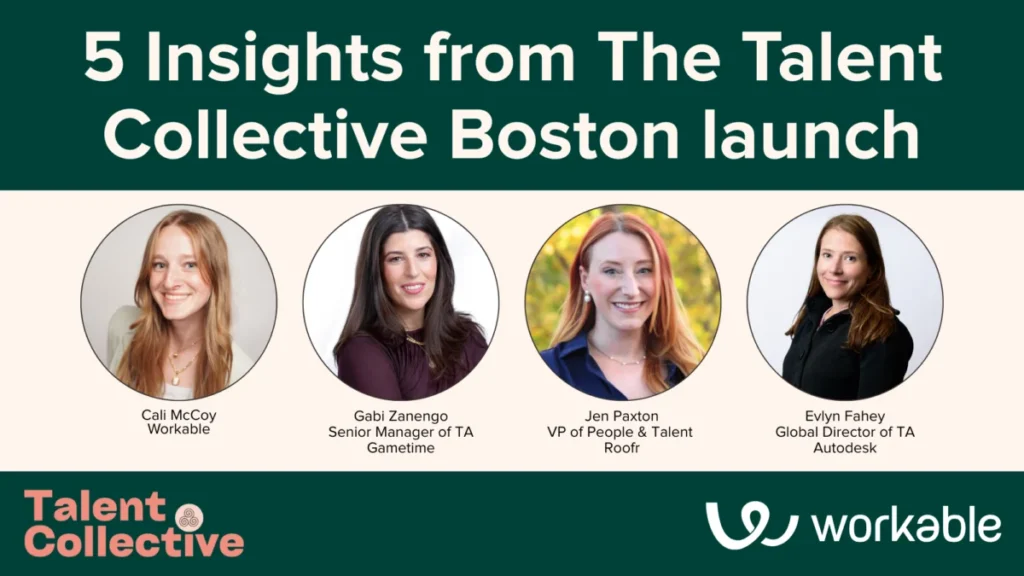
The inaugural Boston chapter launch of The Talent Collective, a prominent professional network for talent acquisition leaders, convened a distinguished assembly of human resources and recruitment professionals in late 2025. This pivotal event, moderated by Workable’s esteemed Cali McCoy, Head of Community, ignited a vibrant and candid discussion centered on a pressing challenge echoing across industries: how can talent acquisition (TA) teams embrace rapid innovation, particularly with emerging technologies like artificial intelligence, without compromising the inherently human core of the hiring process? The gathering, a testament to Boston’s burgeoning role as a hub for both technological advancement and strategic HR practices, underscored the critical need for dialogue and collaboration as the global talent landscape undergoes its most profound transformation in a decade.
A New Forum for Talent Leaders
The Talent Collective, an organization dedicated to fostering community and knowledge exchange among talent acquisition professionals, chose Boston for its newest chapter, recognizing the city’s dynamic ecosystem of tech innovation, biotech, finance, and education. This launch event, held in a packed room, brought together senior leaders from diverse sectors and company sizes, all grappling with common yet complex issues. Workable, a leading applicant tracking system (ATS) provider, played a significant role in facilitating the discussion, leveraging its deep industry insights and platform capabilities. Cali McCoy, known for her expertise in talent strategy and community building, skillfully guided the conversation, ensuring a comprehensive exploration of the challenges and opportunities facing TA in the near future. The presence of three unnamed but highly influential industry leaders on the panel—representing various corporate structures and market segments—provided a rich tapestry of perspectives, offering a clear vision for what hiring will entail in 2026 and beyond. The collective insights revealed a consistent set of concerns and priorities, transcending specific industry nuances, and pointing towards universal trends in talent acquisition.
Key Trends Shaping the 2026 Hiring Landscape
The discussion at The Talent Collective Boston launch crystallized five critical trends that are fundamentally reshaping the recruiter playbook and demanding innovative responses from TA teams. These themes highlight a complex interplay between market dynamics, technological advancement, and the enduring importance of human judgment and empathy.
1. The Rise of Hyper-Specialized Roles and the "Unicorn" Conundrum
A significant shift observed across the talent market is the move away from high-volume, generalist hiring towards deeply niche and often hybrid-skill roles. Companies are no longer merely seeking "more of the same" to fill broad categories; instead, they are actively hunting for unique combinations of expertise, such as professionals who are both technically proficient and creatively astute, or individuals with strong AI literacy coupled with strategic business acumen. This evolution is driven by the accelerating pace of digital transformation, the integration of advanced technologies like AI and machine learning into core business functions, and the increasing complexity of problem-solving in modern enterprises.
This trend has necessitated a fundamental recalibration of expectations between talent acquisition teams and hiring managers. Recruiters are now tasked with educating stakeholders on the realities of today’s talent pool. While the pursuit of excellence remains paramount, the quest for the mythical "unicorn"—a single individual possessing an impossibly broad and deep set of skills—is often unrealistic. Data from recent industry reports, such as a 2024 LinkedIn "Future of Work" study, indicates that the demand for highly specialized skills has grown by nearly 30% in the past three years, particularly in areas like data science, cybersecurity, and advanced engineering, which frequently require cross-functional competencies. This forces TA professionals to become strategic partners, guiding hiring managers to focus on core competencies and potential for growth, rather than an exhaustive checklist of rare attributes. The implication is a pivot towards a more consultative approach, where TA acts as a market expert, grounding hiring expectations in the practical availability of talent and helping to define realistic, yet impactful, role profiles.
2. Exploding Candidate Volumes Overwhelm Talent Acquisition Teams
Paradoxically, even as roles become more specialized, the volume of applications for open positions has surged dramatically, with many requisitions now attracting over 1,000 applicants. This unprecedented spike in candidate volume, fueled by factors such as economic uncertainties leading to increased job seeking, widespread layoffs in sectors like technology, and the simplified application processes enabled by digital platforms, is creating significant operational strain for TA teams.
The ramifications are extensive:
- Time-to-Hire Delays: Sifting through thousands of applications manually significantly extends the time it takes to identify qualified candidates, delaying critical hires.
- Diminished Candidate Experience: Overwhelmed recruiters struggle to provide timely feedback or even acknowledgments, leading to a perception of "ghosting" and a negative impact on the employer brand. A 2023 survey by Talent Board revealed that candidate satisfaction drops precipitously when response times exceed two weeks.
- Increased Recruiter Burnout: The sheer volume of administrative tasks associated with managing high applicant counts contributes to stress and burnout among TA professionals, diverting their energy from strategic activities.
- Risk of Missing Top Talent: Without efficient screening mechanisms, genuinely strong candidates can easily get lost in the deluge of applications, impacting hiring quality.
This burgeoning challenge underscores the urgent need for technological intervention. The consensus among the leaders at the Boston launch was the accelerating demand for AI support in initial candidate screening. However, a crucial caveat was emphasized: such AI integration must be implemented with unwavering transparency and ethical considerations. The goal is for AI to augment human capabilities, not replace them, by efficiently filtering out unsuitable applications and highlighting those most deserving of human review, thereby preserving the quality and integrity of the hiring pipeline.
3. The Rising Threat of Candidate Fraud
Perhaps no topic resonated more universally with the assembled leaders than the alarming rise of candidate fraud. This issue, manifesting in increasingly sophisticated forms, poses a significant threat to organizational integrity, security, and the overall fairness of the hiring process. The types of fraud encountered are diverse and pervasive:
- Impersonation: Candidates attempting to have others take interviews or assessments on their behalf.
- AI-Generated Applications: The use of generative AI to craft compelling, but potentially misleading, resumes, cover letters, and even initial interview responses.
- Fabricated Experience and Credentials: Exaggerated or entirely false claims regarding work history, skills, or educational qualifications.
- Automated Application Bots: The deployment of bots to submit large numbers of applications, often for positions for which the "candidate" is entirely unqualified, further exacerbating the volume problem.
The increasing prevalence of remote work, coupled with advancements in AI and deepfake technology, has created new vectors for fraudulent activity. The financial implications of a bad hire, including recruitment costs, training investments, and potential damage to team morale or company reputation, can be substantial. A recent study by the Association of Certified Fraud Examiners (ACFE) estimated that organizations lose approximately 5% of their revenue to fraud each year, with internal fraud and hiring-related deception contributing significantly.
In response, TA leaders are rapidly adopting creative and robust tactics to verify candidate identity and claims. These include implementing multi-factor authentication for online assessments, utilizing IP address checks and location validation during virtual interviews to ensure the candidate is where they claim to be, and deploying specialized identity verification services. The challenge lies in balancing stringent security measures with the imperative to maintain a positive and seamless candidate experience. The goal is to build a secure hiring ecosystem that protects both the organization and legitimate candidates from malicious actors, reinforcing trust in the recruitment process.
4. Accelerating AI Adoption with Varying Maturity Levels
The integration of artificial intelligence into talent acquisition is no longer a futuristic concept; it is a present reality, albeit one with widely varying levels of maturity across organizations. "Every company is somewhere different on the map," observed one panelist, highlighting the spectrum from cautious experimentation to advanced, integrated deployment.
Some progressive organizations are rapidly experimenting with AI across various stages of the recruitment funnel:
- AI-powered Sourcing: Identifying passive candidates through intelligent analysis of public data and professional networks.
- Automated Screening: Utilizing AI algorithms to review resumes and applications, identifying candidates whose profiles best match job requirements.
- Personalized Candidate Outreach: Crafting tailored communications and follow-ups based on candidate profiles and engagement history.
- Interview Scheduling and Chatbot Support: Automating logistical tasks and providing instant answers to common candidate queries, freeing up recruiter time.
However, widespread adoption faces hurdles, particularly legal and compliance friction. Concerns around data privacy, algorithmic bias, and regulatory frameworks (such as GDPR or state-specific AI regulations) are common. A standout insight from the discussion offered a powerful reframing for navigating these challenges: instead of asking legal teams, "Can we do this [with AI]?", TA leaders should instead inquire, "Under what conditions would this not be allowed?" This proactive and solution-oriented approach transforms legal review from a potential roadblock into a strategic partnership, fostering controlled experimentation rather than outright prohibition. It encourages a framework for responsible innovation, allowing TA teams to explore AI’s potential while mitigating risks. Across the board, there was a unanimous alignment on a core principle: AI’s primary role should be to eliminate administrative burden and enhance efficiency, not to become the ultimate decision-maker in the hiring process. Human judgment, empathy, and strategic oversight must remain at the core of critical hiring decisions. The global market for AI in HR is projected to reach over $5 billion by 2027, indicating a strong trajectory for continued investment and integration.
5. The Evolution of Candidate Experience Towards Continuous Feedback
Traditional candidate experience models, often relying on a single end-of-process survey administered after a candidate is either hired or rejected, are proving insufficient in today’s dynamic environment. TA teams are now shifting towards a more agile and proactive approach: continuous, stage-by-stage check-ins throughout the recruitment journey. This paradigm shift allows organizations to surface friction points and gather feedback much earlier in the process.
The benefits of this continuous feedback loop are significant:
- Real-time Issue Identification: Instead of waiting until the hiring process concludes—when feedback is often most emotionally charged and less actionable—TA teams can spot issues like unclear communication, inconsistencies in interview panels, or process delays as they occur.
- Proactive Adjustments: Early signals enable teams to make real-time adjustments to the process, improving the experience for subsequent candidates and potentially salvaging relationships with current candidates.
- Enhanced Employer Brand: A commitment to continuous feedback demonstrates an organization’s dedication to respectful and transparent interactions, strengthening its employer brand and fostering goodwill, regardless of the hiring outcome.
- Improved Conversion Rates: Addressing issues promptly can prevent qualified candidates from withdrawing due to a poor experience, thereby improving offer acceptance rates.
While not every candidate will respond to every check-in, the goal is not merely volume of feedback, but the acquisition of early, actionable signals. These insights empower TA teams to iterate and refine their processes while candidates are still actively engaged, ensuring a more positive and effective journey for all involved. A 2024 Candidate Experience Report indicated that companies with a strong continuous feedback mechanism reported 20% higher offer acceptance rates and 15% lower candidate drop-off rates during the interview process. This strategic pivot reflects a deeper understanding that candidate experience is not just a HR function, but a critical component of brand reputation and business success.
The Bottom Line: A Balanced Approach for the Future of Hiring
The comprehensive discussion at The Talent Collective Boston launch left no doubt: the field of hiring is undergoing its most dramatic and transformative shift in a decade. The prevailing sentiment was clear: while artificial intelligence will undoubtedly revolutionize and streamline many aspects of the recruitment process, the human element—characterized by connection, judgment, and empathy—will continue to define the candidate experience and drive successful outcomes.
As the complexity of the talent landscape continues to grow, the true competitive advantage will belong to those talent acquisition teams that master a delicate yet powerful balance. This equilibrium encompasses:
- Innovation: Embracing new technologies and methodologies to stay ahead.
- Integrity: Upholding ethical standards and transparency in all hiring practices, particularly with AI.
- Automation: Leveraging technology to eliminate administrative burden and enhance efficiency.
- Empathy: Maintaining a human-centric approach that prioritizes candidate experience and well-being.
- Speed: Optimizing processes to respond quickly to market demands and candidate expectations.
- Substance: Focusing on genuine talent matching and long-term organizational fit, beyond superficial metrics.
The energetic and insightful exchanges among the diverse group of people leaders in Boston underscored that these qualities—innovation, integrity, automation, empathy, speed, and substance—are not merely aspirational ideals but are actively being championed and integrated by the forward-thinking professionals who gathered. This launch event served as a powerful reminder that while technology provides the tools, it is the strategic vision and human ingenuity of talent leaders that will ultimately shape the future of work. The insights gleaned from this event will undoubtedly inform best practices and strategic planning for TA teams globally, as they navigate the complexities of a rapidly evolving talent ecosystem.






