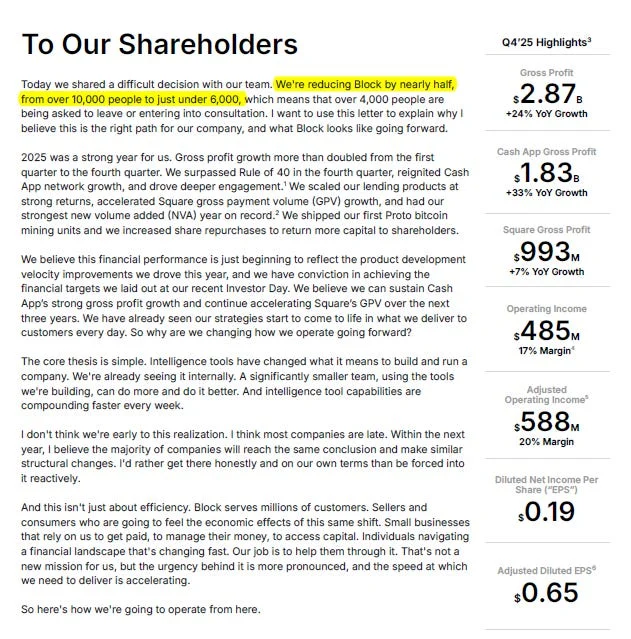
The recent announcement by Jack Dorsey, CEO of Block Inc., the financial technology company behind Square and Cash App, regarding plans to lay off 40% of its workforce—approximately 4,000 employees—and replace them with artificial intelligence (AI) has sent ripples through the tech industry and beyond. The declaration, characterized by its stark brevity and lack of specific implementation details, has ignited a fervent debate about the practicalities, ethics, and true motivations behind such a sweeping AI-led workforce transformation.
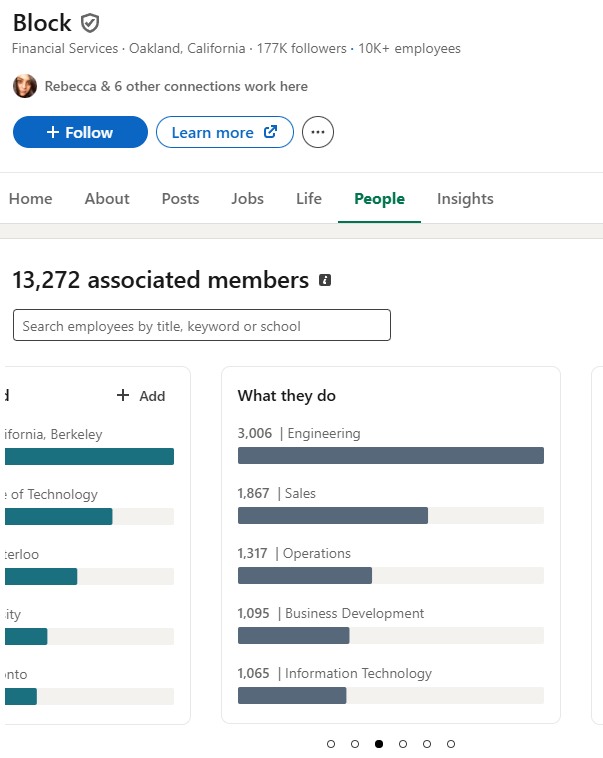
Block Inc., a company that has grown to employ over 10,000 individuals, with significant concentrations in engineering, IT, operations, and sales, now faces intense scrutiny over its ambitious, and some would say audacious, strategy. While Dorsey’s pronouncement was clear, the path forward remains opaque, prompting industry analysts, employees, and observers to question the feasibility and implications of replacing such a substantial portion of its human capital with automated systems.

The Announcement and Initial Reactions
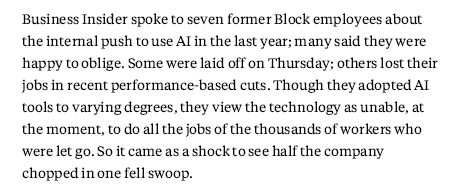
The initial announcement, made by Dorsey himself, was notably concise, offering little in the way of a roadmap for this significant organizational shift. This lack of detail immediately raised red flags. Interviews with seven Block Inc. employees, as reported by Business Insider, revealed a collective uncertainty regarding the specifics of how this "business transformation" is intended to unfold. This internal ambiguity underscores the profound challenges inherent in such a large-scale AI integration.
Industry insiders and those working closely with AI development have acknowledged the significant implications of such a move. A friend working at Anthropic, a leading AI research company, reportedly highlighted the magnitude of this announcement, emphasizing the growing trend of AI adoption and its potential to displace human roles across various sectors. This sentiment is echoed by many who believe that this event may be a harbinger of more widespread AI-driven workforce changes.
Examining the Block Inc. Financial Landscape
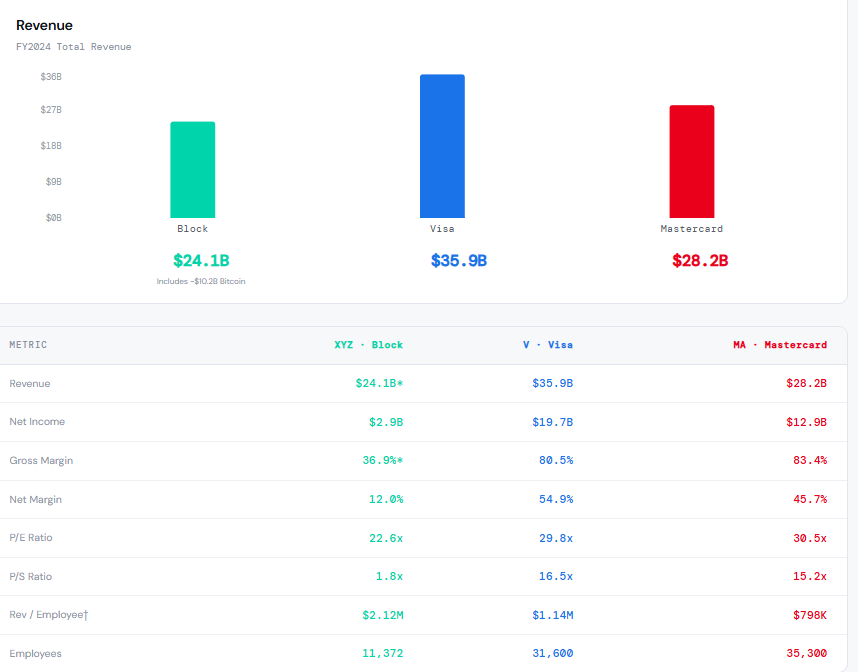
To understand the context of this aggressive AI strategy, a closer look at Block Inc.’s financial performance is warranted. When compared to established players in the financial services and e-commerce sectors, such as Visa, Mastercard, and Shopify, Block Inc. presents a different financial profile. Data indicates that Block Inc. is considerably less profitable and exhibits a lower gross margin than these counterparts. This suggests that the company may not be operating at the same level of efficiency or scale, a factor that could be driving a search for cost-saving measures and operational improvements.

The stark difference in profitability and gross margin could be a critical underlying factor influencing Dorsey’s decision. Investors have reportedly expressed dissatisfaction with Block’s financial performance, increasing pressure on the company to demonstrate a clear path toward greater efficiency and profitability. In this light, the AI-driven workforce reduction can be interpreted not just as a technological advancement, but as a strategic maneuver aimed at enhancing operational efficiency and appeasing investor concerns.
Is AI an Excuse for Performance Management?
The narrative surrounding AI and job displacement often overlooks a crucial aspect: the potential for AI to serve as a convenient justification for performance management and organizational restructuring. The situation at Block Inc. raises questions about whether the AI agenda is truly about technological advancement or a broader strategy to streamline operations and potentially address performance issues within the existing workforce.
This perspective is informed by historical parallels. Following Elon Musk’s acquisition of Twitter, significant layoffs occurred, ostensibly to combat perceived bureaucracy. It is plausible that, in the case of Block Inc., AI is being leveraged as a more palatable and forward-looking rationale for a similar organizational "cleanup." This approach allows companies to frame workforce reductions within a narrative of innovation and future-proofing, rather than solely focusing on cost-cutting or performance remediation.
The Realities of AI Implementation in the Workplace
While the allure of AI-driven efficiency is undeniable, the practicalities of its implementation are far more complex than a simple replacement of human workers. Research and real-world case studies suggest that AI transformation, particularly aimed at eliminating jobs, is often a short-term approach with limited long-term benefits if not coupled with fundamental business re-engineering.
1. The Myth of Pure Job Elimination
The notion that AI can simply eliminate jobs without creating new roles or requiring new skill sets is largely a misconception. Building, implementing, and scaling enterprise AI solutions is a resource-intensive endeavor. It necessitates the creation of new roles and teams dedicated to managing these sophisticated systems. This includes AI model building, training, verification, and ongoing maintenance to ensure the accuracy and reliability of AI outputs. The non-deterministic nature of AI technology means that continuous oversight is critical to prevent unexpected errors or drift in performance, especially in critical applications like financial services.
2. The Significant Cost of AI Adoption
The financial investment required for AI implementation is substantial and multifaceted. While AI can automate tasks previously performed by humans, the costs associated with AI development, deployment, and ongoing operation are considerable. For instance, replacing a customer support center, which might employ individuals earning around $35,000 annually, with AI agents could yield savings of 50-60% of operating costs. However, even an AI agent can incur costs of $15,000-$20,000 per year, not including the expenses of training, maintaining the AI ecosystem, and ensuring data governance.
The cost analysis becomes even more intricate when considering roles like software engineering. While AI can assist in coding, generating code snippets, or identifying bugs, the operating costs of AI systems, particularly for complex, high-context, non-linear tasks, can potentially exceed the salary of a human engineer. For a team of 100 engineers earning $100,000 annually ($10 million payroll), if AI can automate 80% of their manual coding tasks, it represents a significant buyback of labor capacity. However, the underlying infrastructure, compute power, and specialized talent needed to manage these AI coding assistants represent a substantial ongoing investment. Data from analyses, such as those provided by Gemini, illustrate these complex cost dynamics, highlighting that the capital and operational expenses of AI infrastructure can often represent one-third to one-half or more of the cost of human staff.
3. Re-engineering Processes: The True ROI of AI
The most profound impact and return on investment from AI are realized not through job displacement, but through fundamental business re-engineering. Leading companies are leveraging AI to transform their operations, enhance productivity, and create new value. Examples include Allianz’s use of digital twins to optimize claims processing and knowledge sharing, and Travelers’ application of AI to accelerate employee enablement and time-to-market. HubSpot, rather than reducing its workforce, is developing AI to offer new services to its clients, expanding its market reach.
At Josh Bersin’s own company, Galileo, AI has been instrumental in scaling the business exponentially, enabling the firm to engage with a far broader client base than would be possible through traditional human-led interactions. This shift from a "hire to grow" model, which can dilute employee productivity, to a "talent density" approach, where AI augments human capabilities, is the hallmark of successful AI transformation.
The Block Inc. Context: Efficiency Over Revolution?
Given Block Inc.’s financial performance—specifically its lower profitability and gross margin compared to industry peers like Visa, Mastercard, and Shopify—the AI-driven workforce reduction could be a strategic move to boost operational efficiency. The company’s financial structure suggests it may not be operating at optimal scale, making efficiency gains a critical objective.
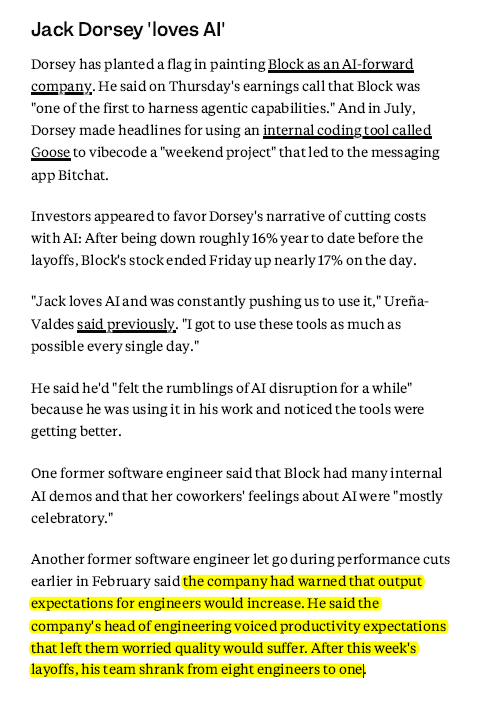
The timing of this announcement, amidst broader economic shifts and investor pressures, further suggests that AI may be serving as a catalyst for necessary organizational adjustments. While Dorsey’s enthusiasm for AI is evident, the practical application of replacing 4,000 employees with AI raises questions about the company’s readiness and the underlying strategic goals. Without a clear plan for re-engineering its business processes around AI, the layoffs might represent a short-sighted cost-cutting measure rather than a sustainable transformation.
Lessons for the Broader Business Landscape
The situation at Block Inc. offers critical lessons for other organizations contemplating similar AI-driven workforce changes:
- AI is not solely a job-eliminating strategy: While AI can automate tasks, its true power lies in re-engineering processes, enhancing human capabilities, and creating new opportunities. Companies focusing solely on job displacement risk missing the broader transformative potential of AI.
- Implementation requires careful planning and investment: The cost and complexity of deploying and managing AI are significant. Organizations must conduct thorough cost-benefit analyses and develop robust strategies for AI integration, including training, maintenance, and governance.
- Focus on re-engineering for sustainable ROI: The most impactful AI transformations are those that fundamentally redesign business processes to leverage AI’s strengths. This requires a strategic vision that goes beyond mere automation and embraces innovation.
- Transparency and communication are paramount: The lack of specific details surrounding Block Inc.’s announcement has generated uncertainty and skepticism. Companies undertaking significant workforce changes, especially those involving AI, must prioritize clear and transparent communication with their employees and stakeholders.
The announcement from Block Inc. serves as a stark reminder that the integration of AI into the workforce is a complex and evolving phenomenon. While the potential for increased efficiency and productivity is immense, the path forward requires a nuanced understanding of technological capabilities, financial realities, and the fundamental principles of organizational design. Whether Block Inc. ultimately succeeds in its ambitious AI-driven transformation remains to be seen, but the lessons learned from this bold move will undoubtedly shape the future of work for years to come.
Additional Information and Resources
For those seeking to delve deeper into the strategic imperatives of AI in the enterprise and its impact on HR and business operations, the following resources offer valuable insights:
- Enterprise AI Architecture: Imperatives for 2026: This resource outlines essential considerations for building effective AI architectures within organizations.
- New Research: How AI Transforms $400 Billion Of Corporate Learning: Explore the significant impact of AI on corporate learning and development initiatives.
- Webinar Recording: From Predictions to Imperatives: A replay of a discussion on the 11 essential imperatives for HR and business leaders navigating the age of AI.
- Josh Bersin Podcast: Understanding the Biggest HR Transformation in Decades: Listen to expert guidance on the profound changes AI is bringing to the HR landscape.
- Galileo Learn Program: The Superworker Organization: AI Goes Enterprise: This learning program provides hands-on skills for redefining work, HR teams, and organizations in the era of AI-powered superworkers and superagents.