For businesses navigating the competitive landscape of talent acquisition, the journey from posting a job to extending a signed offer has become a protracted ordeal. The average time-to-hire, typically hovering between 36 and 44 days, can stretch considerably for specialized or technical roles. Even high-volume hourly positions, often characterized by their urgency, can feel interminably long when vacant shifts translate to strained existing teams. This prolonged recruitment cycle isn’t merely an inconvenience; it represents a significant drain on resources, a potential loss of top-tier candidates, and a drag on operational efficiency. The critical question facing modern HR departments is not whether this timeline can be shortened, but rather, what fundamental changes are required to halve it without compromising the integrity of the hiring process. The answer lies not in accelerating candidate evaluation or lowering standards, but in systematically dismantling the extraneous layers of waiting, coordination, and back-and-forth that have become the default, yet often inefficient, modus operandi of recruitment.
The prevalent understanding of hiring bottlenecks often points to interviews as the primary culprit. Hiring managers frequently cite the need for multiple interview rounds, panel discussions, and internal debates as the primary drivers of delays. However, a closer examination of the recruitment lifecycle reveals a more nuanced reality. While interviews are undeniably a crucial stage, they are frequently sandwiched between even more time-consuming preparatory and follow-up activities.
A typical 30-to-40-day hiring cycle can be more accurately deconstructed as follows:
- Job Posting and Initial Sourcing: This phase, often involving the creation of job descriptions, advertising across various platforms, and initial outreach, can consume 5-10 days.
- Candidate Screening and Qualification: Reviewing resumes, conducting initial phone screens, and assessing basic qualifications typically adds another 5-7 days.
- Interview Scheduling and Coordination: This is the often-overlooked but highly impactful stage, where aligning candidate and interviewer availability can stretch for 7-14 days.
- Interviews and Assessments: The actual time spent in interviews, while important, is often a smaller fraction of the overall timeline, typically 3-5 days.
- Post-Interview Debrief and Decision Making: Internal discussions, reference checks, and reaching a consensus can add another 5-7 days.
- Offer Extension and Acceptance: The final steps of extending an offer, negotiation, and securing a signed contract can take 3-5 days.
As this breakdown illustrates, the "interview" itself is not the largest impediment. Instead, it is the extensive lead time required to schedule those interviews and the subsequent waiting periods for feedback and decisions that inflate the overall timeline. These interstitial periods, characterized by administrative friction, are precisely where the most significant opportunities for compression lie.
The Hidden Cost of Scheduling and Coordination
The administrative burden associated with coordinating interview schedules is a significant, yet often underestimated, drain on recruitment efficiency. The process of matching a candidate’s availability with that of multiple interviewers, who themselves juggle competing priorities and time zones, is a complex logistical challenge. Recruiters find themselves navigating a labyrinth of email chains and instant message threads, attempting to pinpoint mutually agreeable slots. Interviewers, often pressed for time, may reschedule meetings at the last minute due to urgent business needs, further disrupting the candidate’s and the recruiter’s plans. For candidates who are currently employed, their availability can be exceptionally limited, often confined to narrow windows outside of their core working hours.
Research into remote hiring practices has highlighted the stark difference in efficiency between automated scheduling systems and manual coordination. Studies indicate that the transition from a candidate expressing interest to completing an interview can take mere hours when managed by an automated system, as opposed to several days when reliant on manual scheduling. This delay is critical. Each day a strong candidate remains in limbo, they are actively engaged with other organizations, potentially receiving faster offers and disappearing from the recruitment pipeline entirely.

When this scheduling gap is multiplied across every interview round within a typical hiring process, it’s not uncommon for two weeks or more to elapse before any substantive hiring decision can even be considered. This realization can be jarring for many hiring managers, as it reflects a pervasive inefficiency they likely witness on a daily basis within their own teams.
Revolutionizing the Interview Stage with AI
The most profound impact on compressing the hiring timeline can be achieved by fundamentally transforming the interview stage. This is where the real gains in efficiency are realized, primarily through the adoption of AI-assisted interviewing technologies. The core innovation of these systems lies in their ability to decouple the interview process from the constraints of a shared calendar.
Instead of requiring candidates to find a specific 45-minute window that aligns with the availability of multiple interviewers across different time zones, AI interviewers allow candidates to complete structured, role-relevant interviews on their own schedule. This flexibility enables candidates to participate at times that are most convenient for them, whether it be evenings, weekends, or short breaks between other professional commitments. The traditional back-and-forth of scheduling, the need for rescheduling due to unforeseen conflicts, and the risk of losing candidates due to prolonged waiting periods are effectively eliminated.
For interviewers, the shift is equally transformative. Rather than dedicating significant time to conducting numerous similar first-round conversations, recruiters and hiring managers receive structured summaries and scored evaluations of candidates shortly after each AI-driven interview concludes, often within hours. This immediate feedback loop allows for a much more agile assessment of talent. The consistency of the questioning ensures that every candidate is evaluated against the same criteria and at the same depth, regardless of their position in the interview queue. This standardized approach mitigates unconscious bias and provides a more objective basis for comparison.
The scale of time savings offered by AI-assisted interviewing is dramatic. Organizations that have integrated these technologies for early and mid-stage candidate assessments have reported a compression of their overall time-to-hire from approximately six weeks down to as little as one week. Specifically, the time required to conduct initial interviews has been reduced by as much as 99%, as the interview no longer necessitates calendar synchronization. This single technological advancement is the key to transforming a compressed hiring timeline from an aspirational goal into an achievable reality.
A Realistic Vision of a Five-Day Hiring Cycle
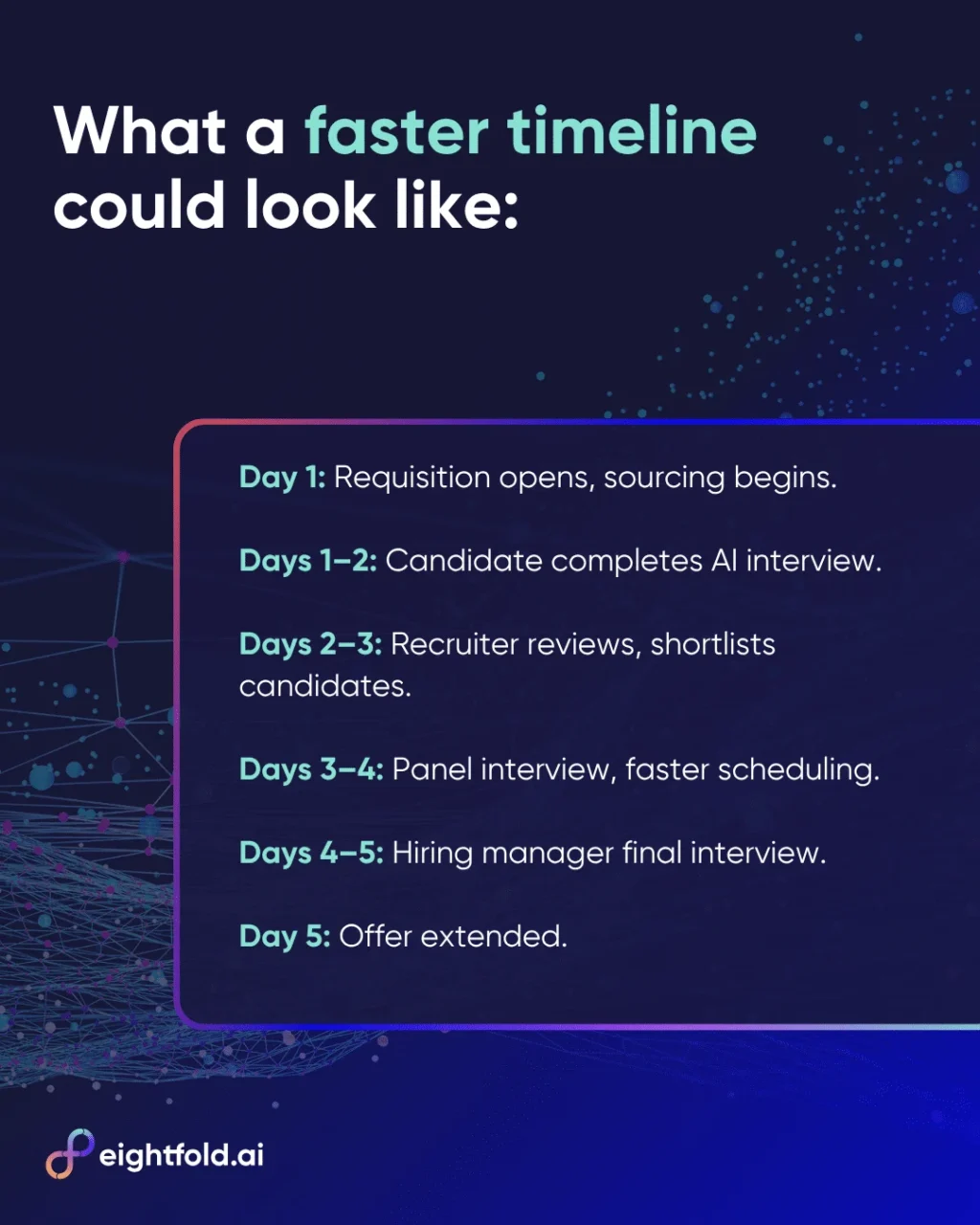
By systematically addressing and mitigating the friction points identified above, a drastically accelerated hiring timeline becomes not only possible but practical. Consider a realistic scenario for a requisition-to-offer process when these inefficiencies are systematically removed:
- Day 1: Requisition Approved & Job Posted: The process begins immediately upon approval. Job descriptions are optimized for clarity and appeal, and postings are distributed across relevant channels.
- Day 1-2: AI-Powered Screening & Initial Assessment: Candidates applying receive immediate acknowledgment. AI tools screen applications against predefined criteria and initiate AI-driven interviews for qualified candidates, allowing them to participate at their convenience.
- Day 2-3: Structured Interview Feedback & Candidate Shortlisting: Within hours of candidates completing their AI interviews, recruiters and hiring managers receive comprehensive evaluations and scores. This allows for rapid identification of top candidates.
- Day 3-4: Final Interviews & Decision Making: A select group of candidates proceeds to final, in-person or video interviews with key stakeholders. These interviews are strategically scheduled, often on the same day or the next, leveraging the efficiency gained in earlier stages. Debrief sessions are concise and data-driven.
- Day 4-5: Offer Extension & Acceptance: Once a decision is made, the offer is extended promptly. Negotiation, if necessary, is handled efficiently, leading to a signed offer within the same day or the following.
This streamlined process culminates in a five-day turnaround from requisition to a signed offer. Crucially, this is not achieved through haste or by compromising candidate experience. It is the result of a process where no stage is left idle. The critical human touchpoints – the final interviews where nuanced judgment and interpersonal connection are paramount, the offer conversation, and the moments where relationship building is essential – remain firmly in human hands. What disappears is the unproductive "dead time" that traditionally padded out the recruitment cycle.

The Ripple Effects of a Swift Hiring Process
The benefits of a significantly reduced time-to-hire extend far beyond the recruitment dashboard, creating positive ripple effects across the entire organization.
For hiring managers, the most immediate impact is the ability to fill critical open positions much faster. This prevents the burden of understaffing from cascading onto existing team members, alleviating workload pressures and improving overall team morale and productivity. Projects that were on hold awaiting necessary headcount can finally commence, driving business initiatives forward.
From the candidate’s perspective, a swift and transparent hiring process is a significant positive differentiator. Candidates today value their time and expect a professional, responsive experience. A process that involves weeks of silence after a promising initial conversation, or leaves them wondering if they’ve been overlooked, fosters frustration and can lead to disengagement. Conversely, a fast, consistent, and communicative hiring journey – regardless of the technology used for initial assessments – consistently garners higher satisfaction ratings from candidates.
Furthermore, in today’s competitive talent market, speed is a strategic imperative. Top-tier talent is in high demand and does not typically remain on the market for extended periods. If a company’s recruitment process takes three weeks to reach a decision, while a competitor engages with the same candidate and extends an offer within five days, the outcome is often predetermined before the slower organization has even completed its internal debrief. Compressing the hiring timeline is therefore not just an internal efficiency gain; it is a direct defense against losing valuable candidates to more agile competitors. It is a proactive measure to secure the talent needed to maintain a competitive edge.
The Takeaway: Less Waiting, More Hiring
The hiring timeline that many organizations have come to accept as standard is not an immutable law of nature. It is, in fact, the cumulative result of numerous small, yet addressable, delays. The most significant of these delays have little to do with the actual evaluation of a candidate’s ability to perform a job and much to do with the administrative overhead surrounding the process. The most substantial gains in reducing time-to-hire do not come from cutting corners on crucial interview stages or lowering the bar for talent. Instead, they are achieved by systematically eliminating the "scheduling tax" and the "coordination drag" that have become endemic to traditional recruitment practices.
Ultimately, cutting your time-to-hire in half is not about working harder or faster in the traditional sense. It is about working smarter by waiting less. By embracing technological solutions like AI-assisted interviewing and streamlining administrative processes, organizations can transform their recruitment from a protracted ordeal into an agile and effective engine for acquiring the talent they need to thrive.
For organizations eager to explore how this accelerated approach can be tailored to their specific hiring needs, requesting a demonstration of advanced recruitment solutions is the next logical step.