The landscape of professional document creation has undergone a profound transformation, with collaborative platforms like Google Docs and Microsoft Word becoming indispensable tools for teams across industries. These environments allow multiple users to suggest edits, leave comments, and track every change in real-time, fostering unparalleled efficiency and accountability. Yet, a striking paradox persists within the human resources domain: job descriptions, arguably among the most critical and collaborative documents in an organization, often remain trapped in an outdated paradigm of Word files, email attachments, and a chaotic proliferation of competing versions. This glaring discrepancy highlights a significant void in current job description software, prompting a consistent refrain from HR professionals: "Can we review job descriptions like we do in Google Docs?"
This seemingly simple question underscores one of the most substantial operational gaps in contemporary HR technology. While many existing platforms offer basic version history, providing a snapshot of a document at a previous point in time, true collaboration demands a more dynamic and interactive approach. The ability to track individual changes, facilitate discussions directly within the document, and manage approvals systematically is not merely a convenience; it is a strategic necessity for organizations striving for efficiency, compliance, and excellence in talent acquisition.
The Collaborative Labyrinth: Who Truly Owns a Job Description?
A common misconception is that job descriptions are solely the purview of recruiters. In reality, the creation and refinement of an enterprise job description is a profoundly collaborative endeavor, touching numerous departments and requiring diverse expert inputs. A single job description can pass through the hands of a wide array of stakeholders, each contributing a unique and vital perspective.
Typically, the journey begins with the Hiring Manager, who defines the core needs, responsibilities, and desired qualifications for the role. Following this initial draft, the Recruiter refines the language for candidate appeal, ensures clarity, and aligns it with branding guidelines. HR Business Partners (HRBPs) often review for internal equity, career pathing, and alignment with broader HR policies.
Beyond these core players, the document’s journey extends to highly specialized functions. Compensation Teams meticulously scrutinize the description to ensure accurate leveling and salary benchmarking, directly impacting budget and internal pay equity. Legal Counsel reviews every clause for compliance with labor laws, non-discrimination regulations, and intellectual property considerations, mitigating potential legal risks. In an increasingly diverse and inclusive world, Diversity, Equity, and Inclusion (DEI) Professionals analyze the language for unconscious bias, ensuring it attracts a broad and diverse candidate pool. Finally, Talent Leaders or Senior HR Executives often provide strategic oversight, ensuring the description aligns with organizational goals and talent strategy.
Each of these stakeholders brings a distinct lens to the document:
- Hiring Managers focus on technical requirements and team fit.
- Recruiters prioritize candidate attractiveness and search keywords.
- HRBPs consider internal consistency and employee relations.
- Compensation Teams analyze market value and pay grades.
- Legal safeguards against compliance risks and litigation.
- DEI Professionals champion inclusive language and equitable access.
The inherent challenge lies in harmonizing these diverse perspectives and managing their collective edits without descending into operational chaos. The current fragmented approach often transforms this essential collaboration into a time-consuming and error-prone administrative burden.
The Unspoken Challenge: A Decade-Old Review Process in a Digital Age
Despite the rapid advancements in business software, many companies continue to manage job description reviews with methods that are, at best, a decade behind the curve. The familiar cycle often unfolds as follows: a recruiter downloads a Microsoft Word document, drafts the job description, and emails it to the hiring manager. The hiring manager makes revisions and emails an updated copy back. Subsequently, the legal department might receive a separate version, mark it up, and return their edits, perhaps in a different file format or even as annotated comments in an email. The compensation team then receives yet another iteration, making their own adjustments in a disconnected spreadsheet or document.
This iterative, disconnected process invariably leads to a single individual—typically the recruiter or HR partner—being tasked with the unenviable job of merging all these disparate inputs. This manual amalgamation is not only incredibly inefficient but also highly susceptible to errors, oversights, and the accidental deletion of critical feedback. The process frequently culminates in a series of vexing questions:
- Which is the latest version?
- Whose changes were accepted, and whose were overlooked?
- Did Legal approve the final wording, or was that from an earlier draft?
- Are we sure this version incorporates all the feedback?
As organizations grow in size and complexity, this problem scales exponentially, transforming what should be a streamlined collaborative effort into a significant bottleneck in the hiring process. Industry reports suggest that HR professionals spend up to 30% of their week on administrative tasks, a significant portion of which is dedicated to coordinating and reconciling document reviews. The cumulative effect of these inefficiencies can delay time-to-hire, increase recruitment costs, and potentially impact the quality of candidates due to misaligned or outdated job descriptions.
Distinguishing Core Capabilities: Version History vs. Track Changes
Many modern job description platforms boast "version history" as a feature, and while useful, it is fundamentally different from "Track Changes" or true collaborative editing. Version history primarily serves as an archival tool, allowing users to revert to a previous state of a document. It answers a singular, retrospective question: "What did this document look like yesterday, or last week?" It’s about restoring the past, a crucial capability for auditing and recovery.
Track Changes, however, addresses a much broader and more immediate set of questions essential for active collaboration:
- Who made this specific change?
- When was this edit proposed?
- Why was this particular phrase added or removed (via comments)?
- Has this change been approved or rejected by all relevant stakeholders?
- Can we discuss this proposed change directly within the document?
These are two entirely distinct capabilities with different purposes. Version history provides a safety net; Track Changes facilitates dynamic, real-time collaboration. The former allows for historical review; the latter enables active, concurrent refinement and decision-making within a shared workspace. Without true collaborative editing, the process remains fragmented, forcing users to export, edit offline, and then re-import, effectively negating the benefits of a centralized platform.
The Vision: Transforming Job Description Reviews with Modern Collaboration
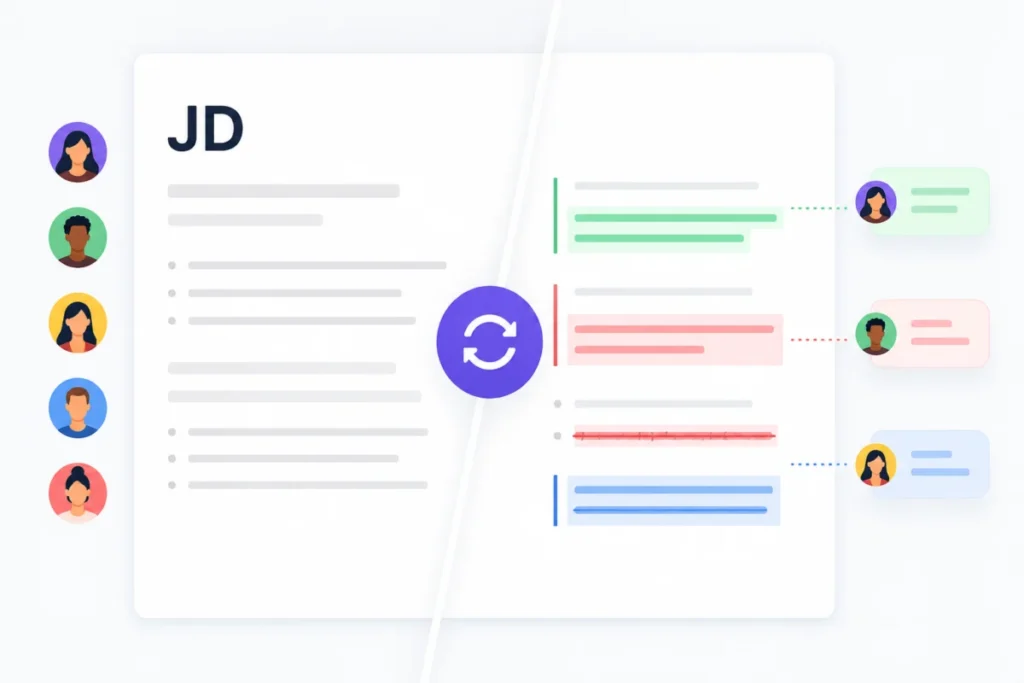
Imagine applying the intuitive, efficient collaborative experience of Google Docs or Microsoft Word to the creation and review of job descriptions. In these widely adopted tools, users don’t overwrite each other’s work. Instead, they:
- Suggest edits that appear as visible, pending changes.
- Leave comments directly alongside specific text for clarification or discussion.
- Accept or reject individual changes with a clear audit trail.
- Work concurrently on the same document without fear of losing contributions.
- Receive real-time notifications when changes are made or comments are left.
Bringing this level of sophistication to job descriptions would revolutionize HR workflows. Consider the transformative impact:
- Recruiters could initiate a draft, and hiring managers could propose specific wording changes directly within the document.
- Compensation teams could highlight salary ranges or leveling details, and legal could review clauses, all within a single, live document.
- DEI professionals could suggest alternative phrasing for inclusive language, visible to all collaborators.
- All edits, comments, and discussions would be centralized, eliminating the need for email chains or fragmented feedback.
- The final version would be a consensus document, clearly showing who approved which change, fostering accountability and transparency.
This approach transforms the job description from a static document passed between individuals into a living, evolving asset collaboratively shaped by all stakeholders.
Broader Implications: Driving Efficiency, Compliance, and Talent Quality
The absence of robust collaborative editing in job description software extends its impact far beyond mere administrative inconvenience. It directly affects critical aspects of an organization’s talent strategy and operational health.
Efficiency and Time-to-Hire: Streamlined collaboration dramatically reduces the back-and-forth communication inherent in traditional review processes. By eliminating manual merging, reducing email traffic, and providing a single source of truth, organizations can cut down the time it takes to finalize and post job descriptions. This directly translates to a faster time-to-hire, which is crucial in competitive talent markets. Studies indicate that delays in hiring can cost companies thousands of dollars per day in lost productivity and revenue.
Quality of Hire: A collaboratively crafted job description is inherently more accurate, comprehensive, and appealing. With input from all relevant experts, the description can precisely articulate the role’s requirements, cultural fit, and value proposition. This clarity attracts better-suited candidates, reducing misalignments and ultimately improving the quality of hire. Poorly written job descriptions are a leading cause of misapplication and early attrition, contributing to a reported 15-20% higher turnover rate in the first year for new hires.
Compliance and Risk Mitigation: Legal and DEI reviews are paramount. Collaborative editing ensures that every legal or inclusive language suggestion is properly addressed and documented. The audit trail of accepted and rejected changes provides an invaluable defense in the event of legal challenges related to discrimination or unfair hiring practices. This proactive approach significantly reduces legal and reputational risks associated with non-compliant job descriptions.
Employer Branding and Candidate Experience: A well-crafted, consistent, and up-to-date job description is a powerful tool for employer branding. It reflects professionalism, clarity, and an organization’s commitment to finding the right talent. Conversely, a confusing or outdated description can deter top candidates and negatively impact the candidate experience, which is increasingly critical in today’s talent market.
Remote and Hybrid Work Enablement: In an era where remote and hybrid work models are prevalent, the need for effective digital collaboration is amplified. Teams are often geographically dispersed, making asynchronous and real-time co-editing a fundamental requirement rather than a luxury. Traditional file-sharing and email-based reviews are simply untenable for modern distributed workforces.
The Future of Job Description Workflows: Beyond Approval to True Collaboration
Most organizations have established approval workflows within their HR systems, dictating who reviews a document first, who provides subsequent sign-offs, and who grants final approval. These structured workflows are undoubtedly important for governance. However, current software often falls short precisely where the real work begins: once a document is "opened for review." At this critical juncture, the system typically stops assisting, leaving collaborators to resort to antiquated methods.
Modern workflows must transcend mere sequential approvals. They should actively facilitate and simplify the intricate process of co-creation and revision within the document itself. Approval is the final gate; collaboration is the intensive journey leading up to it. The hardest part is no longer just getting a signature; it’s ensuring that all necessary feedback is incorporated seamlessly, accurately, and efficiently.
Why Collaborative Editing is the Next Evolution of Job Description Software
The recurring request from enterprise customers is not merely for version history, but for a familiar, intuitive editing experience they already utilize daily. They seek the ability to:
- Propose edits directly within the job description.
- Add comments for context and discussion.
- Accept or reject individual changes.
- Track who made what change and when.
- Collaborate in real-time on a single document.
This feedback underscores a fundamental shift in user expectations. Collaborative editing is not merely a "nice-to-have" feature; it represents the logical and necessary next step in the evolution of job description management software. Just as Google Docs redefined how teams collaborate on reports, presentations, and spreadsheets, the time has come for job descriptions to benefit from the same modern, efficient, and user-centric experience.
The integration of robust collaborative editing tools into job description platforms promises to unlock significant efficiencies, enhance compliance, improve the quality of hire, and ultimately empower HR teams to operate more strategically. This development signals a future where the administrative burden of job description management is drastically reduced, allowing HR professionals to focus more on strategic talent initiatives rather than chasing versions and merging documents.
Ongig, a leader in job description optimization, recognizes this critical need and is at the forefront of developing solutions that bring this modern collaborative experience to enterprise HR teams. By innovating in this space, companies like Ongig are addressing a long-standing pain point, paving the way for a more streamlined, effective, and compliant approach to talent acquisition. The future of job description management is not just about automation; it’s about intelligent collaboration.
FAQs
What’s the difference between version history and track changes?
Version history allows users to view and restore earlier saved states of a document. Track Changes, conversely, enables real-time collaboration by allowing reviewers to suggest specific edits, leave contextual comments, and then accept or reject individual changes without overwriting the original content, maintaining a clear audit trail.
Who benefits from track changes in job descriptions?
Virtually anyone involved in the creation, review, or approval of job descriptions benefits, including recruiters, hiring managers, HR Business Partners, legal counsel, compensation teams, DEI professionals, and senior talent leaders. It streamlines communication and ensures all perspectives are considered and documented.
Why isn’t version history enough for job descriptions?
While version history is useful for auditing and recovery, it’s insufficient for dynamic collaboration. It shows what a document looked like at a certain point but doesn’t facilitate the iterative process of review, discussion, and approval of individual edits within a shared workspace. It lacks the interactive elements necessary for true team co-creation.
Can track changes improve hiring workflows?
Absolutely. By centralizing all feedback and edits within a single document, organizations can drastically reduce manual effort, eliminate the confusion of multiple document versions, enhance accountability for changes, and significantly accelerate the job description approval process. This leads to faster time-to-hire and a more efficient overall recruitment cycle.
July 9, 2026 by Heather Barbour Fenty in Job Descriptions