The landscape of the United States labor market is poised for a significant transformation over the next decade, according to the latest Bureau of Labor Statistics (BLS) Employment Projections report for 2025-2035. Contrary to widespread concerns about artificial intelligence (AI) leading to mass job displacement, the report indicates a future characterized by labor shortages, driven by a confluence of demographic shifts, evolving economic growth, and the accelerating adoption of AI. This projection challenges prevailing narratives and necessitates a strategic reevaluation of workforce planning for businesses and policymakers alike.
The BLS report, a comprehensive analysis of projected employment trends, reveals a stark contrast between anticipated economic growth and workforce expansion. Over the next ten years, the U.S. labor market is expected to grow by a modest 3.5%. This sluggish growth is juxtaposed with an aggressive GDP growth projection of 22%, signaling a substantial increase in labor productivity. To achieve this productivity surge, companies will be compelled to accelerate their AI transformation agendas, integrating advanced technologies to augment human capabilities and streamline operations.
This transition, however, is not anticipated to be without its challenges. The report foresees labor shortages emerging across various sectors, alongside a significant transformation in job roles and required skills. This evolving environment demands a new organizational paradigm, one that HR professionals and business leaders are increasingly terming a "Dynamic Organization." For those within the human resources field, the demand for their expertise is paradoxically projected to intensify, suggesting a critical role in navigating these complex workforce shifts.
Key Findings from the 2035 Projections
The BLS report meticulously outlines several pivotal findings that will shape the future of the U.S. job market:
1. Slowing Workforce Growth and Emerging Shortages
The projected growth rate of the U.S. workforce stands at a mere 3.5% for the decade spanning 2025-2035. This represents a significant deceleration compared to the preceding decade, which experienced a 10.9% increase in the labor force. This slower expansion rate is a primary driver behind the anticipated labor shortages, even as AI continues to automate certain tasks.
An in-depth analysis within the report categorizes jobs based on their reliance on physical or human-centered work. Approximately 61% of U.S. jobs fall into these categories, with healthcare representing the largest segment. While AI currently possesses the potential to fully automate around 13% of existing jobs, the report’s overarching conclusion is that AI is more likely to augment human capabilities, creating "Superworker" opportunities rather than widespread job elimination. This perspective is further detailed in forthcoming research, highlighting the collaborative potential between humans and AI.
Compounding the demographic trends, current U.S. immigration policies are identified as a significant constraint on workforce growth. Reports from publications like The Economist have highlighted the economic repercussions of restrictive immigration measures, suggesting that these policies will further exacerbate impending workforce shortages. The confluence of anti-immigration policies, declining birth rates, and an aging population are identified as the three primary factors contributing to this projected slowdown in labor availability.

2. The Aging Workforce and Extended Careers
The demographic profile of the U.S. workforce is undergoing a significant shift, with individuals aged 65 and over representing one of the fastest-growing segments. Currently, those aged 65 and above constitute 7% of the workforce. By 2035, this figure is projected to rise to 8.5%, marking a 21% growth rate – seven times the overall workforce expansion rate.
This trend is further amplified by an increasing number of older workers choosing to "unretire." Studies, such as those conducted by AARP, indicate that nearly 10% of workers over 65 are returning to the workforce, a trend expected to continue and lead to the elongation of average career lengths. This phenomenon presents both opportunities and challenges for employers.
For HR leaders, this necessitates a renewed focus on generational diversity programs. It is widely acknowledged that age discrimination can impact older workers in terms of pay and hiring. A significant portion of workers over 50 report feeling "left behind," underscoring the critical need for employers to address age bias and foster inclusive work environments that leverage the experience and skills of older professionals.
3. Healthcare and Home Health Lead Job Growth
The healthcare sector is projected to be a dominant force in U.S. labor market expansion over the next decade. Specifically, roles such as home health and personal care aides are expected to grow significantly, accounting for approximately 5.5 million individuals and an 18% increase in demand.
Registered nurses, a cornerstone of the healthcare system, will continue to be in high demand, with their numbers reaching 3.7 million. This profession is also anticipated to experience the highest percentage wage growth among all segments. Nurse practitioner positions are forecast to see a substantial 41% increase in number, with average wages projected to rise from $132,000 to $181,000. Overall, the healthcare industry is expected to contribute 37% of all job growth, expanding its share of total U.S. employment from 13.3% to 14%.
4. AI’s Impact on Administrative and Low-Wage Roles
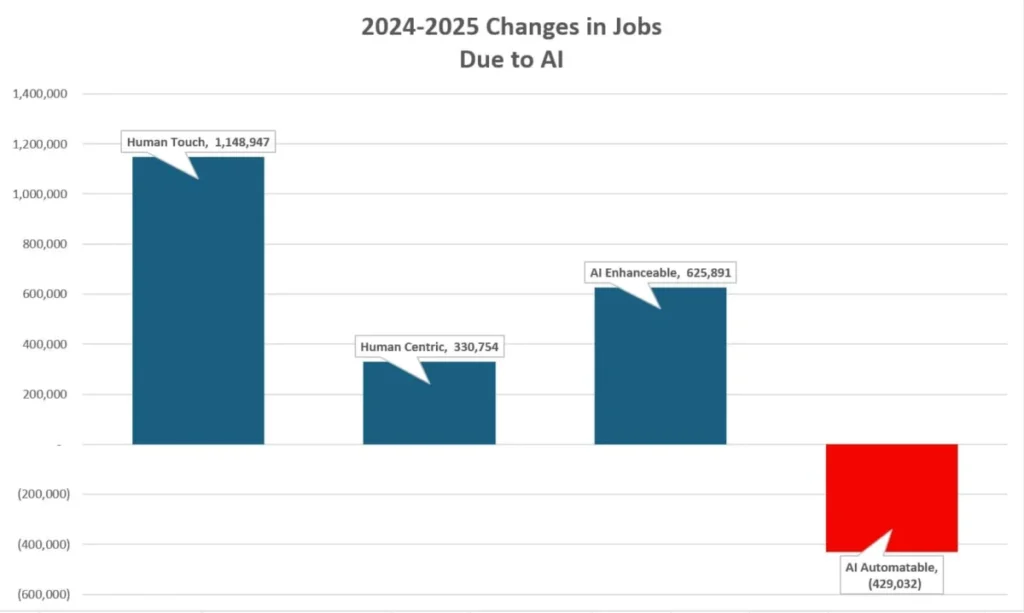
The BLS report categorizes the 830 job titles within its taxonomy into four groups: human-touch, human-centric, AI-enabled, and AI-automated. The analysis reveals a clear trend: job titles experiencing the most rapid decline are concentrated in administrative and clerical functions. This includes positions such as cashiers, clerks, bookkeepers, secretaries, receiving clerks, retail managers, tellers, and other similar roles, which collectively represent approximately 13% of today’s jobs.
The BLS anticipates this trend will accelerate, with similar automation impacts extending to "human-touch" jobs as robotic capabilities mature. Furthermore, certain IT roles that are considered administrative in nature, such as computer support specialists, programmers (distinct from software developers), testers, and data entry personnel, are also projected to see declines in both employment numbers and wages.
In contrast, jobs characterized by high-touch and human-centric attributes are experiencing increasing demand. These roles, which constitute 61% of the workforce, include laborers, electricians, plumbers, as well as professionals in home health, counseling, and psychology. Emerging fields such as energy and power production, aerospace, health sciences, and bio-engineering are also expected to be significant drivers of job creation.
5. Stability in Management, Sales, and Teaching Roles
Contrary to some predictions that AI would lead to a substantial reduction in middle management, the BLS report, in agreement with the analysis presented, forecasts continued growth in management positions. The concept of the "Superworker" necessitates effective leadership and management to guide and support these augmented employees, as detailed in extensive research on the subject.
While retail sales jobs are projected to experience a modest decline of 3-5%, roles in high-value sales are expected to grow. Teaching positions, despite a slowing birth rate, are anticipated to remain stable, driven by the persistent and evolving need for new skills and innovative learning methodologies.
6. Wage Premiums for "Superworker" Roles
The analysis of wage trends indicates a significant upward movement for jobs that are "AI-enabled." Professionals who leverage AI effectively are no longer confined to traditional definitions of their roles. For instance, an AI-powered software engineer transitions from a mere "programmer" to a product leader and problem-solver. Similarly, an HR business partner utilizing AI moves beyond data retrieval and policy lookup to become a strategic consultant and advisor.
These "Superworker" job families are experiencing wage growth at approximately twice the rate of inflation, underscoring the increased value and demand for individuals who can effectively integrate with and utilize advanced technologies.
The "Superworker" Effect: Augmentation, Not Elimination
The central narrative emerging from this analysis is the "Superworker" effect, as explored in depth in the forthcoming book "Superpowered." AI and automation are not primarily instruments of job elimination but rather catalysts for augmenting human capabilities, creating "superpowered" individuals. By automating routine tasks – and the definition of "routine" is continually evolving – jobs such as cashier, clerk, customer service representative, administrative assistant, and bookkeeper are being redefined.

Individuals in these roles are not necessarily facing unemployment but are transitioning to reinvented work that focuses on the core aspects of their professions, rather than being consumed by repetitive tasks. The BLS data, when analyzed through the lens of human-touch, human-centric, AI-enhanceable, and AI-replaceable job categories, reveals that while 13% of jobs are highly susceptible to AI automation, 61% involve human touch or are human-centric. Even within these human-centric roles, AI can provide valuable support for scheduling, training, and operational efficiency, thereby transforming them into Superworker roles.
The report acknowledges that some job displacement is projected, but as a percentage of the over 160 million working Americans, the impact is expected to be relatively small. For example, in a recent year, job destruction attributed to automation was approximately one-third of a percent. While the prospect of automation can be unsettling, the pace of total job loss is projected to be gradual.
Over time, the boundaries between these categories will shift. As robotics advance, "human-touch" jobs may become more susceptible to automation. Similarly, AI’s capabilities will increasingly impact "human-centric" roles.
Implications for the Future of Work
The BLS Employment Projections: 2025-2035 paint a clear picture of a future U.S. labor market grappling with worker shortages, particularly in sectors requiring human interaction and specialized skills. The importance of human-touch and human-centric jobs will escalate, with AI serving as a powerful tool to enhance these roles. Individuals in knowledge and information-intensive professions are also poised for growth.
Industries such as healthcare, manufacturing, logistics, retail, entertainment, hospitality, and transportation will need to prioritize hiring, training, and employee enablement strategies to navigate these impending shortages. Routine jobs will continue to diminish, replaced by roles demanding greater cognitive and emotional intelligence. The overall U.S. economy may experience fluctuations and challenges as these workforce dynamics unfold.
In this evolving landscape, Chief Executive Officers (CEOs) and Chief Human Resource Officers (CHROs) must champion productivity agendas that integrate AI effectively. The coming decade will place an unprecedented emphasis on managing people for growth, fostering skill development, ensuring retention, and cultivating employee engagement. The ability to adapt to these changes and strategically position workforces will be paramount for organizational success and national economic stability.
The detailed analysis of BLS occupational forecasts, particularly as interpreted by organizations like Galileo, provides a crucial resource for businesses and individuals seeking to understand and prepare for these profound shifts in the labor market. The overarching takeaway is that the future of work is not one of widespread unemployment but rather one of profound transformation, where human ingenuity, augmented by artificial intelligence, will redefine the nature of work itself.