Following an extensive global tour spanning nearly 60,000 miles across Europe, Asia, and the Middle East, observing hundreds of companies as they formulate their artificial intelligence strategies, a singular, undeniable truth has emerged: Generative AI has transitioned from a nascent concept to a tangible, potent business tool. Its applications are not only real but are rapidly expanding across diverse sectors. This sentiment is strongly supported by a recent comprehensive survey conducted by Wharton, which illuminates the deep integration of AI into the modern corporate landscape.
Widespread Adoption and Tangible ROI
The Wharton survey reveals a striking adoption rate among business leaders, with 46% reporting daily use of Generative AI and an overwhelming 80% utilizing it on a weekly basis. Crucially, these users are not merely experimenting; 72% are actively measuring the return on investment (ROI) of their AI initiatives, with a significant 74% reporting a positive financial return. This indicates a clear shift from exploration to value realization.
The survey also highlights the departmental impact of AI. While Information Technology (IT) and Finance departments have historically led in technological adoption, Human Resources (HR) is rapidly emerging as a key player, ranking as the third-largest department in terms of AI use cases. This growing prominence of AI within HR functions signifies a fundamental change in how organizations manage their most valuable asset: their people.
This burgeoning adoption is naturally accompanied by escalating investment. The Wharton data indicates a substantial increase in AI budgets, with 23% of large companies now allocating $20 million or more annually to AI initiatives, and a further 43% investing over $10 million per year. This significant financial commitment underscores the strategic importance that businesses are placing on AI.
The Core Benefit: Individual Productivity and Beyond
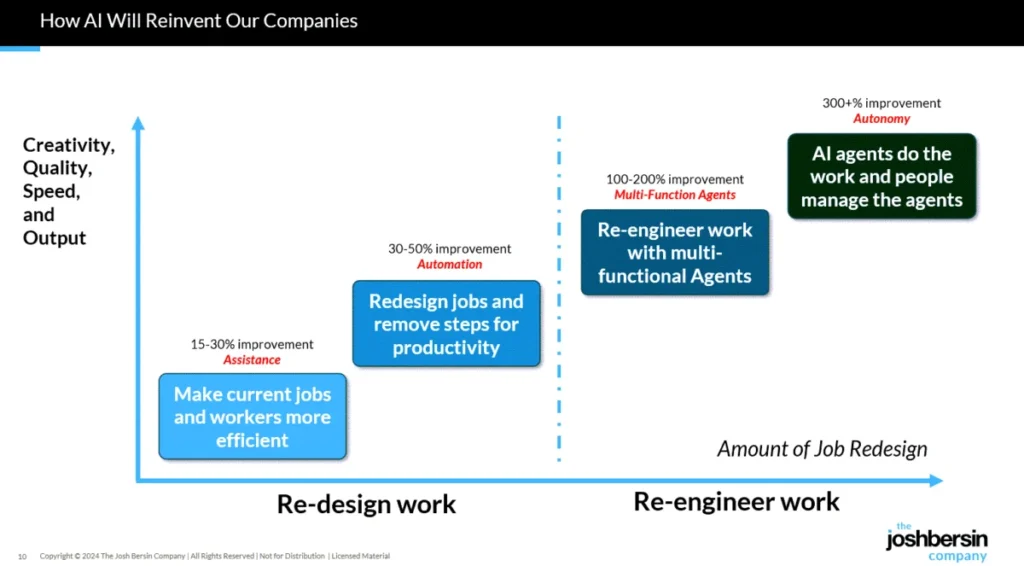
At the heart of current AI adoption lies a focus on enhancing individual productivity. The report categorizes these early-stage applications as "stage 1" usage, where AI assists employees with tasks such as summarizing lengthy meetings, analyzing complex datasets, efficiently retrieving information, and drafting or refining documents. While these personal productivity gains are substantial and immediately apparent, they represent only the initial phase of AI’s potential.
This initial wave of AI integration bears a striking resemblance to the early days of transformative technologies like word processing, spreadsheets, and the internet. These tools, too, initially focused on augmenting individual efficiency. Microsoft’s strategic push with its Copilot integration into its Office suite is a prime example, aiming to transform the entire productivity software ecosystem into an AI-powered platform, much like the original Microsoft Office suite redefined workplace computing.
Evolving Use Cases: From Assistants to Agents
Beyond individual productivity, AI is rapidly evolving into more sophisticated forms, notably through the deployment of "corporate agents." Approximately 12% of companies are now leveraging these agents, exemplified by IBM’s "Ask HR" solution. These knowledge and information management chatbots are poised to become ubiquitous, capable of replacing cumbersome internal portals and SharePoint sites, and serving as efficient customer support systems. The expectation is that virtually every company will soon deploy such an agent.
A compelling case study from a large healthcare company illustrates this evolution. For the past four years, this organization has successfully operated an employee chatbot that has become so integral that virtually all HR applications are now integrated behind it. Employees can seamlessly access information and assistance regarding pay, benefits, work schedules, and even training through this single, intuitive interface.
Recruiting is another area demonstrating proven AI efficacy. Job candidates can now engage with an AI agent to initiate the application process, complete AI-powered assessments, and even undergo initial interviews with an AI avatar. This 24/7 accessibility eliminates the need for candidates to schedule calls with recruiters or hiring managers, streamlining the early stages of the talent acquisition process.
While the ultimate goal of high-ROI, multi-functional agents (referred to as "stage 3" in the referenced AI adoption model) is still being refined, organizations are already deploying AI-based coaches and learning tools. Many large enterprises are implementing AI-native learning systems, reporting significant improvements in workforce enablement, with some seeing reductions in staff required for training functions by as much as 30-40%. This points to a future where AI not only assists but actively drives employee development and upskilling.
The business unit Galileo, specializing in HR and learning solutions, has experienced a dramatic surge in demand, reflecting the growing corporate need for sophisticated, tailored AI agents for both staff and managers. Galileo now positions itself as a digital HR business partner and a comprehensive tutor, underscoring the expanding role of AI in strategic human capital management.
Crossing the Rubicon: A Point of No Return
The current phase of AI adoption can be accurately described as "crossing the Rubicon," signifying a point beyond which there is no turning back. Despite ongoing narratives that paint AI as a threat to livelihoods and careers, its practical utility and ease of understanding are becoming increasingly evident. While imperfections and errors, particularly in complex generative tasks, remain a challenge (as highlighted by the frequent inaccuracies of tools like ChatGPT), the ability to refine prompts and train AI with trusted datasets is mitigating these issues.
Just two years ago, concerns about AI’s potential for social disruption, such as forming romantic relationships, dominated public discourse. However, significant capital investment, estimated to be in the trillions of dollars, has fueled advancements in AI infrastructure, engineering, and computational power, leading to more stable and secure AI systems.
This does not imply a risk-free environment. The potential for AI to generate incorrect answers, poorly written reports, or flawed analyses remains a reality. However, users are developing a crucial skill: verifying AI outputs. This "checking" mechanism, combined with an understanding of AI’s probabilistic nature, fosters a more comfortable and productive human-AI collaboration.
Emerging challenges include the environmental impact of AI, with data centers and power plants becoming increasingly prevalent. Reports indicate that a single ChatGPT query can consume significant amounts of water, presenting a new frontier for sustainable AI development and policy. Addressing these resource demands is becoming a critical concern for the industry and policymakers alike.
The Future Trajectory: From Single Tasks to Integrated Solutions
The trajectory of AI development points towards increasingly sophisticated and integrated applications. As discussed in upcoming analyses of AI trends for 2026, the current stage is merely the beginning.
The Rise of Multi-Functional Agents
The next significant leap in AI’s value proposition lies in the development of "multi-functional agents," moving beyond single-task assistance. Current AI tools are akin to power steering in a car – helpful but not transformative. The true potential lies in AI that can autonomously navigate complex processes, akin to a self-driving vehicle.

This evolution is already evident in areas like recruiting and training, where agents can now manage the entire lifecycle from writing job requisitions and screening candidates to scheduling interviews and even initiating onboarding. The integration of these agents with performance reviews and career development planning will create comprehensive "hiring and career" agents. The development of blueprints to guide the creation of these multi-functional agents for both vendors and buyers is underway.
Organizations are moving away from fragmented AI solutions towards cohesive agents that manage end-to-end business processes, such as the entire product lifecycle from design to sales and post-sale support, or the complete sales funnel from lead generation to customer retention. This integration signifies a move towards AI that orchestrates complex workflows rather than merely assisting with isolated tasks.
The emergence of these multi-functional agents will necessitate a reevaluation of many existing job roles. Positions focused on routine administrative tasks, such as interview scheduling or appointment setting, may be significantly impacted as AI takes over these functions within broader workflows.
The Galileo platform exemplifies this shift. What began as an HR assistant has evolved into a solution builder, capable of addressing complex queries, developing tailored training modules, and providing answers to intricate compensation and benefits questions. Galileo now guides users from problem identification to validated solutions, mirroring the autonomy of a self-driving car.
Personalized AI with Memory and Personality
A second key development on the horizon is the emergence of AI agents with persistent memory and personalized interaction capabilities. Agents like Galileo are beginning to retain user history and preferences, allowing them to learn from individual and organizational usage patterns. This enables more autonomous, personalized, and ultimately, more valuable interactions.
Imagine a manager facing a staffing challenge. An AI agent could proactively ask clarifying questions about the role, consult internal benchmarks for optimal span of control, and suggest exploring internal candidates based on salary benchmarks and existing skill sets. Weeks later, the same agent could follow up, referencing the previous hiring decision and suggesting a revised development plan for the team based on the prior hire’s onboarding experience. This level of contextual understanding and proactive guidance represents a significant advancement in AI’s utility.
As these "steering wheel" agents become more proficient, their integration will enable AI to guide entire operations, a capability that is expected to become widespread in 2026.
Data Management: The Mission-Critical Foundation
Organizations with extensive AI experience consistently identify robust data management, data labeling, and data governance as critical new disciplines. The Galileo experience underscores this: the accuracy and performance of AI are directly contingent upon the quality of its training data. AI models operate on probability and calculus, meaning even minor data inaccuracies can lead to significant errors in output. Studies have shown that a substantial percentage of AI-generated responses can be erroneous without proper data governance.
Consequently, data ownership and integrity have become mission-critical. Companies like IBM are implementing rigorous data governance frameworks, assigning owners to each HR policy within their "Ask HR" agent and actively monitoring for regulatory changes to ensure compliance. This meticulous approach to data management is becoming a prerequisite for effective AI deployment across all sectors.
Inter-Agent Communication: The Next Frontier
The increasing complexity of AI systems necessitates the development of agent-to-agent communication protocols. While these protocols are still maturing, companies are actively working on enabling seamless integration between different AI systems. Galileo’s integration with SAP’s Joule is a prime example, with more such collaborations anticipated.
Organizations are advised to exercise caution and avoid the proliferation of numerous disparate AI agents, as their collective utility diminishes if they cannot communicate effectively. Short-term contracts are becoming a common strategy to mitigate the risk of investing in technologies that may quickly become obsolete. The development of comprehensive blueprints for agent integration is crucial to ensure that AI systems work in concert, much like a well-coordinated autonomous vehicle.
Navigating Vendor Risks and Market Consolidation
The AI vendor landscape presents both opportunities and risks. The stability and strategic direction of major AI players like OpenAI and Microsoft’s Copilot remain subjects of ongoing observation. The competitive environment, with tools like Gemini and Anthropic facing competition from emerging players, suggests potential market consolidation.
Companies demonstrating a focus on pragmatic, quality-driven business applications, such as Galileo, Paradox, Eightfold, and Sana, are well-positioned for sustained growth and potential acquisition. The Human Capital Management (HCM) sector, encompassing giants like SAP, Workday, ADP, and ServiceNow, is actively integrating AI agents into their core offerings. Their acquisitions of companies like SmartRecruiters and HiredScore signal their ambition to become comprehensive, multi-functional AI providers.
Addressing Fears: Job Displacement and Skill Degradation
Throughout extensive global consultations, persistent concerns about job displacement, the authenticity of candidates, and a potential "dumbing down" of the workforce have been raised. The overarching advice is clear: embracing this technological revolution is not optional. Proactive engagement with AI tools is essential for career growth and organizational relevance.
The fear of AI rendering human jobs obsolete is largely unfounded. Historically, transformative technologies, such as the introduction of spreadsheets, did not eliminate accounting professions; instead, they redefined them, allowing accountants to focus on higher-value analytical tasks. Similarly, AI should be viewed as a powerful co-pilot, augmenting human capabilities rather than replacing them.
While AI may automate certain routine tasks, it simultaneously creates new roles for "Superworkers," consultants, and innovators who can identify novel use cases and manage AI systems. For designers, creators, authors, and analysts, AI represents a personal supercomputer, enabling the creation of more sophisticated and elegant outputs.
The mist has indeed lifted, and AI is an enduring presence. The imperative now is for individuals and organizations to embark on the "Superworker" path, learning, applying, and leveraging this transformative technology to drive innovation and achieve unprecedented levels of productivity and effectiveness. The responsibility and opportunity lie with us to shape this new era.