
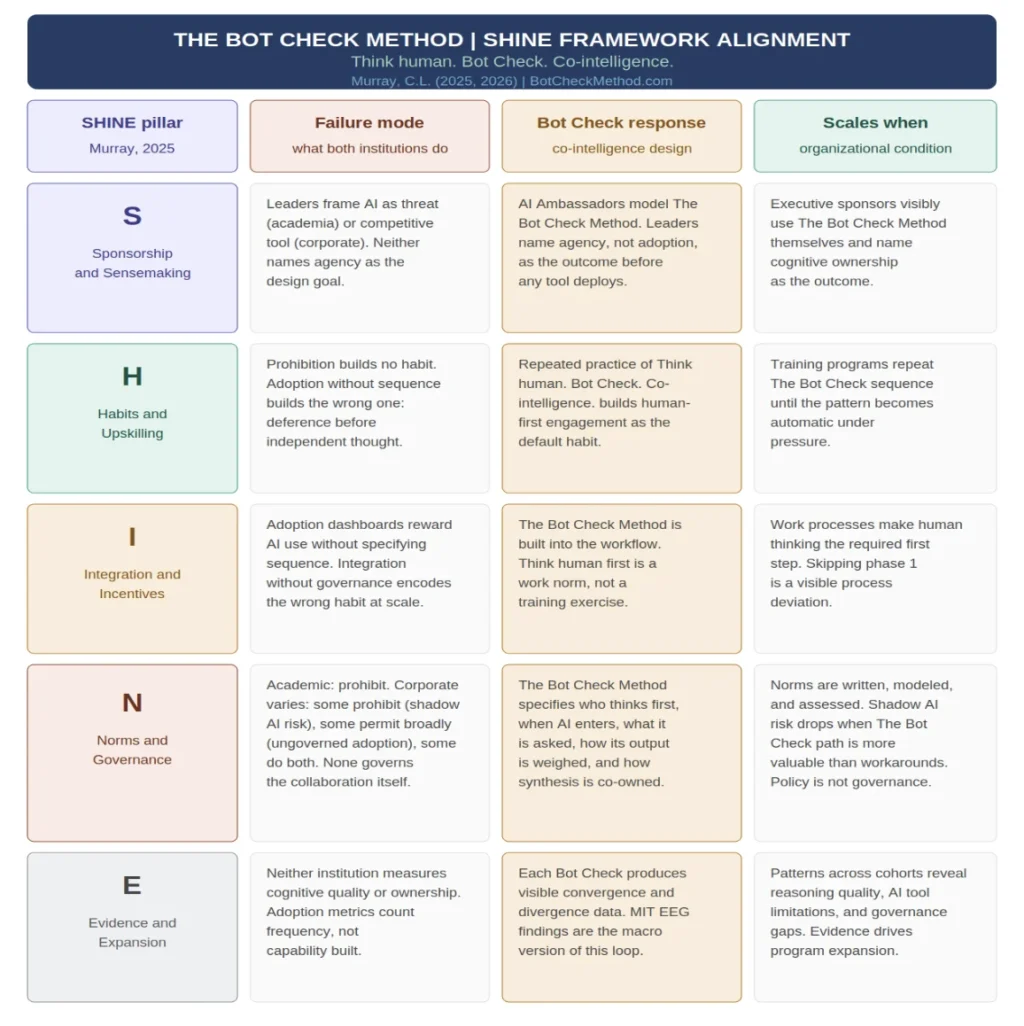
The integration of generative artificial intelligence into the pillars of modern society—academia and corporate America—has reached a critical inflection point where initial reactive policies are proving insufficient. While educational institutions have largely retreated into a posture of prohibition, corporate entities have charged forward with aggressive adoption mandates. New research from the MIT Media Lab, however, suggests that both extremes are failing to address a fundamental neurological risk: "cognitive debt." The emerging consensus among learning experts is that the solution lies not in the volume of AI use, but in the sequence of human-AI interaction. This shift from abstinence or unbridled adoption to a governed model of "agency" is now being codified through frameworks like the Bot Check Method and the SHINE governance model.
The Divergent Responses to the Generative AI Revolution
Since the public release of large language models (LLMs) in late 2022, two distinct and opposing philosophies have emerged regarding their use. In academia, the dominant response has been one of prohibition. Faculty and administrators, fearing the erosion of academic integrity, have invested heavily in AI detection software, revised honor codes, and redesigned assignments to make AI assistance detectable. This "abstinence-only" approach is driven by the concern that if a machine performs the synthesis of information, the student ceases to learn the fundamental skills of critical thinking and composition.
Conversely, corporate America has adopted a "get it in" strategy. Chief Learning Officers (CLOs) and talent development leaders are under immense organizational pressure to demonstrate AI fluency. Success is often measured through adoption dashboards, the number of employees trained on prompt engineering, and the speed at which AI tools are integrated into daily workflows. The underlying assumption is that rapid adoption is the only way to maintain a competitive edge in an AI-accelerated economy.
Both strategies, however, overlook the developmental impact on the human user. By focusing on whether AI is "in" or "out," leaders have failed to define what the human is supposed to be doing while AI is in the room. This lack of intentional design is leading to measurable neurological consequences.
The MIT Media Lab Study: Measuring Cognitive Debt
Groundbreaking research from the MIT Media Lab provides the first empirical evidence of the biological cost of outsourcing thought to AI. In a study titled "Your Brain on ChatGPT: Accumulation of Cognitive Debt when Using an AI Assistant for Essay Writing Task," lead researcher Nataliya Kosmyna and her team utilized EEG (electroencephalogram) caps to monitor the brain activity of 54 university students.
The participants were divided into three groups: those writing essays using ChatGPT, those using a standard search engine, and those using no digital tools. The findings, published in early 2025, revealed that students relying on ChatGPT exhibited significantly weaker brain connectivity across regions associated with memory and active problem-solving. In contrast, those working without AI tools showed the strongest and most distributed neural network activation.
Most alarmingly, the study identified a phenomenon the researchers termed "underengagement." When students who had previously used ChatGPT were asked to perform a task without it, their neural engagement remained depressed. Their brains had seemingly developed a habit of deferring cognitive labor, leading to what Kosmyna calls "cognitive debt"—the accumulated neurological cost of outsourcing thinking. This debt manifested behaviorally as well; AI users reported lower levels of "ownership" over their work and struggled to accurately recall or quote the very essays they had "written" with the tool.

The Chronology of AI Policy and the Rise of Shadow AI
The timeline of AI integration reveals why these current strategies are failing. Following the initial shock of late 2022, 2023 was defined by "The Great Ban" in schools and "The Great Pilot" in corporations. By 2024, it became clear that prohibition was failing in academia. Much like abstinence-only health education, banning AI did not stop the behavior; it merely drove it underground, away from the guidance of educators.
In the corporate sector, a parallel danger emerged: "Shadow AI." When organizations implement overly restrictive policies or fail to provide sanctioned, secure tools, employees do not stop using AI. Instead, they use personal accounts on personal devices to process company data. This creates a massive security vacuum where sensitive information—ranging from HR files and compensation data to proprietary trade secrets—is fed into consumer-grade models that lack enterprise-level data protection.
By 2025, the conversation has begun to shift from "if" AI should be used to "how" it should be sequenced. The realization is that the current binary of prohibition versus adoption is a false choice that ignores the necessity of human agency.
The Bot Check Method: A Four-Phase Sequence for Agency
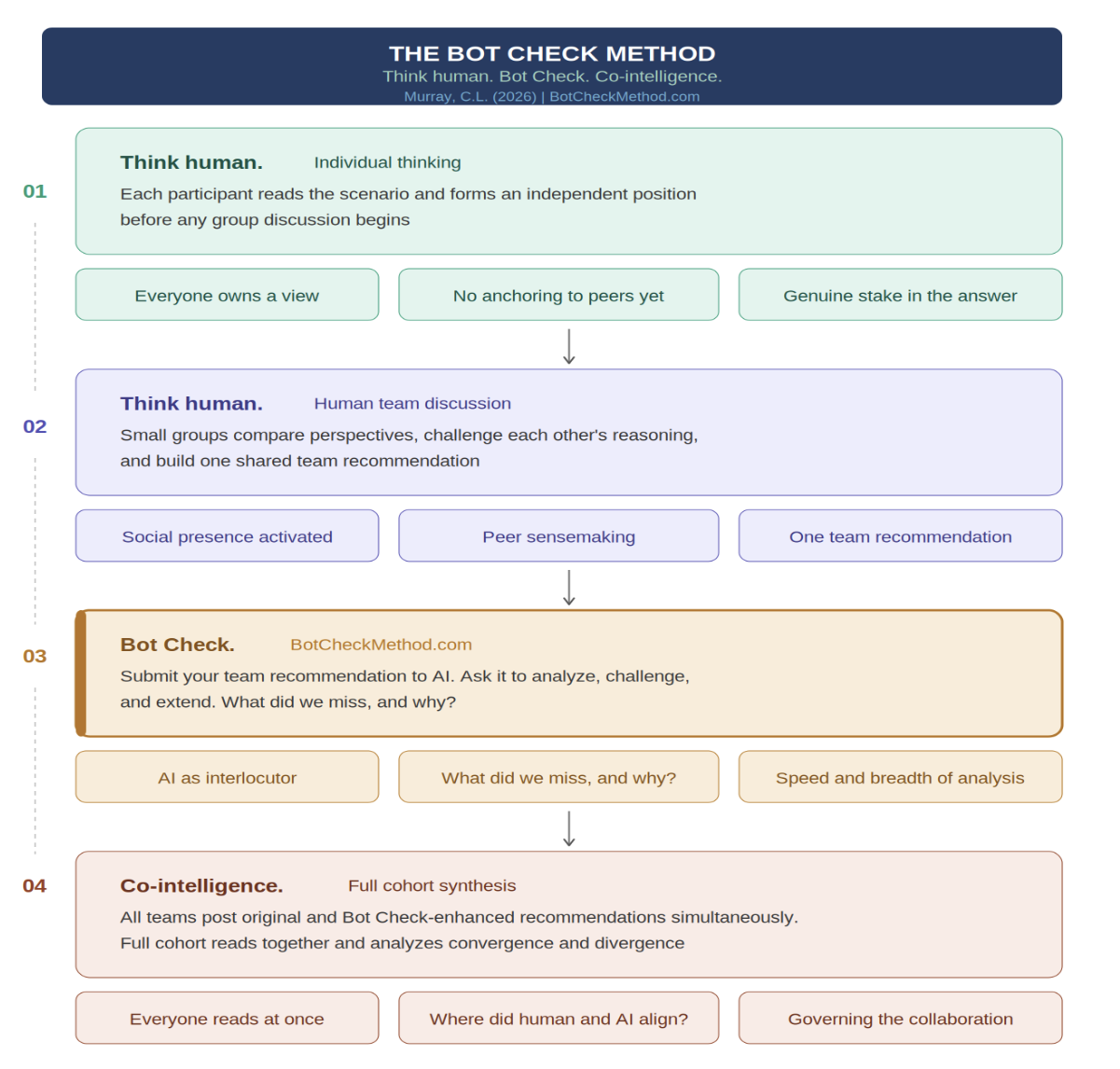
To bridge the gap between human intelligence and artificial assistance, learning designers are turning to the Bot Check Method. Developed and tested in both executive education and graduate-level classrooms, this method prioritizes human cognitive engagement before any AI consultation occurs. It is rooted in the "Community of Inquiry" (CoI) framework, which emphasizes that learning requires a sequence of triggering events, exploration, integration, and resolution.
Phase 1: Think Human (Individual Reflection)
Before engaging with a group or a bot, the individual must work through the problem alone. This "triggering event" ensures the user has a personal intellectual stake in the outcome. By forcing the brain to form its own initial patterns, it avoids the "underengagement" identified in the MIT study.
Phase 2: Think Human Together (Social Exploration)
The individual then brings their ideas to a peer group. This phase leverages "social presence" to challenge reasoning and build a shared recommendation. This collaborative human effort ensures that the logic is sound and the ownership is collective before external tools are introduced.
Phase 3: The Bot Check (AI as Interlocutor)
Only after the human team has a defensible position do they consult the AI. The tool is used not to provide the answer, but to "check" the human work. The team prompts the AI to find gaps, identify missing perspectives, or challenge their weakest assumptions. In this model, the AI is an interlocutor—a sparring partner—rather than an authoritative source.
Phase 4: Co-Intelligence (Synthesis)
The final phase involves the full group analyzing the divergence between the human-only work and the AI-enhanced work. This creates a "co-intelligence" that belongs to the humans, as they must decide which AI suggestions to integrate and which to reject.
Scaling Agency through the SHINE Framework
For organizations to move beyond pilot programs and into sustainable AI governance, the Bot Check Method must be supported by a broader architecture. The SHINE framework provides a roadmap for this transition:
- Sponsorship and Sensemaking: Leaders must act as "AI Ambassadors," modeling the Bot Check Method rather than just mandating tool usage. They must frame AI as a tool for enhancing, not replacing, human judgment.
- Habits and Upskilling: Training must move away from "prompt engineering" and toward "behavioral sequencing." The goal is to make "Think Human" the default habit before "Bot Check" begins.
- Integration and Incentives: Workflow designs must reward the process of human-AI collaboration. If an employee is only incentivized on speed, they will succumb to cognitive debt. Incentives must value the "agency" shown in the final output.
- Norms and Governance: Governance must evolve from a list of "don’ts" to a design for "how." This includes clear protocols for data security to eliminate the risks of Shadow AI.
- Evidence and Expansion: Organizations must build internal "evidence loops," similar to the MIT study, to measure how AI use is affecting team capability over time.
Analysis of Implications: The Future of Cognitive Capital
The implications of cognitive debt extend far beyond the classroom. If a generation of corporate leaders grows accustomed to outsourcing their strategic thinking, the "cognitive capital" of the organization—its ability to innovate and solve novel problems—will inevitably decline.
Industry analysts suggest that the next phase of the AI era will be defined by a "flight to quality" in human thought. As AI-generated content becomes a commodity, the value of independent, critical, and creative human thinking will increase. However, this capacity is a "muscle" that must be exercised. If the habit of deferring to AI becomes neurologically ingrained, the cost of "reclaiming" that thinking capacity may be prohibitively high.
Furthermore, the "Shadow AI" risk highlights a burgeoning legal and ethical frontier. Companies that fail to provide a structured, governed path for AI interaction are essentially operating without a data perimeter. The Bot Check Method provides a way to bring these interactions back into a sanctioned, visible environment where human agency and data security coexist.
Conclusion: A Commitment to Design
The journey from abstinence to agency is not a technological challenge, but a design challenge. The neuroscience is clear: introducing AI too early in the thinking process short-circuits the neural pathways required for deep learning and ownership.
For Chief Learning Officers and academic administrators, the mandate is now to move beyond the reactive policies of 2023 and 2024. The goal is to build a "Human Operating System" that uses AI to sharpen, rather than dull, the human mind. By adopting sequenced methods like the Bot Check and governance frameworks like SHINE, institutions can ensure that they are building capability rather than accumulating debt. The decision to design for the human before deploying the tool is the only way to navigate the complexities of the AI-augmented future.






