
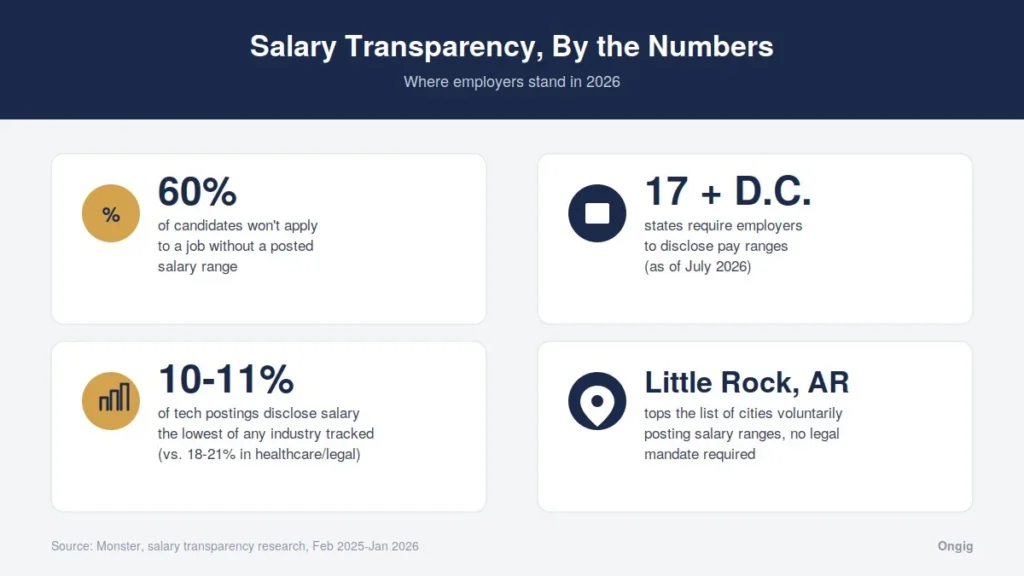
Salary transparency, once a progressive ideal, has unequivocally transitioned from a mere trend to a fundamental expectation in the modern employment landscape. As of mid-2026, the imperative for employers to disclose pay ranges is driven by both surging candidate demands and an accelerating wave of legislative mandates across the United States and globally. Data from Monster reveals a compelling statistic: a staggering 60% of U.S. workers will not even consider applying for a job that fails to list a salary range. This powerful preference indicates a fundamental shift in job seeker behavior, where transparency is now a non-negotiable filter. Simultaneously, the regulatory environment is tightening, with 17 states plus the District of Columbia now legally requiring employers to disclose pay ranges, a figure projected to grow further. This dual pressure from market forces and legal obligations means that concealing compensation figures is no longer a viable strategy but rather a significant compliance risk and a barrier to attracting top talent.
The Evolving Landscape of Pay Transparency
The journey towards pay transparency has been a gradual but persistent one, gaining significant momentum in the last decade. Historically, salary information was often shrouded in secrecy, seen as proprietary data that employers guarded closely. This opacity often contributed to systemic pay disparities, including gender and racial wage gaps, as candidates lacked the necessary information to negotiate effectively or identify inequitable practices. However, several factors converged to challenge this status quo. The rise of online communities and professional networks facilitated informal salary sharing, while a growing focus on diversity, equity, and inclusion (DEI) initiatives brought pay equity to the forefront of corporate social responsibility. The "Great Resignation" or "Great Renegotiation" era, sparked by the COVID-19 pandemic, further empowered job seekers, giving them greater leverage and accelerating the demand for clearer, upfront compensation details. This confluence of social awareness, technological advancements, and shifts in labor market dynamics has culminated in the current environment where transparency is not just desired, but demanded.
The Candidate’s Imperative: Why Transparency Drives Talent
The 60% rejection rate for jobs without listed salary ranges is a stark indicator of candidate priorities. In a competitive job market, candidates are increasingly discerning, seeking not just roles that match their skills but also those that align with their financial expectations and values. Posting salary ranges immediately signals an employer’s commitment to fairness and openness, fostering a sense of trust even before the first interview. This proactive disclosure saves time for both parties; candidates can self-select into roles where the compensation aligns with their needs, reducing the number of applications from individuals who would ultimately decline an offer due to salary. As Monster’s Career Expert Vicki Salemi notes, "Candidates are filtering out blind postings before they even open them." This behavior underscores a fundamental change in how talent approaches job searching – they are no longer willing to invest time in applications where the most critical information, compensation, remains hidden. This shift effectively redefines the baseline for recruitment, making transparency a prerequisite for engagement rather than a bonus.
A Legislative Tsunami: The Rise of Pay Transparency Laws
Beyond candidate preference, the legal framework for pay transparency is rapidly expanding. By July 2026, a significant portion of the U.S. workforce will be covered by state or district-level mandates. States like Colorado (since 2021), New York (since 2023), California (since 2023), and Washington (since 2023) have been at the forefront, implementing laws that require employers to disclose salary ranges in job postings. These laws vary in scope, with some applying to all employers, others to those above a certain size, and some requiring disclosure not just for external postings but also for internal promotions and transfers. The general direction, however, is clear and consistent: greater transparency is becoming a legal obligation.
This trend is not confined to the United States. The European Union, for instance, has introduced the EU Pay Transparency Directive, which aims to strengthen the application of the principle of equal pay for equal work or work of equal value. This directive, adopted in 2023, will require EU member states to implement measures such as mandatory pay gap reporting for larger companies and the right for job applicants to receive information about the initial pay range for a role. This global movement indicates a widespread recognition among policymakers that pay transparency is a critical tool for combating pay discrimination and promoting economic equity. For multinational corporations, this means navigating an increasingly complex web of local, national, and regional regulations, making a standardized, transparent approach to compensation a strategic necessity.
Employer Resistance: Unpacking the Hesitation
Despite the clear benefits and legal mandates, many employers continue to resist full salary transparency. This reluctance stems from several understandable, albeit increasingly outdated, concerns. One primary worry, as articulated by Vicki Salemi, is that publishing salary ranges "may limit their flexibility during salary negotiations." Employers often prefer to keep their options open, tailoring offers based on a candidate’s previous salary history or perceived value, a practice that pay transparency laws aim to curb. Another concern is that transparency "could give competitors insight into their comp packages," potentially leading to bidding wars for talent or revealing strategic compensation decisions.
However, Salemi points to a more fundamental and often more troubling reason for employer hesitation: internal pay inconsistencies. When internal compensation structures are not equitable or well-defined, disclosing external salary ranges can expose these disparities, leading to dissatisfaction among existing employees. As Salemi observes, "Employees may feel shortchanged if they see ranges above what they’re getting paid for a job they’ve done for years." This isn’t a problem created by transparency itself, but rather an existing pay problem that transparency merely brings to light. In states without mandates, the absence of transparency often indicates that pay equity simply isn’t a high-priority item for leadership, allowing existing inequities to persist unseen.
The Hidden Cost of Opacity: Internal Disparities Exposed
The fear of revealing internal pay gaps is a significant barrier for many organizations. It underscores a deeper issue within many companies: a lack of systematic, data-driven compensation frameworks. When salaries are set on an ad-hoc basis, influenced by factors like negotiation prowess, historical pay, or even unconscious bias, inconsistencies are inevitable. These inconsistencies can lead to feelings of unfairness, decreased morale, reduced productivity, and increased turnover among employees who discover they are paid less than peers for similar work.
When transparency laws compel disclosure, these underlying issues are brought into sharp focus. Rather than viewing transparency as the problem, forward-thinking organizations recognize it as an opportunity. Salemi emphasizes this point: "Salary transparency doesn’t create inequities. Instead, it shines a spotlight on them." The "fear of fines or just fear of the work involved" in auditing compensation and rectifying gaps often paralyzes employers. However, the long-term costs of ignoring these issues – including potential lawsuits, reputational damage, and difficulty attracting talent – far outweigh the effort required to establish a fair and consistent pay structure. Addressing these internal inequities proactively, before they are exposed by external transparency, builds a stronger, more resilient, and more equitable workforce.
Where Transparency Thrives and Where It Lags
Despite the legislative push, the actual implementation of pay transparency varies significantly across industries and geographies. Monster’s analysis of job postings between February 2025 and January 2026 revealed that even in the most transparent sectors, there’s considerable room for improvement. Tech, an industry often lauded for its progressive practices, lags significantly, with only 10-11% of job postings disclosing salary ranges. This trails behind sectors like healthcare and legal, which, while still far from universal, show rates of 18-21%. These figures suggest that roughly four out of five job postings, even in the "leading" industries, still omit pay information.
Interestingly, voluntary adoption of salary transparency appears higher in certain mid-size markets without active pay transparency laws. Cities like Little Rock, Virginia Beach, and Topeka often rank higher in voluntary disclosure. This phenomenon can be attributed to these markets’ strategic efforts to compete for talent with larger, more established metros. By proactively adopting transparency, these cities aim to differentiate themselves, attract skilled workers, and foster a more competitive local economy. This suggests that even without legal mandates, market forces can drive transparency when employers recognize its value in talent acquisition.
Beyond the Numbers: The Nuances of Global and Remote Compensation
The challenge of pay transparency is further complicated by the rise of remote work and the globalized talent pool. The original article highlights a critical, "quieter version of the transparency problem" that Monster’s data doesn’t fully capture: the disparity in pay for the "same job" across different geographies and company types. For instance, a software developer in Manila or Bangalore might perform the exact same functions as a developer in San Francisco, yet their compensation packages would differ dramatically due to local market rates. While both might consider their respective offers "fair" within their own economic context, a single posted range struggles to reconcile these vastly different realities.
This issue is exacerbated by factors like company funding and maturity. A startup, dependent on venture capital, might offer a compensation package heavily weighted towards equity, with a lower base salary, or a stringent total compensation depending on its funding stage. In contrast, well-established tech giants like Google can afford to offer significantly higher base salaries and more robust benefits, enabling them to poach top-tier talent. Salary history bans, while a step in the right direction, address only one facet of this problem by preventing employers from anchoring new offers to a candidate’s past earnings. They do not, however, account for geographical differences or the varying financial structures of companies. This means that a posted salary range, while making the "floor visible," does not eliminate the complexities of negotiation or the multiple "markets" that now exist for a single role.
Strategic Imperatives for Employers: Navigating the New Normal
For employers ready to embrace voluntary pay transparency or comply with legal mandates, a structured approach is essential. Vicki Salemi recommends three critical steps:
- Establish Consistent Salary Bands Based on Market Data and Internal Equity: This is the foundational step. Companies must conduct thorough compensation audits, leveraging market data to benchmark roles and ensuring internal equity by comparing similar roles and responsibilities within the organization. This process helps create defensible salary ranges that are fair, competitive, and consistent.
- Regularly Review and Update Compensation Structures: Market conditions, inflation, and talent demands are constantly evolving. Compensation bands should not be static. Regular reviews, ideally annually or semi-annually, ensure that ranges remain competitive and relevant.
- Communicate Transparently with Employees: Beyond just posting ranges, employers should educate their workforce on how compensation decisions are made, what factors influence pay, and how internal pay bands are structured. This open dialogue builds trust and helps employees understand their career progression and earning potential within the company.
Scaling Transparency: Leveraging Technology for Compliance and Consistency
The challenge of maintaining accurate and consistent salary ranges across hundreds or thousands of job postings, multiple locations, and various job boards quickly becomes insurmountable with manual processes. A recruiter might update one posting but forget others, or a range accurate in January becomes stale by June. This operational complexity means that simply having a "policy" for transparency does not equate to actual "compliance" or consistency.
This is where technology becomes indispensable. Solutions like Ongig’s Text Analyzer address the scalability problem by automating the identification and updating of salary information. Such tools can:
- Flag Missing or Outdated Ranges: Automatically detect when a job posting lacks a required salary range or when an existing range falls outside established internal bands or current market rates.
- Suggest Compliant Ranges: Provide AI-driven suggestions for appropriate salary ranges based on market data, internal compensation structures, and relevant legal requirements.
- Automate Updates Across Platforms: Push consistent updates across all job boards and internal systems from a central dashboard, ensuring uniformity and compliance without manual intervention.
Beyond mere compliance, consistent pay transparency significantly enhances the quality of the candidate pipeline. Ongig’s own mini-experiment on salary range visibility demonstrated that posting a range consistently not only attracted more applicants but also drew in "better-aligned ones." This means reduced time-to-hire, fewer unqualified applicants, and a higher likelihood of offers being accepted, ultimately optimizing recruitment efforts and minimizing wasted resources.
The Broader Impact: Trust, Equity, and the Future of Work
The bottom line for salary transparency in 2026 is clear: it is no longer optional. States are catching up to candidate expectations, and international directives like the EU Pay Transparency Directive are setting new global standards. The choice for employers is straightforward: proactively build a robust, transparent compensation framework for both new hires and current employees, or continue to hide pay information, risking legal penalties, damaging employer brand, and alienating top talent.
The first option—embracing transparency—offers substantial benefits. It fosters a culture of trust and fairness, which are increasingly important drivers of employee engagement and retention. It directly addresses issues of pay equity, reducing gender and racial wage gaps and promoting a more diverse and inclusive workforce. It strengthens an organization’s employer brand, positioning it as a progressive and ethical employer. In essence, pay transparency moves beyond a compliance checklist; it becomes a strategic advantage in the fierce competition for talent.
For organizations hiring at scale, achieving and maintaining pay transparency and compliance across all postings is no longer a manual task. Leveraging advanced technological solutions will be crucial for navigating this evolving landscape effectively, ensuring that job postings are not only compliant but also optimized to attract the best-aligned talent.
FAQs on Salary Transparency
1. Why do some employers still avoid listing salary ranges?
Common concerns include a desire to maintain flexibility in salary negotiations, fear of revealing competitive information about compensation strategies to rivals, and a significant worry about exposing internal pay inconsistencies among current employees. Vicki Salemi of Monster points out that in jurisdictions without legal mandates, transparency is often simply not a priority, allowing companies to avoid addressing these underlying issues.
2. Which industries and cities lead in voluntary salary transparency?
While overall adoption remains relatively low, Monster’s data shows that mid-size markets without active legal mandates, such as Little Rock, Virginia Beach, and Topeka, often rank highest for voluntary disclosure. These cities frequently use transparency as a competitive tool to attract talent from larger metros. Industrially, sectors like healthcare and legal slightly lead the tech industry, disclosing salaries in approximately 18-21% of postings, compared to tech’s 10-11%.
3. How can employers keep salary ranges accurate across hundreds of job postings?
Manually updating salary ranges across numerous job postings, varying locations, and different job boards is inefficient and prone to error, causing ranges to quickly become outdated. Technological solutions, such as Ongig’s Text Analyzer, automate this process. They can automatically flag missing or outdated salary information, suggest compliant ranges based on current market data and internal equity, and push consistent updates across all platforms in a single step, ensuring continuous compliance and accuracy.






