
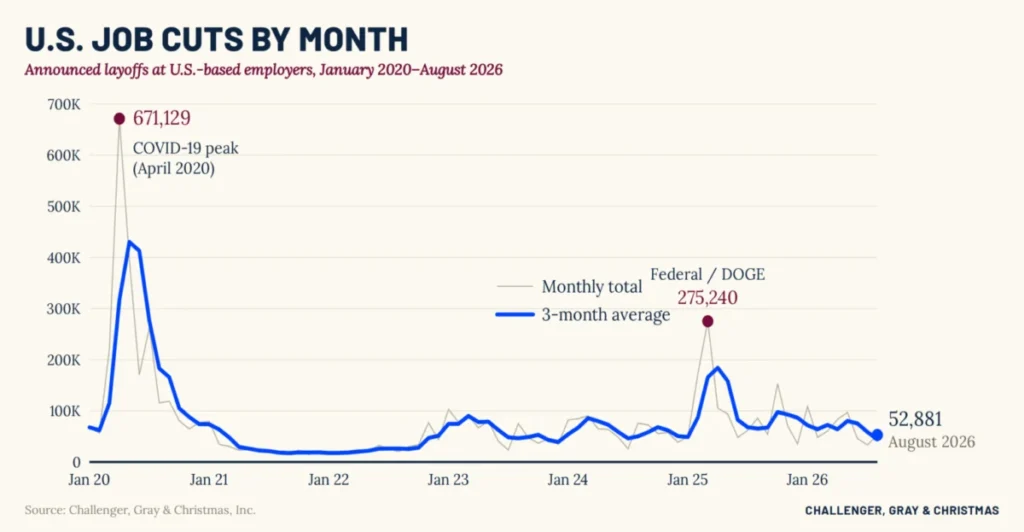
A new report from executive coaching firm Challenger, Gray & Christmas has unveiled a complex and often contradictory picture of the U.S. labor market, indicating a significant month-over-month spike in layoffs in August, yet simultaneously revealing a notable moderation in job cuts when viewed through a year-over-year lens and a surge in hiring plans. This intricate scenario underscores the ongoing recalibration within various industries as businesses navigate persistent economic uncertainties, evolving consumer behaviors, and the lingering effects of post-pandemic adjustments. The findings present a challenging interpretative landscape for economists, policymakers, and human resources professionals alike, highlighting pockets of vulnerability alongside surprising resilience and growth.
According to the firm’s latest monthly jobs report, released on Thursday, August saw a total of 52,881 job cuts across the nation. This figure represents a substantial 58% increase from the previous month’s total, stirring concerns about renewed corporate belt-tightening. However, a deeper dive into the data reveals a more nuanced reality. When compared to August of the previous year, job cuts were actually down by a significant 38%, marking the lowest August rate observed since 2022. This paradox is further emphasized by the fact that this is the sixth instance this year where monthly job cuts have registered lower than those recorded in the corresponding month of the previous year, suggesting that while month-to-month volatility persists, the overall trend of mass layoffs may be decelerating from earlier peaks.
Andy Challenger, a workplace expert and chief revenue officer at Challenger, Gray & Christmas, contextualized these findings, stating, "This is the quietest August since 2022 in terms of overall job cuts, though it generally aligns with the average for the month seen since the mid-2010s. What we’re witnessing is a market in constant flux, where certain sectors are experiencing rapid adjustments while others demonstrate stability or even growth." This perspective challenges a simplistic interpretation of the headline numbers, urging a closer examination of the underlying dynamics shaping the labor landscape.
Dissecting the August Job Cut Data
The 58% surge in layoffs from July to August, reaching 52,881, demands a detailed analysis of the sectors most affected. While the report indicates "Consumer Products" and "Food" industries as leading the charge in job cuts, this often reflects a broader trend of companies adjusting to shifts in consumer demand, inventory management challenges, and supply chain optimizations. For instance, the consumer products sector might be grappling with inflationary pressures impacting discretionary spending, while the food industry could be facing increased operational costs, automation pressures, or evolving dietary preferences.
Historically, August has often been a month of strategic workforce adjustments for many corporations, preceding the final quarter of the year. Companies frequently evaluate performance, streamline operations, and prepare for holiday season demands or year-end financial reporting. This seasonal pattern, however, doesn’t fully explain the magnitude of the month-over-month increase, suggesting that current economic headwinds are playing a more prominent role. Analysts point to persistent inflation, which, despite showing signs of moderation, continues to squeeze corporate profit margins and consumer purchasing power. The cumulative effect of interest rate hikes by the Federal Reserve, aimed at taming inflation, has also elevated borrowing costs for businesses, potentially deterring expansion and leading to cost-cutting measures, including layoffs.
Further breaking down the August figures, while the overall number of cuts was substantial, the distribution across industries was uneven. Beyond consumer products and food, other sectors experienced varying degrees of workforce reductions. Technology, which saw a wave of layoffs earlier in the year stemming from over-hiring during the pandemic boom, continued to make adjustments, albeit at a slower pace than its peak. Financial services also exhibited some caution, reflecting anxieties in the housing market and broader investment climate. Conversely, sectors like healthcare and government generally demonstrated more stability, often driven by consistent demand for essential services.
The Paradox of Robust Hiring Plans
Adding another layer of complexity to the labor market narrative are the concurrent hiring intentions reported by employers. Alongside the reduction in year-over-year job cuts, hiring plans have shown significant strength. Employers surveyed by Challenger, Gray & Christmas indicated intentions to hire 12,325 people last month. This figure represents an astonishing 725% increase from the previous August, marking the highest hiring total for August in four years. Such a dramatic surge in planned hiring acts as a powerful counter-narrative to the layoff figures, painting a picture of an economy that, while shedding jobs in some areas, is aggressively seeking to add talent in others.
However, even within this positive hiring trend, important nuances emerge. The report notes that this rate is down 23% from July’s hiring plans, suggesting that hiring momentum, while strong year-over-year, might be experiencing its own month-to-month fluctuations. More critically, the hiring activity is highly concentrated, with nearly half of the announced new positions slated for manufacturing industries. This concentration points to several potential drivers:
- Reshoring and Nearshoring Initiatives: Government incentives and a renewed focus on supply chain resilience have encouraged companies to bring manufacturing back to domestic shores or closer to home, creating a demand for skilled labor.
- Infrastructure Investment: Significant governmental investments in infrastructure projects, from roads and bridges to renewable energy, are fueling demand in construction, engineering, and related manufacturing sectors.
- Technological Advancements: The adoption of advanced manufacturing techniques, automation, and robotics requires a new generation of skilled workers to design, operate, and maintain these systems.
- Defense and Aerospace: Geopolitical developments often lead to increased spending in defense-related manufacturing, contributing to job growth.
Andy Challenger highlighted the inherent challenges in this concentrated hiring boom: "Employers are clearly making plans to add workers, particularly in critical sectors like manufacturing. The questions, however, are how long will it take employers to actually fill these roles, and will they find workers with the requisite skills?" This statement underscores the persistent issue of the skills gap, where available talent does not always match the specific demands of open positions, potentially slowing down hiring despite strong intentions.
Broader Economic Context: Navigating a Tightrope
The mixed signals from the Challenger report are reflective of a broader economic environment characterized by persistent uncertainty and a delicate balancing act. The Federal Reserve’s aggressive monetary policy, which has seen interest rates climb to multi-decade highs, aims to cool demand and bring inflation back to its 2% target. While inflation has shown signs of easing, it remains above the target, forcing the Fed to maintain a cautious stance. This high-interest rate environment increases the cost of capital for businesses, impacting investment decisions, expansion plans, and ultimately, hiring and layoff strategies.
Consumer spending, a critical engine of the U.S. economy, remains robust but shows signs of strain. While services spending has largely rebounded, goods consumption has been more volatile. High energy prices, elevated housing costs, and the dwindling of pandemic-era savings are all factors that could temper future consumer demand, directly impacting industries like retail and consumer products, which are already seeing job cuts.

Globally, economic headwinds also play a role. Slowdowns in major economies like China and Europe, coupled with ongoing geopolitical tensions and supply chain vulnerabilities, contribute to a cautious outlook for many multinational corporations. These external factors can lead companies to adopt more conservative workforce strategies, impacting both domestic and international operations.
Historical Perspective and Chronology of Trends
To fully appreciate the current state, it’s useful to place the August report in a historical context. The period immediately following the initial COVID-19 lockdowns saw unprecedented job losses, followed by a rapid, if uneven, recovery. 2021 and early 2022 were characterized by a robust labor market, with record low unemployment and significant wage growth. However, by late 2022 and early 2023, as inflation surged and the Federal Reserve began its aggressive rate hikes, several sectors, particularly technology, finance, and real estate, initiated significant layoff rounds. Companies that had over-hired during the pandemic’s digital acceleration phase began to rightsizing their workforces.
The "lowest August rate since 2022" for job cuts suggests a deceleration from the peak layoff intensity observed earlier this year. For instance, some months in early 2023 saw job cut figures exceeding 100,000, driven largely by the tech sector. The current August figure, while higher month-over-month, signifies a potential move towards a more stabilized, albeit still dynamic, labor market. Historically, periods of economic transition often present such conflicting data, where older industries contract or adjust, while newer or strategic sectors expand. The mid-2010s reference point by Andy Challenger indicates that the current August figures, despite the monthly spike, are not entirely anomalous in a long-term view, suggesting a return to more typical cyclical adjustments rather than a full-blown economic downturn.
Expert Commentary and Analysis
Economists and labor market analysts largely concur that the current environment is one of "selective growth" or a "K-shaped recovery," where certain industries and demographics thrive while others face significant challenges. Dr. Elena Rodriguez, a senior economist at a prominent think tank, commented, "What we’re observing is a rebalancing act. The tech sector, for example, is moving past its post-pandemic correction, while manufacturing is experiencing a renaissance driven by strategic investments. The aggregate numbers can be misleading; it’s the underlying sectoral shifts that tell the true story." She further emphasized the importance of distinguishing between cyclical layoffs, often temporary responses to economic downturns, and structural changes, which represent more permanent shifts in industry composition or skill demands.
Another perspective comes from Sarah Chen, a labor market analyst specializing in workforce development. She notes, "The concentration of hiring in manufacturing highlights a critical opportunity but also a challenge. While these jobs are vital, they often require specialized training. The disconnect between available skills and employer needs remains a bottleneck. Companies need to invest more in internal training and upskilling programs, and educational institutions must align curricula with industry demands." This underscores the broader implications for workforce development and talent pipelines.
The role of artificial intelligence and automation is also a growing point of discussion. While not explicitly mentioned as a primary driver of current layoffs, the long-term impact of these technologies on job displacement and creation is undeniable. Companies are increasingly investing in automation to boost efficiency and reduce labor costs, which could lead to further structural changes in the workforce composition over time.
Implications for Workers and Employers
For workers, the report presents a mixed bag. Those in sectors experiencing growth, particularly manufacturing, may find ample opportunities, potentially with competitive wages and benefits. However, workers in industries undergoing contraction or significant restructuring might face increased job insecurity, longer job search durations, and the necessity to re-skill or relocate. The importance of continuous learning and adaptability has never been greater. The "skills gap" is not merely an employer’s problem; it’s a worker’s imperative to remain relevant in a rapidly evolving job market.
For employers, the report emphasizes the ongoing challenge of talent acquisition and retention. Despite the monthly layoff figures, many companies still struggle to find qualified candidates for open positions, especially in specialized fields. This tight labor market, particularly for skilled roles, means that employers must refine their recruitment strategies, enhance their employee value proposition, and invest in robust training and development programs. Workforce planning becomes paramount, requiring a forward-looking approach to anticipate skill needs and potential labor shortages. Balancing the need for cost control with the imperative to attract and retain top talent will remain a critical strategic challenge.
Outlook and Forward-Looking Statements
Looking ahead, the U.S. labor market is expected to remain dynamic and potentially volatile. The Federal Reserve’s future policy decisions, particularly regarding interest rates, will continue to exert significant influence. Should inflation continue to moderate, the Fed might pause or even cut rates, potentially stimulating economic activity and job creation. Conversely, a resurgence in inflationary pressures could lead to further tightening, increasing the risk of a more pronounced economic slowdown and higher layoff numbers.
The manufacturing sector’s robust hiring plans offer a beacon of optimism, suggesting that strategic industrial policies and investment are beginning to bear fruit. However, the broader economy’s resilience will depend on a sustained improvement in consumer confidence, stable energy prices, and a more predictable global economic environment. The next few months will be crucial in determining whether the current mixed signals coalesce into a clear trend of sustained growth or whether the economy is headed for a more challenging period. Policy discussions around immigration, education, and vocational training will also become increasingly vital in addressing the structural imbalances between labor supply and demand.
In conclusion, the latest Challenger, Gray & Christmas report paints a portrait of a labor market in transition. While the month-over-month spike in August layoffs warrants attention, it must be viewed within the context of a longer-term moderation in job cuts and an encouraging surge in hiring intentions, particularly in the manufacturing sector. The inherent complexities underscore the need for a nuanced understanding of economic indicators, adaptability from both workers and employers, and strategic foresight from policymakers to navigate the intricate path ahead.








