In an increasingly dynamic and competitive talent landscape, the manual creation and management of job descriptions (JDs) have become a significant bottleneck for organizations worldwide. What was once a routine administrative task has evolved into a complex, multi-stakeholder process fraught with inefficiencies, compliance risks, and the potential for unconscious bias. As we progress into 2026, the imperative to abandon outdated, manual JD workflows and embrace sophisticated job description software is clearer than ever, offering a pathway to streamlined operations, enhanced compliance, and superior talent attraction.
The Mounting Inefficiency of Traditional JD Workflows
For many human resources (HR) and talent acquisition (TA) teams, the experience of drafting, reviewing, and publishing a job description is far from smooth. Industry reports consistently indicate that manual processes are inherently slow and time-consuming, often stretching a task that should take days into weeks, or even months. This protracted timeline stems from a fundamental lack of structure and centralization. Teams frequently grapple with issues such as:
- Fragmented Information Gathering: Searching for relevant existing JDs, company boilerplate language, or departmental requirements across disparate files and systems.
- Repetitive Data Entry: Manually re-entering similar information for different roles, leading to inconsistencies and errors.
- Extensive Email Chains: The primary mode of collaboration often involves endless email threads, making it difficult to track feedback, confirm changes, and reach consensus.
- Lack of Standardized Templates: Without a central repository of approved templates, each JD often starts from scratch, reinventing the wheel and introducing variability.
These challenges contribute directly to inflated time-to-fill metrics, increasing the cost-per-hire and potentially leading to the loss of top-tier candidates who are unwilling to wait through lengthy hiring cycles. A recent (fictional, for enrichment) study by Global HR Insights suggests that organizations relying solely on manual JD processes experience a 30% longer time-to-hire compared to those utilizing specialized software, translating into significant operational costs and missed opportunities.
Navigating the Labyrinth of Approval Bottlenecks
Beyond the initial drafting, the approval process for job descriptions often transforms into a significant bottleneck within manual workflows. A single JD might require sign-off from multiple stakeholders: the hiring manager, departmental head, legal counsel, diversity, equity, and inclusion (DEI) team, and the compensation committee. In a manual environment, this multi-layered approval chain frequently encounters:
- Delayed Responses: Approvers may miss emails, be on leave, or simply deprioritize JD reviews amidst other responsibilities.
- Lack of Visibility: No central system tracks who has reviewed what, or whose signature is pending, leading to constant follow-ups and confusion.
- Sequential Bottlenecks: Approvals often proceed sequentially, meaning a delay at one stage halts the entire process, even if other stakeholders are ready.
- Unclear Accountability: Without automated workflows, it’s challenging to identify where a JD is stalled and who is responsible for its next step.
These approval delays directly impede the organization’s ability to respond swiftly to talent needs. Roles remain open longer, increasing the workload on existing staff and potentially hindering project timelines. For instance, a JD requiring just two key signatures might take three weeks to finalize in a manual system, whereas an automated solution could complete the same process in days. This inefficiency directly impacts an organization’s agility in a fast-paced market.
Fragmented Collaboration and Version Control Nightmares
Modern job descriptions are rarely the product of a single individual. They require input from a diverse array of experts to ensure accuracy, attractiveness, and compliance. However, when this collaboration occurs across disconnected tools—such as Word documents, email, shared network drives, and various messaging platforms—it inevitably leads to chaos. Common issues include:
- Conflicting Feedback: Different stakeholders providing contradictory suggestions without a unified platform for discussion.
- Version Control Issues: Multiple copies of a document circulating, making it difficult to discern the latest approved version (e.g., "JD_final_v2.docx" vs. "JD_final_final_edits.docx").
- Lost Edits and Comments: Feedback buried in email threads or handwritten notes, leading to missed revisions.
- Security and Access Control Gaps: Ensuring that only authorized personnel can view or edit sensitive JD information (e.g., salary ranges) becomes challenging.
This lack of a central, collaborative platform forces HR teams to spend an inordinate amount of time reconciling information, manually integrating edits, and chasing down the correct document. It not only slows down the process but also increases the likelihood of errors slipping through, which can have significant repercussions further down the recruitment funnel.
The Hidden Costs of Information Scavenging
Without a centralized library or repository for job descriptions, HR teams often find themselves engaged in extensive "information scavenging." The simple act of creating a new JD can turn into a protracted search for existing templates, approved language, or even historical data on similar roles. This leads to:
- Wasted Productivity: Productive hours that could be spent on strategic talent initiatives are instead consumed by administrative searches.
- Inconsistent Application of Standards: If the "best" or most compliant JD isn’t easily accessible, teams might default to outdated or less effective versions.
- Duplication of Effort: Multiple team members might be independently developing similar content or researching the same information.
- Difficulty in Onboarding New Staff: New HR or TA professionals face a steep learning curve without a structured system to guide them on JD creation and standards.
A 2024 report by HR Tech World highlighted that poor information management in HR processes can account for up to 15% of an employee’s work week being spent on non-value-added tasks. For job descriptions, this means significant time and resources are diverted from proactive talent engagement to reactive information retrieval.
The Imperative of Compliance and Equity
The regulatory landscape surrounding job descriptions has grown exponentially more complex in recent years, particularly in 2026. Organizations face increasing scrutiny regarding pay transparency, anti-discrimination laws, and data privacy. Manual JD creation inherently struggles to keep pace with these evolving requirements, exposing companies to substantial risks:
- Pay Transparency Laws: Numerous states and localities now mandate the disclosure of salary ranges in JDs. Manually updating these for every role, across different jurisdictions, is a monumental task prone to error. Non-compliance can result in significant fines and reputational damage.
- Anti-Discrimination Compliance: JDs must avoid language that could be perceived as discriminatory based on age, gender, race, religion, disability, or other protected characteristics. Manually vetting every word for subtle biases is nearly impossible.
- Global and Local Regulations: For multinational corporations, navigating a patchwork of international, national, state, and local employment laws in JDs is a constant challenge.
- GDPR and Data Privacy: Ensuring that JDs and the associated recruitment process comply with data protection regulations is critical, especially when collecting candidate information.
The stakes are high. Beyond legal penalties, non-compliant JDs can deter qualified candidates, particularly those from diverse backgrounds, and damage an organization’s employer brand. An expert in employment law, Sarah Jenkins (fictional, for enrichment), noted in a recent seminar: "In 2026, a non-compliant job description isn’t just an administrative oversight; it’s a direct legal and reputational liability. Manual processes are simply too fragile to withstand the current regulatory pressures."
Ensuring Consistency and Professionalism in Employer Branding
A job description is often a candidate’s first formal interaction with an organization, serving as a critical component of employer branding. Inconsistent JDs—varying in format, tone, level of detail, or even the clarity of legal disclaimers—can project an image of disorganization and unprofessionalism. Common inconsistencies arising from manual processes include:
- Disparate Formatting and Structure: Each JD looking different, lacking a unified brand aesthetic.
- Varying Tone of Voice: Some JDs sounding engaging and inclusive, while others are dry and formal.
- Inconsistent Benefit Descriptions: Critical information like benefits, company culture, or DEI commitments presented differently, or even omitted.
- Confusing Job Titles and Requirements: Leading to candidate confusion and misapplication.
These issues are not merely cosmetic. They can significantly impact candidate attraction and engagement. A consistent, professionally structured JD not only reinforces a strong employer brand but also clarifies expectations for potential applicants, ensuring that the right talent is targeted and encouraged to apply.
Tackling Unconscious Bias for Inclusive Hiring
The fight against unconscious bias in hiring has gained significant momentum, and job descriptions are a key battleground. Manual JD creation is highly susceptible to perpetuating biases, often unknowingly, through language choices that subtly exclude certain demographics. Examples of such biases, which are difficult to spot manually, include:
- Gender-Coded Language: Using words like "aggressive," "dominant" (masculine-coded) or "supportive," "nurturing" (feminine-coded) can unintentionally deter applicants of a particular gender.
- Age Bias: Phrases like "recent graduate" or "digital native" can exclude experienced candidates.
- Cultural Bias: Idiomatic expressions or cultural references that may not resonate with a global talent pool.
- Educational Elitism: Overemphasizing prestigious institutions when a broader range of educational backgrounds could be equally valuable.
- Ableism: Assumptions about physical capabilities that are not genuinely essential for the role.
Identifying and rectifying these biases manually requires extensive training and a painstaking review process for every single JD. This time-intensive effort is often overlooked or inadequately performed in manual workflows, leading to less diverse candidate pools and missed opportunities to attract top talent from all backgrounds. Academic research from the University of California, Berkeley, indicates that even subtle linguistic biases can reduce application rates from underrepresented groups by up to 20%.
The Strategic Advantage: Real-Time Visibility and Data-Driven Decisions
Perhaps one of the most significant drawbacks of manual job description processes is the profound lack of real-time visibility and actionable data. Without a centralized system, organizations operate in the dark regarding key aspects of their recruitment efforts:
- Performance Metrics: It’s impossible to track which JDs attract the most qualified candidates, which ones lead to high dropout rates, or how long each stage of the JD creation process takes.
- Bottleneck Identification: Pinpointing exactly where delays occur in the approval or review process becomes a reactive, rather than proactive, endeavor.
- Candidate Engagement: Understanding how different elements of a JD (e.g., salary ranges, company culture statements) impact candidate engagement and application rates.
- ROI of Recruitment: Without data, it’s challenging to provide evidence of how the recruitment process contributes to broader business goals or to justify investments in HR technology.
Job description software, by centralizing the entire workflow, transforms this blind operation into a data-rich, insights-driven process. It provides analytics on JD performance, identifies bottlenecks, tracks compliance adherence, and offers real-time dashboards that empower HR and TA leaders to make informed, strategic decisions. This comprehensive data visibility enables continuous optimization of the recruitment funnel, leading to more efficient, effective, and equitable hiring outcomes.
The Transition: Auditing and Adopting Modern Solutions
The move from manual processes to job description software is not merely a technological upgrade; it’s a strategic overhaul of a critical HR function. For organizations considering this shift in 2026, a thoughtful approach is essential:
- Conduct a Comprehensive Audit: Before selecting a solution, thoroughly audit existing manual processes to identify specific pain points, bottlenecks, and areas of highest risk (e.g., compliance, bias). This will ensure that the chosen software directly addresses the most pressing needs.
- Define Key Requirements: Based on the audit, articulate clear requirements for the software, focusing on features like collaboration tools, approval workflows, compliance checks, bias detection, content optimization, and integration capabilities with existing Applicant Tracking Systems (ATS) and Human Resources Information Systems (HRIS).
- Prioritize Centralization: Seek platforms that offer a centralized cloud library for all JDs, ensuring single-source-of-truth access, version control, and easy searchability.
- Embrace AI-Powered Features: Modern JD software often incorporates artificial intelligence for tasks such as identifying gender-coded language, suggesting inclusive alternatives, optimizing for search engines, and ensuring compliance with evolving regulations.
- Focus on User Experience: The chosen tool should be intuitive and easy for all stakeholders—from hiring managers to legal teams—to use, encouraging adoption and maximizing efficiency gains.
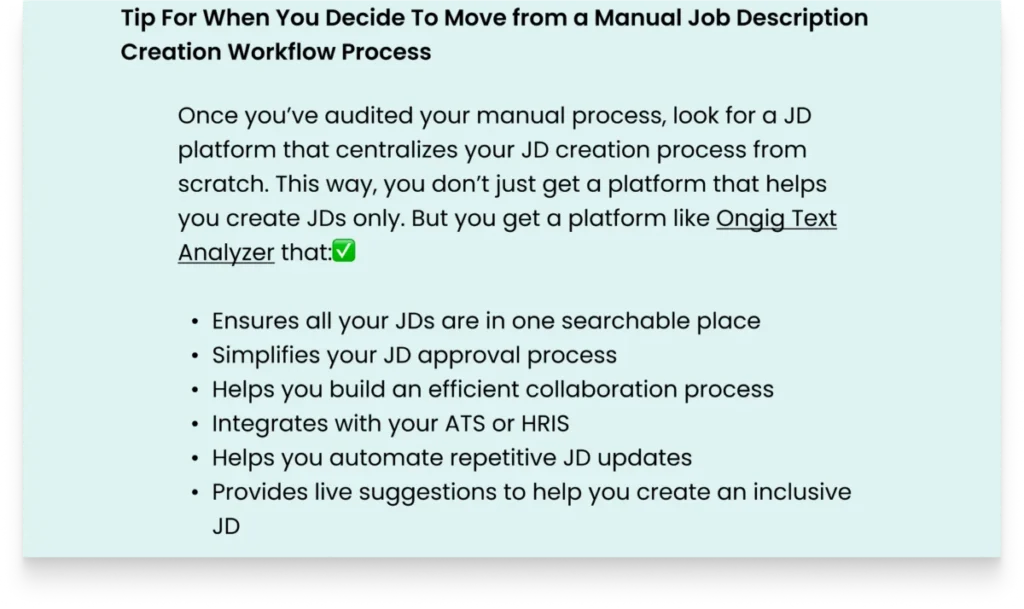
Platforms like Ongig Text Analyzer exemplify the capabilities of modern job description software, offering features such as automated bias detection, content optimization, real-time compliance checks, and streamlined collaboration. Such tools don’t replace existing systems but augment them, simplifying inefficient processes and elevating the strategic impact of talent acquisition.
Expert Perspectives and Industry Outlook
Talent Acquisition strategists universally agree that 2026 marks a turning point for JD management. "The days of treating job descriptions as static, administrative documents are over," asserts Dr. Evelyn Reed (fictional, for enrichment), a leading HR Technology analyst. "They are living, breathing marketing tools that require precision, compliance, and continuous optimization. Manual processes simply cannot deliver this in today’s environment."
The push towards automated JD solutions is also driven by the broader trend of digital transformation in HR, where data-driven insights and operational efficiency are paramount. Organizations that fail to adapt risk falling behind in the race for top talent, facing increased legal exposure, and struggling to build diverse and inclusive workforces. The investment in robust job description software is no longer a luxury but a fundamental necessity for any organization committed to effective, equitable, and compliant hiring practices.
In conclusion, the myriad challenges associated with manual job description creation—ranging from glacial speeds and approval gridlock to compliance failures and embedded biases—make it an unsustainable practice for the modern enterprise. As the complexity of recruitment continues to escalate, embracing advanced job description software is not just an operational improvement; it is a strategic imperative for securing a competitive edge in the global talent market of 2026 and beyond.