The global technology landscape is currently experiencing an unprecedented surge of investment in artificial intelligence (AI), characterized by its sheer scale, rapid deployment, and a palpable sense of optimism among major industry players. Projections for 2025 indicate that leading tech giants such as Google, Nvidia, Meta, Microsoft, OpenAI, and Amazon are poised to collectively invest over $900 billion in AI-related capital expenditures. This figure represents a significant portion of the global economy, nearing 3% of the United States’ Gross Domestic Product (GDP). This immense financial commitment underscores a widespread conviction within the business community that AI is not merely another technological advancement, but rather the definitive productivity engine of the future. The prevailing sentiment is that early and aggressive adoption is crucial for companies to secure a competitive advantage.
However, despite the overwhelming enthusiasm and substantial capital allocation, the tangible results of this AI revolution have, thus far, been decidedly mixed. While AI-powered tools and applications have captivated the public imagination and demonstrated impressive capabilities in specific use cases, the broader economic indicators paint a more nuanced picture. For instance, following a 2.9% growth in 2023, US GDP is estimated to slow to 1.8% in 2025, with a projected contraction of 1.6% in the first half of the year. Concurrently, corporate profits across many sectors are experiencing a slowdown. While the IT sector has seen a notable 34% increase in profits, and financial services have reported a 10% rise, the profitability in nearly all other industries has experienced a significant decline. This divergence strongly suggests that the current economic gains from AI are primarily benefiting the AI technology providers themselves, rather than a widespread uplift across the entire economy.
This dynamic presents a narrative of immense promise, driven by ambitious expectations and innovative conceptualization, yet tempered by the reality of implementation challenges and the uneven distribution of immediate benefits. The author of the original analysis, an acknowledged expert in human resources and talent management, emphasizes that AI’s transformative potential is undeniable. Their own firm, for example, has reportedly revolutionized its research and advisory operations with an AI platform named Galileo®, enabling growth without a commensurate increase in headcount. This personal endorsement highlights the powerful individual and operational efficiencies that AI can deliver.
The Implementation Hurdle: Bridging the Gap from Promise to Widespread Impact
The core challenge, as articulated, lies in the inherent complexity of integrating advanced AI technologies into large, established organizations. These entities often grapple with decades of accumulated bureaucracy, entrenched job titles, and multi-layered organizational structures, all of which can impede the swift and seamless adoption of new productivity paradigms. The path to realizing AI-driven productivity gains is, therefore, considerably more intricate than initially anticipated.

Extensive research, including hundreds of company interviews and a major ongoing study, reveals a landscape dotted with numerous promising AI use cases. The human resources domain alone, for instance, boasts over 100 documented applications aimed at enhancing recruitment, employee support, professional development, and overall productivity. Companies like Standard Chartered are already leveraging AI for performance evaluation and the generation of employee reviews, demonstrating concrete steps towards AI integration.
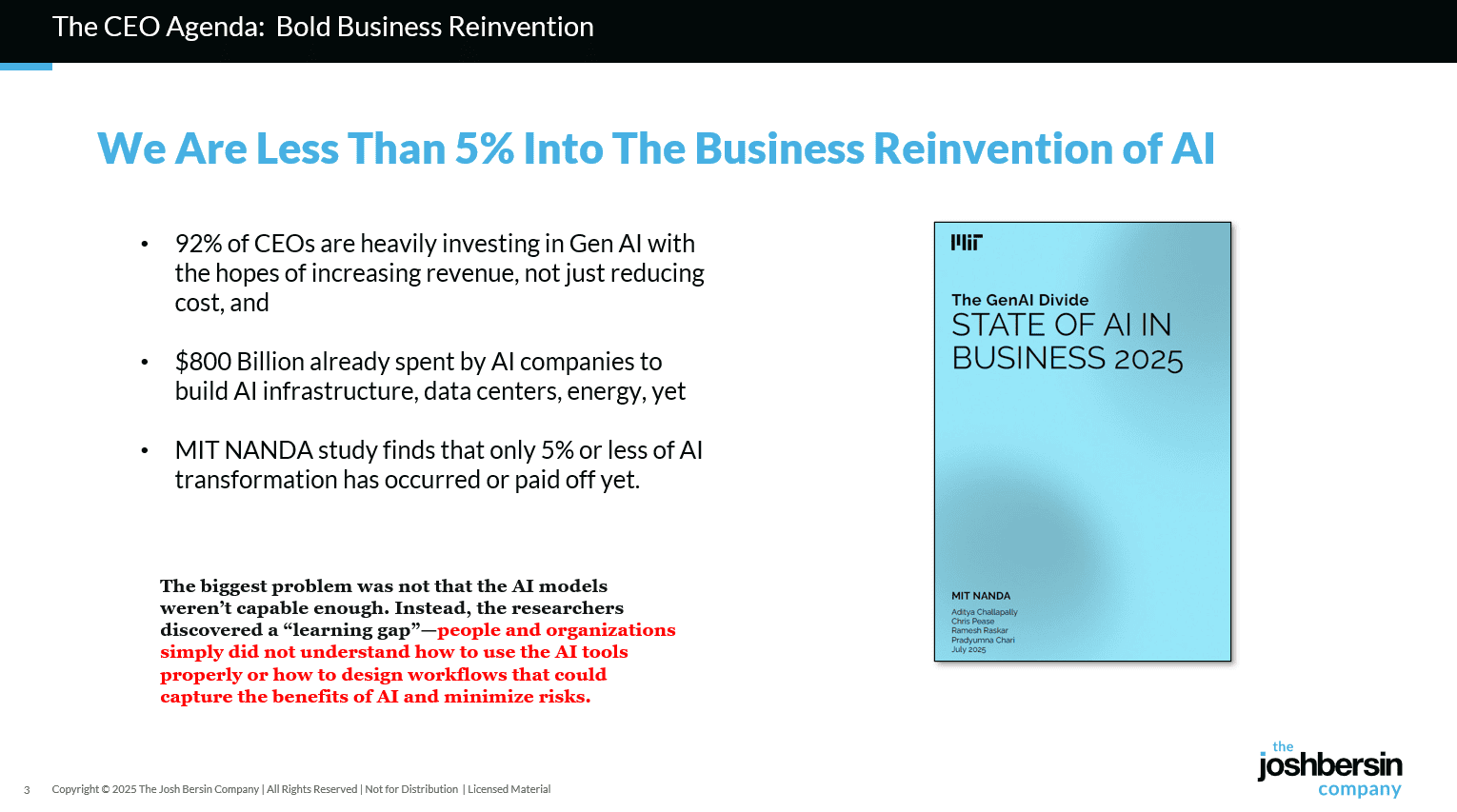
However, a stark warning comes from a recent MIT study, which indicates that a staggering 95% of AI pilot programs fail to transition into full-scale operational deployment. This statistic, while potentially alarming to investors, points to a critical underlying issue: the failure often stems not from the technology itself, but from the absence of the necessary organizational "re-engineering" required for true transformation. The MIT report, widely cited in recent business discourse, suggests that many organizations are adept at identifying AI’s potential but struggle to implement the fundamental changes needed to harness it effectively.
The Four Stages of AI Transformation: From Individual Augmentation to Systemic Redesign
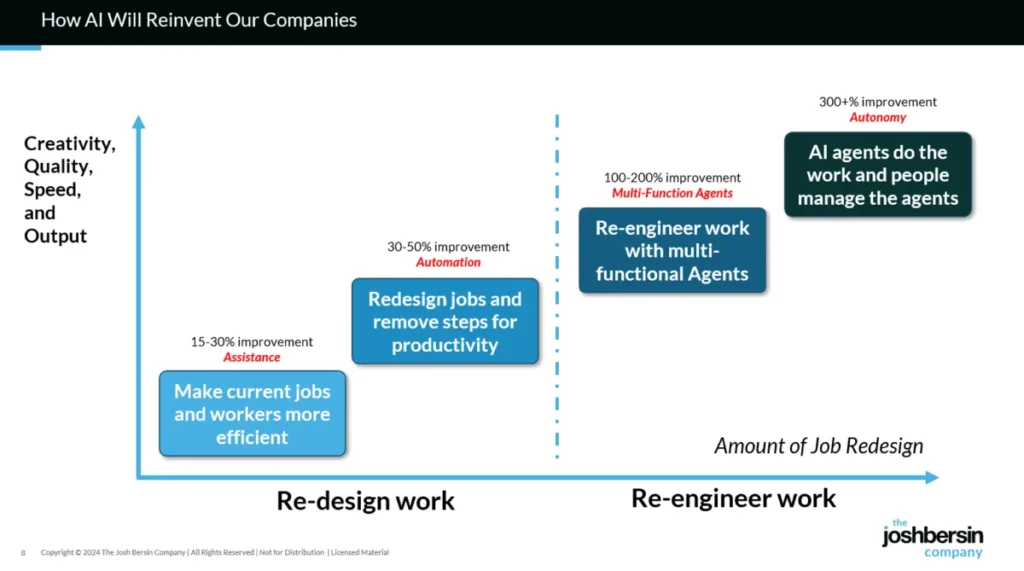
The author’s framework for understanding AI adoption posits a four-stage progression. The initial stage, often observed, involves individual productivity gains. It is relatively straightforward for a single employee to leverage an AI agent to accelerate their tasks. OpenAI reports that 41% of ChatGPT usage is dedicated to information retrieval, with significant benefits also seen in content creation, data analysis, and research. These "personal productivity hacks" can yield relatively rapid improvements, typically in the range of 10-20%.
The crucial, yet more challenging, stages involve moving beyond individual augmentation to "multi-process" automation and, ultimately, the fundamental redesign of how work is accomplished. This transition is the responsibility of management and represents the true frontier of AI’s impact. The journey of management thought itself, from Peter Drucker’s seminal "The Effective Executive" to contemporary approaches like servant leadership, courageous leadership, conscious capitalism, agile methodologies, and even radical experiments like Holacracy, illustrates a continuous evolution in how organizations are structured and led. Each model has attempted to optimize human capital and operational efficiency, but the advent of AI introduces a new dynamic.
The Evolving Role of Management in the Age of AI: Empowerment and Experimentation as Core Pillars
The fundamental question facing today’s business leaders is how effective management practices are adapting in the face of pervasive AI. The analysis suggests that two core principles have emerged as critical drivers of change: empowerment and experimentation. These concepts, long debated in leadership circles, are now playing out in real-time across the business world, creating a dynamic and, at times, disruptive environment. Companies that fail to embrace these shifts do so at their own considerable peril.
Leading organizations such as Microsoft and Meta have demonstrated agility by rapidly pivoting towards AI, fostering cultures that champion project-based leadership. Senior executives at prominent firms like Bayer, Unilever, HSBC, Mastercard, Spotify, and Phillips reportedly attribute their performance gains to small, empowered teams that are directly accountable for driving improvements. In this new paradigm, "Supermanagers"—a term used to describe highly effective and proactive leaders—are innovating independently, often bypassing the need for lengthy senior committee approvals. They are empowered to experiment, iterate rapidly, and spearhead change from within their domains.
The "Supermanager" Dynamic: Driving Innovation from the Front Lines
The current operational model contrasts sharply with traditional hierarchical structures. In the past, innovation often required top-down directives and extensive planning cycles. Today, the dynamic is shifting towards decentralized decision-making and rapid iteration. The emergence of the "Supermanager" is a direct response to the speed and democratizing nature of AI.
The traditional organizational structure, characterized by rigid job titles and defined responsibilities, can act as a significant impediment to progress in an era of rapid technological advancement. The phrase, "It’s not my job," can stifle innovation and slow down the adoption of new tools and processes. Supermanagers, however, actively break this pattern by taking ownership of growth and driving incremental change through experimentation and the empowerment of their teams.
Companies relying on traditional management structures face increasing risks of stagnation, lagging productivity, and falling behind competitors. Conversely, "Supermanagers," as identified in the research, are those who readily embrace new ideas, champion the pioneering efforts of their colleagues, and integrate practical AI applications into their workflows without waiting for formal mandates.
The Democratizing Power of AI: Shifting Innovation to the Edge
The shift in responsibility towards the front lines is intrinsically linked to the nature of AI itself. Unlike previous transformative technologies such as Enterprise Resource Planning (ERP) systems, the cloud, or even mobile computing, which often required substantial upfront investment and central coordination by IT departments and software engineers, AI is proving to be a more democratizing force. The development and deployment of new CRM or ERP systems, for example, could take years.

AI, in contrast, allows individuals across an organization to learn and leverage its capabilities. The most innovative and creative applications may emerge from younger or less experienced employees who approach the technology with a "learn-by-doing" mentality, unburdened by established IT protocols or conventional wisdom. This phenomenon, sometimes referred to as the "Superworker effect," has the potential to elevate the performance of a broad range of employees, even diminishing the relative value of extensive experience in certain contexts. As Reid Hoffman has termed it, this trend contributes to "SuperAgency," where individuals possess enhanced capabilities and autonomy.
Implications for Performance Management and Organizational Structure
The rise of the Superworker and the empowerment of front-line innovators necessitate a re-evaluation of traditional management functions, including supervision, work management, feedback, and performance evaluation. AI can streamline many of these administrative tasks by providing data on employee activities, allowing managers to shift their focus from individual monitoring to more strategic oversight and systemic optimization. This frees up valuable managerial time for coaching, mentorship, fostering collaboration, and the crucial task of redesigning work processes to fully leverage AI’s potential.
While the need for managers will not disappear, their roles are undoubtedly evolving. Performance management and supervision are becoming foundational "table stakes" for effective leadership. The true differentiator for exceptional managers will lie in their ability to drive re-engineering, foster experimentation, and cultivate organizational growth.
Developing AI literacy and staying abreast of its rapid advancements are critical for all employees, particularly for leaders. Supermanagers are not only strong leaders but also architects of learning cultures, actively seeking out and integrating expertise from wherever it may emerge. Traditional management behaviors centered on evaluation and competition remain relevant but are increasingly being reframed within a context of continuous learning and growth. The emphasis is shifting from simply "doing your job" to "what have you learned today?" rather than solely "what have you accomplished today?"
It is vital to remember that Superworkers are not automatons; they are human beings who require support, tools, and a growth mindset to thrive. Supermanagers provide the essential elements of trust, advocacy, and empathy to guide individuals through this journey of learning, reinvention, and growth.

The Future of Management: Evolution, Not Elimination
The central question then becomes: will AI ultimately render managers obsolete? If a manager’s primary role is simply to supervise tasks, then the answer may lean towards yes. AI-driven agents are increasingly capable of coordinating routine work, potentially displacing roles that are perceived as "empty suits" or purely administrative. However, this "empty suit" problem has existed for decades, irrespective of AI. In the new era of Superworkers, leaders will be distinguished by their capacity for driving change and innovation, not merely by their performance metrics. The superfluous roles are likely to be shed rapidly as organizations adapt.
Supermanagers are also instrumental in orchestrating innovation across disparate teams. They make calculated investments in productivity initiatives and are adept at halting projects that are not yielding desired results. Crucially, they facilitate knowledge sharing, ensure organizational alignment, and define priorities that resonate with the company’s broader strategic objectives. Tools like Galileo for Managers are being developed to equip leaders with the skills necessary for this new operational reality.
The prevailing view is not that middle management is becoming redundant, but rather that its function is undergoing a fundamental redefinition. Companies that cultivate Supermanager behaviors are poised for significant acceleration in the evolving business landscape.
The author’s research, slated for full release in October, promises further insights into this transformative shift. The ongoing dialogue and the sharing of experiences are critical for navigating this new era of AI-driven work and management.