The modern HR technology stack, a carefully curated collection of engagement surveys, performance review systems, recognition platforms, development plan tools, and a central HRIS, often appears robust on paper. Each component functions adequately in its silo, meticulously fulfilling its designated purpose. However, the illusion of a seamless system shatters when these disparate tools fail to communicate. A subtle dip in employee engagement, a crucial early indicator, may never reach the manager responsible for a one-on-one conversation. A consistently high performer’s achievements might go unrecognized, with no discernible link to the escalating retention risk simmering beneath the surface. The signals are present, a rich tapestry of organizational health, but they remain isolated, never converging in a unified analytical space.
This pervasive issue, the "disconnected data problem," is more than a mere IT inconvenience; it has profound implications for an organization’s strategic agility. It directly impacts the confidence with which HR leaders can address CHRO inquiries, the timeliness of identifying potential flight risks, and the significant portion of the workweek consumed by the arduous task of manually compiling reports rather than enacting data-driven strategies. The good news, however, is that the solution does not lie in acquiring more data or overhauling entire technological infrastructures. Instead, the imperative is to foster interoperability, enabling these critical systems to finally engage in meaningful dialogue. This article will delve into the quiet but substantial costs associated with fragmented people data and illuminate the transformative benefits of its integration.
Defining Disconnected People Data
Disconnected people data refers to the scenario where essential HR information—spanning engagement surveys, performance evaluations, recognition activities, individual development plans, and core HRIS records—resides within separate, often proprietary, systems that lack inherent integration capabilities. Each platform captures a vital piece of the employee narrative, but no single system provides a holistic perspective of the workforce’s overall health and performance. Consequently, instead of a clear, actionable overview of team dynamics, organizations are left with a collection of isolated snapshots that require manual consolidation, a time-consuming and often incomplete process for strategic decision-making.
The Steep Price of Fragmented Insights
The financial ramifications of disconnected people data are substantial, manifesting as lost productivity, avoidable employee turnover, and the missed identification and nurturing of high-potential talent. For a mid-sized company of approximately 2,500 employees, the annual financial drain can approach $4 million. This figure is primarily attributed to under-equipped managers and the attrition of top performers who depart due to a lack of recognition or development opportunities.
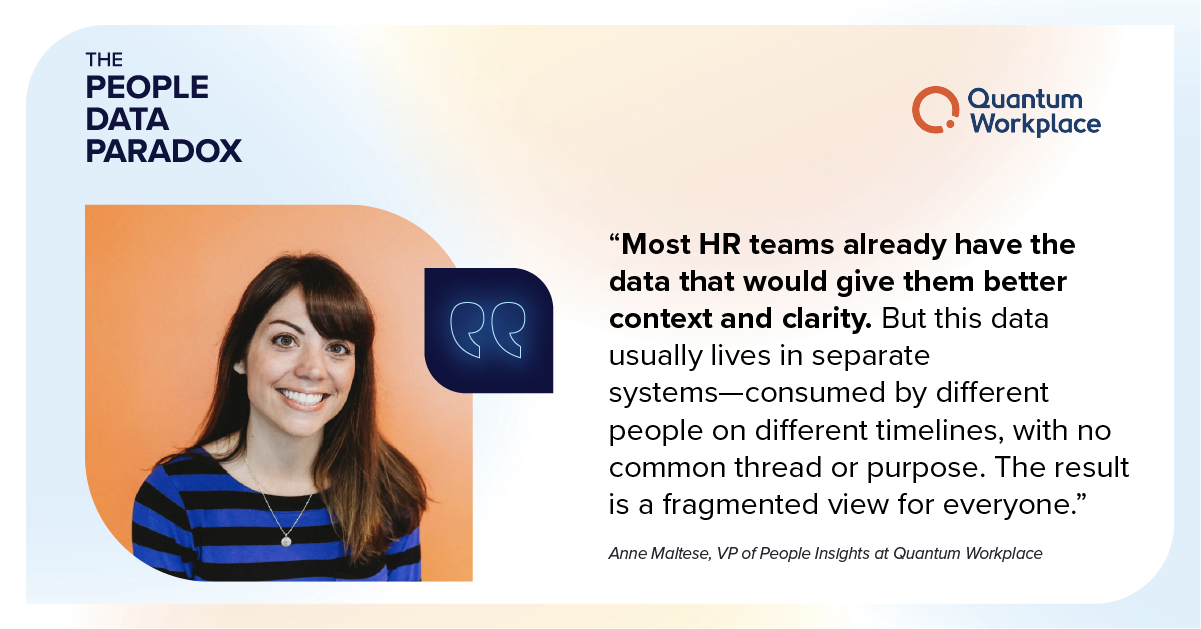
Many HR professionals can attest to the frustration of extracting data from as many as five different systems to answer a single executive question. The knowledge that the crucial answer exists within the organization’s data repositories is palpable, yet the ability to access it cleanly, efficiently, and with the necessary confidence to act remains elusive. This operational chasm is not a reflection of individual shortcomings or technical failures but rather a systemic consequence of siloed technology. Research from Quantum Workplace consistently reveals that HR leaders typically employ between two and four distinct HR solutions from various vendors, with a mere 39% reporting that these systems are effectively integrated. While data accumulates relentlessly, the commensurate clarity and actionable intelligence often lag behind.
The detrimental effects of fragmented data are most acutely felt in several key areas:

The Cost of Under-Equipped Managers
Managers serve as the primary conduit for employee engagement and performance. Their effectiveness directly influences the productivity and morale of their teams. When managers falter, their struggles cascade throughout their direct reports. The root cause of managerial challenges is rarely a lack of innate talent; more often, it stems from an absence of the necessary resources and support structures. The average manager today shoulders approximately 51% more responsibility than is realistically manageable, and a concerning 39% have never received formal leadership training.
The business impact of this managerial deficit is profound. Studies indicate that managers operating within the top decile of leadership effectiveness generate twice the net revenue of their less effective counterparts. This significant performance disparity between top and bottom-performing managers represents not merely a developmental opportunity but a tangible performance issue that quietly erodes organizational profitability.
The Cost of Overlooking High-Potential Talent
High performers are not simply valuable; their contributions are disproportionately impactful, often generating between 400% and 800% of the output of an average employee. Despite this critical role, only 57% of organizations possess a formalized process for identifying these key individuals. In the absence of integrated data, the identification of high-potential talent often relies on subjective factors such as visibility and advocacy—who is nominated, who gains attention, and who has influential champions. This can lead to situations where employees generating the most significant impact are not necessarily recognized or included in talent development programs. Each quarter of unrecognized outsized contribution represents a lost opportunity for the organization to fully leverage its most valuable human capital.
The Cost of Missed Retention Signals
By the time a high-performing employee submits their resignation, the decision to leave has typically been in motion for months. The precursor signals—a decline in survey sentiment, a cessation of development conversations, or a reduction in recognition—are often subtle. Individually, none of these indicators may be sufficient to raise an alarm. However, when viewed collectively, they paint a clear and concerning picture of impending attrition.
Replacing an employee can incur costs ranging from 50% to 200% of their annual salary. Furthermore, research indicates that a significant proportion of departing employees—one in three, according to some studies—believe their exit was preventable. These critical warning signs are frequently embedded within an organization’s existing data, but their scattered nature across disparate systems renders them invisible.
Quantifying the Cumulative Impact
Consider an organization with 2,500 employees and 250 managers. If 50 of these managers are inadequately supported, and as a direct consequence, 10% of their direct reports experience disengagement, the annual loss in productivity could amount to approximately $1.7 million.
When the specter of retention risk is introduced, the financial burden escalates. If 10 high performers depart due to a lack of recognition or development, and their replacement costs double their salaries, this adds another $2 million to the organizational deficit. This brings the total estimated financial drain directly attributable to disconnected data to nearly $4 million. This figure does not even encompass the broader implications of teams lacking the optimal conditions to thrive, leading to misdirected effort, slow skill development, and unrealized potential.
The Transformative Power of Connected Data
For an extended period, the integration of signals across fragmented systems demanded substantial time and resources, often exceeding the capacity of most HR departments. However, this landscape is rapidly evolving. Advances in artificial intelligence (AI) now enable continuous analysis across engagement, performance, development, and recognition data, as well as HRIS records. This AI-powered approach can effectively compare data against established benchmarks and surface patterns that were previously imperceptible.
The fundamental shift is not about accumulating more data; it is about finally deciphering the implicit messages that existing data has been attempting to convey. When these disparate signals converge, organizations can begin to address the complex questions that often preoccupy HR and executive leadership:
- Early identification of flight risks: Proactively identifying employees who are disengaged or whose development has stalled, allowing for targeted intervention before they reach the point of resignation.
- Optimizing manager effectiveness: Pinpointing managers who require additional support or training by correlating their team’s engagement and performance metrics with their own developmental activities and feedback.
- Unlocking high-potential talent: Systematically identifying individuals who consistently exceed expectations and demonstrate leadership qualities, ensuring they are recognized and provided with opportunities for growth.
- Enhancing employee development: Understanding which development initiatives are yielding the greatest impact by linking training programs and career pathing to performance improvements and engagement levels.
- Driving strategic workforce planning: Gaining a comprehensive understanding of the skills, engagement levels, and potential within the workforce to inform recruitment, retention, and talent development strategies.
Transforming Fragmented Data into Cohesive Talent Insights
The true value of gaining a holistic view of people data lies not merely in its acquisition but in its application to drive tangible improvements in organizational practices. This is precisely where solutions like Quantum Workplace aim to bridge the gap. Quantum Workplace’s platform is designed to unify signals from engagement, performance, development, and recognition into a single, cohesive view. This integration liberates leaders from the laborious task of piecing together fragmented data, enabling them to perceive the genuine dynamics at play within their teams. AI-driven insights illuminate the hidden patterns that exist between disparate systems, and each discovery is accompanied by clear, prioritized next steps. These recommendations are contextualized by the organization’s specific priorities and benchmarks, and delivered directly to leaders within their natural workflow.
By connecting previously siloed data, Quantum Workplace empowers HR teams to:
- Proactively address employee concerns: Identify potential issues before they escalate by observing trends across different data points.
- Empower managers with actionable insights: Provide managers with the data and guidance they need to effectively lead their teams.
- Foster a culture of recognition and growth: Ensure that contributions are acknowledged and that development opportunities are aligned with individual and organizational needs.
- Make data-informed strategic decisions: Base workforce strategies on a comprehensive understanding of the employee landscape.
- Improve employee retention and engagement: Create an environment where employees feel valued, supported, and motivated to contribute their best work.
In conclusion, the era of operating with disconnected people data is a costly and inefficient one. By embracing integrated solutions, organizations can transform raw data into actionable intelligence, unlocking their full potential and fostering a more engaged, productive, and resilient workforce. The transition from fragmented snapshots to a connected view of talent is not just an operational upgrade; it is a strategic imperative for sustained success in today’s dynamic business environment.