The burgeoning field of artificial intelligence, a domain now central to global geopolitical strategy, has become a focal point for intense competition between major world powers. In this complex landscape, a significant majority of business and government leaders attending a recent high-profile gathering in Washington expressed a strong desire for President Donald Trump to engage with Chinese President Xi Jinping on establishing international guidelines for AI safety. However, a stark contrast emerged in their expectations regarding the likelihood of such a collaborative step, underscoring the deep-seated mistrust and differing perspectives that characterize the current U.S.-China technological rivalry.
A Mandate for Cooperation, A Doubtful Outlook
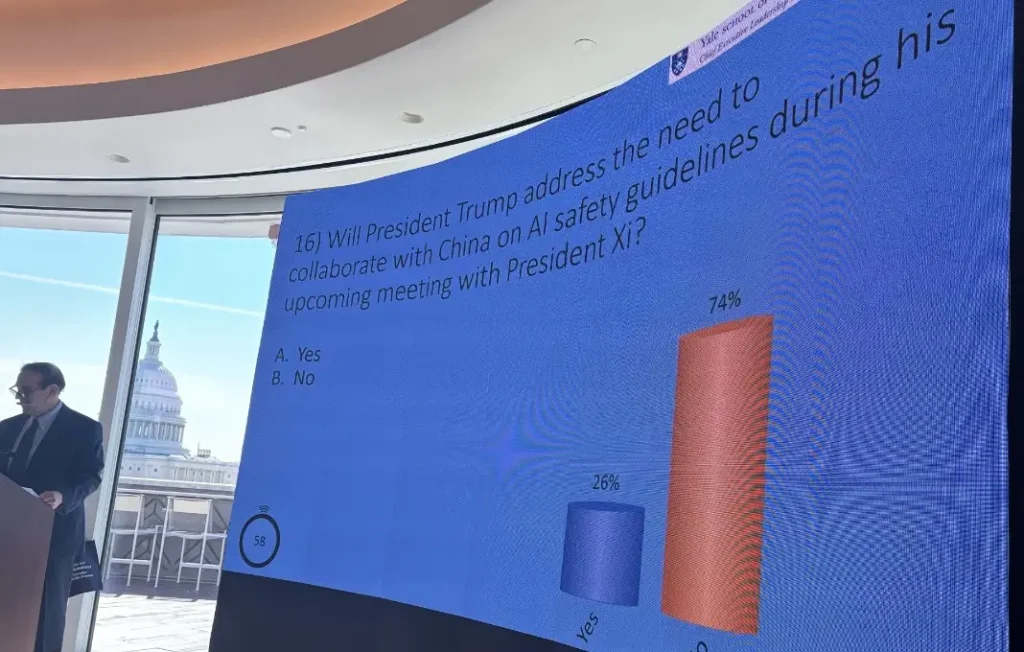
The sentiment for cooperation was overwhelmingly evident at an off-the-record meeting hosted by Yale’s Chief Executive Leadership Institute (CELI) on Tuesday in the nation’s capital. Over 100 prominent figures from the business and government sectors convened to discuss strategies for navigating the intensifying great-power competition, particularly as it pertains to advanced technologies like artificial intelligence. CELI founder and host, Jeffrey Sonnenfeld, conducted a poll of attendees to gauge their views on how the United States should approach this critical issue.
When presented with the question of whether President Trump should advocate for collaboration with China on AI safety guidelines during his upcoming meeting with President Xi, an impressive 88 percent of the polled leaders responded affirmatively. This near-unanimous endorsement suggests a widespread recognition within influential circles that the potential risks associated with unchecked AI development transcend national borders and necessitate a coordinated global response. The rapid advancements in generative AI, capable of producing human-like text, images, and even code, have amplified these concerns, with experts warning of potential misuse in areas ranging from disinformation campaigns to autonomous weaponry.
However, the optimism surrounding the desire for collaboration was significantly tempered by a deep-seated skepticism about its feasibility. In a subsequent poll question, a striking 74 percent of the same leaders expressed doubt that President Trump would indeed pursue such a collaborative approach during his scheduled meeting with President Xi on September 24th in Washington. This divergence between aspirational policy and perceived political reality highlights the significant hurdles to international cooperation in the high-stakes arena of advanced technology.
Divergent Views on AI Risk and National Strategy
The poll results offer a revealing snapshot of the anxieties and strategic considerations among those at the forefront of business and policy-making. The strong call for collaboration on AI safety guidelines stems from a growing awareness of the potential societal impacts of this transformative technology. Leaders from both Anthropic and OpenAI, two of the leading AI research and development firms, have been particularly vocal in recent months. They have publicly articulated their concerns about the accelerating pace and increasing power of AI systems, advocating for new government regulations and even suggesting a deliberate slowdown in the development of the most advanced AI models to allow society time to adapt and implement necessary safeguards.
These concerns are not confined to the United States. Recent reports, including one from The Wall Street Journal, have indicated that even within the highest echelons of the Chinese government, there are palpable worries about the potential disruptive impact of AI on their own political and social structures. This internal apprehension within China, if accurate, could complicate Beijing’s approach to international AI governance, potentially creating both opportunities for dialogue and further areas of contention.
President Trump’s own public stance on AI safety appears to diverge significantly from the prevailing sentiment among the business and government leaders polled. In a recent post on his Truth Social platform, he characterized safety concerns surrounding "renegade AI" as a "sick conspiracy." He asserted that the only necessary "guardrails" for AI development were the presence of a "STRONG AND SMART (high IQ!) PRESIDENT," implying that his own leadership was sufficient to manage any potential risks. This public declaration directly contradicts the desire expressed by the majority of leaders at the CELI event for a more structured, collaborative approach involving international dialogue and formal safety guidelines.
Perceptions of China’s AI Innovation and Influence
Beyond the immediate issue of AI safety collaboration, the poll also delved into perceptions of China’s role in the global AI landscape. Attendees were divided on the extent of genuine Chinese innovation versus their reliance on U.S. technological advancements. Specifically, 58 percent of those polled believed that China was "genuinely innovating" in the AI space, suggesting a recognition of Beijing’s significant investments and progress. Conversely, 42 percent held the view that China was "more reliant on the U.S. than it admits," indicating a belief that much of China’s AI prowess is built upon adopted or adapted American technologies. This split highlights the ongoing debate about the true nature of China’s technological capabilities and its path to leadership in AI.
Furthermore, the poll touched upon the sensitive issue of Chinese influence operations. When asked if they believed Chinese influence operations were at least partially responsible for the public backlash against AI in the United States, 52 percent of attendees responded affirmatively, while 48 percent said no. This finding suggests a notable degree of suspicion among these leaders regarding Beijing’s potential efforts to shape public opinion and policy debates in the U.S. concerning AI, a tactic often employed in broader geopolitical competition.
The Strategic Implications of Pacing AI Development
The question of whether a deliberate deceleration in the pace of AI advancement by U.S. companies would harm the country’s competitive standing against China also yielded a divided response. A majority, 55 percent, believed that such pacing would indeed be detrimental to the U.S. in the technology race, while 45 percent disagreed, suggesting that a slower, more deliberate approach might not necessarily cede ground. This indicates a fundamental disagreement on the optimal strategy for maintaining technological supremacy: whether to prioritize rapid advancement at all costs, or to balance speed with caution and ethical considerations.
Background and Context of the Yale CELI Event
The Yale Chief Executive Leadership Institute (CELI) is a renowned academic institution dedicated to fostering leadership development and promoting dialogue among top executives and policymakers. Founded by Professor Jeffrey Sonnenfeld, CELI has a long history of hosting influential forums that bring together leaders from various sectors to discuss critical economic, social, and political issues. The off-the-record nature of these meetings is designed to encourage candid and open discussions, allowing participants to share their unvarnished views without fear of public reprisal.
The timing of this particular gathering, with its focus on AI and U.S.-China relations, is highly significant. It occurred at a time when both nations are actively vying for dominance in AI research, development, and deployment, recognizing its profound implications for economic growth, national security, and global influence. The event provided a crucial platform for influential figures to grapple with the complex trade-offs inherent in managing this technological race, particularly in the context of a strained bilateral relationship.
Chronology of Key Developments
- Recent Months: Leading AI companies like OpenAI and Anthropic begin to publicly express concerns about AI safety and call for regulation.
- This Week (prior to the poll): The Wall Street Journal reports on internal concerns within the Chinese government regarding AI’s impact.
- This Week (prior to the poll): President Trump posts on Truth Social dismissing AI safety concerns as a "conspiracy."
- Tuesday (day of the event): Over 100 business and government leaders gather for an off-the-record meeting hosted by Yale’s CELI in Washington D.C.
- During the event: Jeffrey Sonnenfeld conducts polls on U.S. strategy for managing AI competition with China.
- September 24th (upcoming): Scheduled meeting between President Trump and President Xi in Washington D.C.
Broader Implications and Analysis
The poll results from the Yale CELI event paint a nuanced picture of the challenges facing U.S. policymakers in the AI domain. The overwhelming desire for international cooperation on AI safety, even with a geopolitical rival like China, suggests a pragmatic understanding among leaders that the potential risks of advanced AI are universal. This sentiment contrasts sharply with the more nationalistic and unilateral rhetoric often seen in political discourse.
The widespread doubt about President Trump’s willingness to engage in such collaboration underscores the significant gap between the aspirations of the business and policy elite and the perceived political realities. This disconnect could hinder the development of a cohesive and effective U.S. strategy for managing AI competition. If key stakeholders believe that collaborative pathways are unlikely to be pursued, it may lead to a more risk-averse or purely competitive approach, potentially missing opportunities for mutually beneficial risk mitigation.
The division on China’s innovation versus reliance on the U.S. highlights the ongoing strategic uncertainty surrounding China’s technological trajectory. Whether China is a genuine innovator or a sophisticated imitator has significant implications for how the U.S. should shape its own research and development priorities and its approach to technology transfer and intellectual property protection.
The acknowledgment of potential Chinese influence operations in shaping U.S. public discourse on AI is a critical concern. It suggests a need for greater transparency and resilience in domestic policy debates, ensuring that decisions are based on objective assessments rather than foreign manipulation.
Finally, the split on the strategic implications of pacing AI development reflects a fundamental debate about the nature of technological progress and national competitiveness. While some may see rapid advancement as the only way to stay ahead, others may prioritize a more measured approach to ensure ethical development and societal alignment, even at the risk of falling behind in the short term.
In conclusion, the insights gleaned from the Yale CELI poll reveal a leadership class grappling with the profound implications of the AI revolution. While there is a clear consensus on the need for international dialogue on safety, the path to achieving it, particularly in the complex U.S.-China relationship, remains fraught with uncertainty and divergent perspectives. The upcoming meeting between Presidents Trump and Xi will be closely watched for any signs that these deeply held sentiments are being translated into actionable policy.