In the rapidly evolving landscape of corporate professional development, the efficacy of a training program is no longer measured merely by the volume of content delivered, but by the measurable shift in learner behavior and performance. At the heart of this shift lies the learning objective, a concise statement that serves as the blueprint for instructional design and the benchmark for educational success. As organizations globally increase their investment in human capital, the ability to draft clear, actionable, and measurable learning objectives has become a critical competency for instructional designers, human resources professionals, and corporate trainers alike.
The Strategic Importance of Learning Objectives in Modern Industry
The primary function of a learning objective is to provide a roadmap for both the instructor and the learner. While a syllabus or a course description might outline the topics to be covered, a learning objective specifies the exact knowledge, skills, or attitudes a participant is expected to demonstrate upon completion of the training. According to recent industry data from the Association for Talent Development (ATD), organizations in the United States alone spend upwards of $100 billion annually on employee training and development. Despite this massive investment, a significant portion of training fails to achieve its intended ROI because the desired outcomes were never clearly defined at the outset.
When objectives are vague, the training often becomes a "data dump"—an overwhelming influx of information that lacks a practical application. Conversely, clear objectives ensure that every piece of content, every activity, and every assessment is directly aligned with a specific business goal. This alignment is what distinguishes "checked-box" compliance training from high-impact professional development that drives organizational growth.
A Chronology of Instructional Design Frameworks
The methodology behind writing learning objectives has evolved significantly over the past 70 years, moving from simple rote memorization to complex cognitive application.
- The 1950s: The Birth of Bloom’s Taxonomy: In 1956, Benjamin Bloom and a committee of educators developed a framework to categorize educational goals. This "Taxonomy of Educational Objectives" introduced the idea that learning occurs at different levels of complexity, from basic recall to evaluation.
- The 1960s: The Mager Model: Robert Mager revolutionized the field by insisting that objectives must describe an observable behavior. His "ABCD" model (Audience, Behavior, Condition, Degree) remains a cornerstone of technical and vocational training.
- The 1980s: The Rise of SMART Goals: Originally appearing in a 1981 issue of Management Review by George T. Doran, the SMART criteria (Specific, Measurable, Attainable, Relevant, Time-bound) were adapted from management science into instructional design to ensure that learning goals were grounded in reality.
- The 2000s to Present: The Digital Pivot: With the advent of eLearning and microlearning, objectives have become even more granular. The focus has shifted toward "just-in-time" learning, where objectives are designed to be met in five-to-ten-minute intervals to suit the modern worker’s schedule.
The Three Domains of Learning
To write an effective objective, one must first identify which domain of learning the training targets. Educational psychologists generally categorize learning into three distinct areas:
Cognitive (Knowledge-Based)
The cognitive domain involves mental processes such as facts, patterns, and concepts. In a corporate environment, this is most common in product knowledge sessions or compliance updates. For instance, a cognitive objective might require a salesperson to "list the five key features of a new software update." The focus here is on the intellectual grasp of information.
Affective (Attitude-Based)
The affective domain deals with emotions, values, and motivations. This is often the most difficult domain to measure but is vital for leadership development, diversity and inclusion training, and customer service excellence. Because "feelings" cannot be seen, instructional designers must link them to observable behaviors. Instead of saying "learners will appreciate diversity," a clear objective would be: "Learners will demonstrate active listening techniques during a simulated conflict resolution exercise."
Psychomotor (Skill-Based)
The psychomotor domain involves physical movement, coordination, and use of motor-skill areas. This is the bedrock of manufacturing, healthcare, and technical trades. A psychomotor objective is highly action-oriented, such as: "The technician will be able to disassemble and reassemble a turbine engine within two hours, following all safety protocols."
Implementing the SMART and ABCD Frameworks
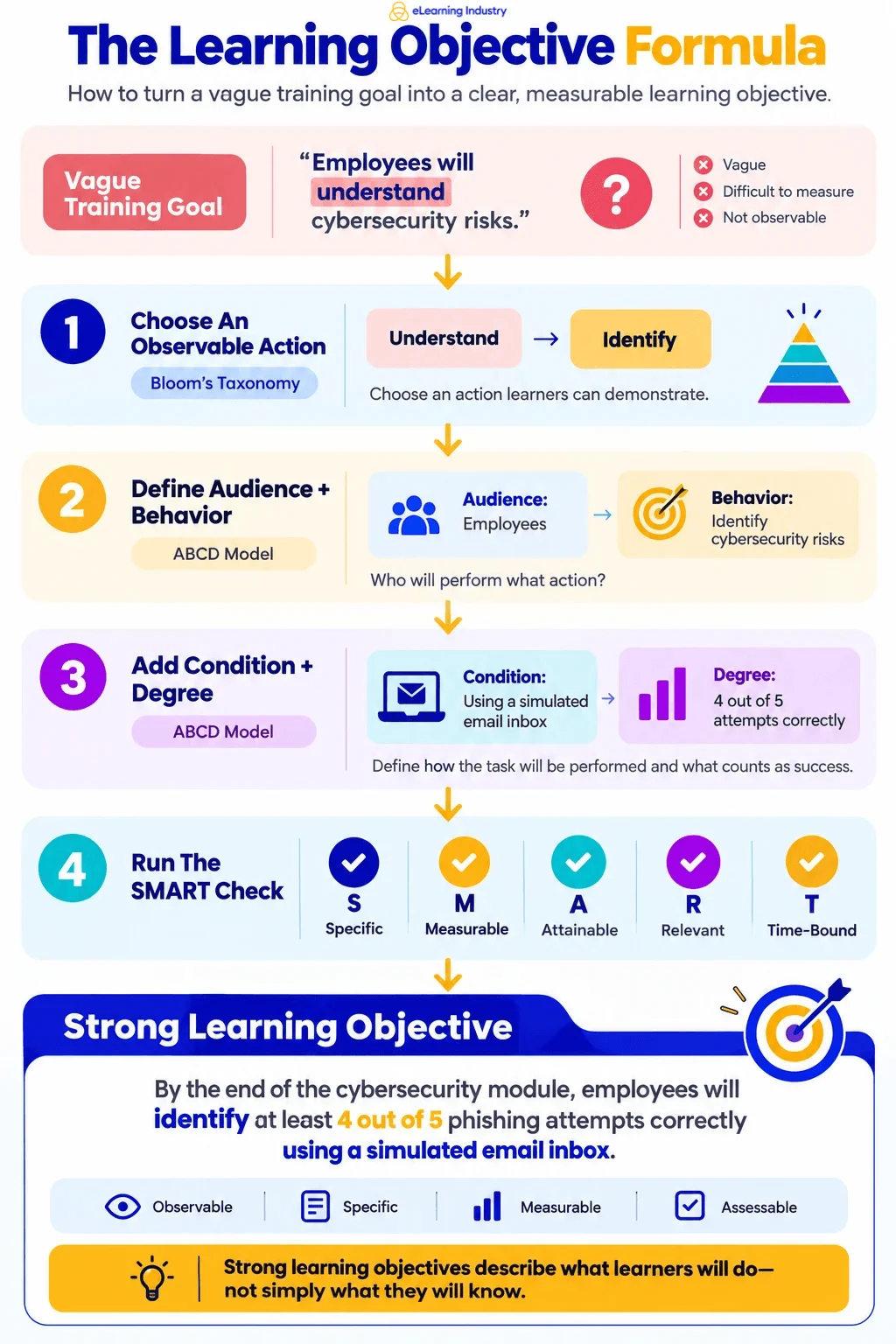
Professional instructional designers rely on structured frameworks to eliminate ambiguity. The SMART criteria ensure that an objective is not just a wish, but a measurable target.

- Specific: Use precise language. Avoid "understand" or "know."
- Measurable: There must be a way to prove the objective was met.
- Attainable: The goal must be realistic given the time and resources.
- Relevant: The objective must solve a real-world problem or fill a skill gap.
- Time-bound: The goal should be achieved by the end of the module or course.
Complementing this is the ABCD Model, which provides the grammatical structure for the objective:
- Audience: Who is the learner? (e.g., "The Junior Analyst…")
- Behavior: What will they do? (e.g., "…will create a pivot table…")
- Condition: Under what circumstances? (e.g., "…using Microsoft Excel and the provided quarterly data set…")
- Degree: How well must they do it? (e.g., "…with 100% accuracy in under ten minutes.")
The Linguistic Precision of Action Verbs
The choice of verb is perhaps the most critical element of a learning objective. Vague verbs lead to vague results. Industry experts generally categorize verbs based on the "level of thinking" required, often drawing from the revised Bloom’s Taxonomy.
Verbs to Utilize:
- For Basic Knowledge: Define, list, label, name, state.
- For Application: Calculate, demonstrate, operate, solve, illustrate.
- For Analysis: Categorize, compare, contrast, debug, simplify.
- For Creation: Design, formulate, construct, devise, generate.
Verbs to Avoid:
- Understand: It is impossible to "see" understanding without an action.
- Learn: This describes the process, not the outcome.
- Know: Too broad and unobservable.
- Appreciate: Subjective and difficult to quantify in a professional assessment.
Common Pitfalls and Mitigation Strategies
Despite the availability of frameworks, many training programs suffer from "objective drift." One common mistake is writing objectives that focus on what the instructor will do rather than what the learner will achieve. For example, "The instructor will demonstrate how to use the fire extinguisher" is a teaching goal, not a learning objective. The correct version would be: "The learner will be able to operate a fire extinguisher to put out a controlled Class A fire."
Another frequent error is the "kitchen sink" approach, where a single objective contains multiple unrelated tasks. This makes assessment nearly impossible. If a learner passes one part of the task but fails another, the objective remains unfulfilled. Experts recommend "atomizing" objectives—breaking them down into the smallest possible measurable units.
Industry Implications and the Broader Impact
The implications of clear learning objectives extend far beyond the classroom. In a legal and regulatory context, well-defined objectives are often the first line of defense for companies during audits. In high-stakes industries like aviation or medicine, the clarity of a learning objective can literally be a matter of life and death.
Furthermore, as Artificial Intelligence (AI) begins to play a larger role in content creation, the human ability to define "the end state" becomes even more valuable. While AI can generate content rapidly, it requires human-defined objectives to ensure that the content is accurate and relevant to the specific needs of the workforce.
Conclusion: The Future of Outcome-Based Training
As we move deeper into the 21st-century economy, the demand for "upskilling" and "reskilling" will only intensify. The World Economic Forum estimates that over 50% of all employees worldwide will need reskilling by 2025. In this climate, there is no room for inefficient training. Clear learning objectives are the essential tools that allow organizations to bridge the gap between current capabilities and future needs. By focusing on observable behaviors, measurable outcomes, and strategic alignment, instructional designers can ensure that every minute spent in training translates into a tangible improvement in performance, safety, and innovation.