For many organizations, the journey from posting a job to securing a signed offer has become a familiar, often frustrating, marathon. In the current competitive talent landscape, this recruitment cycle typically spans between 36 and 44 days. This average, however, masks significant variations. Technical and specialized roles often extend this timeline considerably, while high-volume hourly positions, where every vacant shift represents immediate operational strain, can feel even more protracted. The critical question facing modern HR departments and hiring managers is not whether this timeline can be improved, but what specific, actionable steps can genuinely cut it in half without compromising candidate quality or the integrity of the hiring process. The answer lies not in accelerating evaluations, but in systematically eliminating the non-evaluative "friction" points that have become ingrained in conventional hiring practices.
The pervasive inefficiency stems from a series of bureaucratic and logistical hurdles that add considerable time, often without directly contributing to the assessment of a candidate’s suitability for a role. These delays are not inherent to the evaluation of talent but are rather byproducts of outdated processes and a reliance on manual coordination. By dissecting the hiring process, it becomes clear that the most significant opportunities for compression lie in streamlining the often-cumbersome administrative aspects that precede and follow direct candidate engagement.
Where the Time Actually Disappears: Beyond the Interview Room
While interviews are the most visible component of the hiring process, they are rarely the primary driver of extended timelines. When a typical requisition is tracked from its inception to the final offer, the time spent in interviews, across multiple rounds and panels, often represents a smaller portion of the overall duration than commonly perceived. A more accurate breakdown of a standard 30-to-40-day hiring cycle reveals a more complex picture, where significant time is lost in the gaps between stages.
The majority of delays are often attributed to the administrative and logistical burdens that precede and follow candidate interactions. This includes the time spent sourcing candidates, initial screening, and crucially, the extensive coordination required to schedule interviews. The actual face-to-face or virtual time spent with candidates, while important, is frequently overshadowed by the days, and sometimes weeks, spent waiting for availability, confirmations, and feedback.
A typical breakdown of a hiring cycle often reveals that:
- Sourcing and Screening: Initial outreach, application review, and pre-screening can consume several days to over a week, depending on the volume and the tools used.
- Scheduling and Coordination: This is arguably the most significant bottleneck, involving the intricate dance of matching candidate availability with multiple interviewer schedules, often across different departments and time zones. This phase can easily account for 5-10 business days or more.
- Interviews: While seemingly the core, the actual interview time might be concentrated over a few days, but the preparatory and follow-up waiting periods around them add to the overall duration.
- Debriefs and Decision Making: Post-interview discussions, internal deliberations, and consensus-building can take several days, especially if key stakeholders have competing priorities.
- Reference Checks and Offer Extension: Conducting thorough reference checks and preparing the formal offer can add another few days to the process.
The "friction" identified in the original analysis points directly to the time elapsed before an interview can occur and after it concludes, before a decision is made. When these interstitial periods are aggregated across every stage of a multi-round interview process, they can easily inflate the total hiring duration by more than half. This realization is crucial: the most significant gains in speed are not achieved by shortening interview durations but by eliminating the "dead time" inherent in the scheduling and coordination phases.
The "Scheduling Tax": A Hidden Cost of Modern Hiring
The administrative burden of coordinating interviews is a pervasive challenge that often lacks dedicated metrics on hiring dashboards, despite its substantial impact. The process of aligning the schedules of a candidate with two, three, or even five interviewers, often spread across different time zones and competing with urgent operational demands, is a complex logistical puzzle. Recruiters find themselves navigating a labyrinth of Slack threads and email chains, while interviewers frequently postpone meetings due to unforeseen business needs. Candidates, especially those currently employed, have limited windows for even brief introductory calls.

Research into remote hiring practices has consistently highlighted this issue. Studies indicate that the transition from a candidate expressing interest to a completed interview can be measured in hours when managed by automated systems, versus days when reliant on manual scheduling. This disparity is critical because every day a highly qualified candidate remains on the market, they are actively engaging with other organizations, increasing the likelihood of accepting a faster offer from a competitor.
Consider the cumulative effect: a typical interview loop for a mid-level role might involve three to four rounds. If each round requires a week for scheduling, this alone adds three to four weeks to the hiring process. When this "scheduling tax" is multiplied across every stage of recruitment, it’s easy to see how two weeks or more can evaporate before any substantive hiring decision has even been considered. This is a pain point that resonates deeply with hiring managers, as it represents a tangible, ongoing operational drag on their teams.
Compressing the Interview Stage: The AI Advantage
The most profound opportunities for compressing the hiring timeline lie within the interview stage itself, specifically through the strategic implementation of AI-assisted interviewing technologies. These solutions fundamentally alter the traditional dependency on shared calendars. Instead of waiting for a mutually convenient time slot between a candidate and a live interviewer, candidates can complete structured, role-relevant interviews on their own schedules. This includes evenings, weekends, or even short breaks between other work commitments.
This approach eliminates the need for back-and-forth communication to reschedule interviews, preventing candidates from dropping out of the pipeline simply because a 45-minute overlapping availability could not be found within a two-week window.
From the interviewer’s perspective, the time investment shifts dramatically. Rather than dedicating significant portions of their week to conducting numerous similar first-round interviews, recruiters and hiring managers receive concise, structured summaries and scored evaluations shortly after each AI-conducted interview concludes – often within hours, not days. This ensures consistency, as all candidates are assessed against the same criteria and at the same depth, irrespective of their position in the interview sequence.
The impact on time savings is substantial. Organizations that have adopted AI-assisted interviewing for early and mid-stage assessments have reported dramatic reductions in their overall time-to-hire, shrinking it from an average of six weeks to as little as one week. Specifically, the time-to-interview has seen reductions of up to 99%, primarily because the interview no longer operates within the constraints of a static calendar. This singular change, more than any other in the recruitment process, transforms the possibility of a compressed timeline from an aspiration into a consistent reality.
The Practical Manifestation of a Faster Hiring Timeline
Transforming a protracted hiring process into a streamlined operation requires a fundamental re-evaluation of where time is spent. A realistic scenario for achieving a requisition-to-offer timeline measured in days, rather than weeks, hinges on proactively addressing the identified friction points. This accelerated model prioritizes efficiency without sacrificing the critical human touchpoints.
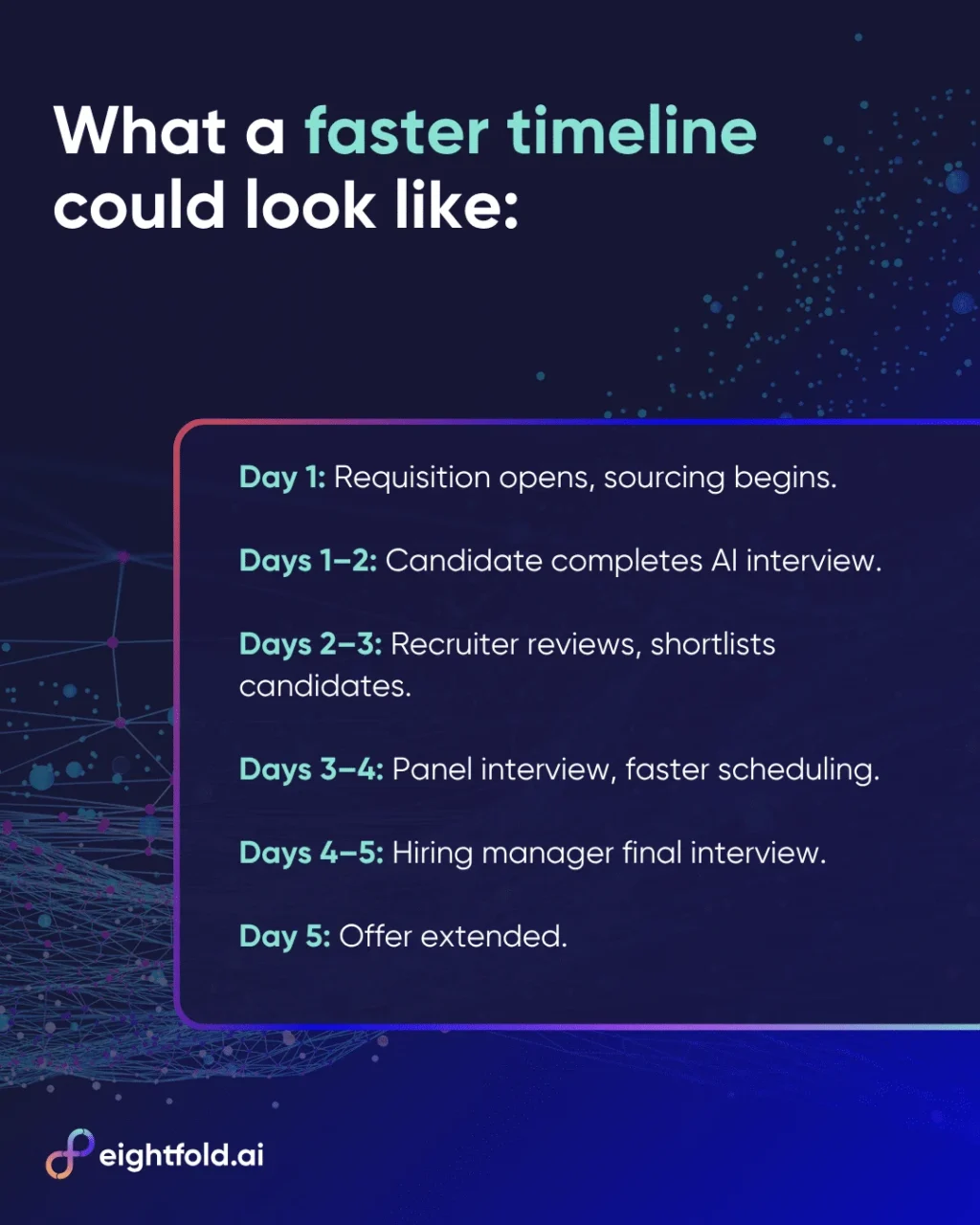
A reimagined hiring timeline might look like this:

- Day 1-2: Automated Screening and Initial Assessment: Following job posting, AI-powered tools can pre-screen a high volume of applications, identify qualified candidates, and conduct initial AI-driven interviews. This phase rapidly filters the applicant pool, presenting a curated list of strong contenders.
- Day 3: Focused Human Evaluation: Hiring managers and recruiters review AI-generated candidate summaries and assessments. This allows them to quickly identify the most promising individuals for more in-depth evaluation.
- Day 4: In-Depth Interviews and Final Assessment: Key stakeholders conduct targeted interviews with the top candidates, focusing on behavioral aspects, cultural fit, and complex problem-solving that require human judgment. This stage is significantly more focused due to the robust initial screening.
- Day 5: Decision and Offer Extension: A swift debrief and decision-making process, informed by comprehensive data from both AI and human assessments, leads to a rapid offer extension.
In this model, the entire process from requisition to offer can be completed in approximately five working days. This is not achieved by rushing candidates or compromising quality, but by ensuring that no stage of the process sits idle. The human interactions that carry the most weight – the final interviews, the offer conversations, and the moments where genuine rapport and expert judgment are paramount – remain firmly in human hands. What is eliminated is the unproductive "dead time" that has historically characterized the recruitment journey.
The Ripple Effects of Accelerated Hiring
The benefits of a compressed hiring timeline extend far beyond the recruitment dashboard. A faster process directly influences broader business outcomes. When open positions are filled promptly, the burden on existing team members is alleviated, preventing burnout and maintaining operational efficiency. Projects that were contingent on new hires can commence without delay, driving innovation and productivity.
For candidates, a swift and transparent process significantly enhances their experience. They are less likely to endure weeks of silence after a promising initial conversation or question whether they have been overlooked. This positive experience is a critical factor in employer branding and candidate satisfaction, with candidates consistently rating fast, consistent, and transparent hiring processes higher than protracted ones, regardless of the interview method.
Furthermore, in today’s highly competitive talent market, speed is a significant differentiator. Top-tier talent rarely remains available for extended periods. If a competitor can assess and offer a candidate within five days, while another organization takes three weeks to reach a decision, the outcome is often predetermined before the slower process even concludes its internal debrief. Therefore, compressing the hiring timeline is not merely an internal efficiency gain; it is a proactive strategy to secure sought-after talent and mitigate the risk of losing promising candidates to more agile competitors.
The Takeaway: Less Waiting, More Hiring
The hiring timelines that organizations have come to accept are not immutable laws of nature. They are, in fact, the aggregate result of numerous small, addressable delays, many of which have no bearing on a candidate’s actual ability to perform the job. The most substantial improvements in recruitment speed are not achieved by cutting corners during interviews but by systematically eliminating the "scheduling tax" and the "coordination drag" that have become embedded in traditional hiring workflows.
Ultimately, reducing time-to-hire by half is not about working faster in the traditional sense. It is about waiting less. By leveraging technology to streamline administrative processes and re-focus human effort on high-value interactions, organizations can transform their recruitment from a lengthy undertaking into a swift, effective, and strategically advantageous function.
For organizations looking to understand how these efficiencies can be applied to their specific hiring needs, exploring tailored solutions and requesting demonstrations can provide a clear path forward towards achieving significantly shorter recruitment cycles.