The human resources technology landscape is witnessing a significant shift with Gloat, a prominent player in skills intelligence and talent marketplaces, launching a strategic entry into the burgeoning field of AI Agents for HR. This move underscores the escalating competition for dominance in core HR technology solutions, as established vendors and innovative startups alike vie to harness the power of artificial intelligence to transform workforce management. Gloat’s offering, Gloat Agentic HR, aims to empower organizations to rapidly develop and deploy AI agents that seamlessly integrate with popular communication and AI platforms like Microsoft Copilot, Teams, and Slack, while leveraging existing business rules and security protocols embedded within leading HR systems such as Oracle, Workday, and SuccessFactors.
The Evolving Architecture of Agentic AI in HR
Understanding Gloat’s strategic positioning requires an appreciation of the layered architecture that defines the current wave of AI agent development. At the foundational level lie the Systems of Record, the robust enterprise resource planning (ERP) and human capital management (HCM) systems that house critical organizational data. This includes platforms like Workday, SAP, Oracle, and UKG, which manage everything from financial transactions and customer information to employee data and inventory. These systems are underpinned by complex databases that serve as the single source of truth for an organization’s operations.
Building upon these systems of record is the Application Layer. In large enterprises, a complex ecosystem of specialized applications and cross-system solutions is common. Companies often deploy hundreds of these applications, with over 100 directly impacting employee experience. This layer includes portals, mobile applications, and workflow tools that bridge the gap between various specialized systems like time-tracking, learning management systems (LMS), applicant tracking systems (ATS), and IT provisioning. For two decades, cloud migration has fueled the growth of this layer, with companies like ServiceNow, a $13.5 billion enterprise software company, becoming dominant players. While employee experience platforms such as Microsoft Viva, Teams, and others have gained traction, many were not initially designed with "agentic" capabilities in mind.
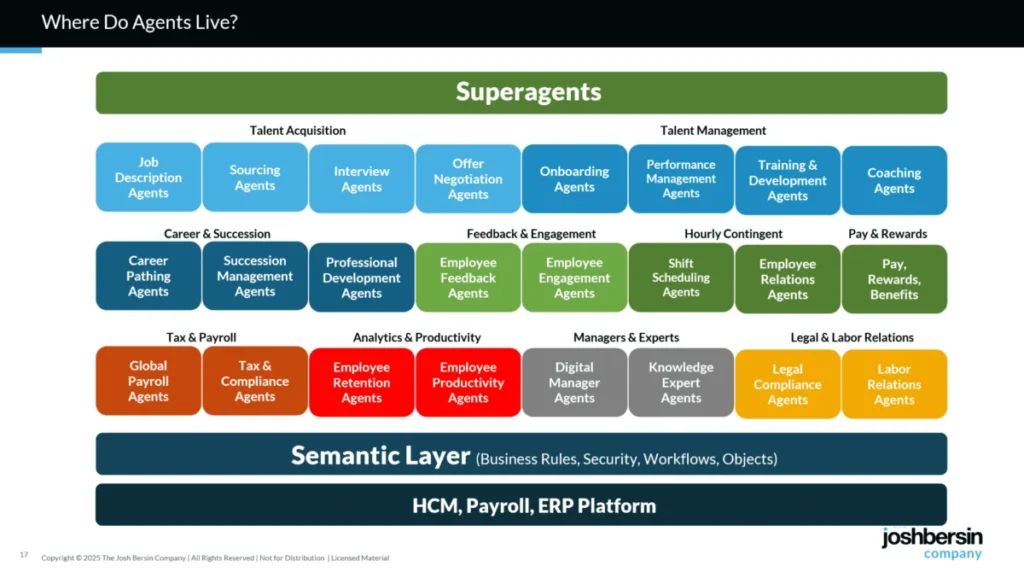
The third critical layer represents the emergence of AI Agents. These are far more than mere portals or workflow automators; they possess an inherent intelligence about the user and can proactively perform tasks on their behalf. The HR technology space is now experiencing an influx of agent tools, from nimble startups to embedded solutions within enterprise systems, designed to facilitate the creation of cross-functional solutions for workforce management.
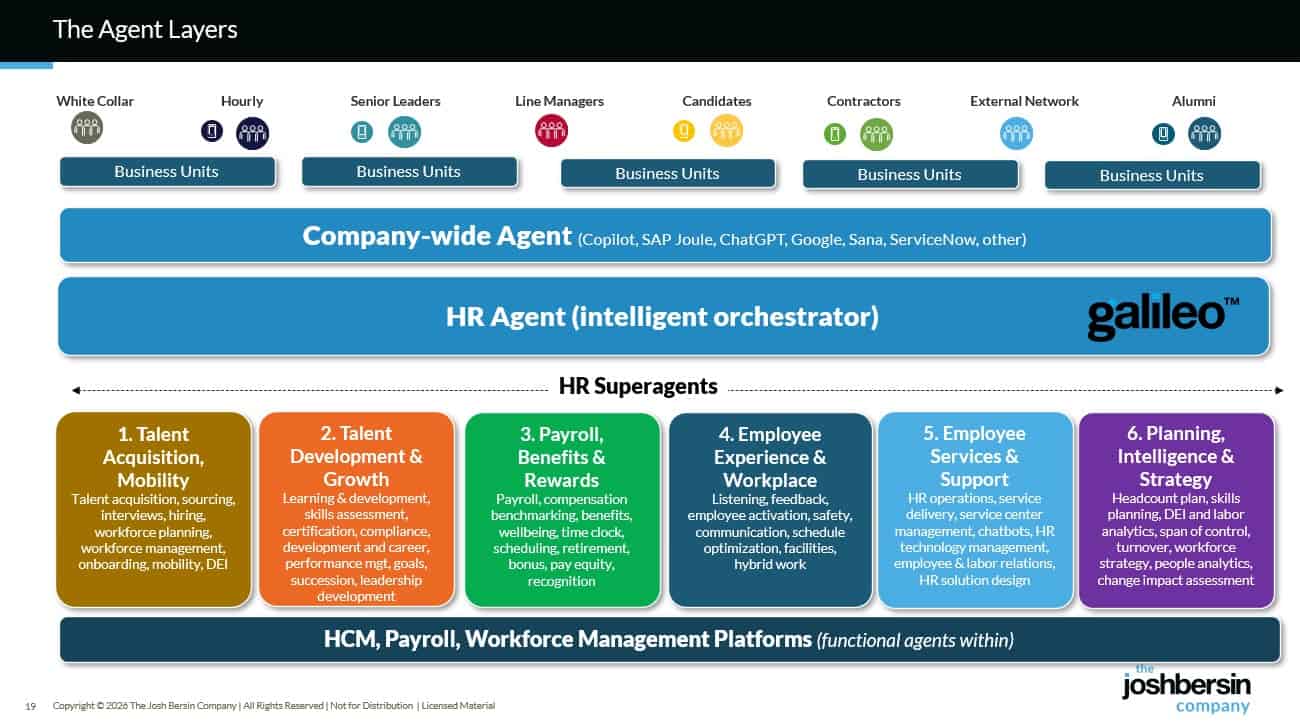
Crowning this architecture are Superagents. These sophisticated tools are capable of orchestrating and accessing multiple functional agents, providing users with an even more intuitive and integrated "walk-up-and-use" experience. This layered model highlights the increasing complexity and interconnectedness of modern HR technology.
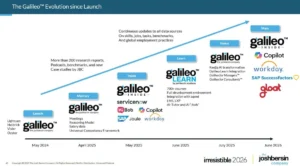
The proliferation of tools across these layers is notable. Companies are increasingly encountering solutions like Sana (for Workday), Oracle Agent Studio, Microsoft Copilot Studio, Leena.ai, and new agent capabilities from ServiceNow (enhanced by its MoveWorks acquisition). SAP is also advancing its offerings with Joule Studio, while foundational AI providers like Anthropic, OpenAI, and Google continue to develop their agent technologies. A notable example of a Superagent is Galileo, which functions as an HR advisor, enabling employees to query information and access underlying agent capabilities.
Navigating the Complexities of Agent Implementation
Despite the excitement surrounding agentic AI, its practical implementation is fraught with challenges, particularly concerning business rules, security, and the integration with legacy systems. Consider a payroll reconciliation agent from a major vendor. While it can monitor payroll transactions and reconcile tax, time-card, employee moves, terminations, new hires, and pay adjustments, its efficacy hinges on being meticulously "trained" with a company’s specific rules and security protocols. Furthermore, if the agent is intended to monitor pay equity or adjust for performance, it must seamlessly interact with other agents and data sources.
This underscores the critical importance of agent architecture. Imagine a scenario where an organization aims to redeploy 5,000 employees from an existing business unit to new roles. An agent tasked with identifying suitable candidates based on job fit and skill gaps would need to access and process information from multiple systems and other agents. This hypothetical agent would need to understand skill and job requirements, provide coaching to employees and managers on available options, and factor in elements such as available training, geographical constraints, licensing requirements, union agreements, and compensation bands. This intricate web of dependencies highlights the complexity involved in developing truly impactful Superagents.
Beyond workforce redeployment, common use cases for agentic HR include global onboarding, facilitating promotions, managing annual reviews and compensation cycles, streamlining talent acquisition processes, ensuring employee certifications, and optimizing time and schedule management.
The Strategic Battleground: Enterprise Agents and Business Rules
Every major HR vendor is actively developing agent capabilities, ranging from simple coaching tools to more comprehensive solutions. Leading vendors like Workday, Oracle, SAP, and ServiceNow are investing heavily in AI studios to simplify agent creation for their customer base. However, the core competition is not solely about the agents themselves, but rather about the ability to effectively stitch them together. This integration challenge directly confronts the critical issue of managing business rules, security policies, existing workflows, and proprietary business "objects" that each company has meticulously developed over time. A career framework or a performance review model, for instance, are prime examples of such business objects.
These established rules and rubrics represent the unique value proposition and operational model of an organization. As businesses evolve, so too must these internal frameworks. The goal is to avoid hard-coding these dynamic rules directly into agents. Instead, agents should be designed to access a semantic layer that maintains this critical information.
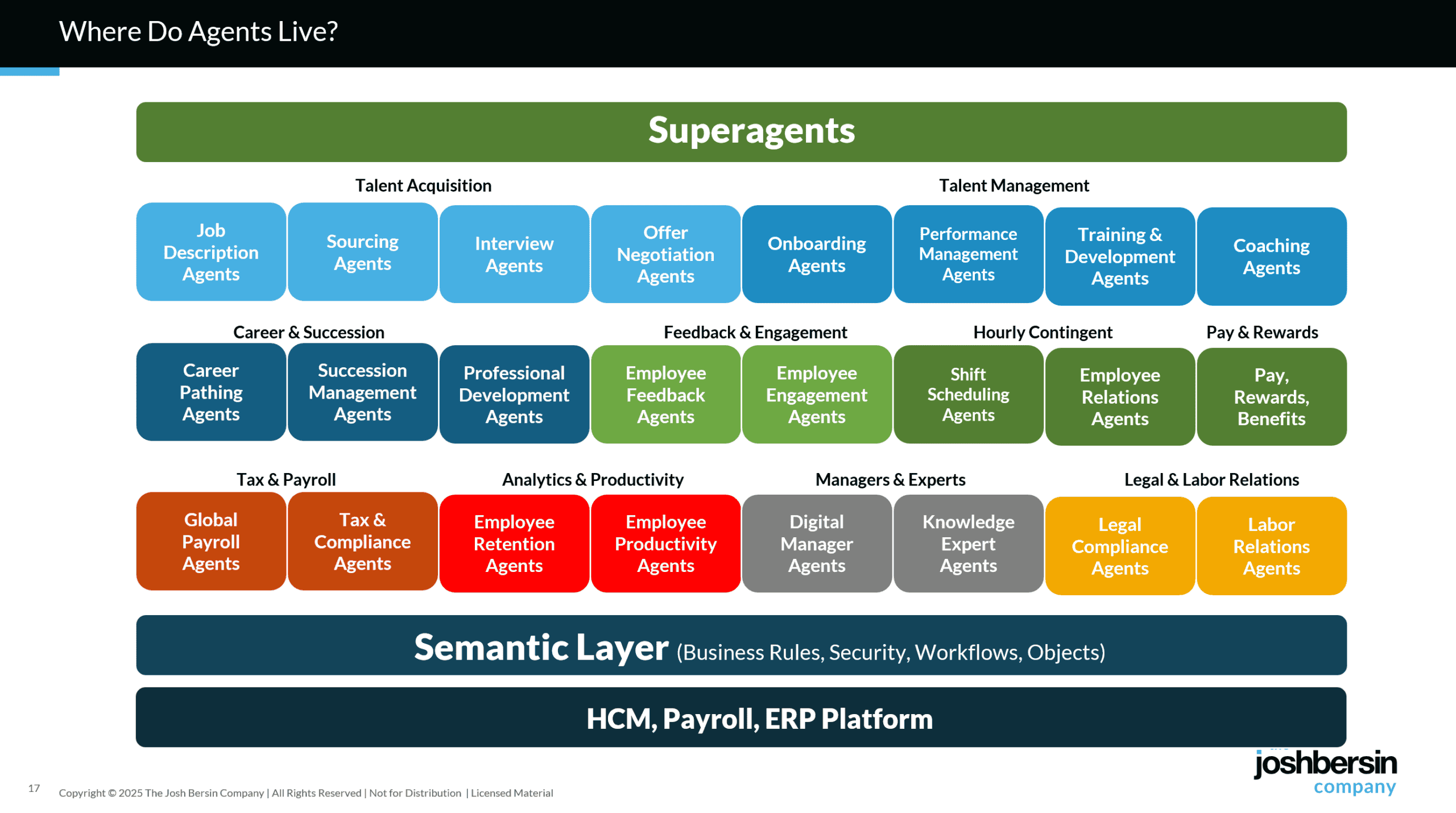
Leading HCM vendors, including Workday, Oracle, and SAP, already possess robust semantic layers—such as Workday’s Business Process Framework—and are actively integrating them into their agent development tools. This strategic move positions them to offer more contextually aware and compliant agent solutions. Consequently, any HR agent or agent development tool will likely seek to leverage this indispensable layer of organizational intelligence. This trend might even challenge earlier predictions of a "SaaSpocalypse," suggesting a more integrated and enduring ecosystem of enterprise software.
Gloat’s Strategic Gambit: Loomra and Agentic HR
Gloat’s latest offering, Gloat Agentic HR, is positioned as a solution designed to liberate organizations from the constraints of traditional, siloed approaches. The company has developed an agent-driven, auto-discovery "injector" that systematically mines entities, workflows, and business rules from existing HCM systems. Crucially, this injector remains synchronized with the HCM as it undergoes changes, effectively replicating the essential rules and objects of the core system. This replicated semantic layer, named Loomra, serves as the foundation upon which organizations can easily build custom applications and agents.
Gloat further enhances its platform with an intuitive agent builder, enabling users to visually construct their own agents. These agents can then be deployed directly into popular platforms such as Microsoft Teams, Copilot, and Slack. The company has already developed pre-built agents addressing key HR functions where it possesses deep expertise, including Workforce Redeployment, Career Development, Internal Talent Sourcing, Succession Planning, and Learning & Reskilling.
The Power of Workforce Context: Gloat’s Differentiator
What sets Gloat’s Agentic HR platform apart is the robust workforce context layer that underpins it. Gloat’s Workforce Context Engine, Loomra, is built upon nearly a decade of experience analyzing enterprise-scale workforce data. It models skill adjacencies, career trajectories, organizational patterns, and workforce relationships across millions of employees globally. This extensive dataset and sophisticated modeling allow Gloat’s agents to transcend mere information retrieval. Instead of simply answering queries like "show me employees who know Python," these agents can proactively reason about which employees are best positioned for a transition into AI engineering roles this year, identify teams most vulnerable to future skill gaps, and recommend optimal talent redeployment strategies in response to evolving business priorities.
Competitive Landscape and Future Implications
Gloat’s approach presents a compelling proposition: organizations can potentially "start with Gloat" to accelerate their AI agent adoption without waiting for their incumbent HCM vendors to develop comparable functionalities. The open nature of the Gloat platform also facilitates integration with other internal systems. Gloat’s context engine, powered by Loomra, appears to be a unique asset, as few, if any, other HCM vendors have developed a comparable system.
However, the market for agent tools is intensely competitive. Organizations already deeply invested in specific ecosystems will likely gravitate towards solutions offered by their primary vendors. ServiceNow users will lean on ServiceNow’s capabilities, Workday customers on Sana, Oracle customers on Oracle AI Studio, and SAP customers on Joule Studio. Gloat faces the challenge of demonstrating that its tools are not only easier to use and fully integrated but also demonstrably more context-aware than competing offerings. As the enterprise IT landscape shifts from "systems of record" to "systems of context," Gloat’s ability to deliver on its promise of rich workforce intelligence could position it as a leader in this transformative market.
The evolution of application development tools has historically seen new platforms emerge, with companies often adopting solutions that align with their existing infrastructure. Gloat’s innovative platform represents a significant advancement for the agent industry, pushing the boundaries of what is possible in HR technology. The true impact and adoption rates will become clearer as early customers begin to leverage these new capabilities and share their experiences.
Broader Impact and Analysis
Gloat’s entry into the AI agent space for HR signifies a maturing market where differentiation is increasingly found in the ability to leverage deep contextual understanding rather than just raw data processing. The emphasis on Loomra, Gloat’s semantic layer, highlights a critical industry trend: the recognition that business rules and organizational context are the true drivers of value. By offering a tool that can effectively ingest and interpret these complex elements, Gloat aims to empower organizations to build more intelligent, responsive, and employee-centric HR functions.
The implications for HR departments are substantial. Organizations that effectively adopt agentic AI can anticipate:
- Enhanced Employee Experience: Personalized career pathing, proactive support, and streamlined HR processes can significantly improve employee satisfaction and engagement.
- Optimized Talent Management: More efficient internal mobility, targeted skill development, and data-driven succession planning can lead to a more agile and resilient workforce.
- Increased Operational Efficiency: Automation of routine tasks, faster decision-making, and reduced administrative burden can free up HR professionals to focus on strategic initiatives.
- Improved Compliance and Risk Management: Agents trained on specific business rules can help ensure adherence to policies and regulations, reducing the risk of errors and non-compliance.
However, the success of Gloat, and indeed the broader adoption of AI agents in HR, will depend on several factors:
- Ease of Integration: The ability to connect seamlessly with existing HCM systems and other enterprise applications will be paramount.
- User Experience: Intuitive interfaces and straightforward agent development tools will be crucial for widespread adoption by HR professionals and even business users.
- Demonstrable ROI: Organizations will require clear evidence of how these investments translate into tangible business benefits, such as cost savings, productivity gains, or improved talent outcomes.
- Trust and Security: As AI agents handle sensitive employee data, robust security measures and transparent data governance practices will be non-negotiable.
The competitive landscape is likely to remain dynamic. As established vendors like Workday, Oracle, and SAP enhance their own AI agent capabilities, and as new players continue to emerge, the pressure to innovate and deliver superior value will intensify. Gloat’s strategic move, backed by its robust workforce context engine, positions it as a significant contender in this rapidly evolving arena, promising to reshape how organizations leverage AI for their most valuable asset: their people. The coming months and years will reveal how effectively Gloat and its competitors can navigate this complex and transformative technological frontier.