The mandate for a modern Chief Learning Officer (CLO) often begins with a clear, measurable objective: deploy an artificial intelligence copilot across multiple business units, establish a comprehensive enablement curriculum, certify management, and track progress through an interactive dashboard. On the surface, such a rollout appears successful when the data points indicate high completion rates and widespread tool access. However, evidence from the corporate frontlines suggests that 18 months into these initiatives, a profound divide often emerges. While a small percentage of teams successfully integrate the technology to sharpen their workflows, a significant majority frequently treat the tool as a bureaucratic mandate, leaving it open but unutilized. This disparity highlights a critical flaw in traditional corporate training: the focus on technical adoption over the fluid circulation of human knowledge.
The Crisis of Silent Learning and the Limits of Adoption
The primary challenge facing organizations in the AI era is not the availability of technology, but the "silence" that surrounds its use. When a team successfully masters a new AI-driven workaround, that knowledge often remains trapped within that specific unit. Conversely, when teams struggle or find the tool cumbersome, they rarely voice these frustrations for fear of appearing obsolete or "behind the curve." This dual silence is rooted in a lack of psychological safety. Employees often feel that admitting confusion is a confession of falling behind, while sharing an unauthorized "rogue" efficiency carries the risk of disciplinary scrutiny.
By the time a CLO schedules a standard refresher course, the technology has often evolved, rendering the original curriculum outdated. This creates a cycle where the pace of technological change far outstrips the pace of traditional organizational learning. The issue is no longer just about adoption—it is about circulation. Without a system that allows knowledge to move through an organization in real-time, the massive investments currently being funneled into AI are at risk of yielding diminishing returns.
The Current Landscape: AI Investment vs. Human Readiness
The scale of this challenge is underscored by recent industry data. According to research by the Boston Consulting Group (BCG), organizations are currently moving to double their AI investments as a share of total revenue. Furthermore, 72 percent of CEOs report that they are now personally directing AI strategy, signaling that AI capability is no longer a peripheral IT concern but a core pillar of leadership attention.
Despite this executive focus, a significant gap remains between technological investment and human integration. Deloitte’s Global Human Capital Trends report indicates that while 70 percent of business leaders identify speed and organizational nimbleness as their top competitive strategy through 2029, 59 percent of organizations still rely on a purely tech-focused approach to AI implementation. The data reveals a stark consequence for this oversight: organizations that fail to infuse technology with human-centered design are 1.6 times more likely to fall short of their expected returns compared to those that prioritize trust, judgment, and psychological safety.
The employee perspective further highlights this disconnect. Udemy’s 2026 Global Learning and Skills Trends Report found that while 88 percent of employees believe effective leadership is critical for AI initiatives to succeed, only 48 percent believe their own managers are actually "AI-ready." This suggests that the very link in the chain responsible for reinforcing learning—middle management—is often the least prepared and the most hesitant to admit their own lack of expertise.
Chronology of a Failed vs. Successful AI Integration
To understand how organizations can pivot from a "cascade" model to a "circulation" model, it is helpful to examine the typical 24-month timeline of an AI rollout.
Months 1-3: The Launch Phase.
In a traditional model, this involves top-down announcements and mandatory modules. Success is measured by "log-ins." In a human-centered model, this phase begins with senior leaders modeling vulnerability, admitting what they do not yet know about the tool.
Months 4-9: The Trough of Disillusionment.
In the traditional model, usage plateaus. The "silent adopters" find shortcuts but don’t share them; the "silent resistors" go back to manual processes. In the circulation model, "rapid-cycle inquiry" begins. Short, structured listening sessions are held to identify where the tool is failing to meet actual workflow needs.
Months 10-18: The Divergence.
By month 18, the traditional organization sees a "checked box" on the dashboard but no measurable increase in productivity. In the circulation organization, the frontline becomes a source of innovation. A workaround developed by a regional team is identified, vetted, and circulated globally within weeks, not months.

Month 24: Maturity.
The successful organization has moved beyond teaching the "how-to" of the tool and is now focusing on "judgment"—teaching employees when to trust AI outputs and when to interrogate them for bias or inaccuracy.
From Cascade to Circulation: A Structural Shift
The traditional architecture of corporate learning assumes a "cascade": knowledge is designed at the executive or L&D level and pushed downward. This is a unidirectional, single-loop system. It can correct an error in output, but it cannot question the underlying assumptions of the work.
In contrast, a "circulation" model utilizes double-loop learning. In this system, the frontline is not the final destination for information; it is the primary source. Adaptive leadership treats the organization as a system of multidirectional loops. For these loops to carry a "real signal," employees must believe two things: first, that their feedback will actually result in change, and second, that speaking up will not be used against them.
This requires a humanizing mindset that prioritizes people, purpose, and presence over simple process. When a leader models "not-knowing" in real-time, it sets a cultural norm that allows others to do the same. This "adaptive intelligence" allows the organization to sense a live signal and act on it immediately, rather than waiting for a formal quarterly review.
The Role of Agentic AI as a Listening Partner
Paradoxically, the same technology that creates the need for new learning can also facilitate it. "Agentic AI"—AI systems capable of independent action and pattern recognition—is beginning to be used as an internal "sensing infrastructure." A handful of pioneering organizations are using AI to identify patterns of divergence in how different teams use software.
For example, if AI detects that four unconnected teams have independently developed a unique way to use a copilot for financial modeling, it can flag this to the L&D team. The human leaders then decide how to validate and circulate that "rogue" innovation. However, experts warn that this must be framed as a high-trust listening mechanism, not a surveillance tool. The moment employees feel that AI is being used to monitor their "behindness," the candor required for a circulatory system disappears.
Redesigning Potential Around Teams and Equity
As AI takes over the procedural "how-to" of work, the curriculum of the future shifts toward "power skills": reflexivity, ambiguity management, and, most importantly, judgment. Potential is no longer defined by what an individual can be trained to do, but by how quickly a team can recombine its human and machine capabilities around a specific project.
This shift also necessitates a focus on equity. A circulatory model built without intentionality can inadvertently re-concentrate power. Those already closest to the center of power—the visible, the credentialed, and the fluent—are the most likely to have their AI experimentations noticed and rewarded. Meanwhile, the insights of contract staff, frontline workers, or those on different shifts may fade away. A humanizing mindset ensures that learning systems extend beyond traditional power structures, creating a "psychological safety net" that allows knowledge to flow from all levels of the hierarchy.
Strategic Recommendations for the Next Two Quarters
For organizations looking to move from a cascade to a circulation model, the transition does not require a massive platform migration, but rather a series of deliberate design choices:
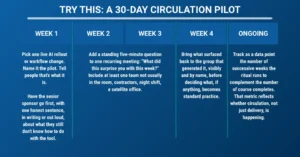
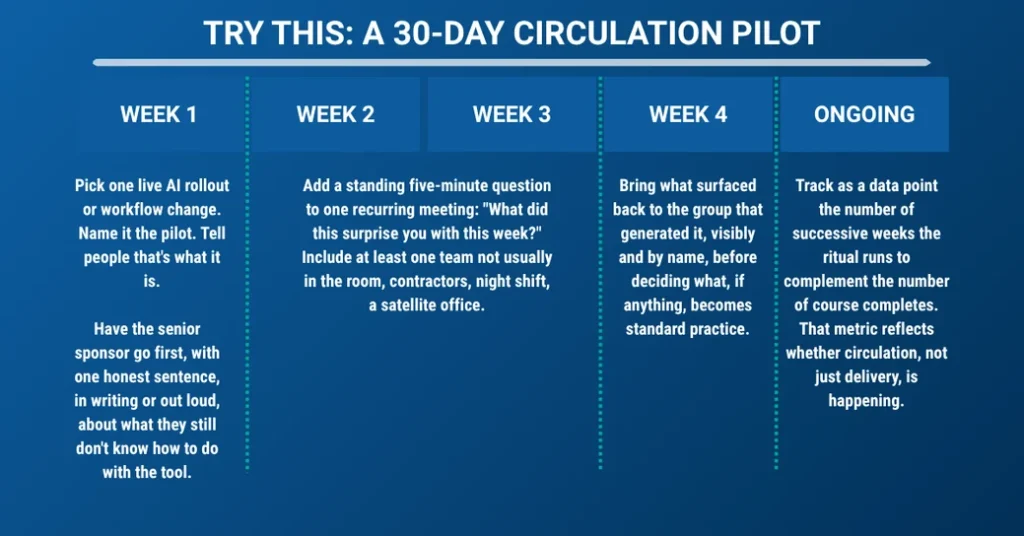
- Implement Standing Inquiry: Choose a current AI initiative and build a five-minute "inquiry slot" into every team meeting. Ask: "How did the tool surprise you this week?" or "What are we assuming about this tool that we haven’t tested?"
- Model Vulnerability: Require senior leaders to publicly share a "prompt failure" or a moment of confusion regarding AI before asking subordinates for their input.
- Trait-Mapping: Move away from fixed job descriptions. Map specific human strengths—such as interpersonal sensitivity or future-focus—to active projects, and then embed AI where it best supports those specific human traits.
- Widen the Sensing Net: Ensure that feedback mechanisms include those often left out of the corporate loop, such as night-shift workers or external contractors, treating their frontline experience as a primary design input.
Conclusion: The CLO as Learning Architect
The role of the Chief Learning Officer is undergoing a fundamental transformation. In an era defined by volatility, the CLO must move from being a "curriculum owner" to a "learning architect." The goal is no longer to manage change, but to design a system that produces continuous connection and resilience.
Ultimately, the organizations that thrive in the AI era will be those that realize technology is only as effective as the human network it inhabits. AI has opened a portal for organizational growth, but that portal only remains open if people feel safe to share what they know—and what they don’t. A system that circulates knowledge rather than simply cascading instructions creates a durable habit of learning that serves as the ultimate competitive advantage in a rapidly shifting global economy.