The landscape of corporate Learning and Development (L&D) is currently defined by a profound paradox: while Artificial Intelligence (AI) is heralded as the most transformative force in the history of workplace education, the actual implementation of these technologies remains strikingly low. According to new industry research, a significant "expectation gap" has emerged between the developers of learning technologies and the organizations that use them. While technology vendors are rapidly integrating AI into their core offerings, L&D buyers are moving with a level of caution that suggests a shift from the initial hype of generative AI toward a more pragmatic, value-driven approach.
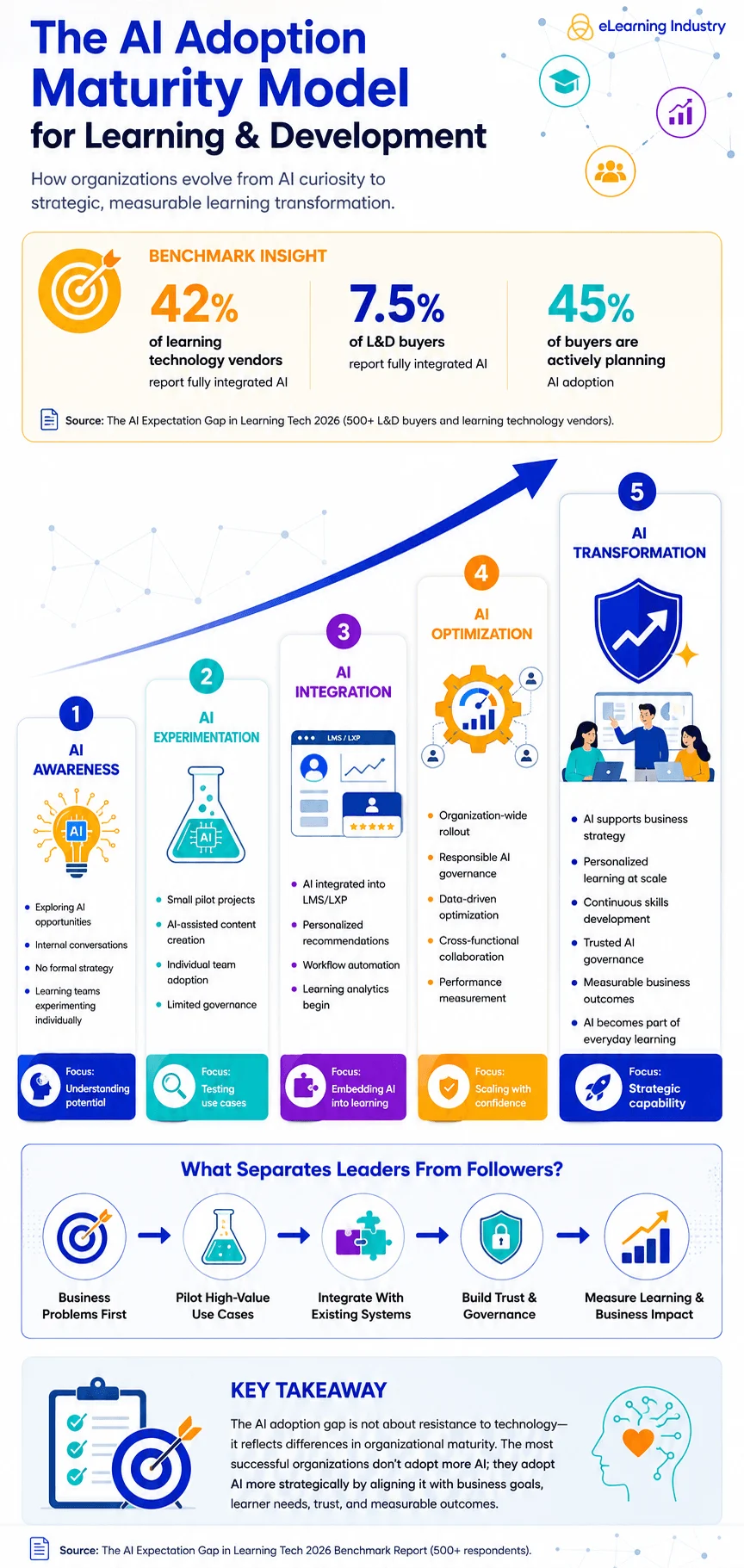
Recent benchmarks from eLearning Industry, compiled from a survey of over 500 L&D buyers and technology vendors, reveal that 42% of vendors have already fully integrated AI into their products. In contrast, only 7.5% of L&D buyers report having successfully incorporated AI into their daily learning strategies. This disparity highlights a critical bottleneck in the digital transformation of the workplace, suggesting that the mere availability of advanced technology does not equate to its effective adoption. As the industry moves toward 2026, the challenge for organizations is no longer about accessing AI, but about bridging the gap between technological capability and measurable business outcomes.
The Current State of AI Integration: Data and Discrepancies
The push for AI in the workplace is not a matter of lack of interest. The research indicates that 45% of organizations are currently planning to adopt AI, while 82% of respondents consider AI capabilities to be a significant factor when evaluating new learning technologies. Specifically, 37% of buyers view AI as "extremely important" and 45% view it as "moderately important."
However, the "AI Expectation Gap" is most visible in the maturity levels of these two groups. Vendors are essentially building for a future demand that they anticipate will explode, while buyers are still in the diagnostic phase, attempting to identify where AI can deliver genuine, non-superficial value. This lag is not necessarily a sign of technological resistance but rather an indication of the complexity involved in modernizing legacy learning ecosystems.
For many organizations, the adoption of AI is not a simple software update. It requires a holistic overhaul of learning processes, including the synchronization of AI tools with existing Learning Management Systems (LMS) and Learning Experience Platforms (LXP). Furthermore, it demands robust change management strategies to ensure that employees and managers are not only capable of using the tools but are also comfortable with the data-driven insights they provide.
Barriers to Adoption: Why Organizations Are Hesitating
The slow pace of AI adoption in L&D can be attributed to several structural and strategic barriers. For the modern L&D leader, the decision to implement AI is viewed as a business choice rather than a technological race. Several key factors are driving this cautious sentiment:

1. The Prioritization of Business Value Over Innovation
Corporate leaders are increasingly demanding proof of Return on Investment (ROI) before authorizing the deployment of AI-powered tools. The primary questions being asked are pragmatic: Will this reduce the time required for Instructional Designers to create content? Will it demonstrably improve employee performance? Will it solve specific skill gaps that traditional methods have failed to address? If a platform offers AI features that do not directly contribute to these goals, it is often viewed as a "nice-to-have" rather than a necessity.
2. The Dominance of User Experience (UX)
Despite the focus on AI, the research shows that fundamental platform qualities still outweigh AI features in the selection process. User Experience (70%), pricing (63%), and ease of integration (59%) remain the top priorities for buyers. AI capabilities, by comparison, were cited as a top priority by only 30% of respondents. This suggests that even the most sophisticated AI assistant is seen as secondary to a platform that is intuitive, affordable, and compatible with existing workflows.
3. Technical and Systemic Integration Challenges
AI does not operate in a vacuum. To be effective, it must be deeply integrated with Human Resources Information Systems (HRIS), analytics platforms, and internal content libraries. Many organizations struggle with fragmented data silos that make it difficult for AI to provide accurate, personalized recommendations. Without seamless integration, AI tools can actually increase the administrative burden on L&D teams by creating more "disconnected data points" that require manual reconciliation.
4. The "Trust Deficit" and Governance
Trust has become a significant competitive advantage for vendors. Organizations are increasingly concerned with the "black box" nature of some AI algorithms. They require transparency regarding how AI-generated recommendations are made, how data privacy is maintained, and how the system adheres to internal corporate governance policies. The demand for "Responsible AI"—which includes clear processes for data handling and explainability—is now a mandatory requirement for large-scale enterprise adoption.
The Feature Mismatch: What Buyers Want vs. What Vendors Build
One of the most revealing aspects of the 2026 report is the disconnect between the specific AI features being developed and those that buyers actually desire. This mismatch is a primary driver of the adoption gap.
The research shows that Personalized Learning is the most sought-after AI capability, with 65% of buyers identifying it as their top priority. However, only 44% of vendors are currently focusing their development efforts on personalization. Instead, 70% of vendors are prioritizing AI-generated content and automation. While content generation is a valuable tool for efficiency, it does not address the core desire of L&D leaders to provide highly relevant, individualized learning paths for their employees.
This suggests that vendors may be focusing on features that are easier to scale across a broad customer base, such as automated quiz generation or video transcription, while buyers are looking for more complex, data-heavy solutions that improve the actual effectiveness of the learning experience.
A Chronology of AI in L&D: From Experimentation to Maturity
The evolution of AI in the workplace has moved through several distinct phases:
- 2022-2023: The Awareness Phase. Following the public release of large language models, L&D teams began experimenting with AI for basic content creation and brainstorming.
- 2024: The Evaluation Phase. Organizations began to audit their existing tech stacks, realizing that "adding AI" was more complicated than initially thought. This year was marked by a focus on data security and privacy.
- 2025: The Pilot Phase. Companies started launching small-scale pilots, focusing on specific use cases like AI-powered search or basic chatbots for learner support.
- 2026 (Projected): The Value Phase. The focus shifts toward "outcome-based AI." Organizations will likely move away from vendors who offer generic AI features in favor of those who can demonstrate measurable improvements in skill acquisition and job performance.
Strategic Framework for Successful AI Adoption
To overcome these barriers, industry experts suggest a five-step framework for organizations looking to move from planning to execution:
- Identify Business Pain Points: Organizations should avoid "AI for the sake of AI." Instead, they should identify specific bottlenecks, such as a slow onboarding process or low engagement in compliance training, and determine if AI is the right tool to solve them.
- Target Repetitive Tasks: The highest immediate ROI often comes from automating time-consuming administrative tasks. This allows L&D professionals to pivot their focus toward high-level strategy and human-centric coaching.
- Execute High-Impact Pilots: Rather than a global rollout, organizations should test AI in a controlled environment. A pilot program for personalized learning paths in one department can provide the data needed to justify a larger investment.
- Establish Human-in-the-Loop Governance: AI-generated content should never be deployed without human oversight. Establishing clear review processes ensures that the training remains accurate, culturally appropriate, and aligned with company values.
- Measure Outcomes, Not Activity: Success should not be measured by how many people used an AI chatbot, but by how much time was saved or how much performance improved. Organizations must align their AI metrics with their overall business KPIs.
Implications for the Future of Workplace Learning
The current gap in AI adoption suggests that the "gold rush" era of AI in L&D is ending, replaced by a period of rigorous vetting and strategic alignment. The organizations that will succeed in the long term are those that treat AI as a core component of their business infrastructure rather than a superficial add-on.
For vendors, the message is clear: innovation must be tempered with utility. Building more features is less important than building the right features—specifically those that enhance personalization and integrate smoothly into the learner’s daily flow of work.
As AI continues to evolve, the distinction between "learning technology" and "performance technology" will likely blur. AI has the potential to move learning out of the classroom and directly into the moment of need, providing real-time coaching and support. However, reaching this level of maturity requires L&D leaders to bridge the expectation gap by focusing on trust, usability, and, above all, the human element of the learning experience. The future of L&D is not a choice between humans and machines, but a synthesis of both to drive organizational growth in an increasingly complex global economy.