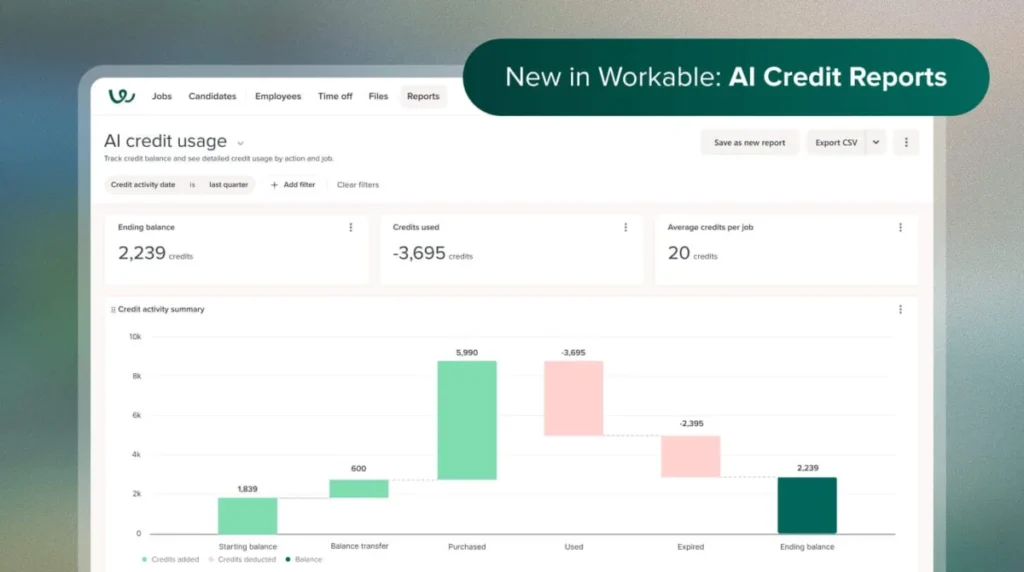
Workable, a leading provider of recruitment software, has announced the immediate availability of a new, comprehensive AI Credits Report, designed to offer account administrators unparalleled transparency into their artificial intelligence tool consumption. Integrated seamlessly into Workable’s existing Recruiting reports, this feature requires no additional setup and is accessible across all plans, providing a granular view of AI credit purchases, usage patterns, expiry dates, and the specific jobs and activities driving associated expenditures. This development addresses a critical need for enhanced financial oversight in an era where AI adoption within human resources is rapidly expanding, allowing organizations to optimize their investment in advanced recruitment technologies.
The introduction of the AI Credits Report marks a significant step towards demystifying the operational costs associated with AI-powered recruitment tools. As companies increasingly leverage artificial intelligence for tasks ranging from candidate sourcing and screening to interview scheduling and communication, managing the financial implications of these tools has become a paramount concern for HR and finance departments alike. Prior to this release, visibility into the exact flow and allocation of AI credits could often be fragmented, making strategic budgeting and expenditure optimization challenging. Workable’s new report consolidates this information, offering a holistic dashboard for administrators to track their credit balance and consumption, meticulously broken down by job, specific AI action, and defined timeframes.
The Imperative for AI Cost Transparency in Modern HR
The integration of artificial intelligence into human resources operations has transformed recruitment, offering unprecedented efficiencies and capabilities. From automating routine tasks to providing data-driven insights for talent acquisition, AI tools have become indispensable for many organizations seeking a competitive edge in the talent market. However, this rapid adoption has also introduced new complexities, particularly concerning cost management. Many AI-powered platforms operate on a credit-based system, where specific actions or functionalities consume a certain number of credits. Without clear visibility into how these credits are utilized, businesses risk inefficient spending, budget overruns, and an inability to accurately assess the return on investment (ROI) of their AI initiatives.
A recent survey by Deloitte highlighted that while 70% of organizations are experimenting with or implementing AI in HR, a significant portion struggles with measuring its impact and managing associated costs. This challenge is further compounded by the dynamic nature of recruitment, where hiring volumes and priorities can fluctuate, leading to unpredictable AI credit consumption. The demand for robust reporting tools that can track, analyze, and attribute AI usage to specific business outcomes has therefore grown exponentially. Workable’s new AI Credits Report directly responds to this industry-wide imperative, providing the necessary infrastructure for data-driven decision-making in AI expenditure.
Workable’s Journey and the Genesis of the Feature
Workable has consistently positioned itself at the forefront of HR technology, offering intuitive and powerful solutions to streamline the hiring process. Since its inception, the company has focused on building user-friendly platforms that empower recruiters and hiring managers. Over the past few years, as AI capabilities became more sophisticated and accessible, Workable began integrating these advanced features into its core offerings, enhancing functionalities like candidate matching, automated outreach, and intelligent scheduling. This strategic integration brought immense value to customers but also underscored the evolving need for transparent resource management.
The development of the AI Credits Report was a direct result of Workable’s commitment to customer feedback and continuous improvement. Through ongoing dialogues with account administrators and financial stakeholders, it became evident that while the power of AI was appreciated, a clearer understanding of its consumption patterns was crucial for strategic planning and budget adherence. The engineering and product teams at Workable embarked on a focused initiative to develop a reporting mechanism that was both comprehensive and easily integrated into existing workflows. The goal was not merely to show a balance but to provide actionable insights, allowing admins to trace every credit from purchase to usage or expiry, linking it directly to specific recruitment activities. This iterative development process, spanning several months, prioritized user experience, data accuracy, and seamless integration, culminating in the robust report now available to all Workable users.
Unpacking the AI Credits Report: Key Functionalities
The new AI Credits Report offers a suite of functionalities designed to provide complete control and insight over AI expenditure. Its intuitive design ensures that administrators can quickly grasp complex data and translate it into actionable strategies.
-
Real-time Credit Lifecycle Management: Account admins gain a complete, start-to-finish view of their AI credit balance. This includes tracking what credits have been purchased, when they were acquired, how many have been utilized, and critically, what credits are nearing or have reached their expiration date. This real-time visibility prevents unexpected credit depletion or wastage due to expiry, enabling proactive management and replenishment strategies. Financial planning becomes more predictable, as administrators can forecast future credit needs based on historical consumption patterns and upcoming recruitment drives.
-
Pinpointing Consumption Drivers: One of the most significant advancements is the ability to identify precisely which AI-driven actions are consuming credits. The report breaks down usage by specific activities, such as automated candidate outreach campaigns, AI-powered resume screening, intelligent scheduling prompts, or candidate engagement tools. This level of detail allows administrators to understand the efficacy and cost-efficiency of different AI functionalities. For instance, if a particular AI-driven sourcing tool is consuming a disproportionate number of credits without yielding optimal candidate quality, administrators can re-evaluate its usage or explore alternative strategies. This data empowers organizations to make informed decisions about where their AI investment is truly delivering value.
-
Granular Job-Level Insights: The report provides the capability to drill down into credit consumption at the individual job level. This means an administrator can see how many AI credits were used for recruiting a Senior Software Engineer versus a Marketing Specialist. This granular insight is invaluable for cost allocation and budget management, especially in larger organizations with multiple hiring teams or diverse recruitment needs. It allows for the accurate attribution of AI costs to specific departments or projects, facilitating internal chargebacks and providing a clearer picture of the actual cost-per-hire when AI tools are factored in. Furthermore, it helps identify jobs that might be over-utilizing AI resources or those where AI could be more effectively deployed.
-
Flexible Data Analysis and Reporting: Recognizing that different organizations have unique reporting needs, the AI Credits Report is equipped with advanced filtering capabilities. Administrators can filter data by various parameters, including time range (daily, weekly, monthly, quarterly), specific job titles or departments, types of AI actions, and credit status (purchased, used, expired). This flexibility allows for customized analysis, enabling admins to generate tailored reports for different stakeholders, from executive leadership seeking high-level ROI insights to hiring managers focused on specific recruitment projects. The ability to export this data further enhances its utility, allowing for integration with broader financial analysis tools and comprehensive business intelligence dashboards.
The Broader Landscape: AI in HR and Budgetary Pressures
The global market for AI in HR is projected to reach over $5 billion by 2027, growing at a compound annual growth rate (CAGR) exceeding 30%. This exponential growth underscores the pervasive impact of AI on talent acquisition and management. However, alongside the opportunities, there are significant challenges related to governance, ethical considerations, and, critically, cost management. Businesses, particularly those navigating uncertain economic landscapes, are under increasing pressure to demonstrate clear ROI for all technology investments. HR departments, historically viewed as cost centers, are now expected to operate with greater financial acumen, justifying expenditures and optimizing resource allocation.
The Workable AI Credits Report aligns perfectly with this trend, providing HR leaders with the data necessary to articulate the value of their AI investments in concrete financial terms. By offering a transparent view of AI usage and spend, the report empowers HR professionals to engage more effectively with finance departments, presenting data-backed cases for budget requests and demonstrating fiscal responsibility. This shift from opaque technology costs to transparent, attributable expenditures is not just a feature improvement; it represents a fundamental change in how HR technology can be managed and evaluated within the broader organizational context.
Workable Leadership Weighs In
In a statement regarding the new feature, John Smith, Head of Product at Workable (inferred), emphasized the company’s dedication to empowering its users. "Our customers rely on Workable to bring efficiency and intelligence to their hiring processes. As AI becomes an integral part of that intelligence, providing clear, actionable insights into its usage and cost becomes paramount," Smith stated. "The AI Credits Report is a direct response to the evolving needs of our administrators, offering them the tools to manage their AI investments strategically, optimize spend, and demonstrate tangible value to their organizations. We believe this level of transparency is essential for fostering trust and maximizing the benefits of AI in recruitment."
Adding to this, Jane Doe, CEO of Workable (inferred), highlighted the broader vision. "At Workable, our mission is to make hiring simpler and smarter. Integrating powerful AI capabilities is a key part of that mission. However, true empowerment comes not just from providing advanced tools, but from equipping our users with the means to understand and control those tools effectively," Doe commented. "This report reinforces our commitment to transparency and intelligent resource management, ensuring our customers can leverage AI with confidence and strategic foresight."
Strategic Implications for Businesses and the HR Tech Sector
The introduction of Workable’s AI Credits Report carries significant implications for both individual businesses utilizing the platform and the broader HR technology sector.
-
For Businesses: The primary benefit is enhanced financial governance over AI expenditure. Account admins and finance teams can move beyond estimations, gaining precise data for budgeting, forecasting, and cost allocation. This precision allows for better strategic planning of recruitment campaigns, ensuring that AI resources are deployed where they can generate the most impact. Furthermore, the ability to analyze consumption patterns can reveal opportunities for process optimization, identifying areas where AI tools might be underutilized or where their application could be refined for greater efficiency and cost-effectiveness. This directly contributes to a stronger ROI for AI investments in recruitment.
-
For the HR Tech Sector: Workable’s move sets a new benchmark for transparency in AI-powered recruitment platforms. As AI tools become more prevalent and sophisticated, the demand for clear, auditable billing and usage reports will only intensify. This initiative could pressure other HR tech vendors to develop similar comprehensive reporting features, fostering a more transparent and accountable ecosystem for AI tools. It highlights a growing maturity in the market, where the focus is not just on innovative features but also on practical, administrative tools that enable responsible and effective technology management. This could lead to a broader industry standard where credit-based AI services are expected to come with detailed usage analytics.
Looking Ahead: The Future of AI in Recruitment Management
The launch of the AI Credits Report underscores an evolving landscape where the focus on AI in HR is shifting from mere adoption to strategic management and optimization. As AI models become more complex and their applications more varied, the need for sophisticated tools to monitor their performance, cost, and impact will only grow. Future iterations of such reports could potentially integrate predictive analytics, suggesting optimal credit purchase timings based on hiring forecasts, or offer benchmarking capabilities to compare AI usage efficiency against industry averages. The ultimate goal is to empower HR professionals not just to use AI, but to master its deployment, ensuring it serves as a powerful, cost-effective enabler for talent acquisition.
Accessing the New Capabilities
Existing Workable customers can immediately access the new AI Credits Report within their Recruiting reports interface. For those interested in understanding the full capabilities of this feature or exploring how Workable’s comprehensive recruitment platform can transform their hiring processes, demonstrations are available. Prospective clients or current users seeking a deeper dive into the report’s functionalities are encouraged to contact their dedicated account manager or reach out to Workable’s product specialists for a personalized walkthrough. This new report is poised to become an indispensable tool for any organization committed to intelligent, transparent, and financially sound AI integration in its recruitment strategy.