In an era defined by rapid technological shifts and increasingly complex operational environments, situational awareness (SA) has transitioned from a specialized military concept to a cornerstone of modern corporate resilience. Once the exclusive domain of fighter pilots and elite combat units, the ability to perceive, process, and project environmental information is now recognized as a critical skill set for employees across every sector, from healthcare and manufacturing to retail and corporate finance. As organizations grapple with heightened safety standards, cybersecurity threats, and the need for agile decision-making, the implementation of structured situational awareness training has become a strategic priority for leadership teams worldwide.
The fundamental objective of situational awareness training is to equip personnel with the cognitive tools necessary to identify environmental cues, understand their significance, and anticipate potential outcomes before they manifest as crises. In high-stakes environments, the difference between a successful intervention and a catastrophic failure often rests on a few seconds of observation and the correct interpretation of a subtle anomaly. By institutionalizing these skills, organizations are moving away from reactive "incident management" toward a proactive culture of "risk anticipation."
The Evolution of Situational Awareness: A Historical Chronology
The concept of situational awareness finds its roots in the early days of military aviation. During World War I, the term was used informally by pilots who recognized that "seeing the enemy first" was the primary determinant of survival in aerial combat. However, it was not until the post-World War II era that the concept underwent rigorous scientific scrutiny.
- The 1950s-1970s: The OODA Loop: Col. John Boyd of the United States Air Force developed the OODA loop (Observe, Orient, Decide, Act). While not titled "situational awareness" at the time, this framework provided the first structured approach to decision-making in fast-paced, life-threatening environments.
- The 1980s: Formalization by Dr. Mica Endsley: The modern definition of situational awareness was largely established by Dr. Mica Endsley, a former Chief Scientist of the U.S. Air Force. Her research into human factors and cognitive engineering led to the creation of the three-level model of SA, which remains the industry standard for training programs today.
- The 1990s: Expansion into High-Reliability Organizations (HROs): Following several high-profile industrial disasters and medical errors, fields such as nuclear power generation and surgery began adopting SA principles to reduce "human error," which was identified as a contributing factor in over 70% of workplace accidents.
- The 2000s to Present: Universal Adoption: The digital revolution and the rise of global supply chains have expanded the need for SA. Today, it is applied to cybersecurity (threat detection), retail (loss prevention), and corporate leadership (market volatility).
The Theoretical Framework: Endsley’s Three Levels of Awareness
To build an effective training program, organizations must understand that situational awareness is not a single "instinct" but a three-stage cognitive process. Training failures often occur when programs only focus on the first stage without addressing the higher-level thinking required for the latter two.
Level 1: Perception (Gathering Data)
The foundation of SA is the perception of the status, attributes, and dynamics of relevant elements in the environment. In a warehouse setting, this might involve noticing a forklift driver who is not looking at their blind spot. In a corporate office, it could be identifying a suspicious email that mimics a vendor’s invoice. Training at this level focuses on "sensory discipline"—teaching employees what to look for and how to filter out irrelevant "noise."
Level 2: Comprehension (Synthesizing Information)
Comprehension goes beyond mere observation. It involves the integration of Level 1 data to understand how it impacts the individual’s goals. An experienced nurse does not just see a drop in blood pressure (Perception); they understand that in the context of the patient’s recent surgery, it signifies internal hemorrhaging (Comprehension). Training here relies heavily on "mental models" and past experience.
Level 3: Projection (Anticipating the Future)
The highest level of SA is the ability to project the future actions of elements in the environment. This is the "proactive" stage. An IT professional who sees a surge in failed login attempts (Perception) and realizes it is a brute-force attack (Comprehension) will project that a system breach is imminent and take preemptive action to lock down the server (Projection).
Supporting Data: The Cost of Cognitive Failure
The drive toward situational awareness training is supported by staggering data regarding the costs of human error. According to the Occupational Safety and Health Administration (OSHA), workplace injuries cost U.S. businesses over $170 billion annually. Research suggests that a significant portion of these incidents are not due to a lack of technical skill, but a breakdown in situational awareness.
In the healthcare sector, a study by the Joint Commission found that communication failures and a lack of situational awareness were root causes in over 60% of sentinel events (incidents resulting in death or permanent harm). Similarly, in the realm of cybersecurity, the "2023 Verizon Data Breach Investigations Report" highlighted that 74% of all breaches include a human element, often involving a failure to recognize social engineering tactics—a direct failure of Level 1 and Level 2 situational awareness.
Industry-Specific Applications and Training Modalities
While the core principles of SA are universal, the application varies significantly across industries. Modern training programs are increasingly moving away from static classroom lectures toward immersive, high-fidelity simulations.
Healthcare and Patient Safety
In clinical settings, SA training often utilizes "TeamSTEPPS," an evidence-based framework aimed at optimizing patient outcomes by improving communication and teamwork. Hospitals use "huddles" and "debriefs" to ensure every member of the surgical or nursing team has a shared mental model of the current situation. By fostering an environment where a junior nurse feels empowered to "stop the line" when they perceive a risk, organizations significantly reduce preventable errors.
Manufacturing and Heavy Industry
For the manufacturing sector, SA is synonymous with "Safety 2.0." Instead of just following checklists, workers are trained in "hazard recognition." This involves walking the floor and identifying "weak signals"—minor equipment vibrations or slight changes in floor temperature—that could indicate a looming mechanical failure. Companies like Caterpillar and GE have integrated augmented reality (AR) into their training, allowing workers to visualize potential hazards in a controlled, digital environment.
Logistics and Supply Chain
In logistics, SA training focuses on "dynamic risk assessment." Drivers and warehouse operators are trained to manage "attentional tunneling," a phenomenon where a person becomes so focused on one task (like meeting a delivery deadline) that they lose track of their surroundings. Training emphasizes the "search-and-scan" technique used by pilots to maintain a 360-degree view of their operational space.
Corporate and Cybersecurity
In the white-collar world, situational awareness is the first line of defense against cyber threats. Employees are trained to maintain "digital SA," which includes recognizing the psychological triggers used in phishing (urgency, fear, authority). Furthermore, in executive leadership, SA is applied to "environmental scanning," helping leaders detect shifts in market sentiment or geopolitical stability that could affect business continuity.
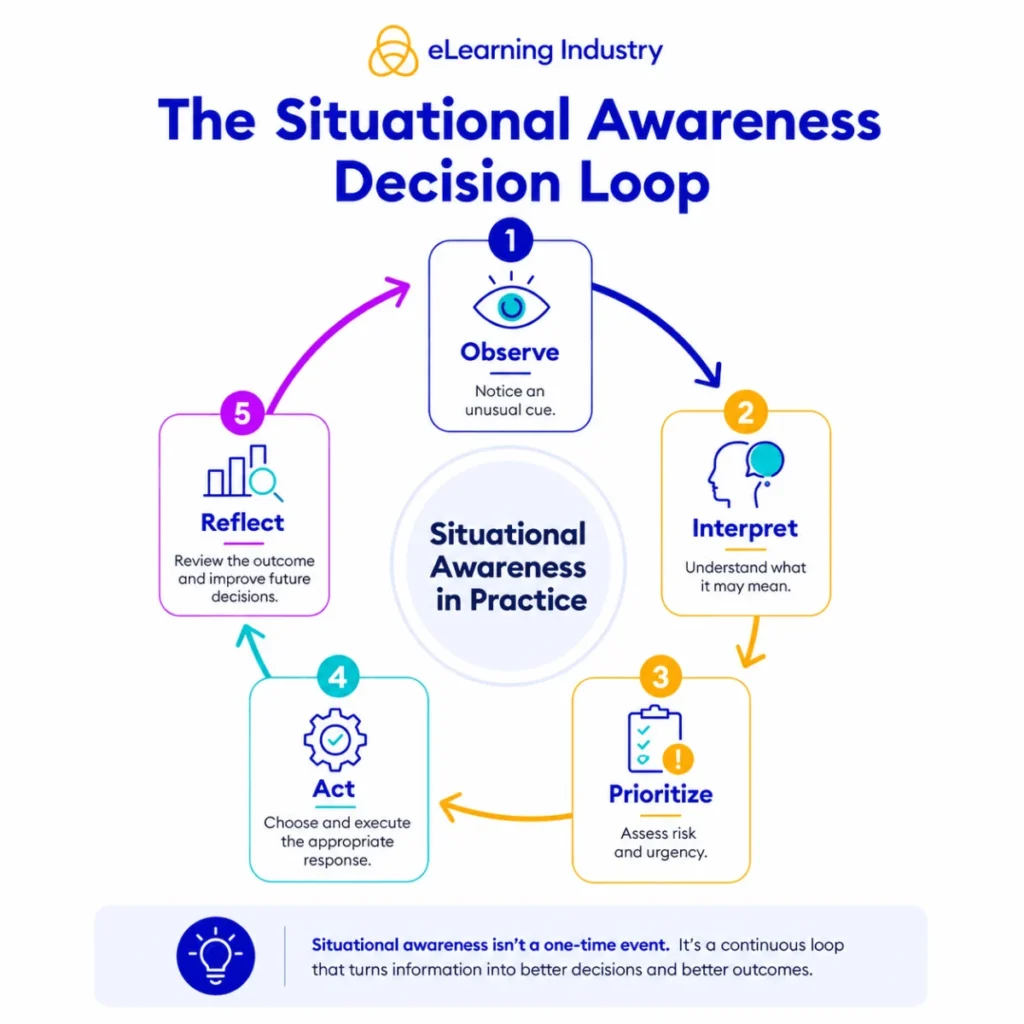
Building an Effective Training Program: The Five-Step Cycle
Organizations that successfully implement SA training follow a structured pedagogical approach that mirrors the cognitive process of awareness itself.
- Observe: Employees are taught to identify "environmental cues." This includes both physical cues (a smell of gas) and behavioral cues (a coworker acting unusually erratic).
- Interpret: Training utilizes case studies to help employees understand the "context." They learn to ask: "Why is this happening now, and what does it mean for our current operation?"
- Decide: This stage focuses on prioritization. In a crisis, an employee may face five different problems at once. SA training teaches them to address the most "time-critical" or "high-consequence" risk first.
- Act: Practical drills, such as fire evacuations or active shooter simulations, ensure that the transition from thought to action is seamless and calm.
- Reflect: The "After-Action Review" (AAR) is perhaps the most critical part of the cycle. By analyzing what went right and what went wrong after a drill or a real-world event, the organization fine-tunes the collective mental models of its workforce.
Expert Perspectives and Official Responses
Industry leaders and safety experts increasingly view SA as a non-negotiable component of professional development. "We can no longer rely on ‘common sense’ in environments that are this complex," says one leading safety consultant for the energy industry. "Common sense is a myth; situational awareness is a trained skill."
Insurance providers have also taken note. Several major commercial insurers have begun offering lower premiums to organizations that can demonstrate a robust, documented situational awareness training program, particularly in high-risk sectors like maritime shipping and chemical processing. This financial incentive underscores the fact that SA is not just a "soft skill" but a quantifiable risk-mitigation strategy.
Broader Impact and Future Implications
The future of situational awareness training lies in the integration of human intelligence with Artificial Intelligence (AI). As AI systems begin to monitor workplace environments through IoT sensors and camera feeds, the role of the human worker will shift toward "supervisory SA." Employees will need to be trained not just to monitor their physical environment, but to monitor the AI that is monitoring the environment.
Furthermore, as remote work becomes a permanent fixture of the global economy, "distributed situational awareness" is becoming a new field of study. How does a team maintain a shared understanding of a project when they are spread across ten time zones? Future training programs will likely focus on digital communication cues and virtual "presence" to bridge the gap created by physical distance.
Ultimately, situational awareness training is about more than just avoiding accidents; it is about building an adaptable workforce. In a world characterized by "VUCA" (Volatility, Uncertainty, Complexity, and Ambiguity), the organizations that thrive will be those whose employees can look at a chaotic situation, understand its components, and move forward with confidence and clarity. By investing in the cognitive resilience of their people, organizations are securing their most valuable asset in an unpredictable future.