As global enterprises accelerate their investments in artificial intelligence, a widening gap has emerged between technical deployment and actual workforce integration. Recent industry data indicates that while the majority of Fortune 500 companies have initiated AI "copilot" rollouts, the results remain starkly bifurcated. In a typical 18-month deployment cycle, organizations frequently observe a small subset of high-performing teams that have successfully integrated AI into their core workflows—improving speed and output quality—while the remainder of the workforce continues to rely on legacy processes, viewing the new technology as a temporary mandate rather than a fundamental shift in operations.
This discrepancy highlights a critical failure in traditional corporate learning models. For decades, the "cascade" model of information—where knowledge is curated at the executive level and pushed downward through rigid curricula—served as the standard for organizational change. However, in the era of generative AI, where the technology evolves faster than quarterly training cycles can accommodate, this top-down approach is proving insufficient. Experts now argue that the primary barrier to AI ROI is not the technology itself, but "circulation"—the ability for learning to move multidirectionally across an organization at the speed of the technology’s own evolution.
The AI Implementation Timeline: From Hype to Structural Realignment
The current corporate struggle with AI adoption follows a distinct three-year chronology that has forced Chief Learning Officers (CLOs) to rethink their strategic value.
Phase 1: The Reactive Surge (Late 2022 – Mid 2023)
Following the public release of advanced large language models, CEOs moved rapidly to establish AI task forces. During this period, the focus was almost entirely on procurement and data security. Learning and Development (L&D) teams were tasked with basic "AI literacy" programs designed to introduce employees to the concept of prompting.
Phase 2: The Pilot Proliferation (Late 2023 – Mid 2024)
Organizations began rolling out specific AI tools—most notably "copilots" for coding, writing, and data analysis—across business units. Success was measured through "adoption rates," defined simply as the number of employees who had logged into the software. This phase saw the emergence of the "checkerboard" adoption pattern, where usage was high in some pockets but virtually non-existent in others.
Phase 3: The Integration Crisis (Late 2024 – Present)
As the initial pilot periods concluded, the limits of the "cascade" model became apparent. Organizations realized that "checking the box" on training did not translate to a change in work habits. This led to the current realization that AI adoption requires a shift in organizational psychology, focusing on psychological safety and the circulation of frontline insights back to leadership.
Supporting Data: The Cost of a Tech-First Approach
The shift toward a more human-centered approach is supported by a growing body of empirical evidence. According to Deloitte’s 2024 Global Human Capital Trends report, approximately 70 percent of business leaders identify organizational nimbleness as their top competitive priority through 2029. Despite this, 59 percent of organizations continue to treat AI as a purely technical implementation rather than a human-centered design challenge.
The financial implications of this misalignment are significant. Research suggests that organizations focusing solely on the technical aspects of AI are 1.6 times more likely to fall short of their expected returns compared to those that integrate the technology with human-centered design. This "human-centered" approach involves designing for trust, judgment, and psychological safety rather than just functional proficiency.
Furthermore, a gap in leadership readiness is undermining these efforts. The Udemy 2026 Global Learning and Skills Trends Report found that 88 percent of employees believe effective leadership is the most critical factor in AI success. However, only 48 percent of those same employees believe their direct managers are actually "AI-ready." This suggests that the middle-management layer—the very people responsible for reinforcing new habits—is the most significant bottleneck in the adoption chain.
The Psychological Barrier: Why Knowledge Stagnates
The primary reason AI learning fails to "circulate" is a lack of psychological safety. In many corporate environments, admitting a lack of proficiency with a new, high-stakes tool is perceived as a confession of obsolescence. Conversely, employees who discover innovative "workarounds" or advanced use cases often keep those insights to themselves, fearing that "going rogue" could lead to disciplinary action or that their discoveries will be used to automate their own roles.
This silence creates two distinct silos: the "silent adopters" and the "quiet resisters." The silent adopters become more efficient but do not share their methods, preventing the organization from scaling their success. The quiet resisters struggle in private, waiting for the "trend" to pass. By the time a CLO schedules a refresher course, the underlying technology has often evolved, rendering the original curriculum obsolete and leaving both groups further behind.
From Single-Loop to Double-Loop Learning
To address this, organizational theorists point to the concept of "double-loop learning," a term coined by Chris Argyris.

- Single-loop learning involves correcting an error within a given set of rules (e.g., teaching an employee how to write a better prompt for a specific task).
- Double-loop learning involves questioning the rules and assumptions themselves (e.g., questioning whether the task itself should still exist in its current form given the capabilities of AI).
A traditional training "cascade" is a single-loop system. It can adjust an output, but it cannot touch the logic beneath it. A "circulation" model, however, is double-loop learning at scale. It treats the frontline employee not as the final destination for knowledge, but as a primary source of it. In this model, the role of the leader shifts from an instructor to a "sensing mechanism" that captures and validates these frontline discoveries.
The Role of Agentic AI as a Listening Partner
Ironically, the same technology causing the disruption may also provide the solution. Organizations are beginning to experiment with "agentic AI" as a tool for organizational listening. Unlike traditional surveys, which provide lagging indicators of sentiment, AI-driven sensing tools can analyze patterns in how teams are interacting with software and each other in real-time.
For example, an AI "listening partner" can identify when four disparate teams have independently developed a similar workaround for a software limitation. This allows L&D leaders to intervene and codify that workaround as a new standard long before a formal review cycle would have caught it. However, experts warn that this must be implemented with extreme transparency. If a sensing tool is perceived as surveillance, the candor required for circulation will vanish instantly.
Expert Analysis: Judgment as the New Curriculum
As AI takes over the "how" of technical tasks—drafting code, creating financial models, or writing communications—the focus of corporate learning must shift to "judgment." This represents a fundamental change in the L&D mission.
"Once a tool can teach the procedure on demand, L&D no longer has to teach the procedure," notes a recent analysis from the Boston Consulting Group (BCG). "Judgment becomes the new curriculum: when to trust an output, when to interrogate it, and what to do when a confident answer is inaccurate or encodes bias."
This reinforces the importance of "soft skills," or what many are now calling "power skills." The capacity to sit with ambiguity, the ability to exercise ethical reflexivity, and interpersonal sensitivity are no longer adjacent to technical competence; they are the load-bearing skills that determine whether a team can effectively collaborate with machine intelligence.
Implementation: A Two-Quarter Strategy for CLOs
For organizations looking to move from a cascade to a circulation model, the transition requires deliberate design choices rather than massive platform migrations.
Quarter 1: Modeling Vulnerability and Inquiry
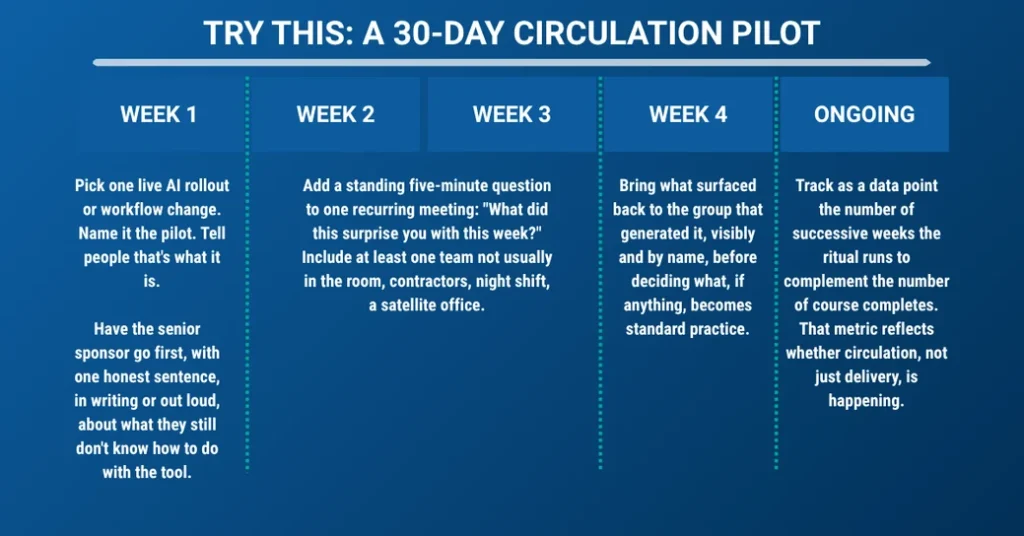
The first step involves senior leadership modeling an "inquiry mindset." This can be as simple as a senior executive admitting to their team that they are struggling with a specific AI tool. By making "not-knowing" visible and acceptable, leaders create the psychological safety necessary for others to share their own struggles and successes. Organizations are encouraged to build a five-minute "inquiry slot" into every standing meeting, asking a single question: "How did the tool surprise or frustrate you this week?"
Quarter 2: Trait-Mapping and Reconfiguration
The second phase involves moving away from rigid job descriptions toward "trait-mapping." This involves identifying individual strengths—such as future-focus, idea generation, or execution—and assembling teams around specific projects rather than department lines. In this model, AI is treated as a reconfigurable team member. This approach allows organizations to leverage human strengths that were previously invisible because they didn’t fit into a traditional organizational chart.
Broader Impact and Future Implications
The transition to a circulatory learning model represents more than just a change in training strategy; it is a fundamental redesign of the modern corporation. In a period defined by extreme volatility, the ability of a system to absorb disruption and convert it into collective knowledge is the ultimate competitive advantage.
The Chief Learning Officer of the future is no longer a curriculum owner but a learning architect. Their primary responsibility is to build and maintain the "circulatory system" of the organization—ensuring that trust is high enough for knowledge to flow, and that the infrastructure is agile enough to capture that knowledge in real-time.
As AI continues to reshape the landscape of work, the organizations that thrive will be those that realize the technology’s true potential is unlocked not through top-down mandates, but through the safe, transparent, and rapid exchange of human insight. The goal is no longer to teach the workforce how to use AI, but to build an organization that can learn from its own experience with AI at the speed of the technology itself.