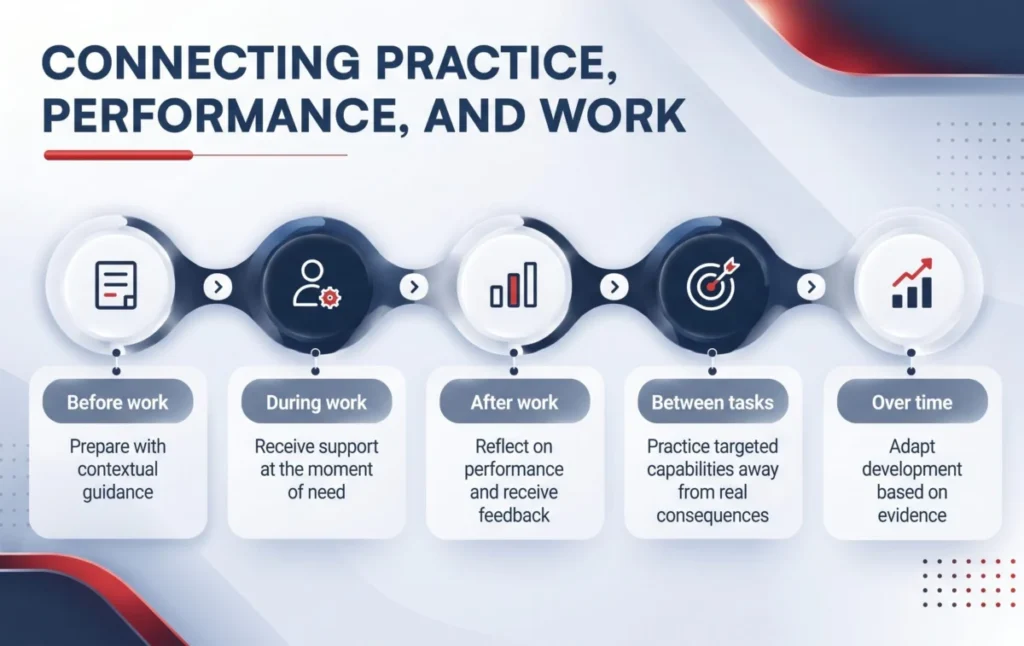
The corporate learning landscape is currently undergoing a fundamental transformation, shifting its primary objective from the mere delivery of personalized content to the verifiable demonstration of professional capability. For decades, the central challenge for Learning and Development (L&D) professionals was logistical: how to deliver the right training material to the right employee at the right time. While advancements in technology—moving from static course catalogs to sophisticated AI-driven recommendation engines—have largely solved the problem of content relevance, a more critical question has emerged for global organizations. Business leaders are no longer asking if employees have finished their modules; they are asking for evidence that those employees are ready to perform in high-stakes, real-world environments.
The Evolution of Learning Technology: A Chronological Perspective
To understand the current shift toward capability-based learning, it is necessary to examine the technological trajectory of the industry over the last thirty years. The evolution of L&D technology can be categorized into four distinct eras, each attempting to solve a more complex version of the personalization problem.
In the 1990s and early 2000s, the "Catalog Era" focused on digitization. Organizations moved from physical classrooms to Learning Management Systems (LMS), where the primary goal was accessibility. The challenge was simply making sure employees could find a course. By the mid-2010s, the industry entered the "Search and Discovery Era." As content libraries grew to include thousands of videos and articles, the focus shifted to helping users navigate the noise. This gave rise to Learning Experience Platforms (LXPs) that mirrored the user interfaces of consumer streaming services.
The late 2010s introduced the "Adaptive Learning Era," where early-stage artificial intelligence began to tailor content pathways based on a learner’s previous answers or stated interests. However, even in this stage, the metric of success remained "completion." The current era, beginning in the early 2020s with the explosion of Generative AI, marks the "Capability Era." In this phase, the focus has moved beyond recommending content to generating interactive environments where skills can be practiced, assessed, and refined in real-time.
The Personalization Paradox: Why Content is No Longer Enough
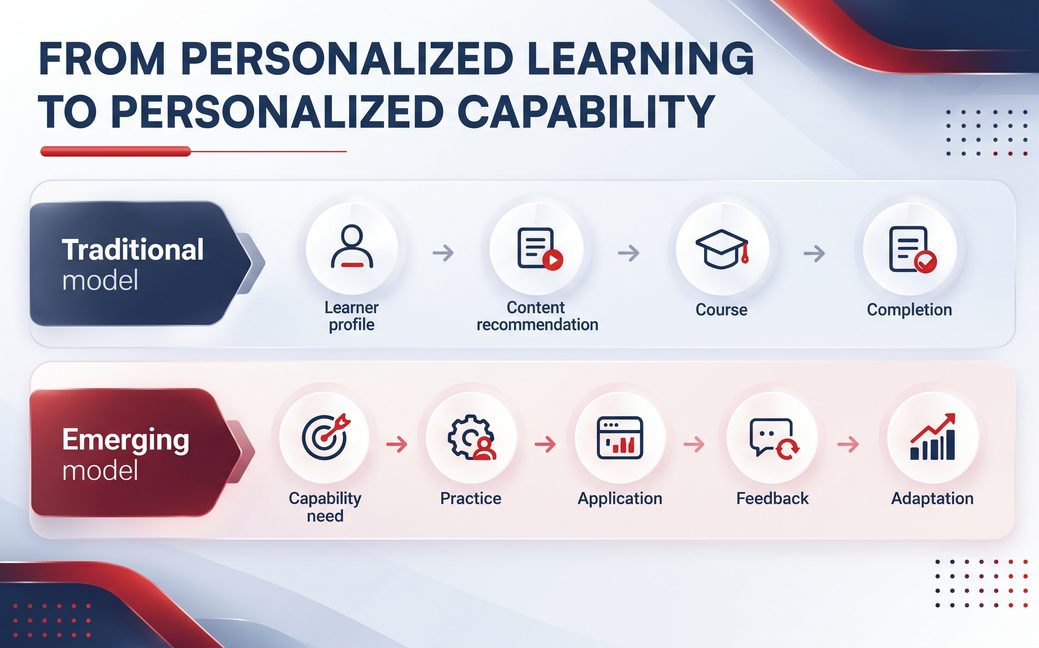
The traditional model of personalized learning has focused almost exclusively on the consumption of knowledge. By identifying skill gaps and recommending specific courses, AI has successfully reduced the cognitive load on learners. However, data from various industry analyses suggests that "relevance" does not equate to "readiness." According to recent studies on the "forgetting curve," learners typically lose up to 70% of new information within 24 hours if it is not immediately applied.
The distinction between a personalized content pathway and a personalized development pathway is significant. Content personalization asks, "What should this person watch or read next?" Capability development asks, "What does this person need to do to perform better?" This shift requires a move away from "vanity metrics"—such as course completion rates and total learning hours—toward "value metrics" that measure behavioral change and proficiency.
The Role of Agentic AI and the 2026 Projection
The next frontier of this evolution lies in the deployment of task-specific AI agents. Market research firm Gartner has projected a massive surge in this technology, estimating that 40% of enterprise applications will include task-specific AI agents by the end of 2026, a staggering increase from less than 5% in 2025.
Unlike general-purpose chatbots, these specialized agents are designed to function within specific professional domains. In an L&D context, this means AI can serve as a "practice partner" rather than just a tutor. For example, in leadership development, an AI agent can simulate a disgruntled employee or a high-pressure negotiation. The learner is not merely reading about conflict resolution; they are actively navigating it. The AI can then analyze the learner’s choices, tone, and decision-making logic, providing a level of personalized feedback that was previously only possible through expensive one-on-one executive coaching.
Closing the Readiness Gap through Deliberate Practice
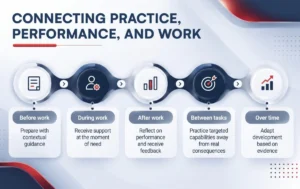
The transition to capability-based learning emphasizes "deliberate practice"—a concept popularized by psychologist K. Anders Ericsson. For a skill to be mastered, the learner requires a safe environment to fail, immediate feedback, and the opportunity to repeat the task with increasing levels of complexity.
This is particularly vital in high-stakes industries where "learning in the flow of work" carries unacceptable risks.
- Safety-Critical Roles: A technician in a chemical plant or a nuclear facility should not encounter a critical safety procedure for the first time during an actual emergency. AI-enabled simulations allow for the repeated practice of rare but catastrophic scenarios.
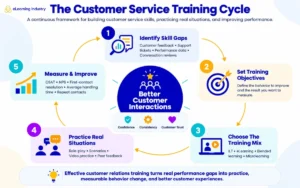
- Customer-Facing Positions: Sales representatives and customer service agents can use AI agents to rehearse responses to complex objections or hostile interactions, ensuring they are "battle-tested" before speaking to a high-value client.
- Management and Leadership: Navigating performance reviews or delivering difficult news requires emotional intelligence and nuance. AI provides a "safe harbor" for managers to refine their approach without the risk of damaging real-world professional relationships.
Moving Toward a Multidimensional Evidence Model
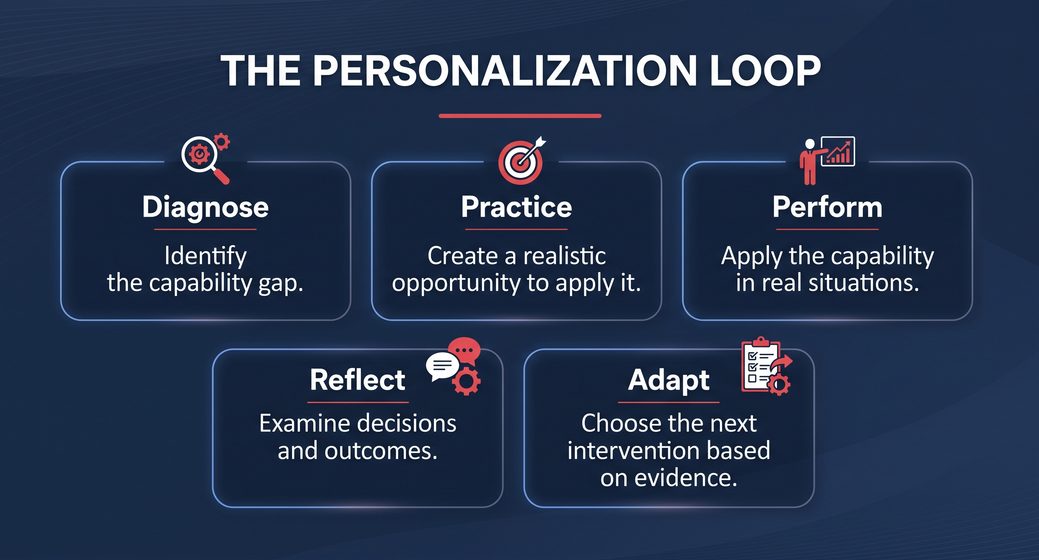
If completion rates are no longer the gold standard for L&D success, organizations must define what constitutes "meaningful evidence" of capability. Industry experts suggest that a robust picture of readiness is built from multiple data points rather than a single signal. This "Personalization Loop" involves four key stages:
- Demonstrated Proficiency: How did the individual perform in a simulated or controlled practice environment?
- Manager and Peer Observation: Does the employee’s real-world behavior align with the skills they have purportedly acquired?
- Consistency Over Time: Is the capability maintained across different contexts and over an extended period?
- Confidence and Self-Assessment: Does the learner feel prepared to handle the task, and does their confidence correlate with their actual performance?
By aggregating these signals, Chief Learning Officers (CLOs) can provide the business with a "readiness score" for the workforce, allowing for more strategic talent allocation and succession planning.
Strategic Implications for the C-Suite
The shift from content to capability changes the mandate of the Chief Learning Officer. No longer just a curator of content libraries, the modern CLO must act as a bridge between business strategy and human performance. To lead this transition effectively, L&D leaders must make three critical strategic decisions:
First, they must collaborate with business unit leaders to define what "good" looks like. This requires breaking down abstract skills like "innovation" or "leadership" into observable, measurable behaviors. Without a clear definition of the target performance, even the most advanced AI cannot effectively guide a learner.
Second, they must determine the appropriate "modality of practice." While AI simulations are powerful, they are not a universal solution. Some capabilities are best developed through peer-to-peer coaching, mentorship, or on-the-job "stretch assignments." The CLO’s role is to design a curriculum that utilizes the most effective tool for the specific skill being developed.
Third, organizations must establish a governance framework for capability data. As AI begins to monitor and analyze how employees practice and perform, issues of privacy and "workplace surveillance" become paramount. L&D leaders must ensure that data collection is used strictly for developmental purposes and that employees understand how their performance data is being used to support their growth.
Conclusion: Capability as the Ultimate Destination
The narrative of corporate learning is moving away from the "what" and toward the "how." While personalized content was a necessary milestone in the history of L&D, it was never the ultimate destination. The true goal of any organizational learning initiative is to ensure that when a critical moment arises—whether it is a sales pitch, a technical failure, or a leadership crisis—the right person is ready to act with the right capability.
As AI continues to mature, the barriers to high-fidelity practice are falling. The organizations that thrive in the coming decade will be those that stop measuring how much their employees know and start measuring what their employees can actually do. In this new era, personalization is the engine, but demonstrated capability is the destination.