Active listening is more than just hearing words; it is a profound skill encompassing the ability to focus completely on a speaker, to grasp the full scope of their message—both spoken and unspoken—and to respond in a way that demonstrates comprehension and fosters continued engagement. This nuanced form of communication involves not only processing the verbal content but also meticulously observing body language, tone, and subtle cues. In the dynamic landscape of contemporary leadership, mastering active listening is no longer a soft skill but a strategic imperative, instrumental in cultivating trust, resolving complex conflicts, ensuring clarity, and nurturing a positive and productive work environment. Leaders who actively listen are better positioned to understand the multifaceted needs and concerns of their teams, thereby facilitating more effective collaboration and driving organizational success.
The profound benefits of integrating active listening into a leader’s repertoire extend across various facets of professional and personal life. At its core, active listening builds a bedrock of trust and rapport. When individuals feel genuinely heard and understood, their willingness to share ideas, voice concerns, and commit to shared goals increases exponentially. This, in turn, can lead to a significant reduction in workplace friction and misunderstandings, as potential conflicts are identified and addressed early. For leaders, this translates into enhanced decision-making, as they gain access to a wider spectrum of perspectives and insights from their teams. Moreover, active listening fosters a sense of psychological safety, where employees feel secure enough to express themselves without fear of reprisal, a critical component for innovation and organizational resilience.
In the realm of leadership effectiveness, active listening is a cornerstone. It allows leaders to gauge team morale, identify skill gaps, and understand individual motivations. This deep understanding enables leaders to provide more targeted support, mentorship, and development opportunities, thereby maximizing individual potential and team performance. Beyond the workplace, the principles of active listening are transferable to personal relationships, strengthening bonds with family and friends through genuine empathy and understanding. In social situations, it allows for more meaningful connections and a deeper appreciation of diverse viewpoints.
The practice of active listening, while conceptually straightforward, requires conscious effort and the application of specific techniques. It is a skill that can be developed and refined through deliberate practice and a commitment to continuous improvement. Leaders and managers are increasingly recognizing the value of moving beyond superficial engagement to truly "listen to understand"—to uncover the facts, emotions, and underlying values that shape an individual’s communication. This deeper level of listening can transform organizational culture, fostering an environment characterized by truth, courage, and mutual respect.
Six Key Active Listening Techniques for Leaders
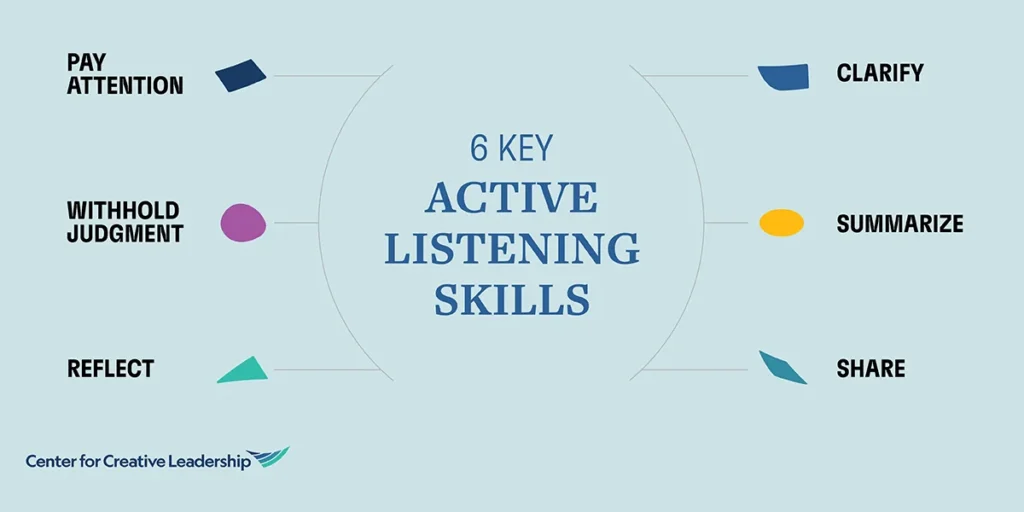
Enhancing one’s active listening skillset involves a deliberate and multi-faceted approach. It transcends merely being present during a conversation; it requires an active and engaged posture that signals respect and genuine interest. The following six techniques are fundamental to cultivating effective active listening:
-
Pay Attention: The foundation of active listening is undivided attention. This means creating an environment conducive to open communication, allowing the speaker ample "wait time" to articulate their thoughts without interruption. Leaders must resist the urge to complete sentences, formulate responses prematurely, or cut speakers off. Beyond verbal cues, attention must also be paid to non-verbal signals. Maintaining consistent eye contact, adopting an open and relaxed posture, and ensuring a focused frame of mind are crucial. This present-moment awareness, coupled with an attitude of respect, creates a space where the speaker feels valued and encouraged to express themselves fully. This practice is particularly vital in high-pressure situations or when discussing sensitive topics, where a leader’s focused presence can de-escalate tension and build confidence.
-
Withhold Judgment: Active listening necessitates an open mind and a willingness to consider new ideas and perspectives without immediate evaluation. Even when leaders hold strong personal views, the practice involves suspending judgment, setting aside criticisms, and refraining from immediate arguments or attempts to persuade. Maintaining an open body posture, such as resting arms at the sides rather than crossed, can physically signal this receptiveness. This non-judgmental stance is critical for fostering an environment where diverse opinions can be shared freely, leading to more comprehensive problem-solving and innovation. For example, when a team member presents a novel but unconventional idea, a leader who withholds judgment is more likely to explore its potential rather than dismiss it outright.
-
Reflect and Validate: It is essential to confirm understanding and ensure the speaker feels genuinely heard. This involves periodically paraphrasing key points to mirror the speaker’s emotions and ensure alignment. Reflecting demonstrates that the listener is engaged and processing the information accurately. This technique is a powerful tool for showcasing emotional intelligence, a trait increasingly recognized as vital for leadership effectiveness. For instance, if a speaker expresses frustration about a team member’s performance despite strong interpersonal skills, a leader might paraphrase by saying, "So, it sounds like you’re recognizing Emma’s excellent rapport with her team, but you’re struggling with the lack of accountability leading to missed deadlines." Similarly, when a speaker expresses distress, helping them label their feelings, such as, "It appears you’re feeling quite overwhelmed and stuck," can provide a sense of validation and support.
-
Clarify: Ambiguities and unclear statements require clarification to ensure accurate comprehension. Leaders should proactively ask questions to resolve any doubt or confusion. Phrases like, "Let me see if I’m understanding correctly, are you referring to…?" or "Could you help me understand that point further?" signal attentiveness and a commitment to grasping the speaker’s message. Open-ended, clarifying, and probing questions are instrumental in encouraging speakers to engage in self-reflection and problem-solving rather than feeling defensive or pressured to provide a "right" answer. Questions such as, "What are your thoughts on…?" or "Can you elaborate on…?" empower the speaker and foster a collaborative dialogue. The emphasis is on inquiring rather than dictating, assuming the other person possesses valuable insights.
-
Summarize: Periodically summarizing key themes reinforces comprehension and solidifies the speaker’s perspective. This practice helps both parties to be clear on mutual responsibilities and agreed-upon next steps. A brief restatement of the core points discussed can ensure accuracy and clarity. For example, a leader might summarize by saying, "To ensure I’ve captured everything, Emma was promoted, her team is fond of her, but you’re concerned about her ability to enforce deadlines, leading to recurring issues. You’ve attempted various solutions with limited success. Have I understood this correctly?" Summarizing not only aids understanding but also fosters accountability and encourages proactive problem-solving.

-
Share: Active listening is fundamentally about understanding the other person before seeking to be understood. Once a clear understanding of the speaker’s perspective has been established, it becomes appropriate to introduce one’s own ideas, feelings, and suggestions. Individuals are generally more receptive to new input when they feel their own viewpoint has been acknowledged and respected. Following a thorough discussion, the conversation can naturally transition into collaborative problem-solving, exploring assumptions, potential solutions, and unknown factors. As a listener-coach, the leader guides and offers support without imposing solutions, empowering the individual to arrive at their own conclusions, thereby fostering confidence and ownership.
The research conducted by organizations like the Center for Creative Leadership (CCL) underscores a critical dimension of effective leadership: active listening, while vital, is insufficient on its own to make individuals feel truly heard. The impact of a leader’s response—specifically, their actions following a conversation—significantly amplifies the perception of being listened to. Studies indicate that employees’ sense of being heard is more than twice as strong when a leader not only listens but also takes action on the information shared. This combination of listening and acting is crucial for building trust, fostering psychological safety, and encouraging employees to voice their ideas and suggestions in the future.
Conversely, research suggests that a leader who is an excellent listener but consistently fails to act on what they hear may be perceived less positively than a leader who is a less adept listener but demonstrates a willingness to take action. This highlights the tangible impact of leadership behavior on employee engagement and organizational culture. When leaders demonstrate that they value input by taking appropriate action, they cultivate an environment where employee voice is not only welcomed but actively encouraged. This open communication channel is directly linked to improved decision-making, enhanced organizational innovation, and increased creativity. The absence of such a feedback loop, often driven by perceived risks to career, reputation, or relationships associated with speaking up, can lead to employees withholding valuable insights, thereby depriving the organization of opportunities for growth and improvement. Therefore, the final, and arguably most crucial, element of the active listening skillset is the commitment to translate understanding into appropriate action, embodying compassionate and effective leadership.
Assessing Active Listening Effectiveness
Many individuals tend to overestimate their listening abilities, assuming their engagement is self-evident to others. However, research consistently reveals a significant disparity between self-perception and actual effectiveness. Leaders, in particular, often face challenges due to technological distractions, information overload, and the inherent difficulty in receiving negative feedback or addressing emotionally charged conversations. Even with the best intentions, leaders can unintentionally convey disinterest, leading to misunderstandings, diminished psychological safety, and a sense of alienation among team members.
Leaders should critically assess their own listening habits. Questions that might prompt introspection include: Do you frequently interrupt others or finish their sentences? Do you find yourself formulating your response while the other person is still speaking? Do you often check your phone or get distracted by your surroundings during conversations? Do you tend to offer unsolicited advice or jump to solutions without fully understanding the problem? Do you find it difficult to make sustained eye contact or appear disengaged? Do you dismiss or minimize others’ feelings or concerns? Do you find yourself mentally rehearsing your own points rather than actively processing what is being said? Answering "yes" to any of these questions suggests an opportunity for improvement in active listening skills.
Improving Active Listening Skills
To enhance active listening capabilities, deliberate practice of specific techniques is essential. This involves a conscious effort to shift from passive reception to active engagement. Several strategies can be employed:
- Embrace the "7-Day Active Listening Challenge": Structured challenges can provide a focused framework for developing and practicing new habits. These challenges often guide participants through specific techniques and encourage immediate application in real-world interactions.
- Focus on Non-Verbal Cues: Paying attention to body language, facial expressions, and tone of voice can provide crucial context and reveal underlying emotions or nuances that may not be explicitly stated.
- Practice Empathy: Attempting to understand the speaker’s perspective and feelings from their point of view is fundamental. This involves stepping into their shoes and considering their experiences and motivations.
- Minimize Distractions: Creating an environment free from distractions, both internal and external, is paramount. This means putting away phones, closing unnecessary tabs on computers, and mentally preparing to be present in the conversation.
- Seek Feedback: Actively soliciting feedback from colleagues and team members about one’s listening skills can provide invaluable insights into areas for improvement.
- Be Patient: Developing strong active listening skills takes time and consistent effort. It is important to be patient with oneself and to celebrate small victories along the way.
Building Stronger Active Listening Skills and Fostering a Culture of Conversation
Honing leaders’ active listening skills is not merely about individual improvement; it is about cultivating a broader organizational culture that values open communication and mutual understanding. Partnering with organizations that specialize in conversational skills training can equip leaders and employees at all levels with the tools to engage in more effective dialogues. These programs often emphasize the interconnectedness of listening, empathy, and actionable follow-through, reinforcing the idea that true communication is a two-way street involving both understanding and being understood.
Becoming a more effective listener and communicator benefits individuals both professionally and personally. By practicing active listening, leaders can foster stronger relationships, resolve conflicts more effectively, and drive greater engagement and innovation within their teams. Resources such as structured challenges offer a practical pathway to developing these essential skills, providing concrete techniques to implement in daily interactions.
Frequently Asked Questions About Active Listening for Leaders
What is the primary goal of active listening?
The primary goal of active listening is to fully understand the speaker’s message, including their underlying feelings, values, and intentions, while also ensuring they feel heard and respected.
How does active listening differ from passive listening?
Passive listening involves simply hearing words without active engagement, while active listening requires conscious effort to focus, understand, respond, and retain information, incorporating both verbal and non-verbal cues.
Why is active listening particularly important for leaders?
Active listening is crucial for leaders as it builds trust, fosters rapport, facilitates conflict resolution, ensures clarity, and promotes a positive work environment, all of which are essential for effective team management and organizational success.
Can active listening skills be learned and improved?
Yes, active listening is a skill that can be learned and significantly improved through conscious practice, the application of specific techniques, and a commitment to continuous development.
What is the role of body language in active listening?
Body language plays a significant role, as non-verbal cues such as eye contact, posture, and facial expressions can convey attentiveness, openness, and engagement, greatly influencing the speaker’s perception of being heard.
How does taking action after listening contribute to effective leadership?
Taking action on what is heard demonstrates that the leader values the input, builds trust, enhances psychological safety, and encourages employees to continue sharing their ideas and concerns, ultimately fostering a more innovative and engaged workforce.
What are the potential consequences of poor listening skills in leadership?
Poor listening skills can lead to misunderstandings, unresolved conflicts, decreased employee morale, reduced trust, diminished psychological safety, and a stifled environment for innovation and employee voice.
How can leaders assess their own active listening effectiveness?
Leaders can assess their effectiveness by seeking feedback from others, self-reflecting on their conversational habits, and observing the impact of their listening on team dynamics and communication outcomes.
What is the connection between active listening and creating a culture of psychological safety?
Active listening, especially when combined with responsive action, is a cornerstone of psychological safety, as it signals to individuals that their contributions are valued and that it is safe to express themselves openly.
How can organizations support the development of active listening skills?
Organizations can support this development through training programs, workshops, coaching, and by creating a culture that explicitly values and rewards effective communication and listening practices.