A recent comprehensive study of compensation practices within U.S. private companies reveals a significant correlation between corporate profitability and the size of annual bonuses awarded to senior leadership. However, the findings simultaneously raise a critical question for Chief Executive Officers and boards: are these lucrative bonuses truly incentivizing the performance that drives sustainable, long-term success, or are they merely a retrospective reward for outcomes that may have been influenced by factors beyond individual executive control? This in-depth analysis delves into the nuances of executive compensation, exploring how profitability directly impacts bonus payouts while examining the potential disconnect between financial results and individual executive contributions.
The Chief Executive Group Research’s latest compensation study, which meticulously analyzed data from 1,551 U.S. private companies, provides compelling evidence of a direct link between a company’s bottom line and the variable compensation received by its executive team. The report highlights that as profitability escalates, so too do the annual bonuses for C-suite executives. Yet, this strong correlation begs a deeper examination of the underlying incentive structures. The research suggests that while bonuses are indeed rising with profitability, the critical question remains whether these incentives are strategically designed to foster future performance or simply to acknowledge past achievements, regardless of the individual executive’s direct influence.
The Direct Impact of Profitability on Executive Bonuses
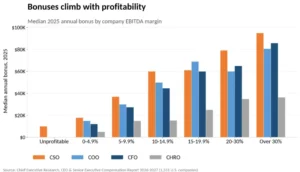
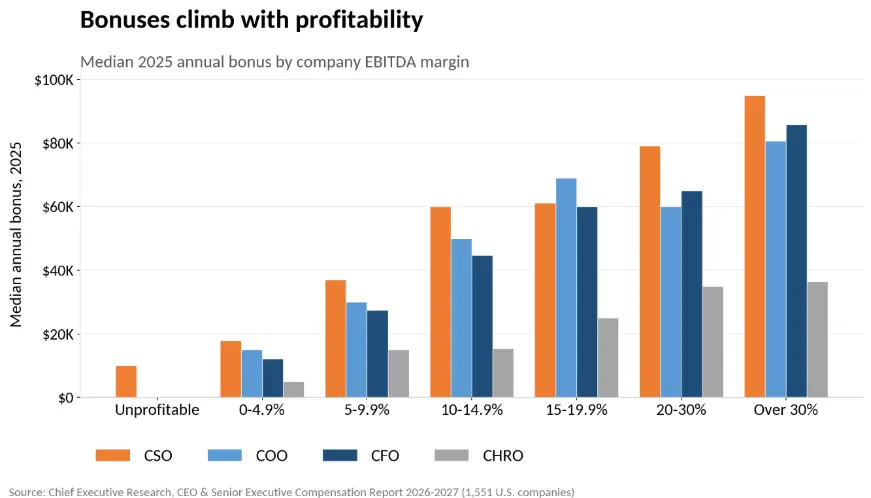
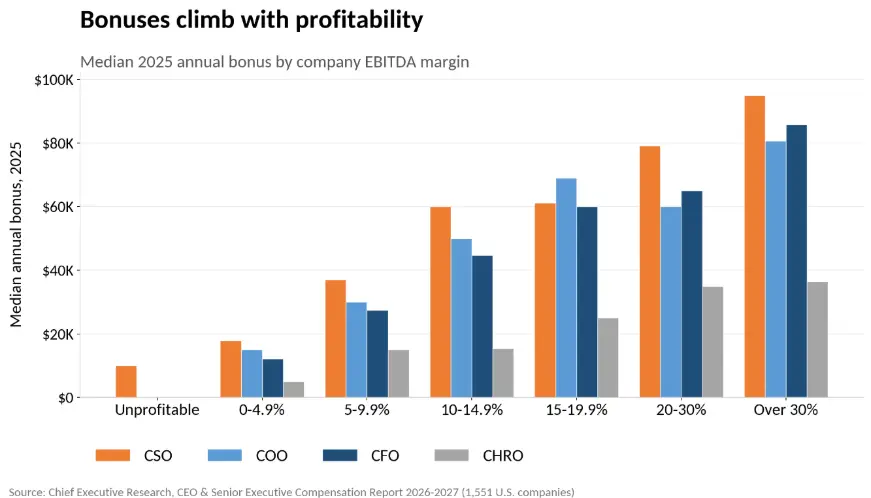
The study’s findings paint a clear picture of how financial performance directly translates into executive bonuses. For companies that reported being unprofitable in 2025, the median bonus for key roles such as Chief Financial Officer (CFO), Chief Operating Officer (COO), and Chief Human Resources Officer (CHRO) was effectively zero. This starkly contrasts with companies that demonstrated robust financial health, specifically those achieving EBITDA (Earnings Before Interest, Taxes, Depreciation, and Amortization) margins exceeding 30 percent. In these high-performing organizations, the median bonus for a CFO soared to $85,842, for a COO to $80,625, and for a CHRO to $36,503.
This pattern is not confined to operational and financial leadership. Sales leadership also sees a significant uplift in compensation tied to profitability. Chief Sales Officers (CSOs) at unprofitable companies received a median bonus of just $10,103. However, in businesses with EBITDA margins above 30 percent, this figure jumped dramatically to $95,000. The influence of revenue growth on bonuses is equally pronounced. Companies experiencing flat revenue in 2025 saw their median CFO receive a bonus of $20,000. This figure escalated to $36,500 for CFOs in companies with revenue growth between 10 and 19.9 percent, and further climbed to $59,000 for those in companies with growth rates of 20 percent or more. For CHROs, the median bonus mirrored this trend, increasing from $6,450 in companies with flat revenue to $20,000 for those with 10-19.9 percent growth, and reaching $30,000 for companies achieving 20 percent or greater revenue expansion.
Deconstructing Executive Contributions: Beyond the Company’s Bottom Line
While the linkage between profitability and bonuses is statistically evident and intuitively sensible, the study emphasizes that an over-reliance on company-wide financial metrics can inadvertently obscure the specific contributions of individual leaders. This can lead to situations where executives are either under-rewarded for exceptional performance that didn’t directly translate to overall company profit in a given year, or conversely, over-rewarded for outcomes influenced by external market forces rather than their strategic acumen.
Consider the example of a COO who, despite a dip in overall customer demand, successfully navigates challenges by significantly reducing production costs, enhancing product quality, and shortening delivery times. Simultaneously, a CFO might bolster the company’s financial resilience by strengthening liquidity and securing favorable debt refinancing terms, even if revenue targets are not met. In such scenarios, if their bonuses are primarily tethered to an EBITDA target, their accomplishments might not be adequately reflected in their compensation.
The inverse scenario is also plausible. A company might exceed its profit targets due to favorable market conditions or unforeseen economic tailwinds, even if certain executives have fallen short of their individual objectives. This highlights a fundamental challenge in compensation design: ensuring that "fair and equitable pay" accounts for the diverse responsibilities and impact of each executive role.
Tailoring Incentives to Role-Specific Responsibilities
The study advocates for a more nuanced approach to executive compensation, one that recognizes the distinct roles and responsibilities within the C-suite. For a CFO, performance evaluation and bonus determination could reasonably incorporate metrics such as improvements in working capital, the effectiveness of capital allocation strategies, the reduction of financing costs, and the robustness of internal financial controls.
For a COO, key performance indicators might include advancements in productivity, enhancements in operational efficiency, improvements in product or service quality, and the successful execution of major strategic initiatives. A CHRO’s impact could be measured by their success in retaining critical talent, strengthening leadership succession pipelines, elevating workforce productivity, and effectively addressing capability gaps within the organization. Sales leaders, meanwhile, should be accountable for revenue growth, customer retention rates, maintaining pricing discipline, and ensuring the profitability of the business they generate.
While periods of strong revenue growth often create the financial capacity to reward executives generously, this growth is a testament to the success of collective decisions and strategies implemented across the entire organization. The critical question for CEOs is whether their current compensation programs genuinely recognize these individual and team contributions, or if they leave executives unduly dependent on the broader performance of the company. The optimal set of performance measures, the study suggests, should be intrinsically linked to the company’s overarching strategic objectives.
The Strategic Imperative of Long-Term Incentives
Annual bonuses, while effective for acknowledging near-term achievements, may not adequately incentivize decisions that yield value over longer horizons. Investments in crucial areas such as technological upgrades, comprehensive leadership development programs, expansion of operational capacity, or penetration into new markets often require a short-term sacrifice of immediate earnings for the promise of sustained future growth and profitability.
An incentive program that disproportionately focuses on annual profit targets might inadvertently discourage executives from prioritizing these vital long-term investments. This is precisely where the strategic implementation of longer-term incentives becomes paramount.
Equity-based awards, multiyear performance plans, and long-term cash incentives are designed to align executive compensation with outcomes that inherently take more time to materialize. However, the efficacy of these plans hinges not only on their potential rewards but also on their structural integrity. Executives must possess a clear understanding of their objectives, the defined metrics for measuring success, and the tangible benefits they stand to gain upon achieving the company’s long-term goals. A long-term incentive plan with ambiguous targets or an uncertain payoff is unlikely to significantly influence the strategic decisions made today.
Evaluating the Effectiveness of Your Compensation Plan
For CEOs and compensation committees undertaking a review of executive remuneration, the most pertinent question transcends whether bonuses are simply increasing in lockstep with profitability – a trend that the research indicates is generally true. The more profound inquiry is whether these bonuses are effectively rewarding the individual and collective contributions that are essential for sustaining and enhancing performance over time. This necessitates a rigorous evaluation that extends beyond the mere size of the payout.
Key considerations for evaluating an executive compensation plan include:
- Alignment with Strategic Goals: Does the compensation structure directly support the company’s long-term strategic objectives and competitive positioning? Are the performance metrics chosen truly reflective of what drives sustainable value creation?
- Differentiation of Individual Contributions: Does the plan adequately differentiate between the performance of individual executives and their specific roles, or does it rely too heavily on aggregate company performance?
- Incentivizing Future Performance: Are the incentives structured to encourage forward-looking decision-making, including investments in innovation, talent development, and operational improvements, rather than solely rewarding past results?
- Clarity and Transparency: Are the performance metrics, targets, and payout structures clear, transparent, and easily understood by all executives? Ambiguity can undermine the motivational power of incentives.
- Risk Mitigation: Does the compensation plan encourage prudent risk-taking that aligns with the company’s risk appetite, or does it inadvertently promote excessive risk-taking to achieve short-term bonus targets?
- Retention and Motivation: Does the compensation package effectively retain top executive talent and foster a motivated leadership team committed to the company’s enduring success?
There is no universally applicable compensation formula that perfectly suits every executive or every private company. However, a critical distinction exists between simply paying executives more because the company has performed well and implementing compensation strategies that actively encourage and drive the company to perform better. The former is a passive acknowledgment of success, while the latter is an active driver of future value creation.
For private companies seeking to benchmark their executive compensation practices against industry peers and understand the nuances of compensation by company size, industry, and ownership structure, Chief Executive Group Research offers detailed insights in its latest CEO & Senior Executive Compensation Report. This resource provides valuable data points for informed decision-making in the complex landscape of executive remuneration.