The landscape of B2B software procurement is undergoing a fundamental shift as generative artificial intelligence begins to replace traditional search engine queries as the primary method for product research. For Learning Management System (LMS) vendors, this transition presents a critical challenge: many platforms that historically dominated Google’s search engine results pages (SERPs) are now finding themselves omitted from AI-generated recommendations provided by ChatGPT, Perplexity, and Google’s AI Overviews. As enterprise buyers increasingly ask AI assistants to "shortlist the best LMS for healthcare compliance" or "compare LMS platforms for mid-sized tech firms," the failure to appear in these synthesized responses represents a significant loss in potential pipeline and market share.
The Emergence of Generative Engine Optimization in the LMS Market
The transition from Search Engine Optimization (SEO) to Generative Engine Optimization (GEO) marks the third major era of digital marketing for the educational technology sector. Following the initial directory-based era of the 1990s and the keyword-centric era of the 2010s, the current period is defined by "answer-based" discovery. In this new environment, AI models do not merely provide a list of links; they synthesize information from across the web to provide a definitive recommendation.
Market data suggests that this shift is not merely a trend but a structural change in buyer behavior. According to industry analysis, approximately 75% of B2B buyers now prefer a "rep-free" sales experience, conducting the vast majority of their research through digital channels before ever engaging with a sales team. When these buyers pivot from Google Search to AI interfaces, the criteria for visibility changes. While traditional SEO prioritized backlinks and keyword density, AI visibility relies on a platform’s ability to be "understood" as a relevant solution within a specific context.
Chronology of the AI Search Evolution
The current crisis of visibility for LMS vendors can be traced through a specific timeline of technological advancements:
- November 2022: The launch of ChatGPT introduces the public to Large Language Models (LLMs) capable of answering complex procurement questions, though with data cutoffs.
- Early 2023: The integration of live web browsing into LLMs (via Bing and plugins) allows AI to research current software markets in real-time.
- Late 2023: The rise of Perplexity and other "answer engines" creates a dedicated space for cited, research-based AI queries.
- May 2024: Google announces the wide-scale rollout of AI Overviews (formerly SGE), placing AI-generated summaries at the top of the world’s most-used search engine.
- Late 2024: The introduction of ChatGPT Search further merges traditional web indexing with generative synthesis, making the "visibility gap" a critical issue for SaaS marketing teams.
Identifying the Visibility Gap: Why LMS Platforms Are Overlooked
When an LMS is omitted from an AI response, it is rarely due to a single technical error. Instead, it is typically the result of a "thin" digital footprint that fails to provide the AI with enough verifiable evidence to support a recommendation.
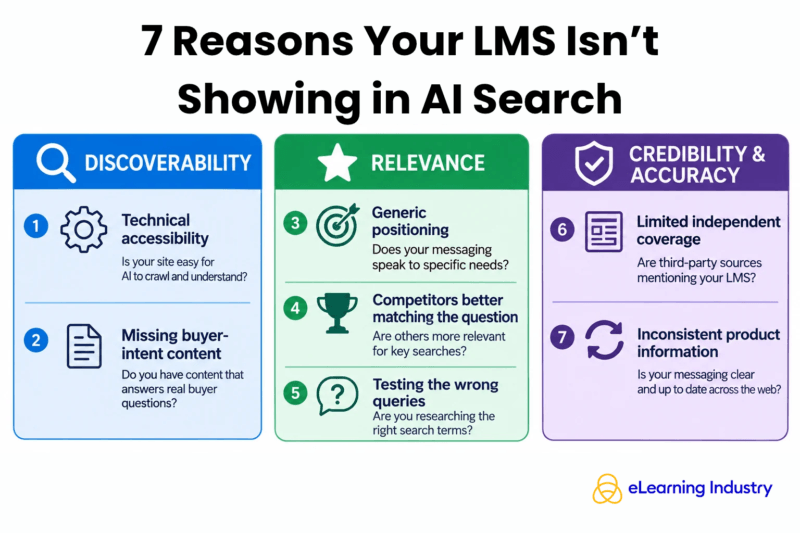
One of the primary reasons for exclusion is generic positioning. Many LMS vendors utilize broad marketing language—phrases like "empowering learners" or "seamless integration"—that lacks the semantic specificity required for AI models to categorize the software accurately. If an AI cannot determine whether a platform is specifically built for external partner training versus internal employee compliance, it will default to a competitor that explicitly states its niche.
Furthermore, a lack of independent industry coverage acts as a significant barrier. AI models are trained to prioritize "consensus" and "authority." If a vendor’s website is the only source claiming the LMS is "the best for manufacturing," but third-party directories, industry publications, and review sites remain silent or focus on other brands, the AI will likely view the vendor’s claims as unverified marketing copy rather than objective fact.

Supporting Data: The Cost of Invisibility
Recent studies into B2B software discovery highlight the growing influence of synthesized search. Data indicates that:
- Direct Clicks: AI Overviews and ChatGPT Search results capture a higher "intent to buy" than traditional organic results, as users have already filtered their requirements through the AI.
- Brand Authority: 68% of users perceive brands recommended by AI assistants as "market leaders," even if those brands do not hold the largest market share.
- The "Winner-Take-Most" Effect: While a traditional Google page shows 10 results, an AI response often highlights only three to five vendors, significantly narrowing the window of opportunity for smaller or mid-market players.
Technical Barriers and Accessibility Issues
Beyond content and positioning, technical accessibility remains a hurdle. AI "crawlers"—such as GPTBot—must be able to access and parse a website’s content to understand its value proposition. Many LMS websites suffer from "dark data" issues, where critical information regarding features, pricing, or use cases is hidden behind gated PDF whitepapers, login screens, or complex JavaScript that some AI scrapers struggle to interpret.
Additionally, inconsistent data across the web creates "hallucination risks" for AI. If an LMS is listed as a "Video Learning Platform" on one directory and a "Compliance Tool" on another, the AI may encounter conflicting information, leading it to exclude the brand entirely to maintain the accuracy of its response.
Strategies for Improving AI Search Visibility
To regain visibility, LMS vendors must adopt a multi-layered approach that prioritizes clarity, credibility, and technical openness.
1. Precision in Product Positioning
Vendors must move away from "all-in-one" marketing speak and toward specific, use-case-driven descriptions. An LMS that describes itself as "a healthcare-focused platform designed for HIPAA-compliant nursing certifications" provides the AI with specific "hooks" that make it the obvious choice for relevant queries.
2. Developing Content for the "Buyer’s Journey"
AI models favor content that answers specific questions. Instead of high-level blog posts, vendors should publish detailed guides on "How to Implement an LMS for Global Sales Teams" or "Comparing SCORM vs. xAPI for Corporate Training." This type of granular content provides the "evidence" AI needs to cite a brand as an authority.
3. Strengthening the Third-Party Ecosystem
Since AI models cross-reference multiple sources, visibility on third-party platforms is essential. This includes:
- Directories: Maintaining comprehensive, up-to-date profiles on industry-specific directories like eLearning Industry.
- Reviews: Encouraging detailed, long-form customer reviews that mention specific features and industry contexts.
- Earned Media: Securing mentions in editorial comparisons, research reports, and industry news outlets.
4. Technical Optimization for AI Crawlers
LMS marketing teams should audit their robots.txt files to ensure they are not inadvertently blocking AI agents. Implementing structured data (Schema markup) specifically for "SoftwareApplication" and "Review" can also help AI models parse the technical specifications of the platform more effectively.
Measuring Success in the Age of GEO
Traditional metrics like "keyword ranking" are becoming less relevant in the age of AI. Instead, LMS vendors should track "AI Mention Rate" and "Recommendation Rate." These metrics involve running a standardized set of buyer prompts across multiple AI platforms (ChatGPT, Claude, Perplexity, Google Gemini) and recording how often the brand appears, whether it is cited as a source, and whether it is recommended as a top-tier solution.
Market analysts suggest that a healthy "AI Visibility Score" is now a leading indicator of future revenue growth for SaaS companies. Brands that appear in the "AI shortlist" are seeing a direct correlation with high-quality inbound leads, as the AI has effectively performed the "initial qualification" for the buyer.
Broader Impact and Industry Implications
The shift toward AI visibility is leveling the playing field in some ways while creating new monopolies in others. Smaller, specialized LMS vendors now have the opportunity to outrank much larger competitors in niche AI queries if their positioning is more precise and their content more helpful. However, for established legacy vendors, the risk of "digital obsolescence" is real if they fail to adapt their 2010s-era SEO strategies to the requirements of the 2025 AI landscape.
Furthermore, this evolution is forcing a return to "truth in advertising." Because AI models can compare vendor claims against thousands of user reviews and third-party reports in seconds, brands that overpromise on capabilities are more likely to be flagged or excluded by AI systems that prioritize accuracy.
Conclusion: The Path Forward for LMS Marketing
The invisibility of an LMS in AI search results is not a permanent state, but it is a clear signal that a vendor’s digital strategy is out of sync with modern buyer behavior. By focusing on semantic clarity, technical accessibility, and a robust ecosystem of third-party validation, LMS vendors can ensure they are not just "on the web," but "in the conversation."
As generative search continues to evolve, the most successful LMS brands will be those that treat AI not as a threat to their traffic, but as a sophisticated new "influencer" that must be educated and informed with the same rigor as a human consultant. The goal is no longer to rank #1 for a keyword; it is to be the most trusted recommendation for a buyer’s specific need.