The realm of human resources, often perceived as deeply intuitive, is revealing a stark reality: a significant reliance on gut instinct over concrete data is hindering effective people management. A recent report indicates that a staggering 71% of senior HR leaders admit to making critical decisions based on instinct rather than leveraging available talent data. This pervasive reliance on intuition stems from a fundamental challenge within organizations: fragmented data systems. Information regarding employee engagement, performance, development, and recognition is frequently siloed across different departments and platforms, making it an arduous and time-consuming task to consolidate. This data fragmentation, often taking weeks or even months to piece together, creates a vacuum that instinct inevitably fills.
However, the potential for more informed and confident people decisions lies within the data organizations already possess. The key is not to collect more information, but to connect and synthesize what already exists. When crucial signals from engagement, performance, development, and recognition are brought together, HR decision-making becomes not only faster and clearer but also more defensible and impactful.
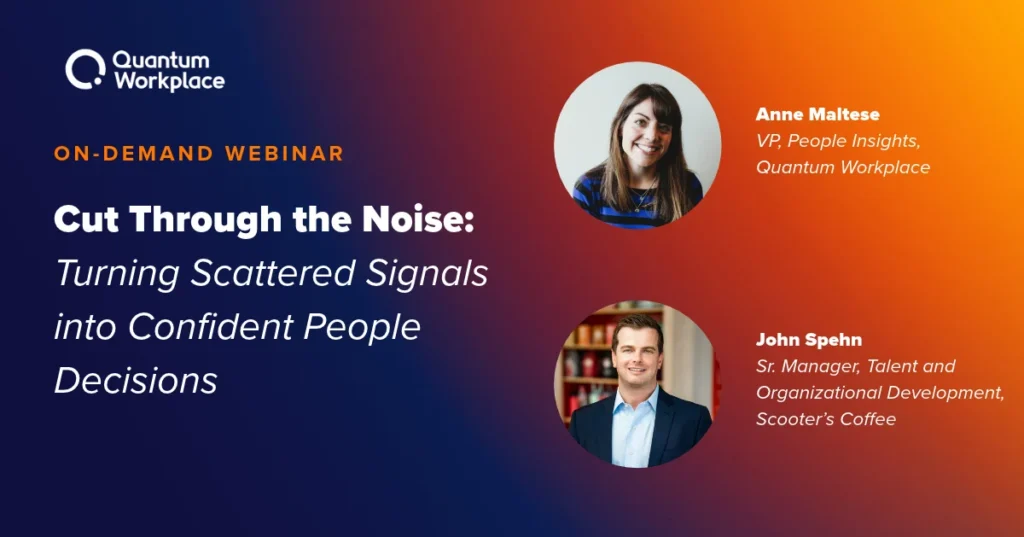
This critical insight was recently highlighted on stage at the Gartner HR Symposium. Anne Maltese, author and representative of Quantum Workplace, shared this perspective alongside John Spehn, Sr. Manager of Talent and Organizational Development at Scooter’s Coffee. Their discussion underscored how interconnected data can be transformed into actionable strategies. This article delves into what confident people decisions look like in practice and explores Scooter’s Coffee’s journey in leveraging connected data to drive significant organizational improvements.
The High Cost of Disconnected Data in HR
The fragmentation of HR data incurs substantial costs, impacting efficiency, clarity, and strategic foresight. These costs manifest in several key areas:
-
Slowness in Decision-Making: The manual process of pulling, merging, and analyzing reports from disparate systems is a significant bottleneck. Leaders report that it can take weeks to access connected talent insights, directly impeding the agility required in today’s fast-paced business environment. This delay can mean missing critical opportunities or failing to address emerging issues promptly.
-
Lack of Context and Actionable Insights: Even when data is accessible, its isolated nature often leaves HR professionals with numbers but without the crucial narrative or context. Consequently, only about 40% of HR leaders feel they can derive actionable insights from their talent data. This disconnect between raw data and strategic understanding limits the ability to translate information into effective interventions.
-
Reactive Problem-Solving: When data is not integrated, organizations often find themselves reacting to problems only after they have materialized. This reactive stance means that risks, such as high turnover or declining engagement, are identified late, making mitigation efforts more challenging and costly. The burden on HR teams often feels administrative and overwhelming, with 73% of leaders reporting their work as such, largely due to the inefficiencies of managing fragmented systems.
-
Subjectivity and Reliance on Instinct: In the absence of clear, connected data, assumptions and subjective interpretations fill the void. This leads to decisions driven by intuition rather than evidence, a situation where 71% of senior HR leaders admit to relying on gut feeling over talent data. While instinct has its place, its unchecked dominance can lead to biased outcomes and missed opportunities for objective talent development.
These challenges do not imply that HR professionals are failing in their roles. Instead, they highlight a systemic issue: the lack of integrated tools that provide a holistic view of the workforce. While advancements in Artificial Intelligence are streamlining data collection and summarization, the ultimate decision-making process still requires human judgment, context, and a clear vision of desired outcomes.
A Tale of Two Decisions: The Power of Connected Signals
To illustrate the profound impact of connected data, consider a common scenario: the sudden resignation of a Vice President of Customer Success. The HR department is tasked with recommending a successor to the C-suite and board. Two candidates, David and Maria, emerge as top contenders, both identified as high-performers with high potential in talent reviews.
Decision One: Based Solely on Traditional Metrics
David has consistently occupied the "top right" quadrant of the talent review grid for years, signifying both exceptional performance and readiness for advancement. His employee records further bolster his case: he possesses long tenure, has completed the company’s leadership development program, and demonstrates a deep understanding of the business, its customers, and internal processes.
Maria is also in the "top right" category, indicating similar high performance and potential. However, her tenure is shorter, and she has not participated in the formal leadership development program. Based on these traditional metrics, David appears to be the more secure and defensible choice for promotion.
The outcome of promoting David, however, paints a different picture a year later. Engagement on his team plummets, communication breaks down, and customer complaints surge. Turnover on his team triples, leading to the loss of a key high-performer. Other executives find themselves working around him, highlighting a leadership deficit despite his strong individual performance metrics.
Decision Two: Incorporating Connected Data Signals
Now, let’s re-evaluate the same candidates with the addition of peer feedback and recognition data, layered onto the existing talent review and employee records. This expanded dataset reveals a more nuanced and accurate narrative.
| Signal | David | Maria |
|---|---|---|
| Talent Review | Top right, ready for growth | Top right, ready for growth |
| Peer Feedback | Brilliant at his craft, but hard to collaborate. Loops people in late. | Makes everyone around her better. The go-to problem solver. |
| Recognition | Receives plenty for hitting goals. Rarely recognizes others. | Receives recognition and also gives it when she sees strong impact. |
This connected data provides predictive insights into team dynamics and employee retention. David’s pattern of late communication and lack of peer recognition suggests a colleague who, while achieving individual targets, might struggle with fostering collaborative environments and employee morale. Conversely, Maria’s consistent recognition of others and her role as a central problem-solver indicate a natural inclination towards team empowerment and positive engagement. The data indicates that teams working closely with Maria exhibit higher engagement and retention rates within the company.
Crucially, this vital information was not hidden; it simply had not been integrated at the point of decision-making. The connected view confirms David’s strength in his current role but suggests that a senior position requiring extensive people leadership might not align with his developmental readiness. Maria, on the other hand, was already exhibiting leadership qualities without the formal title.
This deeper dive clarifies critical questions:
- Who possesses the necessary interpersonal skills to lead a customer-facing team effectively?
- Which candidate is most likely to foster a positive and productive team environment?
- Who is better positioned to drive customer satisfaction and retention?
- Which candidate represents the lower risk for future team disengagement and turnover?
With connected data, the choice shifts decisively towards Maria, enabling a more confident and ultimately more successful leadership transition.

Scooter’s Coffee: A Case Study in Data-Driven Transformation
Scooter’s Coffee, a rapidly expanding drive-thru beverage chain with aspirations of reaching 1,000 stores across more than 35 states, faced the challenge of maintaining its core values and people-centric culture amidst rapid national growth. John Spehn and his team recognized the need for robust systems to ensure their people remained at the heart of their expansion. Partnering with Quantum Workplace, they embarked on a journey to connect their data and drive meaningful action.
Step One: Strengthening Connection Amidst Rapid Growth
As Scooter’s Coffee scaled, the practice of its core value of "love" became more complex. What was easily expressed in a single location became challenging across numerous stores, a central support center, and multiple distribution centers. To address this, they implemented a recognition program tied directly to company values. This initiative provided a tangible and visible way for employees to acknowledge and share these values through various communication channels, including town halls, team huddles, and digital displays.
Step Two: Enhancing Clarity Around Employee Performance
Rapid growth inherently leads to shifting priorities. Employees often struggled to discern what was most critical amidst evolving business needs. To combat this, Scooter’s Coffee made three key adjustments:
- Shifting to Forward-Looking Goals: Performance management transitioned from a backward-looking review of past achievements to a forward-looking approach focused on future objectives.
- Establishing Clearer Priorities: The process was refined to ensure that company priorities were clearly communicated and understood at all levels.
- Aligning with Business Objectives: Performance goals were directly linked to overarching business objectives, providing a strategic framework for individual contributions.
This revised approach ensured that performance management was not only future-oriented but also strategically aligned with the company’s growth trajectory.
Step Three: Building a Comprehensive View of Talent and Readiness
This stage marked a pivotal moment where Scooter’s Coffee began actively leveraging connected data. For the first time, three critical data sources were integrated:
- Employee Surveys: Provided insights into employees’ perceived future at Scooter’s Coffee.
- Talent Reviews: Captured leaders’ assessments of employee readiness for growth and advancement.
- Retention Risk Data: Identified employees who were likely to leave the organization.
By synthesizing this information, the team focused on their "stretch and grow" group – identified as the future leaders of the company. The combined view uncovered development opportunities that these individuals might not have recognized themselves. Furthermore, it exposed a disconnect between the development team’s resource allocation and the actual support needs of this critical talent pool. Individual contributors within this group confirmed this gap, indicating that development programs primarily catered to existing leaders, with limited options for those aspiring to leadership roles.
The data clearly indicated two key areas for investment:
- Targeted Development for Individual Contributors: Providing tailored programs and resources to prepare high-potential individual contributors for future leadership roles.
- Leadership Development for Emerging Leaders: Enhancing existing leadership development programs to better equip those identified as ready for growth.
The impact of these targeted investments was evident in the 2026 engagement survey results:
| Development Outcome (2026 Engagement Survey) | Change |
|---|---|
| Opportunities for advancement | Up 17% |
| Opportunities to learn new skills | Up 12% |
| "Elevate" participants promoted | More than half |
Step Four: Understanding and Rebuilding Trust
Following a significant organizational restructure in 2025, Scooter’s Coffee experienced a decline in trust towards senior leadership. Survey metrics related to senior leaders acting with integrity and valuing people each dropped by over 12%. To address this, the HR team conducted a detailed analysis, correlating survey results with qualitative comments, retention risk data, talent review information, and exit interview feedback. The emerging pattern was clear and concerning.
The "stretch and grow" group, comprising the company’s most valuable future leaders, exhibited particular distress. More than 61% of this group indicated a high risk of departure, highlighting the urgency of rebuilding trust among this key demographic.
In response to this data-driven insight, leadership initiated three targeted interventions:
- Enhanced Communication Channels: Implementing more frequent and transparent communication from senior leadership regarding strategic decisions and organizational direction.
- Leadership Accountability Programs: Introducing programs to reinforce ethical leadership practices and employee-centric values among senior management.
- Employee Feedback Mechanisms: Establishing more robust and accessible channels for employees to voice concerns and provide feedback directly to leadership.
One year later, trust in the support center had demonstrably rebounded, with several key trust indicators showing double-digit increases:
| Trust and Engagement Outcome (One Year Later) | Change |
|---|---|
| Leaders value people | Up 26% |
| Engagement | Up 10 points |
| Intent to stay | Up 17 points |
John Spehn emphasizes that these transformations are not instantaneous. Scooter’s Coffee continues to refine its strategies, acknowledging that the journey toward optimal people decision-making is ongoing. Several key lessons emerge from their experience:
- Focus on Decisions, Not Just Data: Begin by identifying the critical decisions that need to be made. This clarity will then dictate which data signals are most relevant to connect.
- Quality Over Quantity: The emphasis should be on effectively analyzing and connecting existing data, rather than solely on collecting more.
- Simplicity and Continuous Listening: Streamlining processes, such as replacing lengthy annual reviews with concise feedback mechanisms, can yield significant improvements. Ongoing listening to employee feedback is crucial for iterative improvement.
Charting a Course for Confident People Decisions
Initiating the shift towards more confident people decisions does not require an immediate overhaul of existing systems or the acquisition of new dashboards. The following five steps can serve as a practical starting point:
- Identify Your Critical Decisions: Pinpoint the most pressing people-related decisions your organization faces (e.g., promotions, talent development investments, retention strategies).
- Map Existing Data Sources: Inventory the HR data you currently collect across engagement surveys, performance reviews, learning management systems, and recognition platforms.
- Define Key Connections: Determine how different data points might inform each other. For instance, how does peer feedback correlate with performance ratings? How does recognition impact retention risk?
- Pilot a Connected Insight: Choose one critical decision and a few key data points to connect and analyze. Focus on gaining a deeper understanding of a specific talent dynamic.
- Iterate and Expand: Based on the insights gained from the pilot, refine your approach and gradually expand the scope of connected data analysis to address other critical decisions.
Quantum Workplace’s platform is designed with this philosophy in mind, aiming to consolidate engagement, performance, development, and recognition signals into a unified view. Their "Insights Hub" connects these signals to reveal deeper patterns within people data, while "Retention Radar" integrates talent reviews, succession planning, and performance data to proactively flag at-risk top talent.
The overarching message is clear: organizations do not necessarily need more data to make better people decisions. They need to ensure the data they already possess works collaboratively. By connecting these signals, HR leaders can gain clarity, confidently share their reasoning, and make decisions that drive both individual and organizational success.
For those looking to deepen their understanding of this strategic approach, a free eBook, "Connecting Your Talent Data for Stronger People Decisions," offers guidance on which signals to connect first, how to integrate people data with business metrics, and practical strategies for translating insights into tangible actions. The journey towards data-driven people decisions is accessible, and the rewards – enhanced efficiency, greater strategic foresight, and more impactful talent management – are substantial.