The traditional B2B sales cycle has undergone a fundamental transformation, shifting from a process driven by sales representatives to one dominated by self-directed buyer research. Historically, prospective buyers would engage with sales teams early in their journey to understand product capabilities and market positioning. However, contemporary data suggests that by the time a buyer schedules a formal demo or discovery call, the majority of their decision-making process—specifically the identification and shortlisting of vendors—has already concluded. This shift has profound implications for vendors in the Learning and Development (L&D), EdTech, and Human Resources technology sectors, where the "invisible" portion of the buyer’s journey now dictates market success.
The Shift to Pre-Contact Decision Making
The modern B2B purchase journey is no longer a linear funnel but a complex web of independent research and cross-channel validation. According to the 2026 B2B Buyer Experience Report by 6sense, approximately 88% of B2B buyers have already established a ranked list of preferred vendors before they ever make direct contact with a seller. This statistic underscores a critical reality for software providers: if a brand is not visible during the initial research phase, it is effectively excluded from the opportunity before it even knows the opportunity exists.
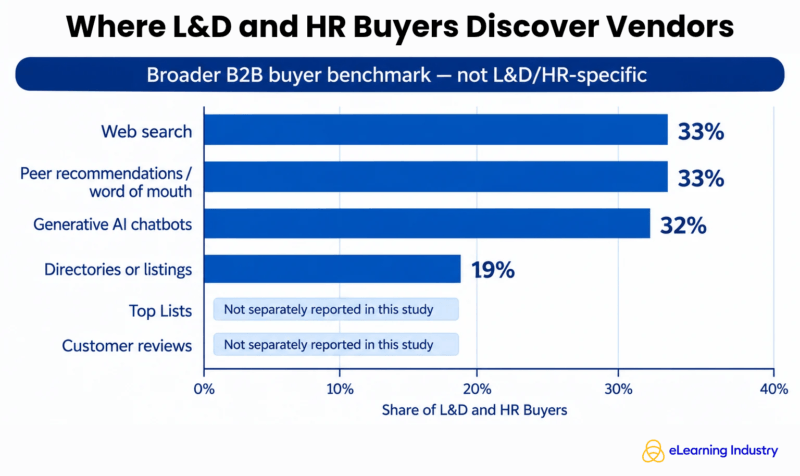
In the specialized fields of L&D and HR tech, this trend is amplified by the sheer volume of available solutions. An L&D Director seeking a new Learning Management System (LMS) or an HR executive looking for a payroll integration is no longer dependent on a salesperson’s brochure. Instead, they leverage a sophisticated ecosystem of search engines, artificial intelligence, industry-specific directories, and peer networks to filter the market.
A Chronology of the Modern Buyer’s Journey
To understand the impact of this shift, one must examine the timeline of a typical software acquisition in the corporate sector. What was once a three-month sales-led process has become a multi-stage research project that often begins months before a CRM entry is created.
Stage 1: Problem Identification and Initial Query (Weeks 1-2)
The journey often begins not with a search for a vendor, but with a search for a solution to a specific business pain point. A manager might experience high employee turnover or a failure in compliance auditing. Initial searches are broad, focusing on "how to improve compliance training" or "reducing administrative overhead in HR."

Stage 2: Category Exploration (Weeks 3-4)
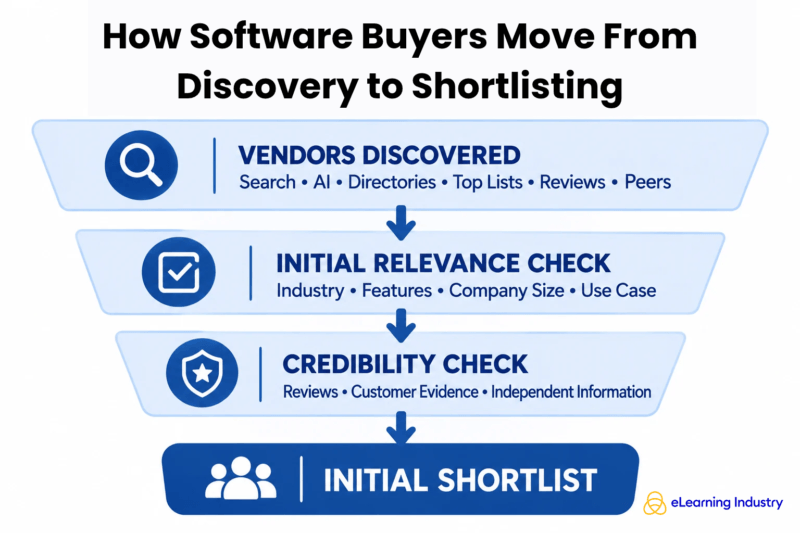
Once the buyer identifies that a specific technology (e.g., an LMS or an HCM suite) is the solution, they begin "category discovery." This involves exploring the landscape to see which players dominate the space. They consult industry "Top Lists," browse software directories, and use AI assistants to generate a broad list of potential candidates.
Stage 3: Peer Validation and Social Proof (Weeks 5-6)
The buyer then moves to validate the "long list." This involves reading third-party reviews, seeking recommendations in professional communities like LinkedIn or specialized HR forums, and reviewing case studies from organizations within their specific industry.
Stage 4: Feature and Capability Filtering (Weeks 7-8)
The list is narrowed down based on technical requirements, such as integration capabilities, deployment options (SaaS vs. on-premise), and pricing models. During this stage, the buyer visits vendor websites specifically to look for documentation, white papers, and webinars that prove the vendor’s expertise.
Stage 5: The "First" Contact (Week 9)
Only after these stages does the buyer submit a "Contact Us" or "Book a Demo" form. At this point, the vendor’s sales team perceives the lead as "new," unaware that the buyer has been evaluating them against three competitors for the past two months.
The Seven Pillars of Modern Vendor Discovery
For vendors to remain competitive, they must maintain a presence across the seven primary channels where discovery occurs. Each channel serves a different psychological need for the buyer during their research.
1. Search Engines and Intent-Based SEO
Search engines remain the primary gateway for problem-solving. However, the strategy has shifted from simple keyword optimization to addressing "search intent." Buyers are increasingly looking for "best-of" comparisons and "how-to" guides. Vendors who provide high-value, educational content that addresses specific industry challenges—rather than just product features—are more likely to capture early-stage interest.

2. The Rise of Generative Engine Optimization (GEO)
The emergence of AI platforms like ChatGPT, Perplexity, and Google’s AI Overviews has introduced a new layer to discovery. Buyers now use conversational AI to "summarize the top five LMS platforms for healthcare compliance." This requires vendors to focus on "Generative Engine Optimization," ensuring that their brand is mentioned in authoritative sources that AI models use for training and retrieval.
3. Specialized Software Directories
Directories serve as the "yellow pages" of the digital age but with added layers of filtering. For L&D buyers, platforms that allow for side-by-side feature comparisons are invaluable. A presence in these directories is not just about a listing; it is about ensuring that data regarding integrations, API availability, and user limits is accurate and up to date.
4. Editorial Rankings and Industry Top Lists
Third-party validation from industry experts carries significant weight. When a vendor appears on a "Top 10" list for a specific niche—such as "Best Employee Onboarding Software for Remote Teams"—it provides an immediate boost to credibility. These lists often act as a shortcut for busy executives who do not have the time to research the entire market.
5. The Power of Verified Customer Reviews
Reviews have transitioned from being "nice-to-have" testimonials to essential decision-making data. Buyers look for "recency" and "relevance." A review from a company of similar size and industry is worth more than a dozen generic five-star ratings. Vendors must actively manage their online reputation, responding to feedback and demonstrating a commitment to continuous improvement.
6. Thought Leadership and Earned Media
Professional buyers gravitate toward vendors who are perceived as "experts" rather than just "sellers." This is achieved through original research, white papers, and participation in industry podcasts or webinars. When a vendor provides a unique insight into the future of HR tech, they build brand equity that pays off when the buyer begins their shortlisting process.
7. Dark Social and Professional Communities
A significant portion of discovery happens in "dark social"—channels that are invisible to traditional tracking tools. This includes private Slack groups, Discord servers, and informal peer networks. While vendors cannot "control" these conversations, they can influence them by fostering strong customer advocacy programs and ensuring their existing clients are satisfied enough to become brand ambassadors.
Analyzing the Impact: Why Visibility Matters
The implications of this research-heavy journey are clear: marketing and sales can no longer operate in silos. If the marketing department fails to secure a place for the brand in the discovery phase, the sales department will never have a pipeline to manage.
From a strategic perspective, this shift requires a reallocation of resources. Companies are moving budgets away from traditional "cold outbound" tactics toward "inbound" and "near-bound" strategies. The goal is to create a "surround-sound" effect where the buyer encounters the brand multiple times across different high-trust channels before they ever speak to a representative.
Furthermore, the data suggests a "winner-takes-most" dynamic. Vendors who appear in the top results of AI queries and industry lists capture the lion’s share of the "invisible" market. Those who rely on the buyer finding them by accident are increasingly left behind.
Stakeholder Reactions and Market Sentiment
Industry analysts suggest that the "consumerization" of B2B buying is now complete. Just as a consumer reads dozens of reviews before buying a vacuum cleaner, a corporate buyer applies the same rigor to a six-figure software contract.
"The buyer is in the driver’s seat more than ever before," notes one industry consultant. "They don’t want to be ‘sold’ to; they want to be ‘helped’ through a complex buying process. The vendors who win are the ones who make it easiest for the buyer to find the information they need to make an informed decision independently."
Marketing executives in the L&D space are also reacting to the rise of AI. Many are now prioritizing "brand mentions" over "backlinks," recognizing that being cited as a top provider by an AI model is becoming as valuable as a high ranking on a traditional search engine results page.
Conclusion: Navigating the Future of B2B Sales
The era of the "uninformed buyer" is over. In the L&D and HR tech sectors, the competition for a place on the initial shortlist is where the real battle for market share occurs. Vendors must recognize that their website is just one small part of their digital footprint. Their true "visibility" is the sum total of their presence in search results, AI responses, directories, reviews, and peer conversations.
To succeed in 2025 and beyond, vendors must adopt a holistic approach to visibility. This involves:
- Maintaining accurate and comprehensive profiles across all industry directories.
- Investing in high-quality, research-driven content that establishes authority.
- Actively soliciting and managing customer reviews to build social proof.
- Monitoring AI and search trends to ensure the brand remains at the forefront of automated recommendations.
By the time the phone rings or a demo is booked, the sale has often already been won or lost. The vendors who understand and master the nuances of the discovery phase will be the ones who thrive in an increasingly self-directed B2B landscape. In this environment, the "first" conversation is no longer an introduction—it is a confirmation of a decision that the buyer has already spent weeks, or even months, making.