Strategic Training Needs Analysis (TNA) has emerged as a cornerstone of modern human resource management, serving as a diagnostic process that ensures corporate learning investments translate directly into measurable business outcomes. In an era where global corporate training expenditures exceed $350 billion annually, the ability to distinguish between genuine skill deficits and systemic operational hurdles has become a critical competency for Learning and Development (L&D) leaders. Rather than treating training as a universal remedy for performance issues, TNA provides a structured framework to identify the "performance gap"—the distance between desired organizational outcomes and current workforce capabilities—before resources are committed to curriculum development.
The fundamental premise of a training needs analysis is grounded in the recognition that not every performance problem is a training problem. Often, sub-optimal output stems from inefficient processes, lack of managerial support, outdated technology, or misaligned incentives. By utilizing a rigorous TNA, organizations can pinpoint the root cause of performance laggards, ensuring that training is only deployed when a lack of knowledge or skill is the primary barrier to success.
Understanding the Nuances: Training Needs Analysis vs. Assessment
While the terms "Training Needs Analysis" and "Training Needs Assessment" are frequently used interchangeably within HR circles, industry experts distinguish between the two based on their scope and objective. A Training Needs Assessment is generally broader in nature; it investigates whether a capability gap exists and explores a wide array of potential causes, which may include non-training factors like organizational culture or resource scarcity. It supports a broad business diagnosis.
In contrast, a Training Needs Analysis is a more granular investigation into the specific learning requirements necessary to close an identified gap. It determines exactly what employees need to know or do differently to reach peak performance. While the assessment identifies the "what" and "why" of a performance issue, the analysis defines the "how" of the learning intervention. For example, if an assessment reveals that a sales team is missing targets due to a lack of technical product knowledge, the analysis would then detail the specific technical modules, competitive comparison data, and troubleshooting skills required to rectify that specific deficit.
The Strategic Importance of Evidence-Based Learning
The transition toward data-driven L&D is fueled by the increasing pressure on HR departments to demonstrate Return on Investment (ROI). Without a formal TNA, organizations risk "training by request" or "training by fad," where programs are launched based on stakeholder anecdotes or the latest industry trends rather than empirical evidence.
The consequences of skipping a formal analysis are often costly. Research into corporate learning efficacy suggests that a significant portion of training content is never applied on the job, largely because the training did not address the actual root cause of the performance issue. A well-executed TNA mitigates this risk by:
- Ensuring Strategic Alignment: It links individual skill development directly to the company’s long-term strategic goals, such as digital transformation or market expansion.
- Optimizing Resource Allocation: It directs budget and time toward high-impact gaps rather than low-priority "nice-to-have" skills.
- Enhancing Employee Engagement: Training that is relevant to an employee’s actual daily challenges is viewed as a benefit rather than a burden, reducing "training fatigue."
- Identifying Non-Training Solutions: By revealing that a problem is caused by poor software or unclear expectations, TNA saves the organization from wasting money on ineffective courses.
The Three-Tiered Framework of Analysis
To capture a holistic view of organizational needs, a TNA must be conducted across three distinct levels: organizational, task, and individual.

1. Organizational Level Analysis
This macro-level view aligns training initiatives with the broader business strategy. L&D leaders must ask how the organization is changing. For instance, if a firm is transitioning to a remote-first work model, the organizational analysis would identify a need for digital collaboration competencies across the entire workforce. This level ensures that the L&D roadmap supports upcoming pivots, such as entering a new regulatory environment or adopting generative AI.
2. Task and Role Level Analysis
This level focuses on the specific requirements of a job function. By conducting a job task analysis, HR professionals define the "gold standard" of performance for a role. For a project manager, this might involve mastery of specific agile methodologies and stakeholder communication protocols. The analysis compares these requirements against current performance to see where the specific "skill friction" lies.
3. Individual Level Analysis
The most granular level determines which specific employees require help. This prevents the "one-size-fits-all" approach that often leads to disengagement. While a new hire might need foundational knowledge, a veteran employee might only need a "booster" session on a specific new feature. Individual analysis utilizes performance data, manager feedback, and self-assessments to customize the learning path.
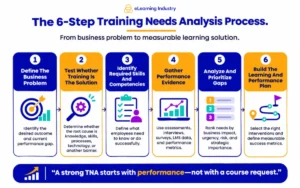
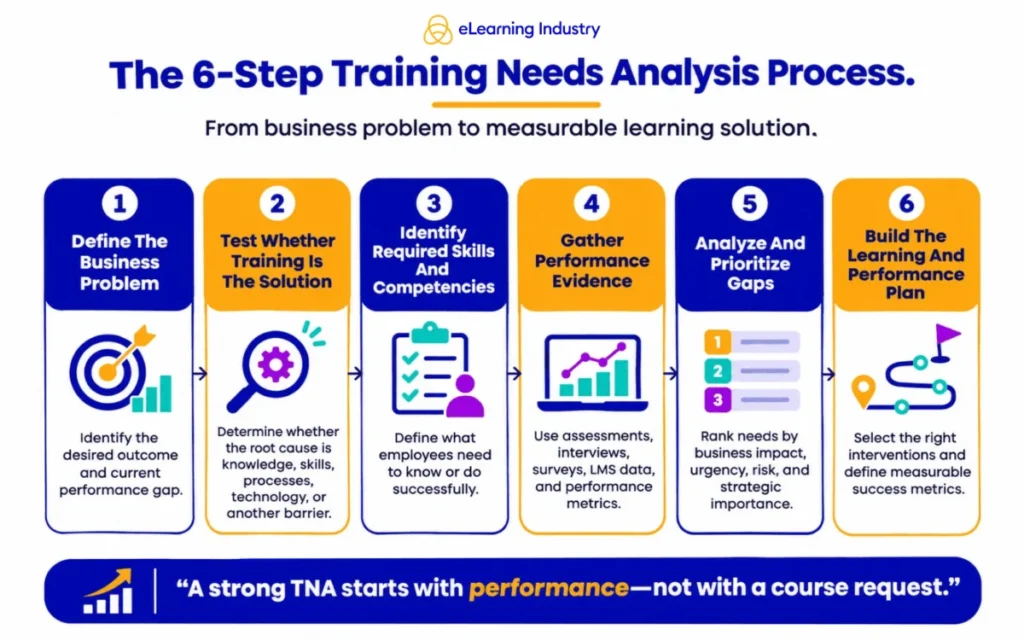
A Six-Step Chronology for Conducting a Training Needs Analysis
Implementing a TNA requires a disciplined, step-by-step approach to ensure the results are both actionable and accurate.
Step 1: Defining the Business Goal and Performance Problem.
The process begins by identifying a specific, measurable business outcome that is not being met. A vague statement like "we need better teamwork" is insufficient. A professional TNA starts with a concrete problem, such as: "Customer churn has increased by 15% in the last quarter, and data suggests it is linked to poor conflict resolution during support calls."
Step 2: Determining the Feasibility of Training.
L&D professionals must determine if the "can’t do" (skill gap) or "won’t do" (motivation/environment gap) rule applies. If an employee has the knowledge but lacks the tools, training will fail. This step involves a root-cause analysis to ensure training is the appropriate intervention.
Step 3: Identifying Required Skills and Competencies.
Once the problem is confirmed as a skill gap, the organization must define the specific behaviors required for success. This involves moving beyond generalities to define specific competencies, such as "the ability to use CRM software to log complex multi-stage tickets" or "demonstrating active listening techniques in high-pressure negotiations."
Step 4: Gathering Evidence of Current Performance.
A robust analysis relies on multi-source data. This includes quantitative data (LMS scores, sales figures, error rates) and qualitative data (interviews, focus groups, and direct observation). Relying solely on employee surveys is dangerous, as individuals are often unaware of their own "unknown unknowns."
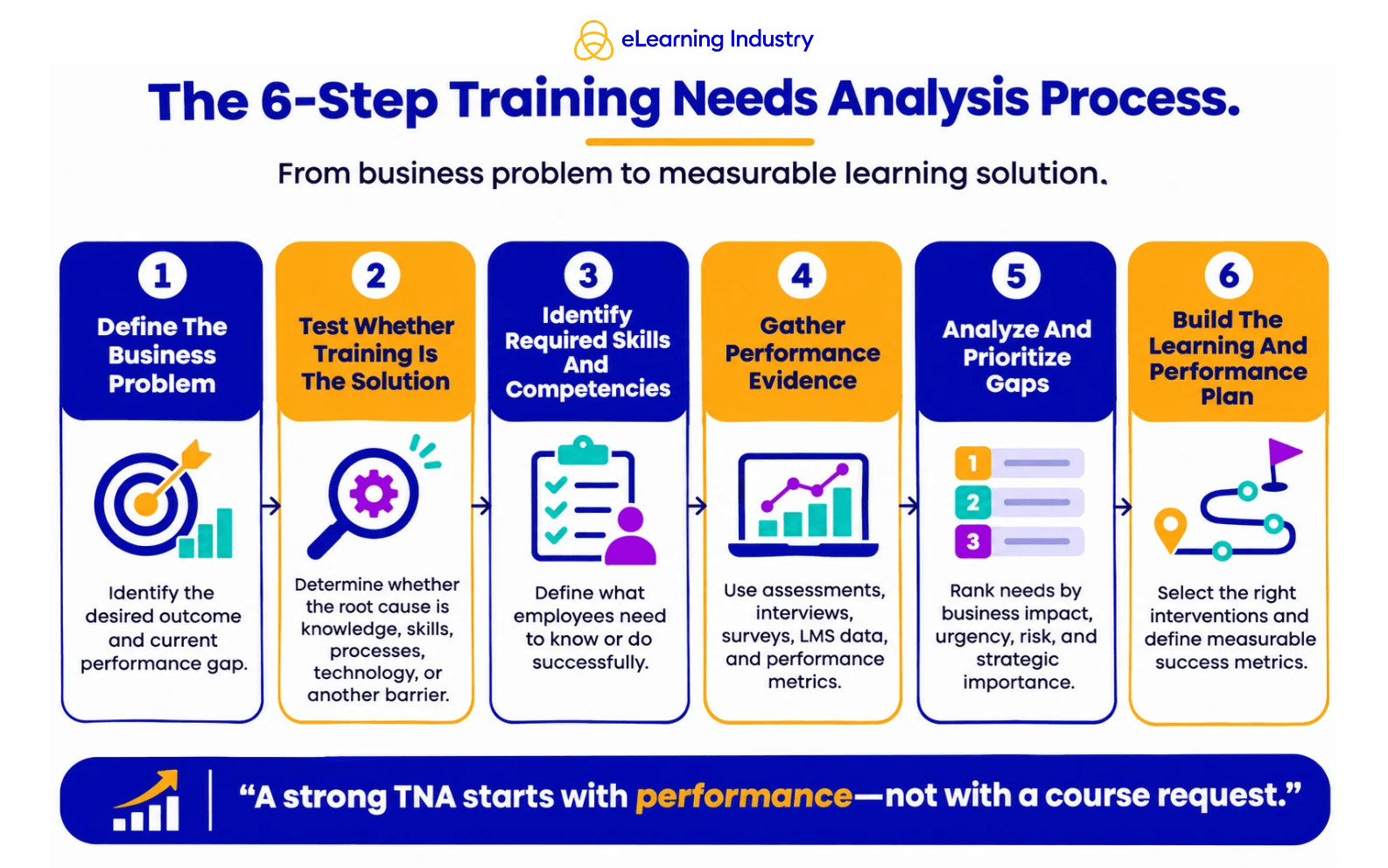
Step 5: Analyzing and Prioritizing Gaps.
Not all gaps are created equal. Using a matrix of "Impact vs. Urgency," L&D teams prioritize which gaps need immediate intervention. A gap in safety compliance, for instance, would always take precedence over a gap in advanced presentation aesthetics.
Step 6: Translating Findings into a Performance Plan.
The final step is the creation of a roadmap. This plan outlines the learning objectives, the delivery method (e.g., microlearning, coaching, or workshops), and the metrics for success. It also includes recommendations for non-training fixes, such as updating an SOP manual or clarifying a reporting structure.
The Role of Educational Technology (EdTech) in Modern TNA
The integration of Learning Management Systems (LMS) and AI-driven analytics has revolutionized the speed and accuracy of training needs analyses. Modern EdTech platforms allow for "continuous TNA," where data is harvested in real-time. For example, if an LMS detects that a high percentage of users are failing a specific module on data privacy, the system can automatically flag a widespread knowledge gap to HR leaders before a compliance breach occurs.
Furthermore, AI can analyze vast datasets from performance reviews and project management tools to predict future skill gaps before they manifest as performance problems. However, industry experts caution that technology should augment, not replace, human judgment. A Chief Learning Officer must still interpret the "why" behind the data to ensure the human element of organizational culture is considered.
Implications for Future Workforce Planning
The broader implications of regular Training Needs Analysis extend into the realms of talent retention and competitive advantage. In a "tight" labor market, employees increasingly value development opportunities. A TNA ensures that the development offered is relevant and empowering, which directly correlates with higher employee retention rates.
Moreover, as industries face rapid disruption, the TNA serves as an early-warning system. It allows organizations to be proactive rather than reactive, building the "workforce of the future" by identifying the need for upskilling in emerging technologies years before they become industry standards.
In conclusion, the Training Needs Analysis is no longer an optional HR exercise but a strategic imperative. By grounding learning initiatives in the reality of business performance and data-driven evidence, organizations can ensure that every dollar spent on training is an investment in the company’s future growth and operational excellence. Turning the focus from "what we want to teach" to "what they need to achieve" is the hallmark of a mature, high-performing organization.