
The seismic shift to remote work has fundamentally altered the employee experience, reshaping how individuals engage with their teams, contribute to organizational goals, and, crucially, how their efforts are acknowledged. The impact is undeniable and far-reaching. Data from Gallup reveals a striking reality: 57% of fully remote workers are actively seeking new employment opportunities or are passively open to them. However, this figure sees a significant 10% reduction when these same individuals report high levels of engagement. This underscores a critical link between engagement and retention, with recognition playing a pivotal role.
The transformation brought about by remote work extends beyond the geographical location of desks; it has redefined the very essence of team cohesion. While the occasional virtual team-building activity can serve as a temporary morale booster, the absence of regular, tangible signals of appreciation can leave even the most dedicated and high-performing employees feeling overlooked and invisible. Consequently, ensuring that remote employees receive adequate recognition can no longer be an afterthought; it demands a proactive and intentional strategy. This guide delves into the nuances of effective remote recognition, offering actionable insights for managers to navigate this evolving landscape successfully.
The Evolving Challenges of Remote Employee Recognition
Recognition stands as one of the most pervasive yet frequently misunderstood challenges confronting remote workforces today. In the absence of shared physical spaces, the subtle cues that foster a sense of being seen and valued often fail to traverse the digital divide. What once occurred organically now necessitates deliberate effort.
Why Remote Recognition Requires a Distinct Approach
Appreciation within a traditional office setting is often intrinsically tied to physical proximity. Managers can readily observe effort as it unfolds, provide immediate feedback, and acknowledge contributions spontaneously throughout the workday. Conversely, remote work erodes these natural feedback loops. Workflows span multiple time zones, progress updates are disseminated digitally, and periods of silence can easily replace ongoing dialogue. Without a structured and intentional approach, recognition risks becoming reactive or, worse, disappearing altogether. Therefore, remote employee recognition cannot simply mimic its in-office predecessor; it must be specifically designed to compensate for diminished visibility, mitigate proximity bias, and ensure that appreciation is conveyed with clarity, consistency, and genuine human connection, irrespective of geographical dispersion.
The Anatomy of Effective Remote Employee Recognition
At its core, effective remote recognition aims to bridge the voids created by physical distance. When team members are not co-located, appreciation must exert a greater effort to convey the same message of value and importance.
Essential Elements of Remote Recognition for Sustained Engagement
For remote employees, recognition must transcend mere acknowledgment; it needs to be a powerful tool for fostering sustained engagement. This involves several key components:
- Timeliness and Frequency: Prompt and regular recognition, even for smaller achievements, is far more impactful than sporadic, grand gestures. This reinforces the message that contributions are consistently valued.
- Specificity and Impact: Recognition that clearly articulates how an employee’s contribution made a difference, rather than just stating it was noticed, provides crucial context and reinforces desired behaviors.
- Personalization: Understanding individual preferences for receiving recognition – whether public or private, through verbal praise, written notes, or tangible rewards – significantly enhances its impact.
- Alignment with Values and Purpose: Recognizing efforts that exemplify company values or contribute to a larger organizational mission fosters a deeper sense of purpose and connection, especially in a remote setting where cultural cues are less apparent.
- Inclusivity and Equity: Ensuring that recognition practices are fair and accessible to all remote employees, regardless of their location or role, is paramount to preventing feelings of disparity and fostering a sense of belonging.
The Manager’s Role in Fostering Recognition Equity, Frequency, and Impact
Managers are the linchpins of effective recognition in remote teams. Their intentionality and consistent application of recognition strategies directly influence its equity, frequency, and overall impact. By actively championing recognition, managers can:

- Set the Tone: Demonstrate a genuine commitment to acknowledging contributions, signaling its importance throughout the team.
- Provide Tools and Training: Equip themselves and their teams with the necessary resources and knowledge to practice effective recognition.
- Promote a Culture of Appreciation: Encourage both formal and informal recognition, fostering an environment where appreciation is a natural and ongoing part of team dynamics.
- Ensure Fairness: Actively monitor recognition distribution to prevent biases and ensure all team members receive equitable acknowledgment.
- Measure and Adapt: Regularly assess the effectiveness of recognition efforts and make adjustments based on feedback and observed outcomes.
Five Strategic Pillars for Robust Remote Employee Recognition
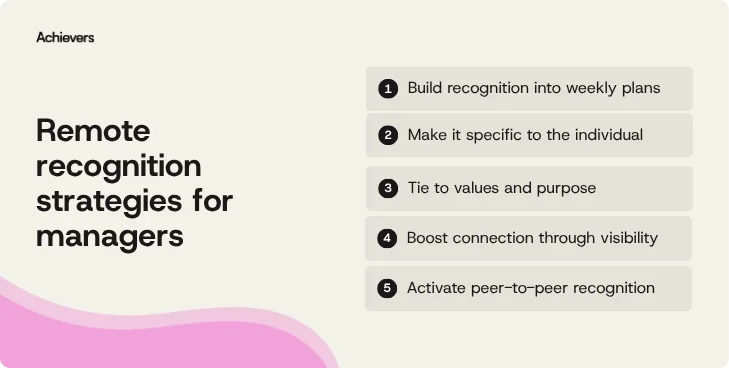
To effectively cultivate a culture of recognition within distributed teams, managers should implement the following five core strategies:
Strategy #1: Integrate Recognition into Weekly Remote Management Cadences
Consistency serves as one of the most accessible yet frequently overlooked avenues for enhancing remote employee recognition. In distributed teams, the magnitude of recognition is less critical than its regularity. Consistent acknowledgment ensures that employees understand their efforts will not go unnoticed simply because their manager isn’t physically present. This regularity builds trust and strengthens the sense of connection over time. Small, frequent instances of recognition often resonate more deeply than infrequent, high-effort gestures.
The Power of Cadence Over Scale
Establishing a weekly cadence for recognition creates a predictable and reliable experience for remote employees. This consistency signals that their contributions are continuously monitored and valued. It reinforces the message that proximity is not a prerequisite for acknowledgment, thereby fostering a stronger sense of belonging and trust. The psychological impact of regular, even minor, acknowledgments can significantly outweigh that of an occasional, elaborate reward.
Implementing Weekly Recognition Without Adding Meetings
Managers can integrate weekly recognition without necessitating additional formal meetings. This can be achieved through:
- Dedicated Time in One-on-One Check-ins: Allocating a few minutes in weekly one-on-one meetings to specifically acknowledge recent achievements or efforts.
- Team Communication Channels: Utilizing team chat platforms or email to share brief, targeted acknowledgments of individual or team successes.
- Project Retrospectives: Incorporating a segment in project wrap-up meetings to highlight notable contributions and express gratitude.
- Automated Reminders: Setting personal reminders to ensure that recognition is consistently provided on a weekly basis.
Strategy #2: Tailor Recognition to the Individual Employee
Specific recognition is crucial for remote employees as it clarifies how their work has made a tangible difference, moving beyond a general acknowledgment of their presence. This specificity eliminates ambiguity, reinforces organizational priorities, and builds employee confidence by illustrating what constitutes "good" performance in concrete terms.
The Characteristics of Specific Remote Recognition
Specific recognition for remote employees involves detailing:
- The Action Taken: Clearly describing the specific task or behavior that is being recognized.
- The Impact: Explaining the positive outcome or consequence of that action on the team, project, or organization.
- The Underlying Skill or Value: Connecting the action to a particular skill, competency, or company value that was demonstrated.
Enhancing Specificity in Remote Recognition
Managers can cultivate more specific recognition by:
- Asking Probing Questions: During feedback sessions or check-ins, ask employees to elaborate on their contributions and the challenges they overcame.
- Documenting Successes: Keep a running log of individual and team achievements, noting the specifics of each success.
- Encouraging Self-Reflection: Prompt employees to articulate their own achievements and their perceived impact.
- Leveraging Data: When possible, use quantifiable data to illustrate the impact of an employee’s work.
Strategy #3: Align Recognition with Values and Purpose, Not Solely Outcomes
In a physical office, organizational culture is often reinforced through the shared environment and daily interactions: how individuals collaborate, offer assistance, and present themselves. In remote settings, these cultural cues are less visible. Recognition thus becomes a powerful mechanism for articulating and reinforcing what truly matters to the organization.
Beyond Performance Metrics: What to Recognize
Effective recognition extends beyond simply celebrating the achievement of targets. It should also acknowledge:
- Demonstration of Company Values: Recognizing employees who embody the organization’s core principles, such as integrity, innovation, or customer focus, even if the immediate outcome isn’t a quantifiable success.
- Proactive Problem-Solving: Acknowledging employees who identify and address challenges before they escalate, demonstrating initiative and critical thinking.
- Collaborative Spirit: Recognizing individuals who actively foster teamwork, share knowledge, and support their colleagues, especially in a distributed environment where collaboration can be more challenging.
- Resilience and Adaptability: Appreciating employees who navigate change and uncertainty with a positive attitude and a willingness to adapt.
- Mentorship and Development: Recognizing those who actively invest in the growth and development of their peers.
Strategy #4: Leverage Visibility to Foster Connection and Belonging
When recognition occurs exclusively in private channels, employees miss out on understanding how their individual contributions fit into the broader organizational tapestry. Visible, virtual appreciation allows teams to acknowledge contributions beyond their immediate roles, fostering a collective understanding of excellence across the organization and reinforcing a shared sense of purpose.
Balancing Public and Private Recognition
The art of effective recognition lies in striking a balance between public acknowledgment and private appreciation. Managers should consider:
- Public Recognition for Team Wins and Value Alignment: Celebrating major project milestones, exceptional displays of company values, or significant team achievements in public forums like team meetings or company-wide announcements.
- Private Recognition for Specific Contributions and Personal Growth: Offering detailed, personalized feedback and appreciation in one-on-one meetings or private messages for individual efforts, skill development, or challenging tasks.
- Peer-to-Peer Shout-outs: Encouraging employees to publicly acknowledge each other’s contributions in shared communication channels, fostering a sense of camaraderie and mutual appreciation.
- Personalized Thank-You Notes: Sending handwritten notes or personalized emails that detail specific achievements and their impact.
Strategy #5: Activate Peer-to-Peer Recognition While Maintaining Managerial Oversight
Managers, by necessity, cannot witness every interaction or contribution within a remote team. Peer recognition empowers employees to acknowledge the efforts of their colleagues with whom they collaborate most closely, reinforcing teamwork, building trust, and ensuring that valuable work does not go unrecognized simply because it occurred outside formal check-ins or meetings.
The Manager’s Role in Sustaining Peer Recognition
While peer recognition is invaluable, managers play a critical role in its effectiveness and sustainability:
- Establish Clear Guidelines: Provide employees with clear parameters and examples of what constitutes appropriate peer recognition.
- Provide a Platform: Implement a system or platform where peer recognition can be easily facilitated and seen.
- Encourage Participation: Actively promote and participate in peer recognition, modeling the desired behavior.
- Amplify Impact: Occasionally highlight exceptional peer-to-peer acknowledgments to further reinforce their importance.
- Monitor and Guide: Gently guide the process if recognition becomes repetitive, overly focused on superficial interactions, or if certain individuals are consistently overlooked.
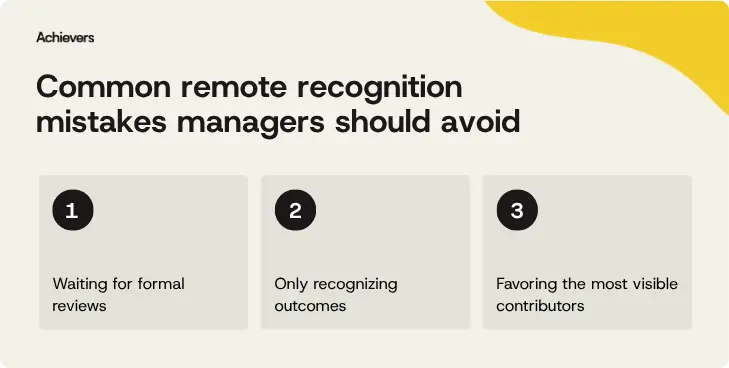
Common Pitfalls to Avoid in Remote Recognition
Even with the best intentions, recognition efforts can sometimes fall short. Managers should be vigilant about avoiding these common missteps, which can inadvertently undermine engagement rather than strengthen it:
- Inconsistency: Sporadic or unpredictable recognition signals a lack of genuine commitment.
- Vagueness: Generic praise without specific examples fails to provide meaningful feedback or reinforcement.
- Proximity Bias: Favoring employees who are more vocal or visible in virtual settings, inadvertently overlooking quieter contributors.
- Ignoring Values: Focusing solely on quantifiable outcomes without acknowledging the behaviors and values that drive those outcomes.
- Over-reliance on Monetary Rewards: Neglecting the power of genuine verbal appreciation and personalized feedback in favor of transactional rewards.
- Lack of Personalization: Using a one-size-fits-all approach to recognition that doesn’t consider individual preferences.
- Forgetting Peer Recognition: Missing the opportunity to empower employees to acknowledge each other, thereby missing out on a powerful engagement driver.
Measuring the Efficacy of Remote Recognition Programs
To truly support remote employees and ensure recognition efforts are impactful, several key metrics can provide valuable insights into their consistency, reach, and effectiveness in driving engagement and retention.
Key Metrics for Assessing Recognition Impact
- Frequency of Recognition: Tracking how often recognition is given, both by managers and peers, to ensure consistent acknowledgment.
- Participation Rates: Monitoring the percentage of employees who both give and receive recognition to gauge widespread engagement with the program.
- Employee Engagement Scores: Correlating recognition data with overall employee engagement survey results to understand its impact on morale and motivation.
- Retention Rates: Analyzing whether teams with robust recognition practices exhibit higher retention rates.
- Qualitative Feedback: Regularly soliciting feedback from employees on their perceptions of recognition fairness, impact, and areas for improvement.
Leveraging Recognition Data for Enhanced Management
Analyzing recognition data provides managers with actionable insights to refine their strategies:
- Identifying Trends: Spotting patterns in who is giving and receiving recognition can highlight potential biases or areas where more intentional encouragement is needed.
- Understanding Impact: Correlating recognition data with performance metrics or engagement scores can reveal which types of recognition are most effective.
- Personalizing Approaches: Data can help managers understand individual preferences for recognition, allowing for more tailored acknowledgment.
- Justifying Investment: Quantifiable data on the positive impact of recognition can support further investment in recognition programs and platforms.
Harnessing Recognition Platforms for Remote Employee Support
As remote teams scale, relying on memory, spreadsheets, or mere good intentions for recognition becomes unsustainable. A dedicated recognition platform offers the necessary structure and visibility to ensure recognition is consistent, equitable, and meaningful, all while preserving the essential human touch.
How Recognition Platforms Empower Remote Recognition
Recognition platforms provide managers with the tools to:
- Centralize Recognition Activities: Offering a single hub for both formal and informal recognition, including peer-to-peer shout-outs, manager-led awards, and milestone celebrations.
- Automate Processes: Setting up automated reminders for birthdays, work anniversaries, and regular check-ins to ensure consistent acknowledgment.
- Facilitate Visibility: Making recognition visible across the organization, allowing for broader appreciation and learning.
- Track and Analyze Data: Providing robust reporting capabilities to measure the effectiveness of recognition initiatives and identify areas for improvement.
- Integrate with Existing Workflows: Seamlessly integrating with communication and project management tools to make recognition a natural part of the daily workflow.
Achievers: Empowering Managers to Bring Remote Recognition to Life
Achievers is purpose-built to assist organizations in transitioning from ad-hoc appreciation to frequent, impactful recognition that demonstrably shapes behavior, particularly within remote and hybrid workforces. Their recognition software empowers managers to cultivate meaningful appreciation on a global scale by:
- Enabling Seamless Peer-to-Peer Recognition: Providing an intuitive platform for employees to acknowledge and celebrate each other’s contributions, fostering a culture of mutual respect and support.
- Facilitating Manager-Led Recognition: Offering tools for managers to deliver timely, specific, and personalized recognition that aligns with company values and objectives.
- Driving Engagement Through Social Recognition: Creating a visible and engaging feed where achievements are shared and celebrated, boosting morale and reinforcing positive behaviors.
- Providing Actionable Insights: Delivering comprehensive analytics that help leaders understand the impact of their recognition programs and identify opportunities for optimization.
- Supporting Global Teams: Offering multilingual support and global accessibility to ensure recognition is effective across diverse and geographically dispersed workforces.
Recognition: The Manager’s Bridge Across Distance
Remote work does not inherently make recognition more challenging; rather, it elevates its importance and necessitates a more strategic and intentional approach. When managers consistently and thoughtfully recognize their remote employees, individuals feel more connected, valued, and intrinsically motivated to remain engaged. The strategies outlined in this guide are designed to embed recognition into the fabric of everyday work life, extending beyond infrequent milestone celebrations. These approaches are demonstrably effective, with organizations worldwide leveraging them to fortify connections and boost engagement across their global, distributed teams.

Key insights
- Remote work has significantly impacted employee engagement, with a substantial percentage of remote workers actively seeking new opportunities.
- Effective recognition in remote settings requires intentionality and must compensate for the lack of physical proximity cues.
- Recognition needs to be specific, personalized, and aligned with company values and purpose, not just outcomes.
- Managers play a critical role in fostering equitable and consistent recognition practices for distributed teams.
- Leveraging recognition platforms can streamline and enhance the effectiveness of recognition efforts for remote employees.