Organizations worldwide are increasingly treating the interview process as a mere operational checkpoint, a logistical hurdle to be cleared as candidates navigate the hiring pipeline. This transactional approach, characterized by scheduling, slot-filling, and form-sending, belies a critical strategic reality: a persistent deficit in qualified interviewers is not just slowing down hiring, but actively undermining core business objectives. The consequences of this overlooked capacity gap ripple outward, impacting employee retention, the strength of an employer brand, competitive positioning, and an organization’s fundamental ability to achieve its growth agenda.
This deficiency in interviewer capacity represents a significant workforce risk, deserving of the same strategic attention as labor market tightness, critical skills gaps, and succession planning. It is a matter that should be elevated from the realm of recruiting operations reports to the executive boardroom. Recognition of interviewer capacity as a strategic imperative by HR leadership is the crucial first step toward implementing effective, sustainable solutions.
The Mounting Pressure: Understanding the Interviewer Capacity Problem
At its core, the interviewer capacity issue is a mathematical one. Who are the individuals tasked with conducting interviews in most organizations? Typically, they are senior contributors and managers—the very professionals accountable for team output, project delivery, and their own performance metrics. Interviewing, therefore, is rarely their primary responsibility; it is an additional duty, often squeezed into an already demanding schedule.
During periods of accelerated hiring—driven by growth phases, new product launches, or organizational restructuring—the availability of these key personnel does not scale in tandem with demand. The number of hours in a workday remains constant, creating a structural mismatch between the supply of interviewers and the burgeoning demand for their time. This imbalance predictably manifests in several detrimental ways:
- Extended Time-to-Fill: With fewer interviewers available to assess candidates, the entire hiring process lengthens. This delay can mean losing out on top talent to competitors or missing critical project deadlines.
- Candidate Experience Degradation: A protracted interview process, marked by scheduling difficulties and long waits for feedback, significantly diminishes the candidate experience. This can lead to valuable prospects withdrawing their applications or developing a negative perception of the employer.
- Increased Recruiter Burden: Recruiters are forced to spend more time coordinating schedules, chasing down interviewers, and managing candidate expectations, diverting their focus from more strategic talent acquisition activities.
- Burnout Among Interviewers: The constant pressure to interview on top of existing responsibilities leads to interviewer fatigue, potentially resulting in rushed evaluations and a decline in assessment quality.
While HR leaders have long been aware of interviewer fatigue and scheduling bottlenecks, the scale of the problem has dramatically intensified. In today’s highly competitive labor market, characterized by distributed workforces and global hiring needs, the interviewer capacity gap has transformed from a minor friction point into a genuine strategic constraint.
Beyond Inconvenience: The Strategic Implications of Interviewer Shortages
When a Chief Human Resources Officer (CHRO) enters a leadership meeting, their mandate is to align people strategy with overarching business outcomes. The scarcity of interviewers directly impedes this objective, impacting critical business functions and warranting a prominent place in strategic discussions.
Inability to Scale During Growth Phases
The execution of business expansion, market entry, or the development of new capabilities hinges on the ability to hire effectively. When the interview process cannot scale to meet increased demand, growth strategies falter at the talent bottleneck. Business plans may fail not due to flawed vision, but because the organization lacks the capacity to acquire the necessary talent swiftly. For instance, a company aiming to launch a new product line might face significant delays if it cannot efficiently onboard the required engineers, marketers, and support staff, thereby missing a crucial market window.
Loss of Competitive Talent to Faster-Moving Organizations
Top-tier candidates, particularly in high-demand fields such as technology, leadership, and specialized roles, are rarely exploring job opportunities in isolation. They are often fielding multiple offers simultaneously. A slow, cumbersome interview process not only inconveniences these individuals but also subtly signals an organization’s operational efficiency—or lack thereof. When a more agile competitor extends an offer first, the talent gap widens, creating a compounding disadvantage. In the competitive landscape of the early 2020s, with reports indicating that time-to-fill for critical roles can exceed 45 days in some sectors, this speed advantage is paramount.
Increased Cost-Per-Hire at Scale
Every week a position remains unfilled incurs significant costs. These include lost productivity from the vacant role, ongoing recruitment expenses, and the valuable time managers spend re-engaging with candidates who have already accepted other offers. When interviewer capacity becomes the binding constraint, time-to-fill metrics stretch, and these accumulating costs impact the profitability of multiple open positions across the organization. Research from industry analysts often cites that the average cost-per-hire can range from $3,000 to over $10,000, a figure that escalates dramatically when roles remain open for extended periods due to interviewer bottlenecks.
Risk of Inconsistent or Non-Compliant Evaluations
When different interviewers assess similar candidates without a standardized framework, the evaluations can reflect individual biases and inconsistencies rather than objective role requirements. This lack of structured assessment is problematic in any context, but it poses significant legal and reputational risks in regulated industries or jurisdictions with evolving compliance laws, particularly concerning artificial intelligence in hiring. Inconsistent evaluations can lead to discriminatory practices, even unintentionally, and expose organizations to legal challenges and reputational damage. For example, the implementation of New York City’s Local Law 144, which mandates bias audits for automated employment decision tools, underscores the increasing scrutiny on hiring practices.
The Limitations of Traditional Solutions
The conventional approach to addressing interviewer capacity shortages typically involves a few well-worn strategies: training more interviewers, reducing the number of interview rounds, or increasing the recruiting headcount. While none of these tactics are inherently flawed, their effectiveness is often marginal and short-lived when implemented in isolation.
- Training More Interviewers: This process requires significant time and resources. Furthermore, once these newly trained individuals assume leadership or delivery responsibilities, their availability for interviewing tends to diminish, effectively returning the organization to its original predicament.
- Reducing Interview Rounds: While this can accelerate hiring timelines, it often comes at the cost of confidence in the hiring decision. This can lead to increased post-hire reassessment, re-openers, and a higher likelihood of mis-hires, ultimately negating the initial time savings.
- Adding Recruiting Headcount: This approach shifts the coordination burden but does not fundamentally address the core issue of who is conducting the interviews. The bottleneck remains with the limited pool of qualified individuals available for assessment.
The fundamental constraint persists: the demand for interviews will consistently outstrip the supply of qualified, available interviewers. This is not merely a matter of insufficient training or headcount; it is a structural capacity problem that necessitates structural solutions.
AI Interviewing: A Strategic Multiplier for Interviewer Capacity
The strategic value of AI interviewing lies not in replacing human judgment, but in significantly augmenting an organization’s interviewing capacity without the need to increase headcount. Crucially, it can achieve this at a level of quality and consistency that structured human screening often struggles to maintain.
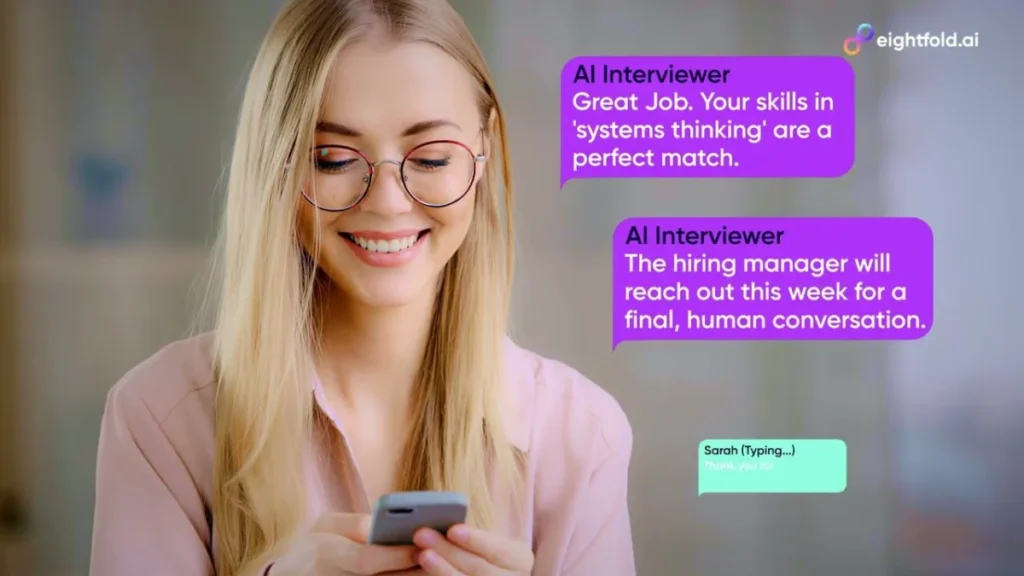
A sophisticated AI interviewer system, such as Eightfold AI’s solution, operates autonomously, 24 hours a day, and can support candidates in multiple languages. This enables candidates to engage in interviews immediately upon application, eliminating scheduling delays and the need for recruiter intervention at this initial stage. Thousands of candidates can simultaneously undergo a standardized, consistent screening process, freeing up valuable human resources.
These AI systems are designed to conduct structured interviews, including behavioral assessments (often utilizing the STAR method), coding challenges with real-time reasoning checks, and language proficiency evaluations based on recognized frameworks like CEFR. Such assessments are grounded in robust Talent Intelligence Engines, which leverage vast datasets of real-world career trajectories to inform evaluation criteria.
The critical benefit of this approach is the liberation of human interviewers—senior contributors, hiring managers, and functional leaders. Their time can be redirected to the stages of the hiring process that truly demand their expertise and nuanced judgment: final-round interviews, in-depth culture and leadership assessments, and high-stakes evaluations where interpersonal dynamics are paramount. This creates a powerful synergy: AI handles the volume and initial screening, while humans focus on depth and critical decision-making.
Furthermore, AI interviewer evaluations are content-based, focusing on a candidate’s responses, experiences, and demonstrated capabilities. This approach deliberately avoids reliance on subjective factors such as facial expressions, tone of voice, or any biometric signals. This design not only promotes fairness and ensures compliance with regulations like New York City’s Local Law 144 and Illinois’ BIPA (Biometric Information Privacy Act) but also generates more consistent and reliable data for hiring decision-makers. This data-driven approach minimizes bias and enhances the objectivity of the hiring process.
Tangible Business Outcomes of Enhanced Interviewer Capacity
When AI interviewing is strategically integrated as a capacity-enhancing layer, the business benefits are direct and measurable:
- Accelerated Time-to-Hire: By processing a high volume of candidates efficiently, AI significantly reduces the time it takes to identify qualified individuals, allowing businesses to onboard talent more rapidly and capitalize on market opportunities.
- Improved Candidate Experience: Immediate interview availability and reduced waiting times contribute to a more positive and engaging candidate journey, enhancing the employer brand and increasing acceptance rates.
- Reduced Cost-Per-Hire: Shorter hiring cycles and more efficient use of human interviewer time directly translate into lower overall recruitment costs.
- Enhanced Quality of Hire: By standardizing initial assessments and freeing up human interviewers for deeper evaluations, AI contributes to more informed hiring decisions, leading to better long-term employee performance and retention.
- Increased Hiring Team Productivity: Recruiters and hiring managers can focus on higher-value activities, such as strategic sourcing, candidate engagement, and closing candidates, rather than being bogged down by administrative tasks.
Addressing the Interviewer Shortage: A Strategic Imperative
The interviewer shortage is not a logistical challenge solvable by improved calendar tools. It is a structural capacity constraint that fundamentally limits an organization’s ability to hire effectively, grow sustainably, and maintain a competitive edge. This challenge is poised to intensify as hiring volumes continue to rise and candidate expectations evolve.
Treating interviewer capacity as the strategic risk it truly is requires a paradigm shift. Organizations must apply the same rigor and investment to addressing this constraint as they do to other critical workforce challenges. This means moving beyond incremental fixes and investing in a scalable infrastructure for interviewing—one that augments human capabilities rather than simply taxing them.
AI Interviewer represents such an infrastructure. It does not aim to replace the crucial human interactions that define effective hiring. Instead, it ensures those interactions occur more rapidly, more equitably, and without contributing to the burnout of the very individuals upon whom the organization depends. For businesses seeking to navigate the complexities of modern talent acquisition and unlock their full growth potential, addressing the interviewer capacity crisis with strategic, technologically advanced solutions is no longer optional—it is essential.