

In the rapidly evolving digital landscape of eLearning and Human Resources (HR) technology, visibility is no longer the sole metric of success. As the global eLearning market is projected to exceed $460 billion by 2026, the sector has become increasingly saturated with vendors offering nearly identical feature sets, targeting the same corporate demographics, and competing for the same digital real estate. In this environment, standing out requires a sophisticated understanding of the competitive landscape. Success is predicated on context—knowing not just what your company does, but how it compares to others across traffic patterns, positioning, content authority, and demand generation.
Despite the high stakes, many marketing and growth teams in the HR tech space continue to operate on assumptions. They frequently rely on surface-level observations of competitor websites or reactively copy tactics without understanding the underlying strategy. This lack of data-driven intelligence often results in stagnated growth and inefficient ad spend. Competitor analysis, when executed correctly, is not merely a tracking exercise; it is a strategic driver that uncovers market gaps, refines brand positioning, and prioritizes high-impact channels.
The Strategic Importance of Intelligence in eLearning and HR Tech
The eLearning and HR tech sectors are characterized by high fragmentation and low barriers to entry for new software-as-a-service (SaaS) providers. Established giants and agile startups often promise the same outcomes: improved employee engagement, streamlined recruitment, and enhanced learning retention. For the buyer, this creates a "sea of sameness" that makes decision-making difficult.

For marketers, the challenge is even more pronounced due to the extended B2B buying cycle. Decision-makers in HR and Corporate Learning & Development (L&D) rarely purchase in isolation. They engage in rigorous vendor comparisons, involving multiple stakeholders and reviewing a wide array of content over several months. Consequently, a brand is constantly being weighed against its peers. Without deep competitive insight, a team may invest heavily in a content strategy that a competitor already dominates, or fail to address specific buyer pain points that a rival has successfully identified. Solid competitive intelligence allows firms to move from a reactive posture to a proactive one, identifying overlooked opportunities and responding to market shifts with precision.
Essential Capabilities of a Competitive Analysis Framework
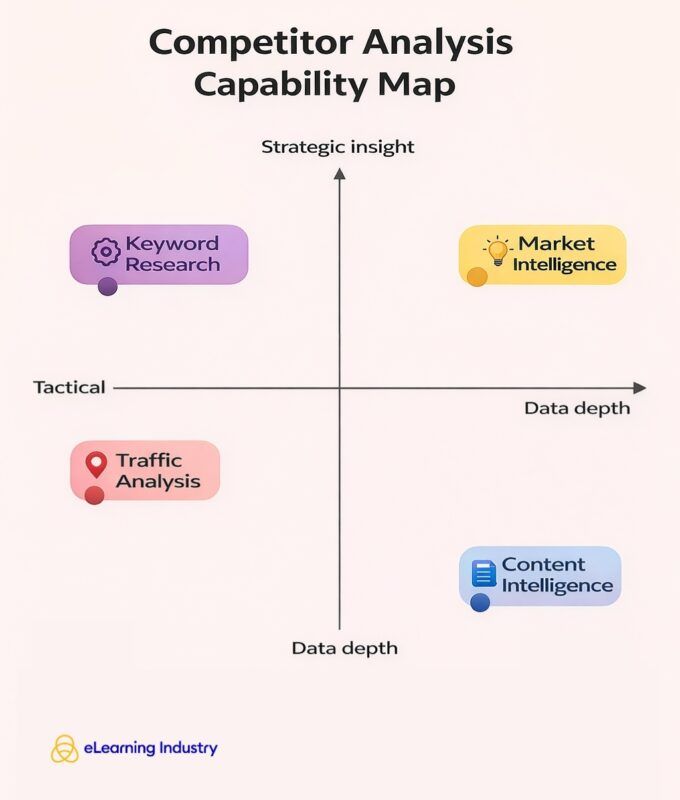
Not all intelligence tools are created equal. To build a robust strategy, teams must look for platforms that provide specific, actionable metrics rather than raw data. A comprehensive framework generally rests on five pillars of capability:
- Traffic and Audience Intelligence: Understanding the volume and source of a competitor’s traffic—whether it is driven by organic search, paid campaigns, direct visits, or referrals—reveals where market demand is currently being captured.
- Keyword and SEO Benchmarking: Identifying which search terms a competitor ranks for allows a company to spot "content gaps"—areas where the competitor is weak or where the market is underserved.
- Content and Messaging Analysis: Beyond keywords, it is essential to analyze the type of content that resonates. This includes white papers, case studies, and thought leadership pieces that move prospects through the sales funnel.
- Ad Intelligence: Monitoring a competitor’s paid media spend provides clues about their most profitable offers and their specific value propositions.
- Side-by-Side Benchmarking: The ability to compare multiple entities simultaneously is crucial for understanding relative market share and brand sentiment.
Top Competitor Analysis Tools by Category
The most successful growth teams utilize a "stack" of tools rather than relying on a single platform. These are categorized by their primary function within the intelligence ecosystem.
Category 1: SEO and Traffic Intelligence
These platforms focus on the "top of the funnel," revealing how competitors build authority and attract visitors.
- Semrush: Widely regarded as an all-in-one platform, Semrush allows HR tech vendors to perform deep domain analysis. Its "Keyword Gap" tool is particularly useful for identifying high-intent search terms that a competitor is utilizing but your brand is missing.
- Ahrefs: Known for having one of the world’s largest backlink indexes, Ahrefs is vital for understanding a competitor’s authority. In the eLearning space, where backlinks from educational institutions and reputable HR blogs are gold, Ahrefs helps teams reverse-engineer successful PR and link-building strategies.
- Similarweb: This tool provides a macro-view of the digital landscape. It excels at showing "referral" traffic, which can help vendors identify which industry publications or partner sites are driving the most traffic to their competitors.
Category 2: Real-Time Monitoring and Sales Enablement
These tools are designed to track the "moves" of a competitor, such as price changes, website updates, or new product launches.
- Crayon: Crayon uses AI to track thousands of data points across the web, including a competitor’s Glassdoor reviews, executive shifts, and subtle website messaging changes. This is essential for HR tech companies that need to pivot their positioning quickly.
- Kompyte: This platform focuses on sales enablement. It generates "battle cards" for sales teams, providing them with real-time rebuttals and talking points when a prospect mentions a competitor’s feature or pricing.
- SpyFu: While it has SEO capabilities, SpyFu is best known for its deep dive into paid search history. It allows you to see every keyword a competitor has ever bought on Google Ads, helping you avoid expensive mistakes in your own bidding strategy.
Category 3: Buyer Perception and Review Platforms
Data metrics tell you what is happening, but review platforms tell you why it is happening from the user’s perspective.
- G2 and Capterra/GetApp: These are the primary battlegrounds for buyer sentiment. High-performing vendors monitor these sites not just for their own reviews, but to analyze the specific complaints users have about their competitors. If a rival LMS (Learning Management System) is frequently criticized for a "clunky UI," a competitor can emphasize its "user-centric design" in its next ad campaign.
Category 4: Social and Ad Transparency
- LinkedIn and Meta Ads Libraries: Since a large portion of HR tech marketing happens on social media, these public libraries are invaluable. They allow teams to see the exact creative assets and messaging their competitors are using to target HR directors and L&D managers.
The "Visibility" Layer: Why Industry-Specific Platforms are Crucial
A common mistake in competitive analysis is focusing exclusively on general SEO or SaaS tools while ignoring where the buyers actually congregate. In the eLearning and HR tech niche, industry-specific visibility platforms like eLearning Industry represent a critical layer of the strategy.
General tools show you what the competition is doing on their own websites. However, visibility platforms show you how the competition is performing in the "neutral zones" where buyers go to research. These platforms offer specialized directories, expert-curated rankings, and high-authority content ecosystems. For a vendor, being absent from these platforms while a competitor is present creates a "credibility gap" that no amount of SEO can easily fix.
Implementing a Real-World Benchmarking Framework
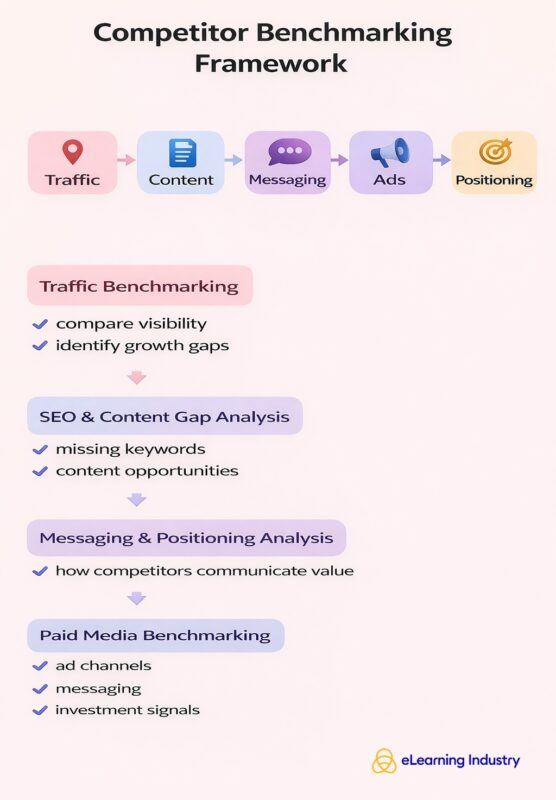
To turn these tools into growth, companies must follow a structured benchmarking process:
- Traffic Benchmarking: Do not just look at your own growth; look at your growth relative to the market. If your traffic increased by 10% but your main competitor’s traffic increased by 50% through referral sources, your "market share of attention" is actually shrinking.
- SEO Gap Analysis: Use Semrush or Ahrefs to identify "bottom-of-funnel" keywords. In HR tech, these are often terms like "best payroll software for remote teams" or "LMS comparison 2024." These terms have lower volume but much higher conversion rates.
- Messaging Dissonance: Analyze if your competitors are all saying the same thing. If every HR tech vendor is talking about "AI-driven insights," there is a strategic opportunity to pivot and talk about "Human-centric leadership" or "Ease of implementation."
Market Implications and the Future of Competitive Intelligence
The shift toward AI-integrated HR tools is making competitive analysis more complex. Features are being released at a faster rate than ever before, and the traditional "annual competitive report" is now obsolete. Intelligence must be continuous.
Furthermore, the "dark funnel"—the phenomenon where buyers research on private communities, podcasts, and third-party platforms before ever visiting a vendor’s site—is expanding. This makes "presence" on industry-specific platforms even more vital. High-performing vendors are those that combine hard data from SEO tools with the "soft power" of being visible in trusted industry ecosystems.
Conclusion
In the eLearning and HR tech sectors, the divide between market leaders and laggards is often defined by the quality of their competitive intelligence. Tools provide the data, but strategy provides the direction. By categorizing competitors, identifying traffic and content gaps, and ensuring a strong presence on industry-specific visibility platforms, vendors can navigate the crowded market with confidence. The goal is not to replicate the competition, but to understand them well enough to offer a distinct, superior alternative to the buyer. In a market where options are endless, the most informed and visible brand is the one that ultimately wins the contract.






