Artificial intelligence has fundamentally reshaped the landscape of recruitment by 2026, moving far beyond its initial role as an assistive workflow tool. What began as AI-powered recommendations for candidates, automated bias flagging, or rudimentary job description drafting has evolved into a more autonomous, agentic paradigm. Today, sophisticated AI tools can independently initiate contact with prospective candidates, conduct initial screenings through voice or chat interfaces, and even schedule interviews without direct human intervention from a recruiter. This profound shift, while promising unprecedented efficiencies, simultaneously ushers in a new era of responsibilities, particularly concerning regulatory compliance and ethical deployment.
The Evolution of AI in Talent Acquisition
The journey of AI in talent acquisition has been rapid and iterative. In the early 2020s, AI primarily served to augment human recruiters, automating repetitive tasks like resume parsing and basic candidate matching. These initial tools, while beneficial, required significant human oversight and input. As generative AI capabilities matured in the mid-2020s, the ability to draft nuanced communications, create tailored job descriptions, and generate preliminary interview questions became commonplace. However, the pivotal leap occurred with the advent of "agentic AI." These systems are not merely reactive but proactive, capable of understanding context, making independent decisions within defined parameters, and executing multi-step processes to achieve recruiting objectives. This evolution was driven by persistent talent shortages, the need for greater efficiency in high-volume hiring, and a global push for more objective and bias-free recruitment processes.
The Regulatory Imperative: Navigating New Legal Frontiers
Accompanying this technological acceleration is a burgeoning regulatory framework designed to govern AI’s application in critical areas like employment. By 2026, landmark legislation such as the European Union’s AI Act has come into full effect, imposing stringent requirements on transparency, risk assessment, and human oversight for AI systems used in hiring decisions. Simultaneously, several U.S. states have introduced their own legislation, creating a complex patchwork of compliance obligations for organizations operating across different jurisdictions. These laws mandate that companies understand not just the capabilities of their AI tools but also their legal boundaries. Non-compliance can result in substantial fines, reputational damage, and legal challenges, making legal and ethical considerations paramount for any organization adopting these advanced solutions. HR leaders emphasize that "understanding the ethical implications and legal mandates of AI is no longer optional; it’s a foundational requirement for responsible innovation," as noted by a spokesperson for the Global HR Tech Alliance.
Key Use Cases and Leading AI Hiring Solutions for 2026
The features organizations seek in AI recruitment tools are directly tied to their specific hiring goals, whether it’s reducing interview cycles, streamlining job description management, or enhancing the sourcing of qualified talent. AI has now been deeply integrated into nearly every facet of the recruitment lifecycle.
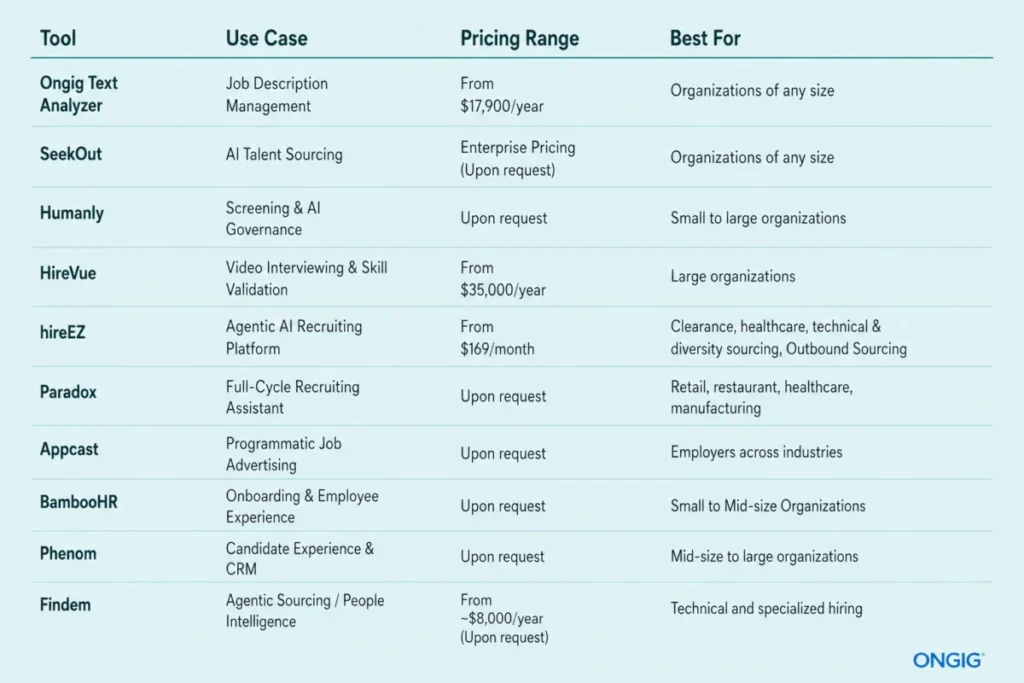
Here are some of the most impactful AI hiring tools available in 2026, addressing diverse talent acquisition challenges:
-
Job Description Management – Ongig Text Analyzer:
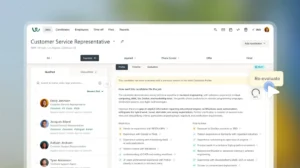
Ongig Text Analyzer stands out for its ability to refine the job description creation and management process. Its AI engine meticulously analyzes job descriptions for biased language, gendered terminology, exclusionary phrases, and industry-specific jargon, promoting inclusivity and clarity. The software leverages generative AI to rapidly create initial job descriptions from a simple job title, offering suggestions for improvement based on millions of data points. This ensures consistency across roles, enhances SEO, and helps organizations comply with anti-discrimination regulations. Its key benefits include real-time bias flagging (e.g., age, gender, race), compliance with accessibility standards, and a vast library of inclusive language recommendations. For instance, the system can flag terms like "young, energetic team" as potential age bias, offering alternatives. Pricing for Ongig Text Analyzer typically starts at $17,900 per year, scaled by features and job volume, making it suitable for organizations of all sizes committed to equitable hiring. -
Candidate Sourcing – SeekOut:
SeekOut has solidified its position as a premier AI-powered sourcing platform. It meticulously searches a vast database exceeding 750 million public profiles, including over 330 million underrepresented candidates and 127 million unique candidate profiles. A major differentiator by 2026 is its "Skills-Based Sourcing" and internal talent mobility focus, enabling companies to identify candidates based on specific competencies rather than just job titles. SeekOut’s AI-powered natural language processing learns continuously, providing data-driven insights to pinpoint highly qualified candidates. It offers two core products: "Recruit" for AI-powered candidate search and "Spot," which pairs AI agents with SeekOut’s own recruiters to deliver interview-ready candidates, often within two weeks. This significantly reduces manual search time and improves the quality of candidate pipelines for organizations of any size. -
Candidate Screening – Humanly:
Humanly offers an end-to-end AI hiring platform known for its "Governance" and "Audit-ready" records, crucial for meeting 2026 global AI transparency laws. Its machine learning capabilities allow it to hold natural conversations with candidates as part of the screening process, saving recruiters up to 75% of time spent on repetitive tasks. Humanly’s AI can conduct initial phone screens using "voice-to-data" technology, summarizing key points directly into the Applicant Tracking System (ATS). It can also join Zoom interviews, take notes, extract valuable insights, and automatically schedule follow-up interactions. The platform provides pre-built templates for screening questions, reference checks, and interviews, ensuring a structured and compliant process. Humanly’s focus on detailed logging and transparency helps organizations maintain accountability in their AI-driven screening processes. -
Interview Management – HireVue:
HireVue remains a leader in video interviewing software, particularly for large enterprises with high-volume recruitment needs. By 2026, its focus has shifted to "Actionable Skill Validation" through Video Interview Analytics, moving beyond simple transcription to help companies hire based on demonstrated abilities. Significant enhancements in "Explainable AI" features have been implemented to meet stringent 2025/2026 global AI regulations regarding transparency in candidate scoring. The platform supports both asynchronous and live video interviews, providing a seamless, mobile-friendly experience. Its extensive library of job-specific interview guides, developed by organizational psychologists, assists recruiters in conducting structured and fair interviews. While its conversational AI for candidate queries is robust, ongoing development aims to enhance its human-like interaction quality. Pricing starts at $35,000 for large enterprises, reflecting its enterprise-grade capabilities. -
Outbound Recruiting – hireEZ:
hireEZ has evolved into an "Agentic AI Recruiting Platform" by 2026, specializing in proactive outbound hiring. It scans a database of over 100 million profiles to identify qualified applicants for specific job ads. Its three core modules – Sourcing/CRM, Applicant Match, and Hiring Intelligence – provide comprehensive tools. The platform’s advanced market insights feature allows recruiters to upload a job description and instantly access labor market data, including candidate availability, salary benchmarks, and talent hotbeds. hireEZ then assists in crafting targeted, automated outreach emails designed for higher response rates. Critically, it prioritizes diversity sourcing, using AI to filter and identify candidates from underrepresented groups based on university affiliations, diversity organization memberships, and pronoun usage, supporting inclusive hiring initiatives. Pricing plans begin at $149 per month, catering to specialized sourcing needs across various industries. -
Automated Chatbots for Candidate Engagement – Paradox (Olivia):
Paradox has cemented its role as a full-cycle "Recruiting Assistant" by 2026, with its AI chatbot, Olivia, handling everything from initial applications to offer letters for high-volume roles. Olivia is designed for natural, scalable conversations with candidates in over 100 languages. It automates interview scheduling across hundreds of calendars and complex time zones without human intervention. Olivia screens candidates against basic skills and qualifications, conducts initial interviews via web chat, SMS, Facebook Messenger, and WhatsApp, and intelligently matches applicants with relevant job openings. Its ability to manage rescheduling requests seamlessly ensures a positive candidate experience, making it invaluable for sectors like retail, hospitality, healthcare, and manufacturing. -
Programmatic Job Advertising – Appcast:
Appcast remains a leader in programmatic job advertising, serving over 2,000 customers. In 2026, the launch of AppcastOne introduced AI to predict "Cost-per-Hire" before any advertising spend, optimizing budget allocation. Its intelligent programmatic technology identifies qualified applicants by distributing job ads across a vast network of over 30,000 job boards and various media channels in more than 100 countries. AppcastOne leverages search engines, automated advertising, traditional media, and social media to reach both active and passive job seekers. Its pay-per-applicant model ensures cost-effectiveness, as organizations only pay when candidates apply, making it an efficient tool for diverse employers seeking global reach. -
Employee Onboarding – BambooHR:
BambooHR stands out as a comprehensive AI recruitment platform that streamlines the entire employee lifecycle from hiring to payroll and onboarding. Its onboarding module offers extensive customization options based on job role, location, and department. It automates critical onboarding tasks, assigning responsibilities to new hires, managers, and other supporting employees. Key features include digital welcome emails, pre-boarding packages, e-signatures for documentation, and IT checklists, enabling new employees to become productive immediately by eliminating traditional paper-based processes. BambooHR’s focus on a smooth, personalized onboarding experience helps boost retention and engagement from day one, serving organizations of all sizes. -
Talent Experience Management – Phenom:
Phenom provides a unified talent experience platform that covers the entire candidate journey: career site, AI chatbot, and CRM. In 2026, Phenom addresses the critical issue of candidate dropout rates, with studies indicating that 66% of candidates are influenced by a positive hiring experience. Its AI-powered career site surfaces highly relevant roles to visitors based on their background, while the integrated chatbot seamlessly continues the conversation, screening candidates, answering questions, and guiding them through the process. The CRM component allows recruiters to manage relationships over time, ensuring that strong candidates who might not fit one role are not lost. Phenom’s continuity across the candidate journey is vital for hiring teams struggling with poor communication and high drop-off rates, making it suitable for organizations of any size aiming to enhance candidate engagement. -
Agentic Sourcing / People Intelligence – Findem:
Findem’s "Agentic Sourcing" is recognized as the 2026 gold standard for technical talent, leading in "People Intelligence." The platform uses "3D data" to track a candidate’s career trajectory and predict future performance, enabling "hyper-personalized" sourcing. Findem aggregates data from hundreds of sources to build a holistic view of each candidate, revealing not just current roles but career growth patterns and future potential. This is particularly valuable for technical roles where growth trajectory often speaks more than a current job title. Its agentic sourcing capabilities allow AI to autonomously identify, score, and rank candidates, freeing recruiters from manual searches. Outreach is highly targeted, leveraging deep candidate context to craft personalized messages that yield better response rates than generic templates. Findem is ideal for organizations with ongoing technical and specialized hiring needs.
Strategic Implementation: Navigating the AI Transformation
Successfully incorporating AI into hiring processes requires a structured and thoughtful approach. Organizations must move beyond mere adoption to strategic integration. This involves:
- Defining Clear Goals: Articulate specific challenges AI is intended to solve (e.g., reduce time-to-hire, improve diversity, enhance candidate experience).
- Starting Small and Scaling: Pilot AI tools in specific recruitment stages or for particular roles before broader implementation to test effectiveness and gather feedback.
- Ensuring Data Quality and Privacy: High-quality, unbiased data is crucial for AI performance. Establish robust data governance policies that comply with privacy regulations like GDPR and CCPA.
- Prioritizing Ethical AI and Bias Mitigation: Actively select AI tools with built-in bias detection and mitigation features. Conduct regular audits of AI algorithms to ensure fairness and transparency.
- Training and Upskilling Recruiters: Equip recruitment teams with the skills to effectively use and manage AI tools, shifting their focus from administrative tasks to strategic engagement and candidate relationship building.
- Maintaining Human Oversight: Emphasize that AI should augment, not replace, human judgment. Recruiters must retain the final decision-making authority, especially in critical hiring stages.
- Integrating with Existing Systems: Ensure new AI tools seamlessly integrate with existing Applicant Tracking Systems (ATS) and Human Resources Information Systems (HRIS) for a cohesive workflow.
- Measuring ROI and Iterating: Continuously track key performance indicators (KPIs) to evaluate the impact of AI tools and make data-driven adjustments for continuous improvement.
- Fostering a Culture of Experimentation: Encourage teams to explore new AI capabilities and provide feedback to vendors for further development and customization.
Broader Implications and the Future of Work
The rise of agentic AI in recruitment signifies a profound shift in the HR landscape. It transforms the recruiter’s role from an administrative gatekeeper to a strategic talent advisor, focusing on high-value activities like candidate engagement, relationship building, and strategic workforce planning. This evolution also intensifies the discussion around ethical AI, demanding greater algorithmic transparency, accountability, and the proactive prevention of unintended biases. While concerns about job displacement persist, industry analysts suggest that AI will primarily create new job categories and redefine existing ones, necessitating a workforce skilled in human-AI collaboration. The balance between automation and the invaluable human touch will be a defining characteristic of successful talent acquisition strategies in the years to come.
Market Growth and Industry Outlook
The rapid adoption of AI in HR is undeniable. SHRM’s "The State of AI in HR in 2026" report indicates that 39% of organizations have already implemented AI in their HR functions, with recruitment leading the charge at 27%. This reflects a growing confidence in AI’s ability to deliver tangible benefits. Market Research Future corroborates this trend, projecting the AI recruitment industry to grow from USD 660.23 million in 2025 to a staggering USD 1,289.13 million by 2035. This exponential growth underscores the industry’s commitment to leveraging AI-driven solutions to streamline processes, enhance candidate matching accuracy, and significantly reduce time-to-hire, ultimately leading to more efficient and equitable talent acquisition.
By 2026, AI is no longer a futuristic concept but a foundational component of modern recruitment. Organizations that strategically embrace these tools, while diligently navigating the regulatory and ethical complexities, are best positioned to attract, engage, and retain top talent in an increasingly competitive global marketplace. The mandate for human oversight remains paramount, ensuring that while AI simplifies the process, the ultimate decision to welcome a new employee is always made with empathy, insight, and a human touch.