A seismic shift is underway in the global labor market, an industrial transformation as profound as the advent of steam power or the personal computer. This is not a gradual evolution, but an abrupt recalibration of how work is conceived, executed, and scaled. The era of traditional human-centric scaling is drawing to a close, replaced by a paradigm where artificial intelligence acts as a force multiplier, creating what industry leaders are beginning to call the "Infinite Workforce." This transition, however, is leaving many human resources departments ill-prepared, clinging to outdated methodologies and tools in the face of unprecedented technological advancement.
The transition from software-driven efficiency to superintelligence is not merely a technological upgrade to be managed on a roadmap. It represents a fundamental restructuring of the very nature of work – defining who performs tasks, at what velocity, and at what scale. Organizations that recognize and proactively adapt to this paradigm shift are poised to achieve a competitive advantage so significant that it will be measured not in quarterly earnings, but in entirely new market categories. Conversely, those that fail to adapt risk managing yesterday’s workforce with yesterday’s tools, while AI-native competitors operate on an entirely different plane of operational effectiveness.
For decades, the prevailing wisdom for business expansion was straightforward: to increase output, one needed to increase headcount. This simple equation dictated that if a company needed to hire faster, it hired more recruiters. If it needed to process more applications, it added administrative staff. If more interviews were required, calendars were simply booked more densely. This model, however, has encountered a hard ceiling. The limitation is not a lack of human capability; rather, it lies in the inherent scalability of human labor itself. Every workflow that necessitates a human to manually initiate an action – a button press, a file transfer, a meeting scheduling – is bound by the finite capacity of human effort. Human beings, regardless of their talent, require rest, observe time zone differences, and can only be in one place at a time.
AI-native organizations have already moved beyond this constraint. Instead of pushing their human employees to achieve more with less, these forward-thinking companies are deploying digital agents to manage high-volume, repetitive execution tasks. This strategic reallocation allows human talent to focus on responsibilities that uniquely demand human judgment, creativity, and emotional intelligence. This approach is, in essence, the manufacturing of intelligence, enabling a scale of operation previously unimaginable. The chasm between these adaptive organizations and legacy enterprises is not widening incrementally; it is expanding exponentially.
The uncomfortable reality for many HR leaders is that the technology investments made over the past decade were not designed to address this new reality. Instead, they were developed to digitize existing processes, effectively automating the inefficiencies of the past. Traditional HR platforms, such as Applicant Tracking Systems (ATS) and Human Resource Information Systems (HRIS), function primarily as systems of record. Their core purpose has been to track employee numbers, ensure compliance, and store data. Within these systems, candidates are often treated as static database entries, and employees as mere cost centers on a balance sheet. While these systems can readily report on who is employed, they falter when asked to identify individuals with specific, transferable skill sets, such as predicting who could become the next engineering lead or which sales executive possesses skills adaptable to three different roles.
Compounding this issue, the artificial intelligence embedded within these legacy systems is typically trained exclusively on internal organizational data. This data is frequently incomplete, historically biased, and siloed across different departments. An AI that learns solely from past decisions is incapable of accurately predicting future outcomes; instead, it tends to amplify past mistakes with an unwarranted degree of confidence. This is not true intelligence; it is a mechanism that can inadvertently launder biases, perpetuating systemic inequalities.
Another seemingly attractive option – the deployment of general-purpose large language models (LLMs) – presents its own distinct set of challenges. While these tools are remarkable at processing and generating language, capable of summarizing documents and engaging in conversational exchanges, they lack a critical "spatial intelligence" within the professional landscape. They do not inherently understand the nuances of career progression, the adjacency of skills, or the compliance ramifications of hiring decisions. Furthermore, their inherent disclaimers about potential inaccuracies are untenable in the high-stakes field of talent acquisition, where precision and reliability are paramount. The industry has, therefore, presented HR leaders with a dichotomy: the inertia of legacy systems or the unreliability of generalized AI.
A New Operational Architecture: Humans Overseeing Agents
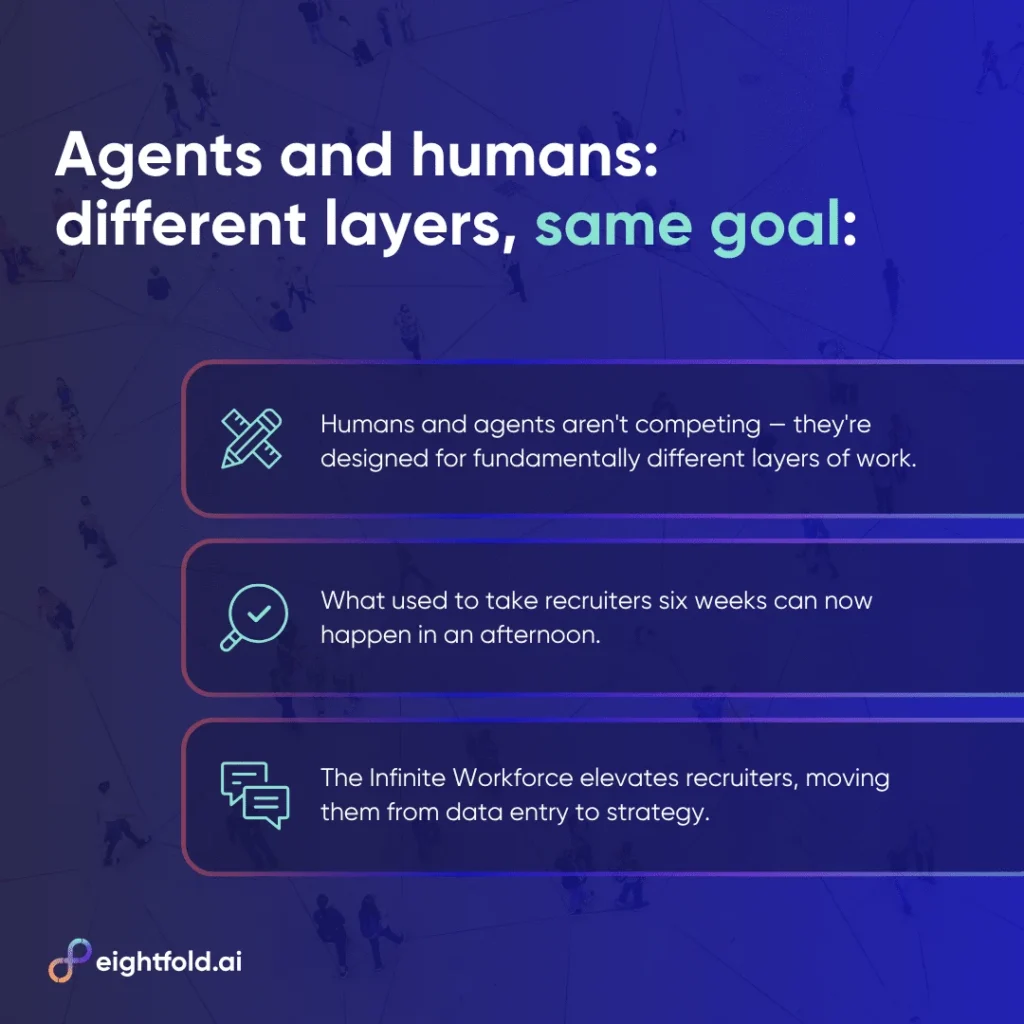
The concept of the Infinite Workforce transcends a mere technological product; it represents a novel operating architecture. This architecture is founded on the recognition that humans and AI agents are not in direct competition for the same tasks. Instead, they are designed to function at fundamentally different layers of the operational workflow.
AI agents are engineered to handle execution at scale. They can efficiently screen candidates, schedule interviews, conduct initial assessments, and identify promising talent. These agents can undertake the high-volume coordination work that traditionally burdens recruiting teams, operating around the clock and across all open positions, accommodating any volume of candidates. Processes that once took a team of recruiters six weeks can now be completed within a single afternoon.
Humans, in this new paradigm, orchestrate from a higher vantage point. They are responsible for the critical judgment calls that AI cannot replicate: determining the strategic importance of specific roles, evaluating cultural fit, and devising strategies to attract passive candidates who may have multiple offers. Human leaders set ethical guardrails, advise hiring managers, and cultivate the essential interpersonal relationships that algorithms cannot replicate.
This shift is fundamentally about elevating the role of recruiters, not diminishing it. When recruiters dedicate a significant portion of their time to administrative tasks like scheduling and initial screening, they are not truly recruiting. They are engaging in data entry, work that fails to leverage their unique expertise, intuition, and ability to connect with people. This is an inefficient utilization of the most sophisticated intelligence available: the human mind. The transition to the Infinite Workforce moves human teams above the operational loop, allowing agents to manage repetitive tasks while humans focus on the irreplaceable elements of talent acquisition and management.
Evidence of the Infinite Workforce in Action
This is not a futuristic vision; it is an unfolding competitive reality. Organizations that are actively deploying agentic AI in their talent acquisition processes are witnessing a dramatic compression of hiring cycles, reducing them from an average of 42 days to less than a week. They are expanding their talent pools by orders of magnitude without increasing headcount. Furthermore, up to 80% of manual recruiter tasks are being automated, while maintaining high interview completion rates (often above 92.5%) and candidate satisfaction scores (frequently exceeding 93% Net Promoter Score). These are not marginal efficiency gains; they represent structural competitive advantages being built by freeing recruiters to focus on the strategic, human-centered work for which they were originally hired.
The World Economic Forum’s "Future of Jobs Report 2025" projects that by 2030, 92 million jobs will be displaced by automation, while simultaneously creating 170 million new roles. The organizations that will ultimately succeed in this evolving talent landscape are not those that waited to react, but those that proactively began building their Infinite Workforce infrastructure before the fundamental shift in operational models became apparent to their competitors. The Intelligence Revolution is not a future event to plan for; it is a present condition that demands immediate strategic response.
Every day that a recruiting team dedicates to administrative execution instead of strategic talent development represents a missed opportunity for the organization to engage in more meaningful work and a day lost to competitors already operating at an AI-driven scale. The Infinite Workforce is not about achieving more with fewer individuals. It is about enabling the existing workforce to perform more valuable work by harmonizing human judgment, empathy, and creativity with the execution capabilities of AI agents. This symbiotic partnership is rapidly becoming the defining competitive advantage of the coming years. The crucial question for every HR leader today is not if this shift is happening, but how quickly their organization is prepared to embrace and build it.
To delve deeper into this transformative approach, resources like the "Infinite Workforce" ebook offer a comprehensive guide on escaping legacy system constraints, effectively deploying agentic AI in talent acquisition, and empowering recruiting teams to focus on activities that genuinely drive business growth. This includes detailed insights into how to harness the power of AI to screen, assess, and engage candidates at an unprecedented scale, while simultaneously enhancing the strategic and relational aspects of human recruitment.