The Evolution of EEOC Enforcement in 2025
The 2025 fiscal and calendar years represented a significant departure from historical norms for the EEOC. Following several years of steady enforcement under the Strategic Enforcement Plan (SEP) for 2024-2028, the agency accelerated its focus on systemic litigation—lawsuits that challenge an employer’s policy or practice rather than an individual instance of discrimination. According to the Seyfarth Shaw analysis, the "dramatic changes" observed in 2025 were driven by a combination of new regulatory mandates, a more aggressive General Counsel’s office, and the maturation of enforcement regarding the Pregnant Workers Fairness Act (PWFA).
Throughout 2025, the EEOC moved beyond traditional investigations, increasingly utilizing its subpoena power to conduct broad probes into corporate hiring algorithms and artificial intelligence (AI) integration. This shift marks a transition from the commission’s traditional "reactive" posture—responding to individual charges—to a "proactive" enforcement model. The Seyfarth report highlights that the agency’s litigation docket in 2025 was characterized by a higher volume of "impact" cases designed to set legal precedents across entire industries, particularly in technology, retail, and healthcare.
Chronology of Major Events and Policy Shifts
The trajectory of EEOC enforcement in 2025 can be divided into three distinct phases that illustrate the agency’s evolving strategy.
First Quarter: Implementation of AI Oversight
In early 2025, the EEOC finalized its guidance on the use of automated systems in employment decisions. This followed a series of "soft" warnings issued in previous years. By March, the agency had initiated several high-profile lawsuits against companies using third-party AI tools for resume screening, alleging that these tools inadvertently filtered out older applicants and individuals with disabilities. This period established the "Artificial Intelligence and Algorithmic Fairness Initiative" as a cornerstone of the agency’s modern identity.
Second and Third Quarters: The PWFA Enforcement Wave
Mid-2025 saw the full force of the Pregnant Workers Fairness Act (PWFA) in the courts. While the act was passed earlier, the 2025 litigation cycle represented the first wave of mature lawsuits reaching the summary judgment phase. The EEOC aggressively pursued cases where employers failed to provide "reasonable accommodations" for pregnancy-related conditions, signaling that it would interpret the statute broadly to include a wide range of medical needs and recovery periods.
Fourth Quarter: Political Realignment and Budgetary Focus
As 2025 drew to a close, the political composition of the Commission became a central focus. With several terms expiring and a shifting national political climate, the agency faced increased scrutiny over its budget and the scope of its authority. Despite these external pressures, the General Counsel’s office ramped up filings in December, a traditional "end-of-year surge" that saw dozens of new lawsuits filed in a 30-day window to meet annual enforcement targets.
Data-Driven Insights: 2025 by the Numbers
The Seyfarth Shaw analysis provides a granular look at the statistics that defined the previous year. While the final official data from the EEOC is often delayed, the report’s tracking of merit lawsuits provides a reliable proxy for the agency’s activity levels.
- Systemic Litigation Growth: In 2025, systemic lawsuits accounted for nearly 35% of all new filings, the highest percentage in a decade. This indicates a strategic move toward "big-game hunting," where the agency seeks to impact thousands of workers through a single legal action.
- Retaliation Remains Dominant: For the twentieth consecutive year, retaliation remained the most frequently cited basis for a charge. However, 2025 saw a specific spike in "anticipatory retaliation" claims, where the EEOC challenged employer policies that might discourage workers from filing charges in the future.
- Monetary Recoveries: Preliminary estimates suggest that the EEOC recovered over $600 million for aggrieved workers in 2025 through both litigation and administrative settlements. This represents a significant increase from the $500-550 million range observed in the early 2020s.
- Disability Discrimination (ADA): Cases involving the Americans with Disabilities Act (ADA) saw a 15% year-over-year increase, largely driven by disputes over remote work as a reasonable accommodation and the management of "invisible" disabilities such as mental health conditions and neurodivergence.
Emergent Legal Frontiers: AI, Pay Equity, and DEI
One of the most critical sections of the EEOC-Initiated Litigation: 2026 Edition focuses on the "new frontiers" of workplace law. The Seyfarth report notes that the EEOC has become increasingly interested in the intersection of corporate Diversity, Equity, and Inclusion (DEI) programs and Title VII of the Civil Rights Act. Following various Supreme Court rulings on affirmative action in education, the EEOC in 2025 navigated a delicate balance—supporting voluntary employer DEI efforts while aggressively litigating cases where those programs were alleged to have resulted in "reverse discrimination" or illegal quotas.
Pay equity also emerged as a top-tier priority. The EEOC leveraged its access to EEO-1 Component 1 data to identify pay disparities across protected classes. In 2025, the commission prioritized cases where gender or race-based pay gaps were identified within similar job categories, even in the absence of a specific individual complaint. This "data-first" approach to enforcement allows the agency to target employers before a worker even realizes a disparity exists.
Official Responses and Industry Reactions
The legal community’s reaction to the EEOC’s 2025 activity has been one of cautious adaptation. Management-side firms, including Seyfarth Shaw, have noted that the EEOC is becoming more "litigious and less conciliatory." Under the law, the EEOC is required to attempt to resolve charges through a process known as conciliation before filing a lawsuit. However, industry experts observed that in 2025, the "window" for conciliation seemed to shrink, with the agency moving to the courthouse more rapidly in high-priority cases.
Corporate counsel have expressed concern regarding the agency’s aggressive use of "pattern or practice" litigation. These cases are notoriously expensive to defend and often result in massive discovery costs. In response, many Fortune 500 companies have initiated "preventative audits," using the very same AI-monitoring tools the EEOC uses to identify potential biases in their own systems before the federal government intervenes.
Analysis of Implications for 2026
The Seyfarth Shaw report concludes with a series of predictions for 2026, suggesting that the "dramatic changes" of the past year are only the beginning of a new era in federal enforcement.
First, the report anticipates a "clash of the titans" regarding AI regulation. As several states pass their own AI employment laws, the EEOC is expected to assert federal preemption in certain areas, leading to a complex patchwork of compliance requirements for multi-state employers.
Second, the "2026 Edition" predicts a heightened focus on the construction and manufacturing sectors. Historically, the EEOC has focused on service and tech industries, but 2025 data showed a rising number of harassment and "hostile work environment" charges in blue-collar industries, particularly as these sectors attempt to diversify their workforces.
Finally, the report warns that the EEOC’s definition of "protected activity" is expanding. In 2026, employers should expect the agency to protect employees who engage in "social advocacy" in the workplace, provided that advocacy relates to underlying civil rights issues. This will likely create friction with corporate "neutrality" policies.
Conclusion: A Strategy for Compliance
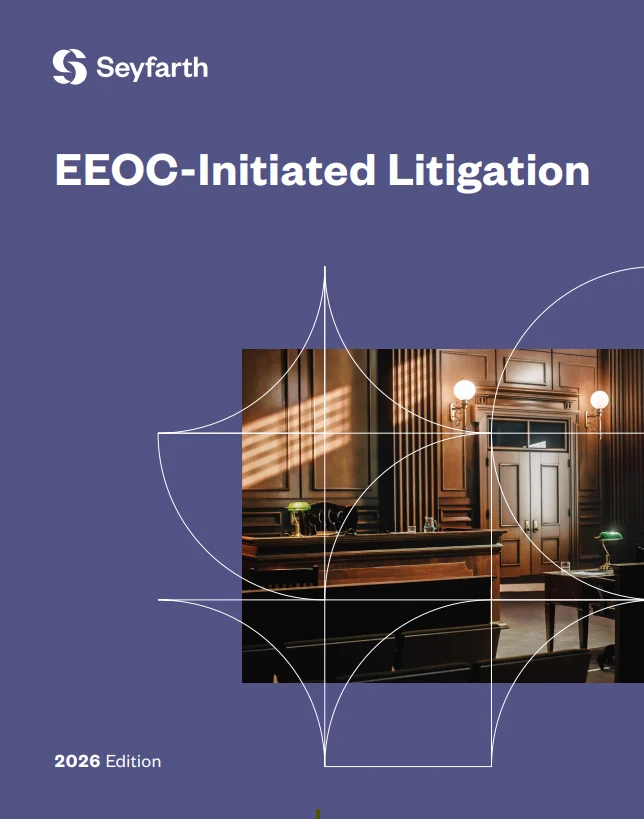
The EEOC-Initiated Litigation: 2026 Edition is more than a historical record; it is a strategic manual for risk mitigation. As Seyfarth Shaw notes, the goal of the reference is to empower operations teams and HR professionals to make informed decisions in an environment where the "rules of the game" are being rewritten in real-time.
For employers, the message of 2025 is clear: the EEOC has the data, the mandate, and the willingness to litigate. To navigate 2026 successfully, companies must move beyond passive compliance and adopt a proactive stance—auditing their algorithms, refining their accommodation processes under the PWFA, and ensuring that their pay structures can withstand federal scrutiny. As the 2026 edition makes clear, the cost of being a "test case" for the EEOC’s new enforcement theories has never been higher.