Enterprise talent acquisition teams are navigating a complex landscape, facing mounting pressure to accelerate hiring, reduce costs, and maximize the output of existing resources. In this environment, Artificial Intelligence (AI) interview assistants have emerged as a high-return investment within the contemporary recruiting stack. This comprehensive guide delves into the tangible financial implications of deploying an AI interview assistant across enterprise recruitment operations. It meticulously examines the critical metrics that define success, provides a framework for calculating your organization’s specific return on investment (ROI), and showcases the real-world results achieved by organizations leveraging Eightfold AI Interviewer.
The evolution of recruitment technology has been marked by incremental advancements, from applicant tracking systems (ATS) to sophisticated scheduling tools. However, the advent of AI interview assistants represents a paradigm shift. Unlike solutions that merely automate administrative tasks, these advanced systems are capable of conducting substantive interviews. They ask role-specific questions, evaluate candidate responses, detect potential fraud, and deliver scored summaries to recruiters, thereby augmenting the initial stages of the hiring process significantly. This capability leads to a more profound and measurable ROI than traditional HR technology investments.
Defining Enterprise AI Recruitment Financial Impact and Measurable ROI
The return on investment (ROI) for an AI interview assistant in enterprise recruitment is defined as the quantifiable financial benefit an organization realizes by integrating an autonomous AI system to either replace or significantly enhance manual screening and initial interviewing processes. At the enterprise level, this return is not singular but compounds across three key dimensions:
- Cost Savings: Direct reduction in expenses associated with recruiter time, agency fees, and the overhead of managing high-volume application pipelines.
- Efficiency Gains: Accelerated hiring cycles, reduced time-to-fill, and the ability for existing recruitment teams to handle a larger volume of requisitions.
- Quality Improvement: Enhanced candidate experience, reduced bias in initial evaluations, and a stronger ability to identify top-tier talent, leading to better long-term retention and performance.
The distinction between an AI interview assistant and simpler automation tools is crucial. While tools that automate scheduling or send reminders offer incremental improvements, a true AI interview assistant engages in the core function of assessment. It replicates the initial human interviewer’s role by posing relevant questions, analyzing verbal and sometimes non-verbal cues, assessing the accuracy and relevance of responses, and flagging any inconsistencies or potential fraudulent activity. This comprehensive approach to initial candidate evaluation underpins the substantial financial impact observed by early adopters.
Solving Large-Scale Hiring Challenges with Measurable Financial Impact
Organizations operating at enterprise scale often grapple with hiring challenges that are exacerbated by volume, speed, and the need for consistent quality. AI interview assistants are proving instrumental in addressing these multifaceted issues. Internal hiring data from organizations utilizing AI Interviewer has highlighted three primary headline metrics that demonstrate significant financial impact:
- Drastic Reduction in Time-to-Fill: Compressing hiring cycles from an average of 42 days to under a week, with a reduction in the time to conduct the initial interview by up to 90%. This speed is critical in competitive talent markets where top candidates are often off the market within days of applying.
- Significant Cost Per Hire Reduction: By automating the initial screening and interviewing phases, organizations can significantly reduce the number of recruiter hours dedicated to these tasks. This directly translates into lower per-hire costs.
- Increased Recruiter Productivity: Reallocating recruiter time from repetitive administrative tasks to higher-value activities like candidate engagement, relationship building, and final decision-making. This allows existing teams to manage a greater volume of requisitions without a proportional increase in headcount.
For enterprises engaged in high-volume hiring, these metrics translate directly into seven-figure annual savings. A dedicated ROI calculator, which considers factors such as annual hire volume, recruiter cost, and current time-to-fill, can model these specific savings. This analytical tool empowers organizations to quantify the potential financial upside before or during implementation.
Calculating AI Interview Assistant ROI for Enterprise Recruitment
The core formula for calculating the ROI of an AI interview assistant at the enterprise level encompasses four primary components:
- Cost Savings from Reduced Recruiter Time: This is calculated by determining the number of hours recruiters save on initial screening and interviewing, multiplied by their fully loaded hourly cost. For instance, if an AI assistant handles 50% of the initial interviews, saving recruiters 10 hours per week, and their hourly cost is $50, the weekly saving is $500.
- Reduction in Vacancy Costs: This is the cost incurred by a position remaining unfilled. Faster hiring cycles directly reduce this cost. It can be calculated as (Average New Hire Salary / Number of Working Days in a Year) * Average Time-to-Fill Reduction in Days.
- Savings from Reduced Agency Fees: For organizations that frequently rely on recruitment agencies for high-volume roles, the accelerated hiring process can lead to a significant reduction in agency placement fees.
- Cost of the AI Interview Assistant Platform: This includes subscription fees, implementation costs, and any ongoing maintenance or support.
The formula can be broadly represented as:
ROI = [(Total Cost Savings – Cost of AI Interview Assistant) / Cost of AI Interview Assistant] * 100%
Early adopters of advanced AI interview solutions have reported remarkable improvements. For example, some organizations have witnessed their hiring cycles compress from an average of 42 days to under a week. This dramatic acceleration in the recruitment process not only reduces the financial burden of prolonged vacancies but also ensures that competitive roles are filled before top talent is secured by competitors.
Drivers of Financial Impact in Enterprise AI Recruitment
The substantial financial impact of AI interview software at the enterprise scale is driven by several key factors that address systemic inefficiencies in traditional recruitment:
Faster Speed-to-Candidate Drives Measurable Enterprise AI Recruitment Financial Impact
In high-volume and hourly hiring scenarios, the speed at which an organization engages with qualified candidates is a significant competitive advantage. Top talent in competitive markets often accepts offers within 10 days of applying. An AI interview assistant that can initiate contact and conduct an initial interview with candidates within minutes of their application, rather than days, dramatically improves an enterprise’s chances of securing that talent before rivals. This immediate engagement is crucial for maintaining a robust talent pipeline and reducing candidate drop-off rates.
Reallocating Recruiter Time from Busywork to Hiring Decisions Drives Measurable Enterprise AI Recruitment ROI
The highest-leverage activities for recruiters involve persuasion, in-depth assessment, and closing deals – tasks that require human judgment, empathy, and strategic thinking. AI interview assistants effectively absorb the administrative burden and the initial evaluation layer of the recruitment process. This liberation of recruiter time allows them to focus on the activities that truly drive successful hires. Consequently, existing recruitment teams can manage a larger volume of requisitions without experiencing burnout or requiring additional headcount, thereby optimizing operational efficiency and reducing the cost per hire.
AI Elasticity Reduces the Financial Impact of Enterprise Recruitment During Hiring Surges
One of the most significant, yet often underappreciated, drivers of ROI from AI interview assistants is their inherent elasticity. During periods of peak demand – such as holiday retail seasons, financial services open enrollment periods, or manufacturing ramp-ups – AI assistants can simultaneously conduct interviews with hundreds or even thousands of candidates. As demand normalizes, the AI’s capacity scales back down accordingly. This contrasts sharply with traditional approaches, which often necessitate temporary recruiter hires, expensive agency fees, or significant hiring delays – all of which incur substantial costs and operational inefficiencies. The ability of AI to dynamically adjust to fluctuating hiring needs provides a critical financial buffer and operational resilience.
Enterprise AI Recruitment Fraud Detection Safeguards the Financial Impact of Every Hire
Hiring fraud is an escalating concern for enterprises, particularly in sensitive or regulated sectors. The cost of onboarding a fraudulent employee can be substantial, encompassing wasted training expenses, potential security risks, compliance violations, and damage to organizational reputation. Advanced AI interview assistants, such as Eightfold AI Interviewer, integrate sophisticated fraud detection systems. These systems can identify anomalies such as tab switching, camera manipulation, and voice duplication, often with seamless integrations to identity verification services like ID.me and CLEAR. By mitigating the risk of fraudulent hires, these capabilities directly safeguard the financial investment in each new employee and protect the integrity of the workforce.
Eightfold AI Interviewer’s Financial Impact on Enterprise Recruitment ROI
Eightfold AI Interviewer is designed as an autonomous AI digital worker, distinguishing itself from basic chatbots or scheduling assistants. It conducts complete, adaptive interviews at scale, a capability that earned it recognition as a Top HR Product of the Year by HR Executive and the HR Tech Conference in 2025. Its key capabilities that drive substantial ROI at the enterprise level include:
- Autonomous Interviewing: Conducts full, adaptive interviews, evaluating responses against role-specific criteria.
- Scalability: Capable of handling millions of interviews simultaneously, ensuring consistent performance during peak hiring periods.
- Bias Mitigation: Evaluates candidates solely on demonstrated skills and responses, adhering to strict compliance and fairness standards.
- Fraud Detection: Integrates over 12 fraud detection systems to safeguard against hiring malpractice.
- Multilingual Support: Operates 24/7 in over 22 languages, enabling global recruitment efforts.
- ATS Integration: Seamlessly integrates with existing Applicant Tracking Systems, minimizing workflow disruption.
Leading organizations across various sectors, including Fortune 500 companies and industry leaders like STMicroelectronics, are leveraging Eightfold AI Interviewer to transform their recruitment processes. These companies benefit from streamlined operations, reduced costs, and a more robust talent acquisition strategy.
Financial Impact of AI Interview Automation for High-Volume and Hourly Hiring
The ROI of AI interview assistants is most immediate and dramatic in the realm of high-volume and hourly hiring. The inherent structural challenges in this segment – an overwhelming volume of applicants, recruiter burnout, protracted time-to-first-interview, high candidate drop-off rates, and seasonal hiring spikes – are all directly addressed by AI interview automation.
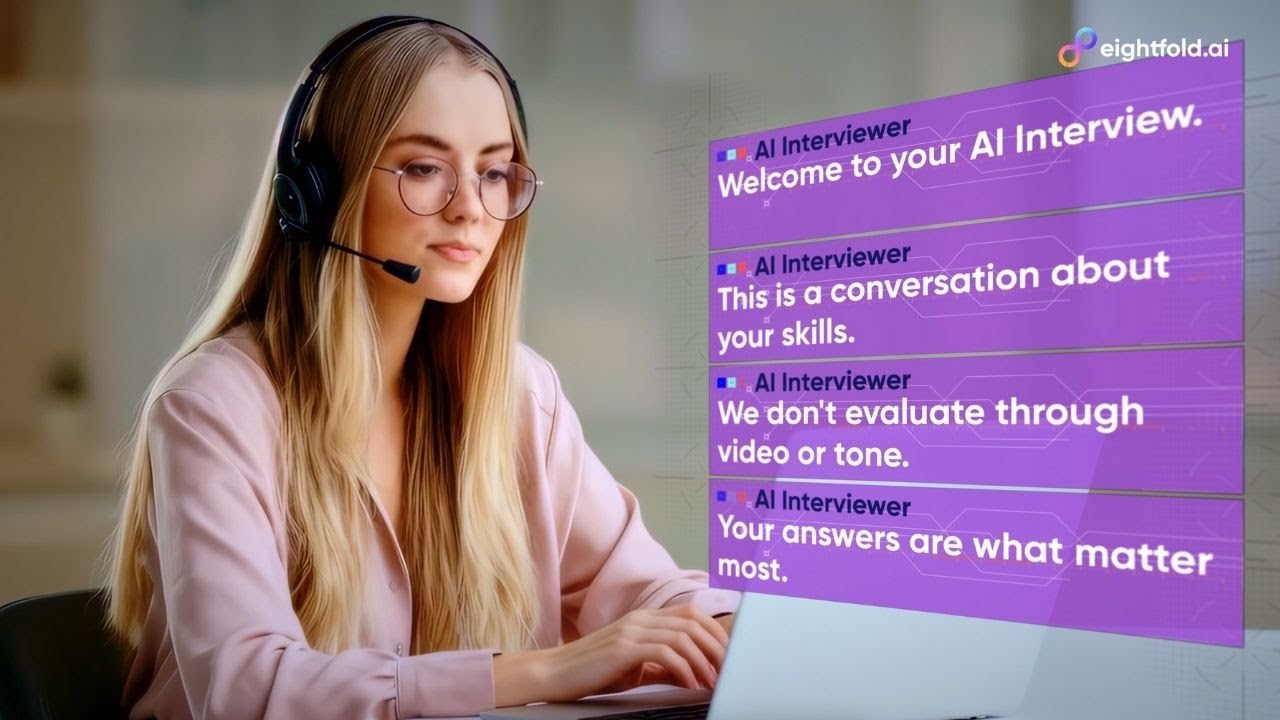
The quantifiable outcomes in high-volume use cases are compelling:
- Reduced Time-to-First-Interview: Down from days to minutes, ensuring candidates engage with the hiring process rapidly.
- Increased Candidate Engagement: AI assistants can manage high volumes of interactions, keeping candidates informed and engaged.
- Improved Candidate Quality: By efficiently screening a larger pool, AI helps identify the most suitable candidates for frontline, warehouse, retail, or service roles.
- Reduced Recruiter Workload: Automation frees up recruiters to focus on essential tasks, preventing burnout and improving retention.
For enterprise operations teams hiring thousands of frontline workers annually, these metrics translate directly into enhanced operational resilience. This resilience allows organizations to scale staffing up for peak seasons without increasing permanent recruiting headcount or incurring premium agency fees, thereby optimizing resource allocation and controlling labor costs.
AI Interview Assistant ROI vs. Traditional Enterprise Recruitment Costs
Traditional enterprise recruitment processes often carry significant hidden costs that are not always apparent on a single financial line item. These can include:
- Recruiter Overtime and Burnout: The strain of high volume leads to increased overtime pay and potential turnover within the recruitment team.
- Agency Fees and Markups: Reliance on external agencies for high-volume or specialized roles can be extremely expensive.
- Cost of Vacancies: Extended time-to-fill directly impacts productivity and revenue generation.
- Onboarding and Training Costs for Poor Hires: Inaccurate initial assessments can lead to costly hires who do not perform well and require significant investment in training and eventual replacement.
- Lost Productivity Due to Unfilled Roles: Critical positions remaining vacant can lead to significant operational bottlenecks and missed opportunities.
AI interview assistants effectively compress or eliminate each of these cost categories simultaneously. The platform cost becomes a single, predictable line item, while the savings are distributed across enhanced recruiter efficiency, reduced vacancy periods, and improved hiring quality – all of which are measurable and quantifiable.
Key Enterprise Questions About AI Interview Assistant ROI and Recruiter Impact
As enterprises consider the adoption of AI interview assistants, several common questions arise regarding their impact on both financial metrics and human resources:
Will this replace our recruiters?
No. AI Interviewer is designed to handle the initial screening and evaluation layer of the recruitment process. Recruiters retain their critical role in reviewing scored summaries, making final hiring decisions, and leading offer conversations. The platform empowers recruiting teams to manage more hires with the same head count, enhancing their capacity without diminishing the value of human judgment in closing top candidates.
How does it handle compliance and bias?
AI Interviewer rigorously evaluates candidates based solely on demonstrated skills and responses to role-specific questions. It deliberately avoids assessing visual appearance, accent, or emotional expression, thereby ensuring a fair and objective assessment. By applying consistent, role-specific criteria to every candidate, the platform provides enterprises with enhanced auditability and visibility into the evaluation logic, crucial for compliance purposes and mitigating unconscious bias.
What does implementation actually look like?
AI Interviewer is engineered for rapid deployment, typically activated within one to two weeks. It integrates seamlessly with existing ATS systems, eliminating the need for extensive workflow rebuilds. The deployment strategy prioritizes high impact with a light lift, ensuring minimal disruption to current operations.
Can it handle our scale?
Yes. AI Interviewer has demonstrated the capacity to conduct over one million interviews within a single hour. It operates 24/7 and supports over 22 languages, providing global scalability. Its elastic architecture allows it to dynamically match hiring surges without requiring additional head count or incurring increased cost per additional interview, making it an ideal solution for organizations with fluctuating recruitment needs.
Calculating the Financial Impact of Enterprise AI Recruitment on Your Hiring Process
To accurately assess the financial benefits, organizations can utilize specialized ROI calculators. These tools allow for adjustments based on specific organizational data, including:
- Annual Hire Volume: The total number of hires made per year.
- Recruiter Fully-Loaded Cost: The comprehensive cost of employing a recruiter, including salary, benefits, and overhead.
- Current Time-to-Fill: The average duration from job posting to offer acceptance.
- Average New Hire Salary: The typical salary of a new employee.
- Platform Cost: The investment in the AI interview assistant solution.
By inputting these variables, organizations can generate an estimated three-year ROI, determine their payback period, and quantify the annual hours freed up for their recruitment teams. This data-driven approach provides a clear financial roadmap for AI adoption.
The Bottom Line on AI Interview Assistant ROI for Enterprise Recruitment
Enterprise recruitment is one of the most operationally expensive functions within large organizations, yet it remains one of the least automated. AI interview assistants represent a category of investment where the ROI is not speculative; it manifests directly in tangible improvements such as reduced recruiter hours, faster time-to-fill metrics, and significant vacancy cost reductions within weeks of deployment.
Organizations consistently achieving the highest returns from AI interview assistants typically share three common characteristics:
- High-Volume Hiring Needs: Organizations that regularly hire at scale, particularly in frontline, retail, or hourly roles, experience the most immediate and substantial financial benefits.
- Strategic Focus on Recruiter Efficiency: Companies that aim to optimize recruiter time by automating administrative tasks and allowing them to focus on higher-value activities are well-positioned to leverage AI.
- Commitment to Data-Driven Decision-Making: Organizations that prioritize quantifiable metrics and utilize data to track progress and measure success are best equipped to realize and sustain the ROI of AI solutions.
For organizations that align with these characteristics, the question is not whether an AI interview assistant delivers a significant return on investment, but rather how much return can be achieved and how quickly. The integration of AI into the recruitment process is no longer a futuristic concept but a present-day necessity for enterprises seeking to maintain a competitive edge in talent acquisition and achieve operational excellence.
Note: All Eightfold performance metrics mentioned are based on internal hiring results using AI Interviewer. Individual results may vary based on hiring volume, role type, and deployment configuration.