A seismic shift is underway in the global economy, mirroring the transformative power of the steam engine and the personal computer, but with an accelerated pace and far-reaching implications. This is not a mere technological upgrade; it represents a fundamental redefinition of how work is accomplished, by whom, at what speed, and on what scale. As organizations grapple with this unprecedented transition from software to superintelligence, many human resources (HR) departments find themselves unprepared for the profound changes that are already reshaping the competitive landscape. The organizations that recognize and adapt to this paradigm will not merely gain a competitive edge; they will define entirely new market categories, while those that lag behind risk managing outdated workforces with obsolete tools, facing AI-native competitors operating on a fundamentally different plane. Welcome to the era of the Infinite Workforce.
For nearly a century, the fundamental equation for business scaling has been a linear one: increased output necessitated a proportional increase in human capital. To achieve higher productivity, companies hired more recruiters, added administrative staff to process applications, and expanded interview capacity by booking more calendars. This model, however, has reached its practical limits. While human capability remains immense, the workflows reliant on manual intervention – clicking buttons, transferring files, scheduling meetings – are inherently constrained by the finite nature of human labor. Humans require rest, operate within time zones, and possess finite energy. This inherent limitation creates a bottleneck that AI-native organizations are actively bypassing. Instead of demanding more from their human employees with fewer resources, these forward-thinking companies are deploying sophisticated digital agents to manage high-volume, repetitive execution tasks. This strategic reallocation allows human workers to focus on higher-value activities that demand critical judgment, creativity, and complex problem-solving. The result is not merely efficiency, but the "manufacturing of intelligence," creating a widening chasm between legacy enterprises and their AI-powered counterparts that grows exponentially, not incrementally.
The HR technology landscape, largely invested in over the past decade, often exacerbates this challenge rather than resolving it. Many of these platforms, including Applicant Tracking Systems (ATS) and Human Resource Information Systems (HRIS), were designed to digitize existing processes rather than fundamentally transform them. These legacy systems function primarily as repositories of data, focused on tracking headcount, ensuring compliance, and storing employee records. They tend to view candidates as static database entries and employees as mere cost centers. While they can report on who is currently employed, they often falter when asked to identify potential internal candidates for leadership roles or to pinpoint transferable skills across different positions.
Furthermore, the artificial intelligence embedded within these legacy systems is typically trained exclusively on an organization’s internal data. This data is often incomplete, suffers from historical biases, and is siloed within departmental structures. Consequently, an AI that learns only from past decisions is prone to amplifying those past mistakes with increased confidence, rather than predicting future needs or identifying novel opportunities. This creates what can be described as a "bias-laundering machine," perpetuating existing inequities and limiting an organization’s adaptability.
An alternative approach, the adoption of general-purpose large language models (LLMs), presents its own set of significant challenges. While these LLMs are remarkably adept at language processing, text generation, summarization, and conversational interactions, they lack a crucial understanding of the intricate dynamics of the professional world. They do not possess an intuitive grasp of career progression, the adjacency of skills, or the critical compliance implications inherent in talent acquisition decisions. The disclaimers that accompany these tools – acknowledging their potential for errors – are simply unacceptable in a field where precision and fairness are paramount. The industry has, therefore, presented HR leaders with a dichotomy: the restrictive confines of legacy systems or the unreliability of generalized AI tools.
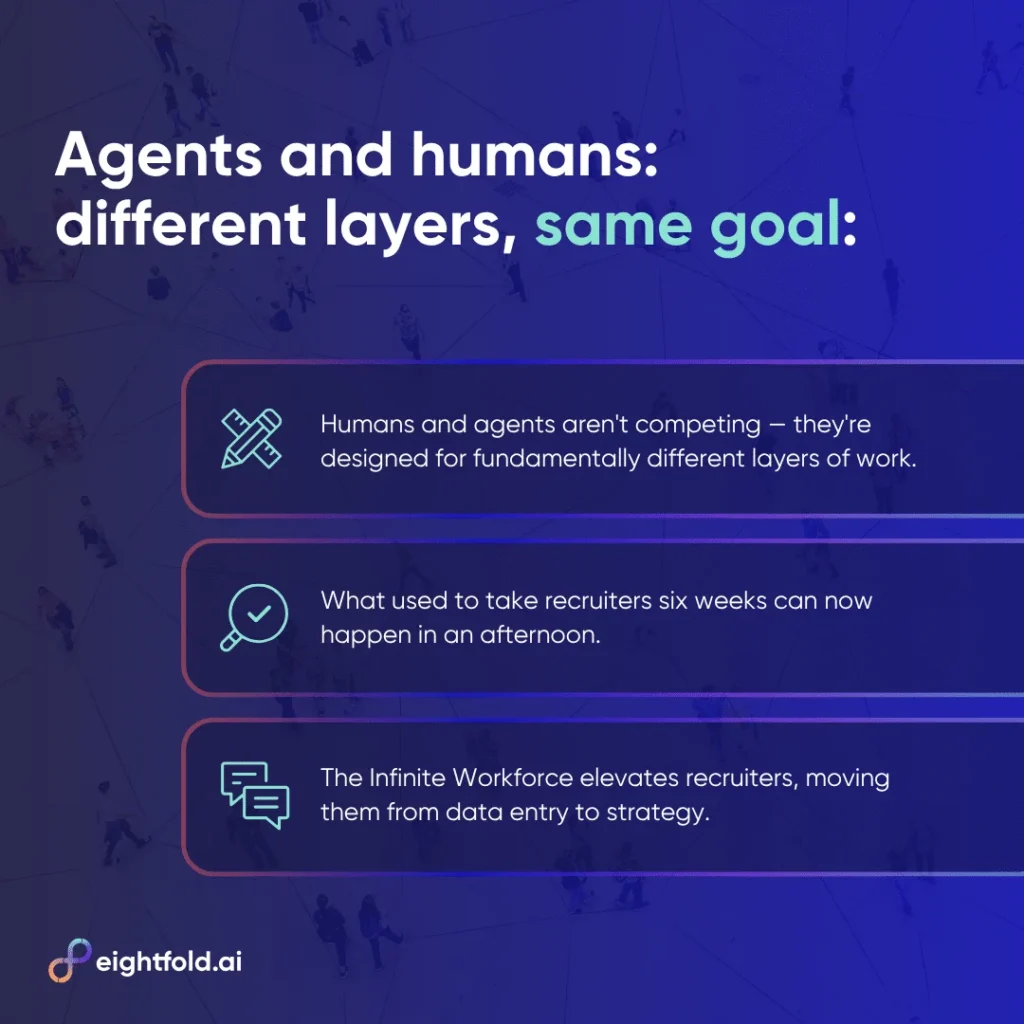
The emerging operational architecture, termed the "Infinite Workforce," offers a new paradigm. It is not a singular product but a strategic framework built on the understanding that humans and AI agents are not in competition for the same tasks. Instead, they are designed to operate at fundamentally different, yet complementary, levels of work.
The Agentic Execution Layer: Scaling at Unprecedented Speed
At the foundational level of the Infinite Workforce are AI agents, designed for high-volume, repetitive execution at scale. These agents can autonomously handle tasks such as screening applications, scheduling interviews, conducting initial assessments, and identifying promising candidates. They operate 24 hours a day, across all open requisitions, processing an unlimited number of candidates within the existing pipeline. What once required a team of recruiters weeks to accomplish can now be executed in a matter of hours. This is not about replacing recruiters but about liberating them from the administrative burden that consumes a significant portion of their time. For instance, a recent analysis by Eightfold.ai indicated that recruiters often spend upwards of 70% of their time on interview scheduling and resume screening – tasks that do not leverage their strategic skills or interpersonal abilities. By offloading these tasks to AI agents, organizations can dramatically compress hiring cycles. Data from companies already implementing this model suggests a reduction in hiring timelines from an average of 42 days to under a week.
The Human Orchestration Layer: Strategic Judgment and Relationship Building
Operating "above the loop," human professionals are empowered to focus on tasks that demand nuanced judgment, empathy, and strategic foresight. This includes defining critical roles, assessing cultural fit, persuading passive candidates in competitive markets, and establishing ethical guidelines for AI deployment. Human interaction remains indispensable for building genuine relationships, understanding complex organizational needs, and providing mentorship. The Infinite Workforce model elevates recruiters, transforming them from administrative gatekeepers to strategic talent architects. Instead of being mired in data entry, they can dedicate their expertise to cultivating talent pipelines, advising hiring managers, and fostering a positive candidate experience – aspects that algorithms cannot replicate. This shift ensures that the most sophisticated intelligence on the planet – the human brain – is applied to the most impactful work.
The Imperative of the Infinite Workforce: A Competitive Reality
The notion of the Infinite Workforce is not a distant futuristic vision; it is an emerging competitive reality for 2026 and beyond. Organizations that are proactively integrating agentic AI into their talent acquisition processes are already demonstrating significant gains. These include:
- Compressed Hiring Cycles: Reducing hiring timelines from an average of 42 days to under a week.
- Expanded Talent Pools: Achieving a 100-fold increase in the reach of talent acquisition efforts without commensurate increases in headcount.
- Automated Workflows: Automating up to 80% of manual recruiter tasks, while maintaining high standards of candidate engagement.
- Exceptional Candidate Experience: Achieving 92.5% interview completion rates and a 93% candidate Net Promoter Score (NPS), indicating high levels of satisfaction.
These are not marginal efficiency improvements; they represent structural competitive advantages that are being built by empowering recruiters to focus on the strategic and human-centric aspects of their roles.
Navigating the Transition: A New Operating Model
The transition to an Infinite Workforce necessitates a fundamental re-evaluation of operational strategies and technological investments. The World Economic Forum’s "Future of Jobs Report 2025" projects a significant churn in the labor market, with an estimated 92 million jobs displaced by 2030, offset by the creation of 170 million new roles. The organizations poised to thrive in this evolving landscape are those that proactively embrace new models, rather than those that wait for the shift to become an insurmountable challenge.
The "Intelligence Revolution" is not a future event to be planned for; it is a present condition that demands immediate response. Every day that a recruiting team dedicates to administrative tasks rather than strategic talent acquisition represents a missed opportunity for more meaningful work and a loss of ground to competitors already operating at agent scale. The Infinite Workforce model is not about achieving more with fewer people; it is about enabling the existing workforce to perform more valuable work by harmonizing human judgment, empathy, and creativity with the scalable efficiency of AI agents. This symbiotic partnership is the defining competitive advantage of the coming years, and the critical question for every HR leader is the speed at which their organization is prepared to build it.
For organizations seeking to understand and implement this transformative approach, a comprehensive resource is available. The ebook, "The Infinite Workforce," offers detailed insights into escaping the limitations of legacy systems, effectively deploying agentic AI in talent acquisition, and empowering recruiting teams to focus on the strategic initiatives that drive business growth. This guide provides a roadmap for navigating the current intelligence revolution and building the workforce of the future, today.