The global business landscape is in a constant state of flux, driven by rapid technological advancements and evolving market demands. Central to navigating this dynamic environment is the imperative for continuous employee development. This has brought "reskilling," "upskilling," and the accelerated adoption of Artificial Intelligence (AI) to the forefront of corporate strategy. A recent deep dive into the state of corporate learning, conducted by industry analyst Josh Bersin and his team, reveals a stark reality: traditional learning and development (L&D) models are no longer sufficient to meet the burgeoning skill needs of organizations.
The AI Readiness Imperative
Recent engagements with over 200 Chief Human Resources Officers (CHROs) in India and Singapore underscored a singular, dominant concern: AI readiness. The primary question on the minds of these leaders was how to effectively accelerate AI fluency and capability across all facets of their organizations. This widespread focus reflects a growing understanding that AI is not merely a technological tool but a fundamental shift that necessitates a corresponding evolution in how workforces are educated and empowered.
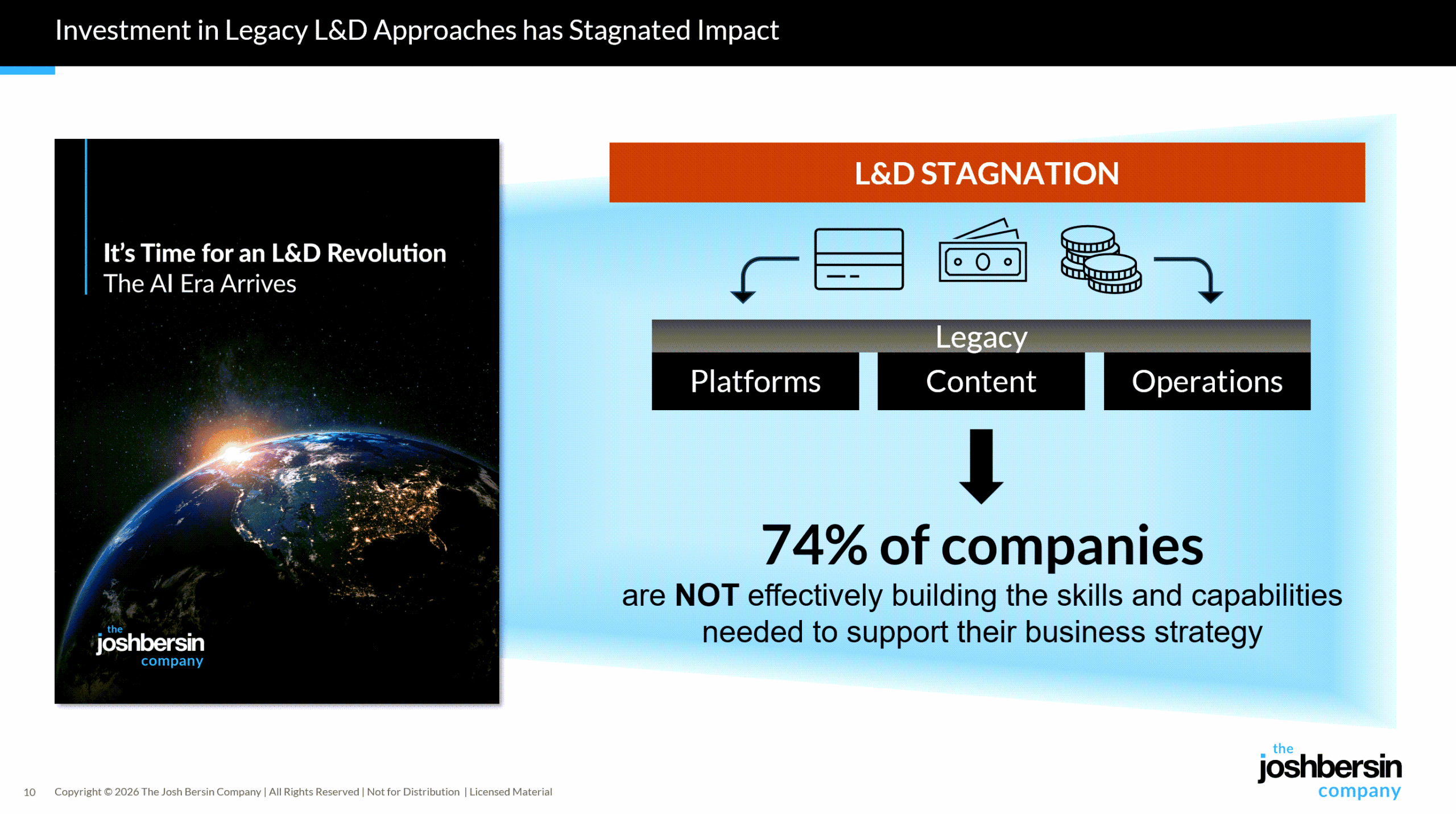
Bersin’s latest research, the fifth major study on corporate L&D, paints a sobering picture. A staggering 74% of companies surveyed reported that they are not keeping pace with their organization’s demand for new skills. This statistic, derived from a market where businesses invest an estimated $400 billion annually in training, content libraries, L&D technology, trainers, and consultants, suggests a significant portion of this substantial investment may be yielding diminishing returns. The implication is clear: billions of dollars are being expended with an insufficient impact, highlighting a critical need for a paradigm shift.

Redefining the Learning Challenge
The core of the issue, as identified by the research, lies in a fundamental misunderstanding of the problem. The challenge is not simply about "learning" or "training" in the traditional sense. Instead, it’s about dynamically sharing information, fostering an environment where individuals can explore, question, and apply new ideas effectively. The long-standing pedagogical approach of "training," with its often static and linear delivery methods, is identified as a significant bottleneck hindering progress.
Introducing the "Learning 2026" Study and AI-Native Learning
The comprehensive "Learning 2026" study, launched this week, offers a compelling vision for the future. Its central hypothesis, detailed in Bersin’s previous work "The Revolution of Corporate Learning," posits that AI is poised to completely reinvent organizational learning. The findings of the latest study strongly validate this assertion, demonstrating that AI-native systems are capable of fundamentally transforming how organizations train, upskill, support, and "enable" their people.
What is AI-Native Learning?
AI-native learning is characterized by the dynamic content generation capabilities of generative AI. Unlike traditional methods that involve manually designing, building, and publishing static courseware that requires constant updates and improvements, AI platforms construct content on demand. This content can be delivered in any desired format, catering to individual learning preferences and contextual needs.

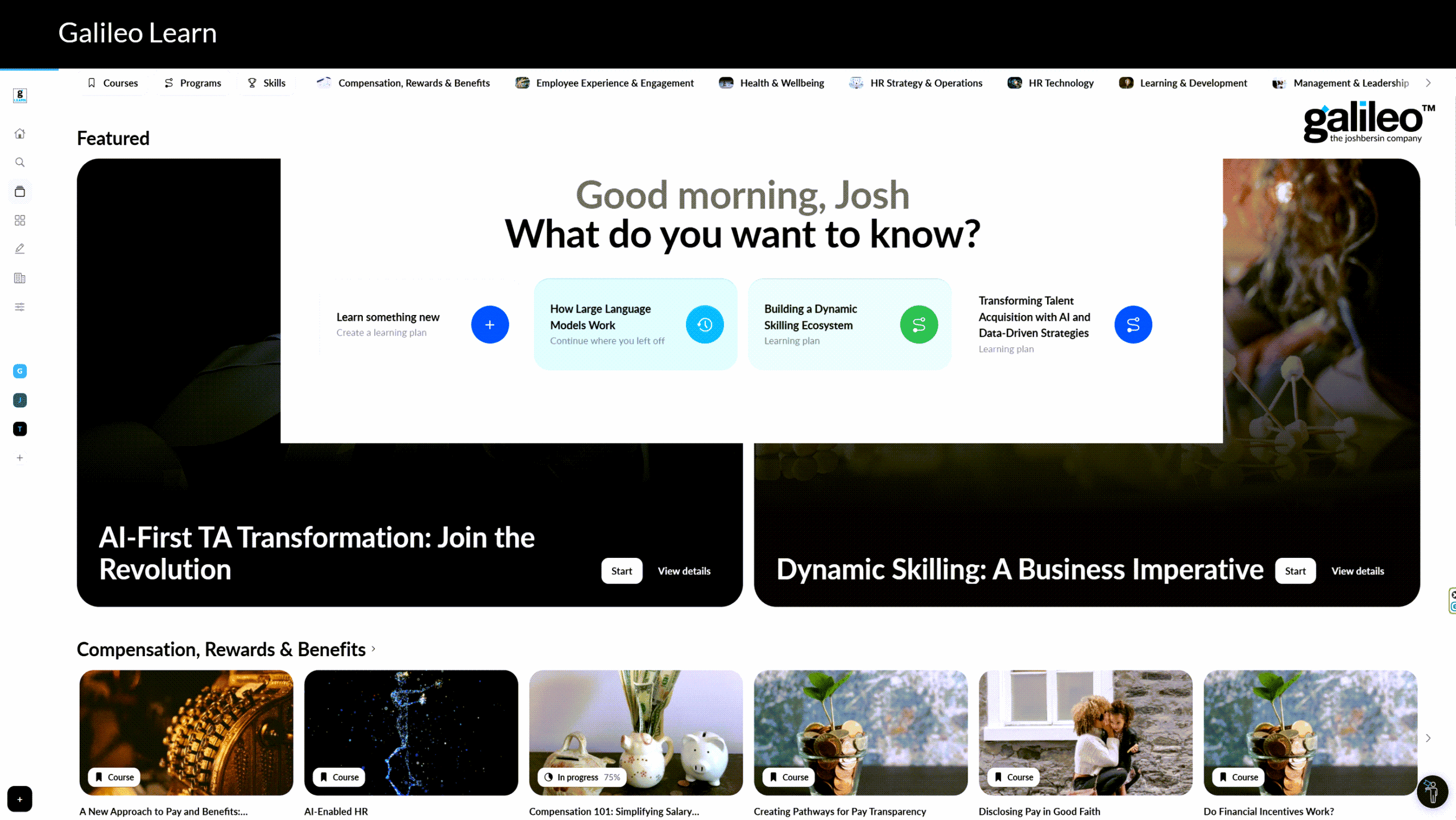
Platforms like Galileo, built on the Sana foundation, exemplify this new paradigm. They can reportedly develop new courses in days rather than months. Crucially, when new information or topics emerge, the entire system can instantly incorporate this new content. This agility empowers employees to:
- Access relevant information precisely when needed: Eliminating the lag time associated with traditional content development.
- Receive personalized learning paths: Tailored to their current roles, skill gaps, and career aspirations.
- Engage with content in various formats: From interactive modules to concise explanations, catering to diverse learning styles.
- Continuously update their knowledge base: Ensuring they remain current with the latest industry trends and organizational changes.
These AI-native systems automatically categorize all content into predefined "skills" based on a company’s established taxonomy. As employees interact with the system, their skill levels are dynamically inferred from their activity. A key advantage is the interconnectedness of all content within the system. This means employees can seek answers to questions without needing to navigate extensive course catalogs. The entire library functions as a unified "intelligence system," constantly updated with new information.
The success of platforms like ChatGPT, with an estimated 60% of its 900 million weekly users engaging in learning activities, serves as a powerful testament to this approach. This level of active engagement surpasses anything achieved by traditional course catalogs, underscoring the efficacy of this new learning paradigm. Furthermore, companies are leveraging AI-native platforms by publishing recordings of expert interviews, further enriching the system with current insights, tips, and findings. This seamless integration of real-world expertise promises significant business improvements, potentially amounting to trillions of dollars globally.
The Learning Maturity Model: A Framework for Evolution
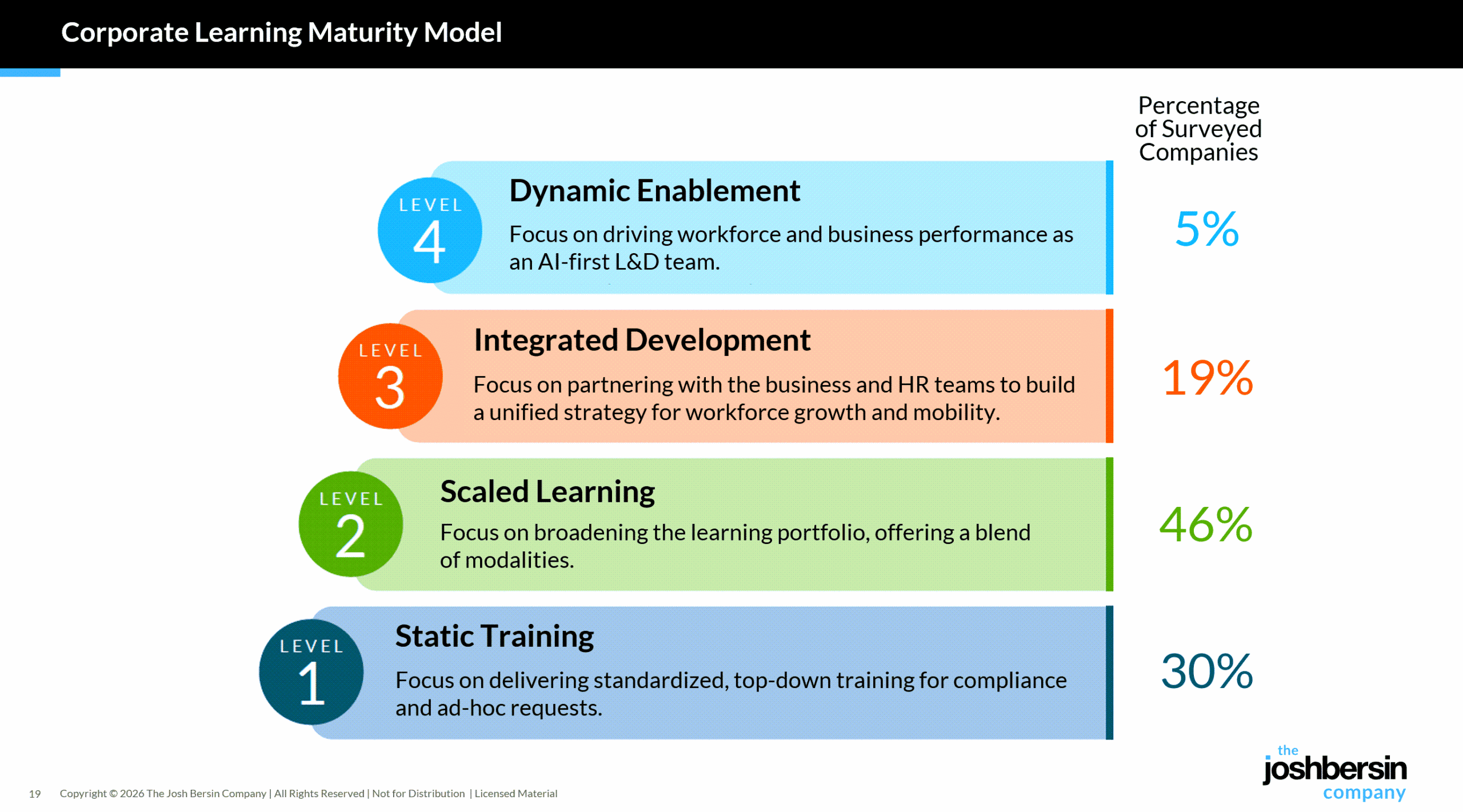
To guide organizations through this transformation, Bersin’s research introduces a new Learning Maturity Model, developed over the past year. This model outlines four distinct levels of organizational learning capabilities:
Level 1: Static Training Programs
At the foundational level, organizations rely on static training programs. This typically involves building or purchasing courses designed for compliance-based learning or mandatory top-down completion. These programs often focus on episodic needs such as compliance, new product launches, or specific event-driven requirements. While these programs are generally cost-effective to develop or acquire and help employees stay current with immediate needs, they offer limited scope for skills-based learning. Approximately one-third of the market currently operates at this level.
Level 2: Scaled Learning
As organizations mature, they progress to Level 2, characterized by "Scaled Learning." Here, companies expand their offerings beyond traditional courses to include a diverse array of learning tools such as videos, audio resources, and job aids. This broader portfolio provides employees with more options, often leveraging multimedia content and interactive elements developed by external content vendors. Major platforms like LinkedIn Learning, Coursera, Skillsoft, and Pluralsight largely fall into this category. While this approach broadens the learning landscape, the onus remains on the individual learner to discern what content is most relevant and when to consume it.
Level 3: Integrated Development
Level 3, "Integrated Development," marks a significant step forward where companies begin to tailor learning programs around specific job roles, skills, and career paths. This involves creating comprehensive "development programs" rather than just standalone training modules. This stage introduces considerable complexity, requiring organizations to manage multi-dimensional skill frameworks encompassing technical skills, professional competencies, job roles, and various job levels.
The challenge at Level 3 is the dynamic nature of the modern workplace. LinkedIn reports that approximately 70% of job-related skills become obsolete annually. This rapid skill decay makes maintaining curated career paths and learning curricula exceptionally difficult. While this approach remains valuable for channel training, technical education (e.g., certifications), and onboarding new employees, few individuals navigate the entirety of these extensive pathways.
The growth in complexity at Level 3 inevitably leads to an increase in the size and cost of L&D operations. Organizations find themselves building, maintaining, and refreshing dozens of programs, curricula, skills models, and content objects. Companies like Cisco and Ericsson, having reached this stage, often grapple with an overwhelming volume of activity and the challenge of operational model design: who is responsible for maintaining what?
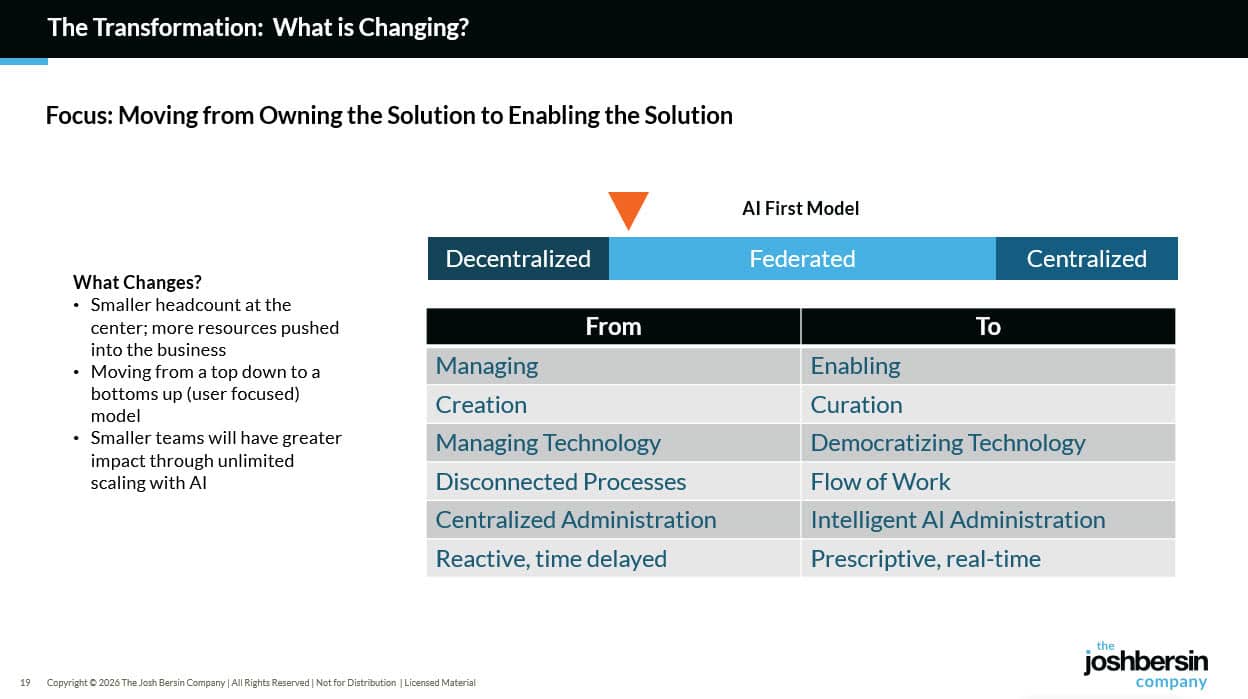
A significant factor contributing to this complexity is the decentralized nature of corporate learning. Unlike many other HR functions, L&D is often distributed across various business units. While central L&D teams manage strategic corporate programs, an estimated 70% of training is localized within sales, manufacturing, customer service, and other specialized domains. This necessitates locally updated content tailored to unique functional requirements, leading to significant investment in content licensing and infrastructure at the core, often diverting resources from frontline training needs. Consequently, many Level 3 companies opt to reduce the size of their central L&D departments, delegating business-specific training to line managers. This creates a more complex yet highly scalable "federated" model of training delivery.
Level 4: AI Transforms Everything (Dynamic Enablement)
The apex of the maturity model is Level 4, where AI fundamentally transforms the learning landscape. This level introduces a concept termed "Dynamic Enablement." Imagine a unified platform that houses all organizational knowledge – not just formal courses, but also documents, policies, and even audio or video recordings of expert interviews. This represents a shift from a "learning platform" to something far more comprehensive.
AI-native learning, as described, enables L&D professionals to publish information in days, not months. Employees, in turn, can learn in ways that best suit their individual needs and contexts. Many companies maintain their traditional Learning Management Systems (LMS) for legacy compliance programs, while new AI platforms are replacing Learning Experience Platforms (LXPs), learning portals, and a majority of content development tools. Early adopters of these AI-native solutions are already reporting significant reductions in internal L&D spend, often between 40% and 50%.
The Promise of Dynamic Enablement
Dynamic Enablement represents a crucial evolution from mere "learning" to true "enablement." The fundamental purpose of learning at work is not just to acquire knowledge for its own sake, but to empower individuals to perform at a higher level, drive innovation, and contribute more effectively to organizational goals.
The implications of this shift are profound. AI-native learning can be seamlessly integrated into every corporate chatbot or agent. Consider a scenario where an employee is filling out benefits forms; they can immediately ask a chatbot for a comparative analysis of different benefit options. Similarly, when entering a new sales opportunity into Salesforce, the system could provide coaching on strategies for that specific industry. For frontline workers, logging into their station could prompt a chatbot to inform them about recent process changes or departmental updates.
A compelling case study involves a large travel reservations company that utilizes call recordings from its top customer service agents. These recordings are fed directly into the learning system, allowing other agents to learn best practices and gain insights into handling challenging customer interactions. This model offers immense potential for training across customer service, engineering, sales, and all support functions.
In its own operations, Bersin’s firm publishes all new materials, including client interviews with permission, into Galileo. This ensures that anyone within the organization can gain insights into specific clients, understand industries, or better comprehend client needs. This approach transcends traditional learning, fostering a culture of continuous, context-aware enablement.
Proven Returns and Strategic Implications
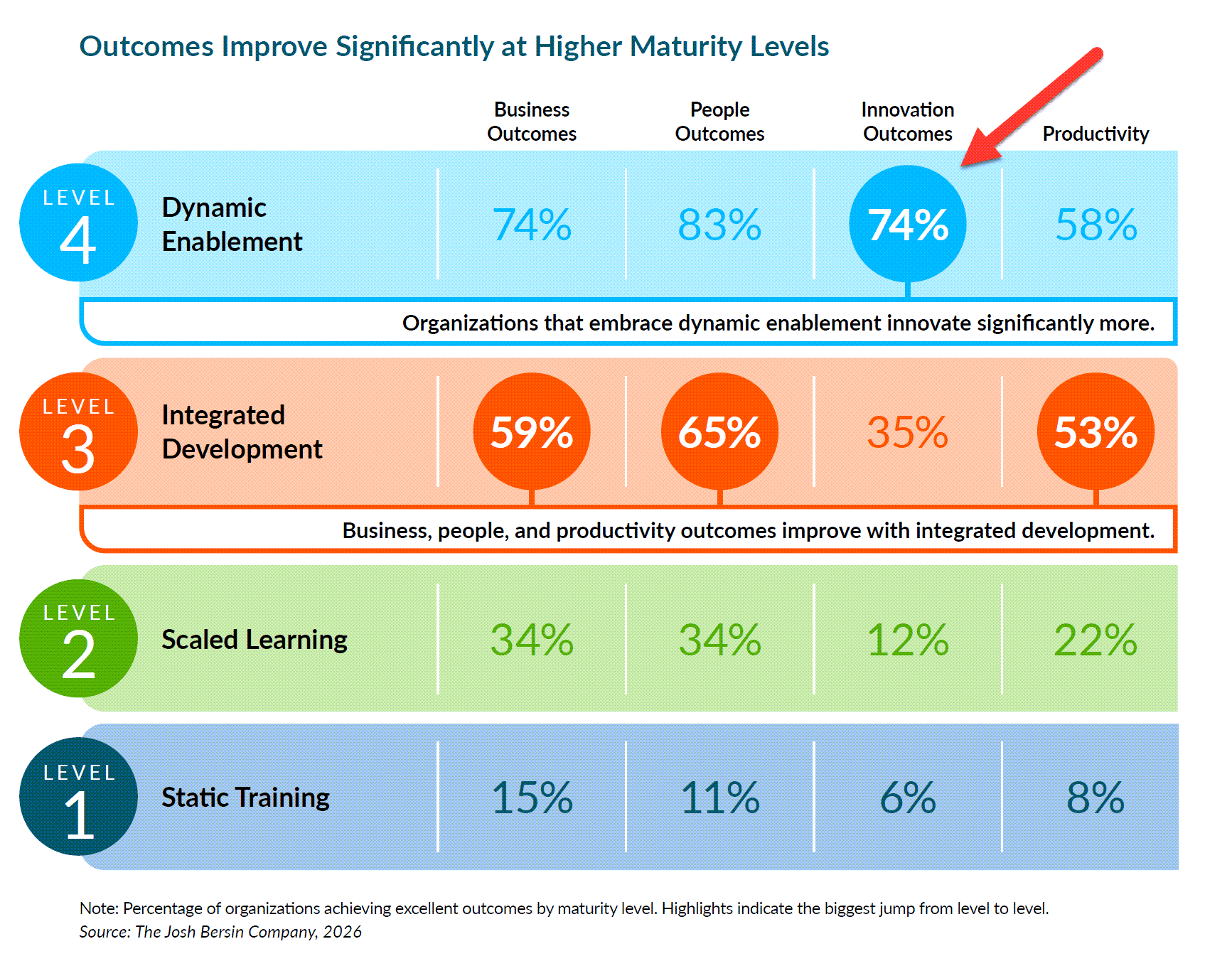
The benefits of embracing Level 4, Dynamic Enablement, are demonstrably clear. Organizations operating at this maturity level are significantly more likely to be innovation leaders (ten times more likely), exceed financial targets (six times more likely), and adapt effectively to change (sixteen times more likely).
The roadmap to this future involves more than simply using AI to accelerate course creation. It necessitates a fundamental replacement of traditional SCORM-based LMS platforms with dynamic content systems. Emerging vendors in this space include Sana, Arist, Disperz, Uplimit, and Colossyan, with many more expected to enter the market.
Organizations are advised to rationalize their existing content, identifying which materials are essential and can be transformed into an AI-native format, as Galileo enables. Establishing a new governance model for L&D is also crucial. Early adopters, including major players in the insurance, healthcare, pharmaceutical, and airline industries, have found that once the system is established, they can effectively delegate line-of-business training to local staff.
This hybrid or distributed operating model fosters agility. Central HR functions can then concentrate on global initiatives such as leadership development, compliance, culture, and business strategy. Meanwhile, individual business areas can establish their own "Enablement Academies" for specialized functions like sales and manufacturing.
The Path Forward: Embracing AI-Native Learning
The transition to AI-native learning promises enormous savings in both time and money, coupled with an exceptional employee experience. The research indicates that this new paradigm offers the learning, change management, and strategy execution capabilities necessary for businesses to thrive in the current environment.
For organizations seeking to understand their current standing and chart a course for the future, Bersin’s Galileo platform offers comprehensive resources. This includes research findings, case studies, benchmark data, and maturity model diagnostics, accessible through Agentic Workflows designed to assist in diagnosing maturity levels and exploring vendor options. Furthermore, a new Galileo Learning program, "The Journey to Dynamic Enablement," is available, allowing users to author courses, upload content, and experience AI-native learning firsthand.
The evidence strongly suggests that embracing AI-native learning is not merely an option but a strategic imperative for businesses aiming to remain competitive, foster innovation, and empower their workforce for the challenges and opportunities that lie ahead. This evolution from traditional training to dynamic enablement represents a profound shift in how organizations invest in their most valuable asset: their people.