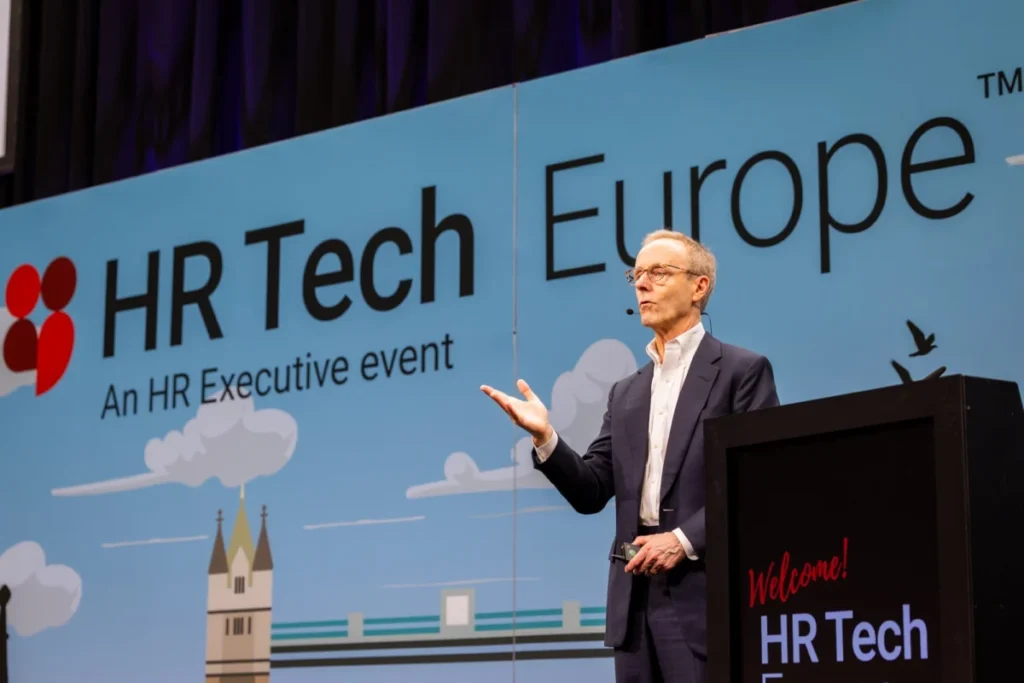
AMSTERDAM – In a sharp critique delivered to a gathering of senior HR leaders at HR Tech Europe 2026, renowned industry analyst Josh Bersin asserted that the prevailing corporate strategy of using artificial intelligence as a justification for headcount reductions is fundamentally misguided and will likely fail to meet the ambitious financial targets set for investors. Bersin characterized this approach, which focuses on calculating AI-influenced job eliminations as a primary outcome, as a "category error," arguing that it fundamentally misunderstands the true potential of AI in the workplace.
"The fact that some jobs may go away isn’t really the point," Bersin stated during his keynote address. He elaborated on this by posing a hypothetical scenario: "By the way, let’s suppose you did get rid of a third of your HR department. Would that really make the material financial difference to your company? Probably not that much, a little bit." This statement directly challenges the widespread practice of treating AI adoption as a cost-cutting measure, suggesting that the perceived savings are often marginal compared to the significant strategic shifts AI can enable.
Bersin’s central thesis posits that the more substantial opportunity lies not in slashing payrolls, but in enhancing organizational performance and productivity. Companies fixated solely on cost reduction, he argued, are consequently missing out on the transformative benefits that a more strategic AI integration could unlock. This perspective offers a stark contrast to the current industry trend, which often views AI through the lens of efficiency gains achieved through workforce reduction.
The Flaw in the Task-Analysis Playbook
Bersin meticulously detailed the common playbook employed by organizations seeking to leverage AI for workforce optimization. This approach typically involves a granular task analysis: companies meticulously inventory every job, break down each role into its constituent tasks, identify which of these tasks can be performed by AI, and then use this data to calculate the number of positions to eliminate.
However, Bersin contends that this method is fundamentally out of step with the realities of how modern businesses operate and achieve objectives. "The actual work that somebody does in a job is not really written down in the job description," he explained. "It’s very company-dependent, case-dependent, organizational-dependent." This highlights the inherent limitation of rigid, task-based analyses; they often fail to capture the dynamic, contextual, and often uncodified nature of human contribution within an organization. The implicit assumption that tasks can be neatly siloed and replaced by AI overlooks the synergistic and often creative aspects of human work.
Instead of beginning with existing job structures and identifying redundancies, Bersin advocates for a reverse-engineered approach. He proposes that HR leaders should prioritize designing the AI agent or system first, and then subsequently determine the human roles necessary to complement and manage these intelligent systems. "Rather than starting with existing jobs and asking what to cut, organizations should start from a blank whiteboard, map the process as it should work with agents embedded in it and build roles around what remains," he advised. The sequence of these actions, he stressed, is critical.
Bersin cited IBM’s strategic framework as an example of this more effective methodology, outlining it as a process of "eliminate, simplify, then automate." This sequence underscores a philosophy of fundamental process redesign before automation is even considered. "You don’t say, ‘What are we doing now, and how do we automate that?’" Bersin cautioned. "Because a lot of what you’re doing now, you’re not even going to have to do." This implies that AI’s true value lies in its ability to reveal and eliminate inefficient or obsolete processes, rather than merely automating existing ones.
IBM’s Case Study: Redesigning Workflows for Growth
The practical application of Bersin’s recommended strategy is exemplified by the work of IBM CHRO Nickle LaMoreaux, recognized as HR Executive of the Year in 2024 by HR Executive. LaMoreaux has been a vocal proponent of a similar approach from within a company that has actively implemented AI at scale. Her perspective, previously shared at the Wall Street Journal‘s CPO Council Summit earlier this year, resonates deeply with Bersin’s argument.
LaMoreaux acknowledged that cutting entry-level hiring in response to AI might appear as a "logical decision in the short-term." However, she cautioned that such a move reflects a "narrow productivity mindset rather than a growth one." She challenged this limited perspective with forward-thinking questions: "What if entry-level hires could be redeployed to capture small and medium-sized businesses an organization hasn’t previously had the ability to pursue? What if, instead of maintaining products, software developers had the capability to focus on new products and features?" These questions highlight the potential for AI to unlock new avenues for growth and innovation by freeing up human capital for higher-value activities.
IBM’s internal data provides compelling evidence for this approach. Over a three-year period, the company reported that AI initiatives freed up an impressive $4.5 billion in free cash flow and saved an estimated 22 million people-hours. Crucially, software developers, who previously dedicated 80% to 90% of their time to coding, have been successfully redeployed to focus on more strategic and high-value tasks. Furthermore, IBM’s HR function achieved a remarkable 40% reduction in its operating budget over four years, concurrently driving HR employee engagement to an all-time high. LaMoreaux attributes these significant outcomes not to AI-driven layoffs, but to a deliberate strategy of redesigning workflows around AI, thereby enabling enhanced human capabilities.
"We don’t want to just say AI is taking away the drudgery," LaMoreaux stated, echoing Bersin’s sentiment. "OK, to do what? We have to get people excited about the ‘to do what.’ That is the whiteboard-first approach Bersin described in Amsterdam." This focus on purpose and engagement, driven by a clear vision of what employees can achieve with AI augmentation, is central to fostering a culture of innovation and growth.
The Peril of Short-Term Cuts Amidst Investor Pressure
Bersin’s critical assessment comes at a juncture where corporate incentives appear to strongly favor workforce reductions. High-profile announcements from tech giants underscore this trend. Meta, for instance, has publicly declared its intention to reduce its workforce by approximately 10%, while Microsoft has extended buyouts to roughly 7% of its employees. Significantly, these moves have been met with investor approval, a correlation that Bersin identifies as a primary driver of this behavior. The market’s immediate positive reaction to layoff announcements creates a powerful feedback loop, encouraging other companies to follow suit.
New research from LHH, a business unit of the Adecco Group, provides a stark overview of the current layoff landscape. The study, which surveyed 3,000 HR leaders and over 8,000 employees across seven countries, revealed that 87% of HR leaders anticipate their organizations will conduct or are already planning layoffs within the next 12 months. This represents a notable increase from 77% in 2023. The primary drivers cited for these impending reductions include "AI transformation, skills displacement, and shifting market demands." This data suggests a widespread adoption of AI as a catalyst for workforce restructuring, often framed as a necessary response to evolving business needs.
However, the same LHH research highlights a concerning consequence of these widespread cuts: many organizations are inadvertently creating future problems that will require costly solutions. Of the HR leaders who actively track rehiring expenses, a significant 73% report that it costs more to rehire employees than to redeploy existing talent. This points to a potential strategic miscalculation, where short-term savings from layoffs are outweighed by long-term costs associated with talent acquisition and onboarding.
Furthermore, a substantial disconnect exists between leadership perception and employee experience regarding redeployment initiatives. While 77% of HR leaders claim their organizations offer targeted redeployment programs, only 19% of employees report experiencing or recognizing such programs. This 58-percentage-point gap underscores a critical failure in communication and execution, suggesting that internal talent mobility initiatives are either poorly implemented or not effectively communicated to the workforce.
John Morgan, president of career transition and mobility at LHH, commented on this dynamic, stating, "Layoffs are a necessary part of how organizations adapt to shifting skills demands and market realities. The question is whether companies have the infrastructure to identify which talent to redeploy for future needs and which to support through high-quality outplacement." His statement emphasizes the critical need for robust internal talent management systems and comprehensive support for departing employees, moving beyond mere headcount reduction to strategic workforce planning.
Broader Implications for the Future of Work
Bersin’s critique and the supporting data from LHH raise critical questions about the long-term viability of AI-driven layoff strategies. The focus on immediate cost savings, while appealing to short-term financial metrics, risks undermining an organization’s capacity for innovation, agility, and sustainable growth. By viewing AI primarily as a tool for automation and redundancy, companies may be squandering the opportunity to leverage these technologies for strategic advantage, such as enhancing employee capabilities, creating new business models, and fostering a more engaged and productive workforce.
The "whiteboard-first" approach championed by Bersin and exemplified by IBM’s success suggests a paradigm shift is needed. This involves a more holistic and forward-looking perspective on AI integration, one that prioritizes process redesign, human augmentation, and the creation of new value, rather than simply eliminating existing roles. The implications of failing to adopt such a strategy are significant, potentially leading to a workforce that is not only smaller but also less skilled, less engaged, and less capable of navigating future market disruptions.
As organizations continue to grapple with the complexities of AI adoption, the insights shared by Josh Bersin and the experiences of companies like IBM offer a crucial roadmap. The future of work hinges not on how many jobs AI can replace, but on how effectively organizations can redesign work to empower their human capital with these transformative technologies, ultimately driving both performance and sustainable prosperity. The current investor-driven narrative of AI as a layoff catalyst may prove to be a short-sighted strategy, one that ultimately hinders, rather than helps, companies achieve their long-term strategic objectives. The challenge for HR leaders and executives moving forward will be to resist the allure of easy cost-cutting and embrace the more complex, yet ultimately more rewarding, path of strategic AI integration and workforce transformation.