The moment arrives unexpectedly. A colleague confides in you that a significant figure in their life has passed away. Your immediate impulse is to offer support, to be present for them during this profound personal crisis. Yet, for many leaders, this well-intentioned response is often followed by a silent, internal panic: "What do I do now?" This ubiquitous scenario underscores a critical leadership development gap, revealing a widespread lack of preparedness for supporting employees through bereavement.
The very etymology of the word "bereaved," stemming from a root meaning "to be robbed," speaks volumes about the visceral nature of grief. It is an experience that cannot simply be compartmentalized, managed away, or worked around, yet this is precisely what many organizational cultures implicitly, or explicitly, demand. Grief, an almost universal human experience that touches nearly all working adults, often multiple times throughout their careers, remains a poorly navigated territory for many in leadership positions. Despite the prevalence of loss, formal training for leaders on how to effectively support grieving employees is remarkably scarce. While good intentions are abundant, effective support often falls short, creating a significant chasm between what leaders aspire to do and what genuinely helps those experiencing loss. This gap, however, presents a vital opportunity for leadership development, not to transform managers into grief counselors, but to equip them with the essential human skills to show up – present, honest, and willing to simply be with what they cannot fix.
The Pervasive Impact of Bereavement in the Workplace
Bereavement in the workplace is the complex intersection of profound personal loss and the persistent demands of professional life. It is a phenomenon that cannot be neatly scheduled or confined within organizational boundaries. Grief, by its very nature, does not cease to exist at the office door. To understand the multifaceted nature of this challenge, research has explored the experiences of managers, coworkers, and bereaved employees, offering a three-dimensional perspective that often goes unnoticed in traditional bereavement studies. This approach highlights that the impact of loss extends far beyond the individual directly experiencing it.
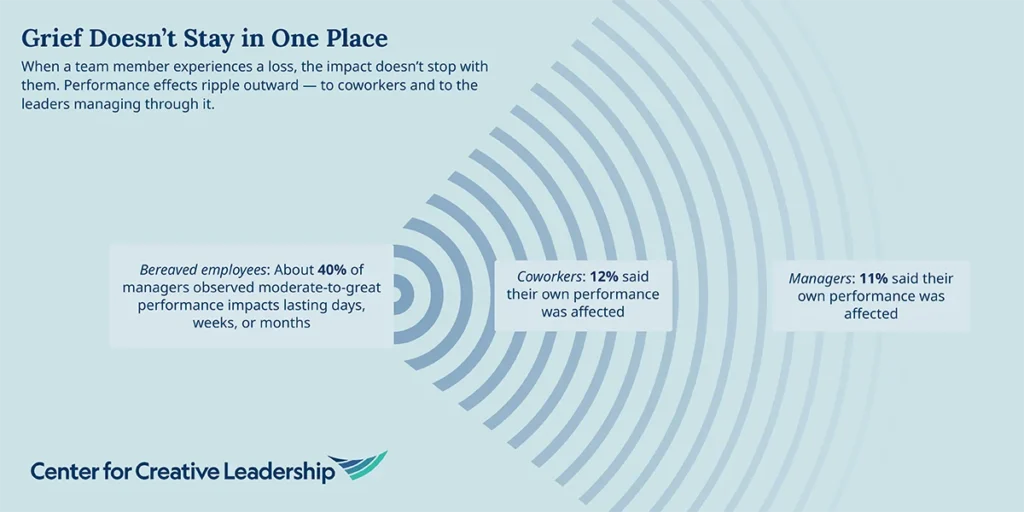
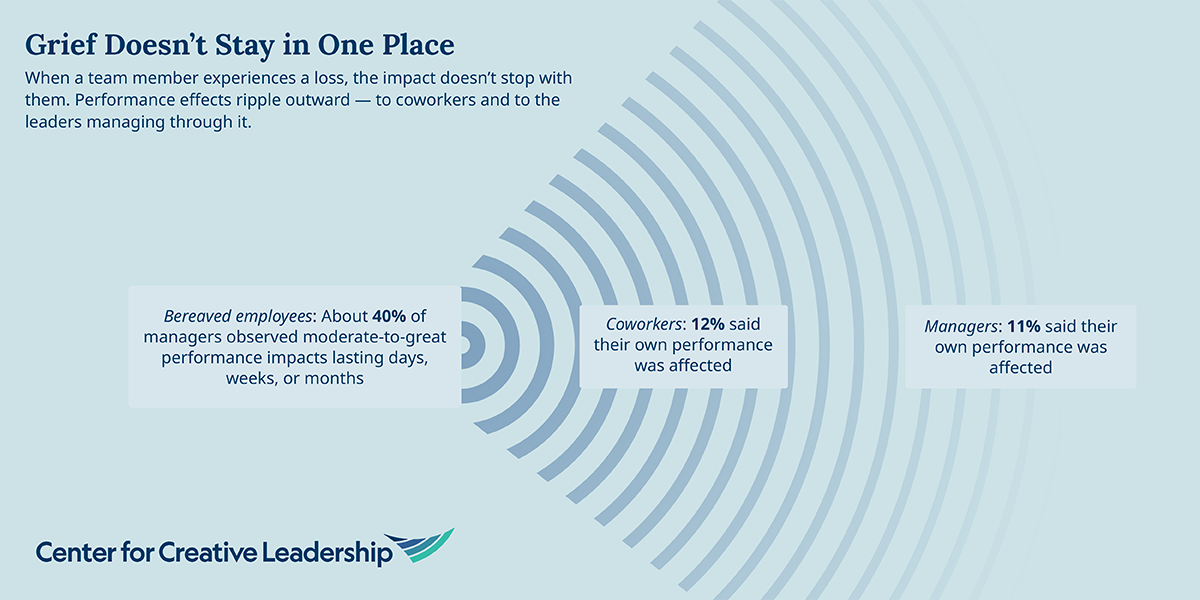
Data reveals a significant ripple effect. A substantial 90% of managers reported observing some form of performance impact in a bereaved employee. More critically, approximately 40% of managers noted moderate to significant performance impacts, which could persist for days, weeks, or even months. This suggests a tangible disruption to productivity and workflow. However, the impact is not confined to the grieving employee. The research also indicates that 11% of managers themselves experienced affected performance, and among coworkers, this figure stood at 12%. This demonstrates that bereavement creates a disruption that extends outward, affecting the emotional and professional equilibrium of those surrounding the grieving individual.
The implications of these findings are stark when considering the current landscape of bereavement leave policies. Alarmingly, nearly three-quarters of bereaved employees (73%) reported that they did not receive sufficient time off from work to adequately grieve. This statistic is compounded by the fact that 28% of employees had no access to any form of bereavement leave whatsoever. Consequently, many employees are compelled to return to their professional duties before they are emotionally or mentally prepared, attempting to navigate the arduous process of grief while simultaneously striving to meet workplace expectations. This emotional burden is often exacerbated by the practical responsibilities that accompany loss, such as coordinating funeral arrangements, managing estate affairs, and supporting other grieving family members. These figures are not merely abstract productivity metrics; they are poignant indicators of the silent burdens employees are often asked to carry, frequently without the requisite support systems in place.
Navigating Grief at Work: Where Good Intentions Fall Short
The desire to offer support when a team member is grieving is a common and commendable trait among leaders. However, the capacity to want to help does not automatically translate into knowing how to provide effective assistance. Research indicates a significant disconnect in this area. While a notable 60% of bereaved employees reported that their manager demonstrated a high degree of compassion, a concerning 20% indicated they received little to no support from their direct supervisor. This means that one in five individuals navigating one of the most challenging periods of their lives felt isolated and unsupported by their leader.

Before delving into what constitutes effective support, it is crucial to clarify what is not expected of leaders when an employee is experiencing bereavement. Leaders are not tasked with finding the "perfect" words, nor are they expected to magically "fix" the grief or accelerate the healing process – tasks that are inherently impossible and unreasonably demanding. The role of a leader is not that of a therapist. Instead, the research points to a more fundamental and achievable approach: leaders are simply asked to show up, to be attentive, to offer options, and crucially, to allow the employee to guide the process.
Subtle Signals and the Critical Window for Support
A fundamental aspect of supporting grieving employees lies in a leader’s ability to pay attention. Often, leaders tend to wait for overt signs of distress, such as a visible emotional breakdown or a missed deadline, before intervening. However, grief in the workplace rarely announces itself so dramatically. More frequently, it manifests in subtler, less obvious changes that managers may observe. These can include a decline in engagement, a perceived lack of focus, increased irritability, or a withdrawal from social interactions. These are not immediate red flags but rather quiet signals that, if missed, represent a lost opportunity to offer timely support.
Conversely, certain leadership behaviors can inadvertently exacerbate the situation. These might include minimizing the loss, offering platitudes that dismiss the employee’s feelings, or pushing for a swift return to "normalcy." Such actions can leave the grieving employee feeling invalidated and alone. The act of checking in, even without certainty about how to proceed, requires simply noticing and acknowledging the employee’s situation.
Small Gestures, Lasting Impressions
When it comes to supporting those who are grieving, consistent, low-key presence often carries more weight than grand gestures. A simple signed card from the team, a coffee brought without fanfare, or a brief, non-intrusive check-in that doesn’t require the employee to feign composure can have a profound and lasting impact. These small acts signal a fundamental human connection and acknowledgment.
In contrast, employees often recall unhelpful interventions, such as overly frequent check-ins that feel intrusive, well-meaning but inappropriate attempts to "cheer them up," or the assumption that grief should follow a predictable timeline. The significance of these gestures lies less in their inherent value and more in the message they convey: "I see you as a person, not just as an employee fulfilling a role."
The Importance of Personalized Support
One of the most critical findings from the research is that grief is a deeply personal experience, and therefore, support needs to be individualized. Not everyone desires the same response or requires the same type of assistance. Some employees may need space and solitude, while others may find solace in talking through their feelings. Some might prefer to immerse themselves in work as a distraction, whereas others may require a temporary reduction in their workload and expectations. Unfortunately, many leaders tend to adopt a one-size-fits-all approach to bereavement at work, often defaulting to either avoidance or excessive, sometimes unwelcome, check-ins, rather than engaging in dialogue.
The solution to this common pitfall is straightforward and hinges on a fundamental leadership skill: asking. Simple questions like, "How can I support you right now?" or "Would you prefer to ease back into your responsibilities, or would you rather jump in?" can be incredibly effective. These questions not only signal that the employee’s experience is valued but also alleviate the guesswork that often leads to mismatched support. It is also important to acknowledge that an employee may not always know what they need. In such instances, offering options, allowing them time to adjust, and revisiting the conversation periodically can be beneficial.
When Leaders Get It Right: The Power of Presence and Protection
Bereaved employees consistently remember the leaders who were present and supportive during their time of loss. The most impactful responses often involved simple acts of flexibility, consistent presence, and protective advocacy. Leaders who got it right were those who paid attention to subtle cues and acted upon their observations. They advocated for extended leave when necessary, maintained regular but not excessive check-ins, allowed employees to set their own pace for returning to work, and practiced active listening. Crucially, they acknowledged the loss directly. This acknowledgment of grief, the research clearly indicates, holds more significance than many leaders realize.
Bereavement at Work: A Crucial Leadership Development Opportunity
Even comprehensive leadership development programs can have blind spots when it comes to navigating unscripted, deeply human moments. A team member’s bereavement is precisely such a moment, and most leaders find themselves unprepared to handle it effectively. The research highlights that a significant 73% of managers expressed a need for training on how to support a bereaved employee, indicating that nearly three-quarters of leaders are actively seeking the basic human skills necessary to be there for their teams.
The competencies required for effectively responding to a grieving employee are not novel concepts in leadership development; they are, in fact, at its very core. Skills such as emotional intelligence, self-awareness, empathy, the ability to conduct difficult conversations, and coaching presence are all fundamental to effective leadership. Bereavement in the workplace serves as a high-stakes, real-world test of these competencies, one for which most leaders have not been explicitly prepared.
The solution is not to develop a standalone bereavement program. Instead, the focus should be on integration. Bereavement in the workplace is a natural context for cultivating the very competencies that already form the bedrock of leadership development initiatives. Every discussion about emotional intelligence implicitly addresses how a leader might navigate grief and offer solace to someone who is grieving. Similarly, modules on coaching skills prepare leaders to ask, without haste or pressure, "How are you really doing?" and "What else do you need to feel supported?" This is not about adding a new, separate layer to leadership training; rather, it is about applying a refined lens to existing frameworks, enhancing their relevance and impact.
The Path Forward: Cultivating Human-First Leadership
Bereavement is an inevitable reality that will touch every workplace and every team. The critical question is whether leaders will be adequately prepared when confronted with such situations. This preparedness is not about possessing a script of perfect phrases. It is about cultivating the essential skills to notice, to inquire, and to follow the lead of the grieving individual. It is, as one research participant eloquently put it, about being "human first."
Therefore, it is imperative to consider where in leadership curricula the essential skills for sitting with another’s pain are taught. Where do leaders practice the vulnerable but crucial act of saying, "I don’t know what to say, but I am here"? Grappling with these questions and actively developing leaders who can show up for their people in the ways they truly need is work that is profoundly worthwhile.
As our research into bereavement in the workplace continues, we invite leaders and organizations to stay informed of our latest insights. By signing up for our newsletters, you can remain updated on evolving best practices and gain deeper understanding of how to foster more compassionate and supportive work environments. The journey towards more effective leadership in times of grief is ongoing, and collective learning is key to building workplaces that truly care for their people.