
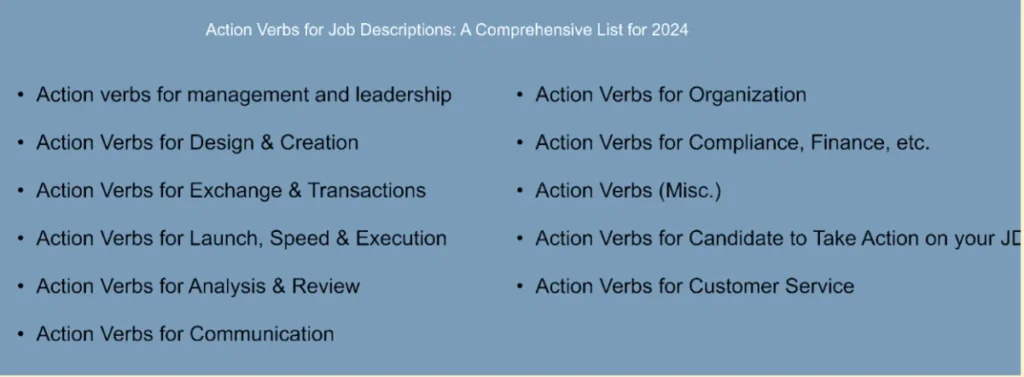
In the fiercely competitive landscape of global talent acquisition, the language employed in job descriptions (JDs) has emerged as a critical differentiator, with action verbs playing a pivotal role in attracting, engaging, and securing top-tier candidates. Far from being mere stylistic preferences, the deliberate selection and deployment of action verbs are fundamental to crafting compelling, inclusive, and highly effective job postings that resonate with prospective employees and optimize recruitment outcomes. This article delves into the profound impact of action verbs, exploring their definitions, benefits, strategic application, and the evolving role they play in the digital age of hiring.
The Evolution of Job Description Crafting
Historically, job descriptions often served as dry, functional lists of duties and qualifications, primarily intended for internal organizational alignment rather than external candidate attraction. They frequently relied on passive voice, generic phrases, and linking verbs, leading to ambiguous expectations and a lack of dynamism. However, the advent of digital recruitment platforms, online job boards, and sophisticated Applicant Tracking Systems (ATS) has irrevocably transformed the function of the JD. Today, a job description is not just an administrative document; it is a vital marketing tool, an employer branding statement, and a primary touchpoint for a candidate’s initial interaction with a potential employer. This paradigm shift necessitated a more precise, engaging, and persuasive linguistic approach, elevating the importance of active language and, specifically, action verbs. The transition from static lists to dynamic narratives has been a gradual but decisive one, driven by the need to stand out in a crowded market and to communicate value propositions effectively to a diverse talent pool.
Defining the Power of Action: What Constitutes an Action Verb?
At its core, an action verb is a verb that expresses either a physical or a mental action. Unlike linking verbs (e.g., am, are, is, was, were, seem, become), which connect the subject to a descriptor, or helping verbs (e.g., can, shall, will, could, would, should, might), which assist a main verb, action verbs convey movement, initiation, and direct engagement. For instance, "I am responsible" uses a linking verb and is vague, whereas "I manage a team" uses an action verb and clearly delineates a task. Similarly, "The project will be completed" is passive and relies on a helping verb, while "You will complete the project" is active and direct.
The distinction is crucial for JDs. Linking and helping verbs often create a passive voice, which can make responsibilities sound less impactful, less direct, and less appealing. They describe a state of being or a potentiality rather than a concrete contribution. Conversely, action verbs immediately place the candidate in an active role, allowing them to visualize themselves performing the tasks and making tangible contributions. This immediate engagement is paramount in capturing a candidate’s attention and fostering a sense of ownership over the role’s responsibilities.
Driving Talent Acquisition: The Multifaceted Benefits of Action Verbs
The strategic incorporation of action verbs into job descriptions yields a multitude of benefits that collectively enhance the effectiveness of recruitment efforts:
-
Unparalleled Clarity and Detailed Expectations: Action verbs strip away ambiguity, providing candidates with a precise understanding of the role’s duties and expected contributions. Instead of vague statements like "responsible for customer problems," a JD that uses "resolve customer complaints efficiently" or "de-escalate critical service issues" paints a clear picture of the required problem-solving and interpersonal skills. This specificity allows candidates to accurately self-assess their suitability, leading to more qualified applications and reducing time-to-hire. It also sets a foundation for clear performance metrics post-hire.
-
Fostering Inclusivity and Promoting Diversity: A significant benefit of skill-based action verbs is their ability to neutralize gender-coded or biased language often found in traditional JDs. Research by various organizations, including Textio and Ongig, has shown that certain adjectives and phrases can inadvertently deter specific demographic groups. By shifting the focus from subjective traits (e.g., "natural leader," "aggressive salesperson") to objective, competency-based verbs (e.g., "lead strategic initiatives," "drive revenue growth," "collaborate cross-functionally," "debug technical issues," "facilitate team meetings"), companies can create more inclusive language. This broadens the appeal of the JD, ensuring that a wider, more diverse pool of candidates feels invited to apply, directly supporting diversity, equity, and inclusion (DEI) objectives.
-
Enhanced Engagement and Positive Candidate Experience: Dynamic action verbs transform a mundane list of tasks into an engaging narrative. When a JD states, "spearhead new sales projects" instead of "work on sales projects," it creates a more compelling vision for the applicant. This active language allows candidates to mentally "step into" the role, imagining themselves performing these impactful duties. This immediate connection fosters enthusiasm and encourages applicants to craft more tailored cover letters and resumes that highlight their relevant experience using similar powerful verbs, thereby simplifying the screening process for hiring managers.
-
Shaping Company Culture and Strengthening Employer Branding: The choice of action verbs subtly communicates a company’s values, work environment, and strategic direction. Verbs like "pioneer," "innovate," and "modernize" signal a forward-thinking, agile organization that embraces change and creativity, attracting candidates who prioritize innovation. Conversely, verbs such as "maintain," "monitor," and "ensure compliance" might appeal to candidates seeking stability, precision, and adherence to established protocols. By carefully curating these verbs, organizations can reinforce their employer brand, attracting talent whose values align with the company’s ethos, which in turn can boost employee engagement and loyalty.
-
Optimizing for Search Engines and Applicant Tracking Systems (ATS): In the digital age, most job applications are filtered through ATS platforms. These systems scan for keywords and phrases, including specific action verbs that match the job description’s requirements with candidates’ resumes. By incorporating industry-standard and role-specific action verbs, companies significantly improve the searchability of their JDs on job boards and increase the likelihood of qualified candidates’ resumes being flagged by ATS. For example, a software engineer searching for "build mobile applications" will find JDs using "develop," "code," or "architect" more readily than those using generic terms. This strategic keyword optimization is crucial for reaching the right talent in a competitive online environment.
-
Facilitating Performance Management and Clear Career Paths: The precise nature of action verbs extends beyond recruitment into employee development. JDs crafted with clear action verbs lay a strong foundation for setting measurable performance goals (Key Performance Indicators or KPIs) and conducting objective performance evaluations. If a JD clearly states "spearhead and develop new sales strategies," it provides a tangible benchmark against which a new hire’s achievements can be measured, unlike a vague "have leadership and technical skills for sales." This clarity fosters a transparent culture, guides employees through their career progression, and enables both managers and employees to track progress against actionable, quantifiable objectives.
Strategic Application: Best Practices for Crafting Impactful JDs
To harness the full power of action verbs, recruiters and hiring managers should adhere to several best practices:
-
Industry and Role Specificity: The effectiveness of an action verb is context-dependent. A verb highly relevant for a tech role might be out of place in a creative position. For an administrative assistant, verbs like "administer," "organize," and "coordinate" are appropriate. For a marketing manager, "analyze," "create," and "strategize" are more fitting. Tailoring the language ensures authenticity and appeals directly to candidates within that specific professional domain.
-
Embracing Present Tense and Active Voice: Always describe ongoing duties and responsibilities using the present tense and active voice. This creates a sense of immediacy and dynamism, allowing applicants to visualize their daily contributions. For example, "oversees new sales projects" is more direct and engaging than "oversaw new sales projects" or "will be overseeing new sales projects." This grammatical choice reinforces that these are current, vital responsibilities.
-
Leading with Action in Bullet Points: Each duty, qualification, or responsibility should ideally begin with a strong action verb. This not only makes the JD easy to scan but also immediately conveys the core activity. Instead of "Your work will be to work on software," articulate it as "Resolve and code backend logic to optimize customer solutions" or "Develop innovative software features." This structure promotes clarity and encourages candidates to structure their resumes similarly, making comparisons easier.
-
Avoiding Ambiguity and Weak Verbs: Common, vague verbs like "work on," "handle," "involved in," "participated in," or "assisted with" provide minimal insight into the actual scope of work. Replace these with specific, descriptive action verbs such as "administer," "arrange," "assemble," "facilitate," or "implement." The goal is to eliminate guesswork and clearly articulate expectations.
-
Seniority-Based Verb Selection: The impact of an action verb should align with the seniority and responsibility level of the role. For entry-level positions, verbs like "assist," "support," or "learn" might be suitable. For mid-level roles, "manage," "coordinate," or "execute" are appropriate. For senior leadership, "architect," "strategize," "mentor," or "revolutionize" convey a higher degree of influence and responsibility. This nuanced approach ensures the JD accurately reflects the organizational hierarchy and attracts candidates at the right career stage.
-
Quantifying Achievements with Measurable Verbs: Whenever possible, pair action verbs with quantifiable outcomes. This demonstrates the tangible impact expected from the role and appeals to achievement-driven candidates. For instance, "boost sales growth" becomes significantly more impactful as "achieve a 30% increase in sales growth" or "reduce operational costs by 15%." Such metrics provide clear targets and benchmarks for success.
The Digital Transformation of Recruitment: Integrating AI-Savvy Verbs
The accelerating pace of digital transformation and the widespread integration of Artificial Intelligence (AI) across industries have introduced a new lexicon of action verbs essential for modern job descriptions. As companies seek talent capable of navigating complex digital ecosystems, JDs must reflect these evolving skill sets. Verbs such as:
- Automate: To make processes automatic via electronic or systematic means, crucial for efficiency.
- Configure: To arrange or set up for specific functions, especially in software or hardware.
- Debug: To identify, analyze, and remove errors or malfunctions from systems or software.
- Deploy: To strategically position or put technology into effective action.
- Extract: To carefully pull specific information or data from larger sources for analysis.
- Integrate: To form, coordinate, or blend fragmented systems into a cohesive ecosystem.
- Model: To create mathematical or visual representations for analysis and presentation.
- Query: To ask specific software questions to retrieve information from databases or APIs.
- Scrub: To thoroughly clean or refine digital data or assets.
- Visualize: To create an image representing complex information in a simplified manner.
These verbs signify a company’s commitment to technological advancement and attract candidates who possess cutting-edge digital and AI competencies, which are increasingly vital across all sectors, not just tech.
Expert Perspectives and Industry Trends
Leading HR analysts and recruitment consultants widely agree that the shift towards action verb-centric JDs is not merely a trend but a fundamental best practice. Rob Kelly, Co-Founder and CEO of Ongig, a company specializing in job description transformation, emphasizes that "Action verbs are key to effective job descriptions… [they help] write the most effective job descriptions to attract top-tier, diverse talent." This perspective underscores the industry’s recognition of the strategic value embedded in linguistic choices. The use of specialized augmented writing tools, such as Ongig’s Text Analyzer, further highlights the industry’s move towards data-driven, optimized JD creation, ensuring compliance, inclusivity, and maximum impact. This evolution is also intertwined with the broader industry trend towards skills-based hiring, where demonstrable abilities and contributions, often articulated through action verbs, are prioritized over traditional credentials.
Conclusion: A Call to Action for Recruiters
In the dynamic arena of talent acquisition, job descriptions are far more than administrative formalities; they are potent instruments of communication and engagement. The strategic deployment of action verbs is no longer optional but a critical imperative for organizations aiming to attract, engage, and retain the best talent. By embracing clarity, fostering inclusivity, optimizing for digital platforms, and aligning with performance objectives, action verbs empower recruiters to craft JDs that truly resonate. As the recruitment landscape continues to evolve, mastering the art of action verb usage will remain a cornerstone of effective talent attraction, ensuring that companies not only fill roles but also build robust, diverse, and high-performing teams for the future.






