The digital tools of the job search sit idle. A resume remains unfinished in a Google Doc, a LinkedIn tab open and untouched. For millions of American workers, the quest for a better career has reached a standstill. It’s not a lack of available positions, but a stark realization: the odds of securing a significantly better opportunity are slim, making the arduous process feel increasingly futile. This widespread professional inertia, fueled by a phenomenon dubbed the "exhaustion tax," is reshaping the American labor landscape.
A recent Glassdoor poll of over 1,300 professionals reveals a significant trend: 53% of U.S. workers have deliberately paused their job searches to safeguard their mental well-being. This statistic captures a critical, yet often unquantified, cost of the current labor market—the psychological toll of sustained effort with minimal tangible return. The demand for constant hustle in a stagnant environment has led to widespread burnout, forcing individuals to prioritize their mental health over career advancement.

The Two-Sided Door: A Stagnant Labor Market
The structural underpinnings of this professional paralysis were articulated by Federal Reserve Chair Jerome Powell in September of the previous year, who characterized the economic condition as a "low-hire, low-fire" environment. Data from the St. Louis Federal Reserve substantiates this observation. As of late 2025, the hiring rate had declined to 3.3%, a mere 0.5 percentage points above the historic low recorded during the Great Recession in June 2009. Concurrently, the firing rate remained at a historically low 1.1%. This data paints a clear picture for workers: the available opportunities for career transition are severely limited.
The quits rate, a key indicator of worker confidence in labor mobility, has also plummeted. In late 2025, it dropped to 1.9%, matching cyclical lows. This decline signals a palpable decrease in optimism regarding the ease of finding new employment. Compounding this sentiment, data from the Federal Reserve Bank of New York indicates that Americans now estimate only a 45% chance of securing a new role within a three-month period. This figure is notably lower than during the peak of the COVID-19 pandemic in December 2020, highlighting a significant erosion of confidence in the job market’s fluidity.
Corporate Posture and Slowing Growth
The reluctance of companies to expand their workforces is a deliberate strategic choice rather than a temporary downturn. A survey of U.S. CEOs in early 2026 revealed that a significant majority had no immediate plans to increase headcount. This corporate posture has contributed to a sustained period of slow job growth. Monthly job additions have averaged between 50,000 and 100,000, falling well short of the 150,000 to 200,000 range typically considered indicative of a healthy and dynamic labor market. This sustained period of subdued hiring suggests a long-term shift in corporate employment strategies, possibly influenced by economic uncertainties and evolving business models.

The Rational Calculation of Burnout
Adding to the immobility of the workforce is the alarming rise in job seeker "ghosting." Over half of applicants now report receiving no response from employers within the past year, a trend that has reached a three-year high. Hiring experts attribute this phenomenon to the overwhelming volume of applications, often exacerbated by AI-driven recruitment tools, which inundates human recruiters. This creates a feedback loop: job seekers feel compelled to apply to a larger number of positions due to low response rates, and response rates remain low because of the sheer volume of applications. The result is a lose-lose scenario for both candidates and employers, contributing significantly to applicant fatigue.
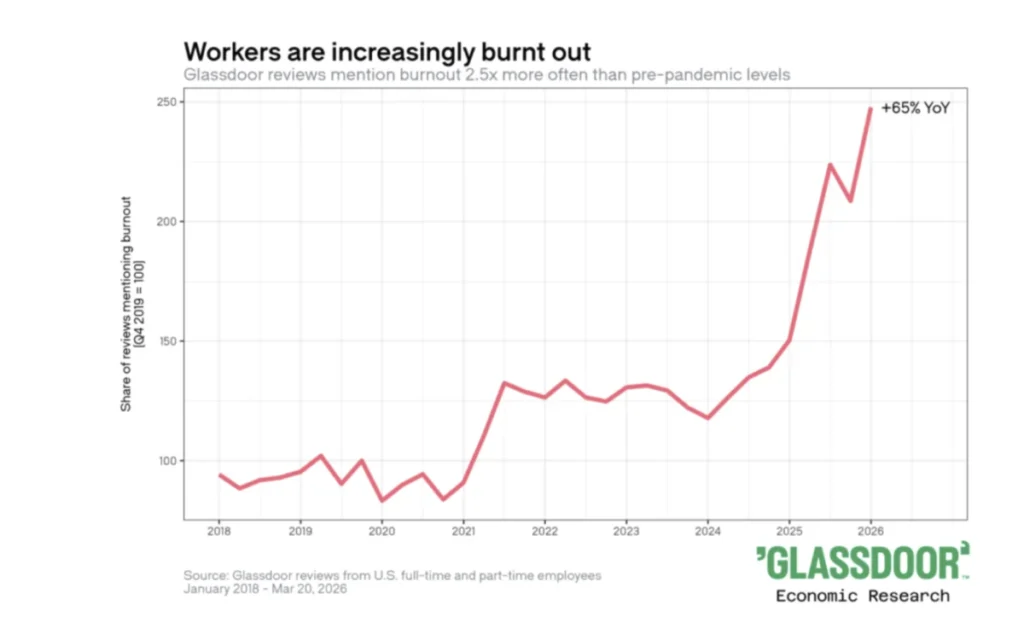
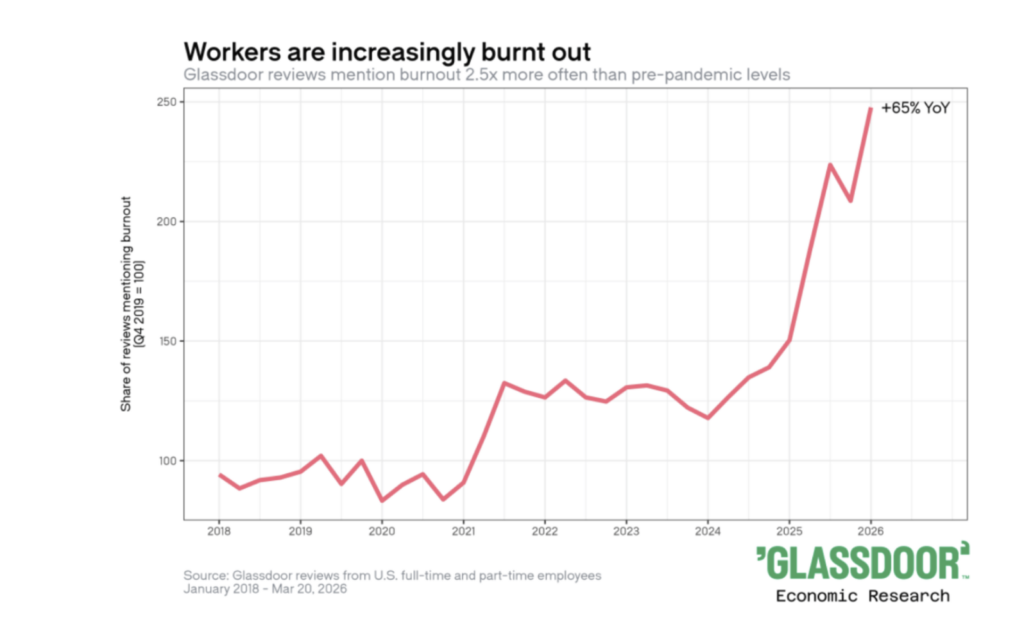
The impact of this strain is evident in the surge of burnout mentions within Glassdoor company reviews, which increased by 65% year-over-year in the first quarter of 2026. The pressure is particularly acute in sectors such as non-profit, healthcare, and technology, which have experienced the most substantial increases in worker exhaustion since 2019.
Jade Walters, a TEDx speaker and founder of the career development platform The Ninth Semester, observes, "One of the biggest signs of exhaustion is noticing a lack of emotional regulation—you’re more irritable, more anxious, more frustrated. You have to set boundaries, because if you keep chugging through and you’re feeling burnt out, you’re just going to keep hitting a wall." This sentiment underscores the critical need for individuals to implement self-preservation strategies in the face of prolonged professional stress.
Trapped in Unsuitable Roles
For those who remain employed, the current market presents a different kind of predicament: being locked into roles that no longer align with their career aspirations or personal well-being. In November 2025, the number of individuals seeking full-time employment but finding only part-time work reached 1.65 million, the highest figure recorded since January 2018. This indicates a growing mismatch between worker desires and available employment opportunities.
Long-term unemployment is also on the rise. As of December 2025, approximately a quarter of unemployed individuals had been jobless for at least 27 weeks, marking the highest proportion in nearly four years. The average duration of unemployment stood at 23.9 weeks as of March 2026, the longest stretch since October 2022. This prolonged period of joblessness leads many to exit the labor force altogether, further exacerbating labor market stagnation.
The quality of employment secured in this environment is also declining. In the fourth quarter of 2025, only 25.2% of new hires reported landing their ideal job, a sharp decrease from 36.2% in the preceding quarter. Furthermore, over a quarter of new employees accepted pay cuts, and a mere 30% were able to negotiate their terms. As ZipRecruiter economist Nicole Bachaud noted, "We’re seeing more decisions being made out of necessity." This suggests a market where desperation, rather than opportunity, is driving many career choices.
Generational Divergence: Gen Z’s Radical Rethink
The toll of the current labor market is not distributed evenly, and the youngest generation of workers is drawing particularly stark conclusions. Gen Z is navigating a job market that is proving significantly more challenging than the one experienced by millennials, characterized by extended job search timelines and higher rates of rejection. In response, a growing number of Gen Z individuals are considering unconventional career paths. Nearly one in four Gen Z workers are actively contemplating leaving traditional desk jobs for skilled trades, with a substantial three-quarters associating white-collar work with burnout and instability. Having witnessed the prolonged periods of intense work experienced by millennials, Gen Z appears to be re-evaluating the traditional markers of career success, questioning whether the perceived rewards of corporate advancement are worth the personal cost.
The Paradox of a "Healing" Market
The prevailing economic narrative often highlights signs of market improvement, such as the April 2026 jobs report, which indicated the addition of 115,000 jobs and an unemployment rate of 4.3%. However, these headline figures mask a significant bifurcation within the labor market. While certain sectors may be recovering, white-collar office roles are experiencing a different reality. AI-driven restructuring continues to compress opportunities in precisely the segment of the workforce most actively engaged in job searching. Michael Feroli, chief U.S. economist at J.P. Morgan, describes this as "resilience in the face of headwinds." Yet, for individuals facing a daunting 45% probability of finding new employment, this resilience feels more like stagnation.
Organizational psychologist Adam Grant has highlighted research suggesting that the frequency of breaks is more critical than their duration for cognitive recovery. Even short, 5-to-10-minute pauses throughout the day can significantly aid mental recuperation. The Glassdoor community echoes this sentiment. The most frequently cited coping mechanism among job seekers, employed by 39% of respondents, is selective application over broad outreach. This is followed by 28% who advocate for structured routines with designated stop times. The emerging wisdom for job seekers is not to intensify their efforts, but to strategically conserve their energy and protect their mental reserves.

The Invisible Economic Drag
The implications of widespread worker burnout extend far beyond individual well-being, posing a significant challenge to economic efficiency. A workforce too exhausted to actively seek new employment is less likely to self-sort into roles that best match their skills and aspirations. This immobility can suppress wage competition, hinder talent allocation to areas of greatest need, and ultimately dampen overall economic productivity. The burnout epidemic is not merely a mental health crisis; it is a critical factor impacting productivity and macroeconomic performance.
Furthermore, the current economic stagnation is exacerbating existing inequalities. Outcomes are becoming increasingly disparate based on race, age, and education. Workers with fewer resources to weather prolonged job searches are disproportionately likely to abandon their efforts altogether, leading to a widening gap in economic opportunities.
The American worker is not just experiencing burnout within their current roles; they are experiencing burnout from the very concept of seeking a new job. In a market characterized by low hiring and firing rates, where the mathematical calculus of career transition offers little incentive for movement, this widespread paralysis—quiet, largely invisible, and structurally rational—represents one of the most significant and consequential labor market stories of the current era.

For this story, Fortune journalists utilized generative AI as a research aid. An editor subsequently verified the accuracy of all information prior to publication.