
The strategic application of action verbs within job descriptions has emerged as a cornerstone for attracting superior talent and enhancing recruitment efficiency in today’s competitive labor market. This linguistic precision, which distinguishes active expressions of physical or mental action from static linking or helping verbs, is not merely a stylistic preference but a critical component in shaping candidate perception, optimizing search engine visibility, and streamlining the applicant screening process. Companies like Ongig have championed this approach, recognizing that a well-articulated job description, rich in specific action verbs, can significantly elevate the quality and diversity of applicant pools.
The Foundational Role of Action Verbs in Talent Acquisition
An action verb, by its very nature, conveys dynamism and purpose. Unlike linking verbs (e.g., am, are, is, was, were) or helping verbs (e.g., can, shall, will, could, would, should), which merely describe a state of being or assist another verb, action verbs like "analyze," "develop," "manage," or "orchestrate" paint a vivid picture of responsibility and contribution. This distinction is paramount in job descriptions, where clarity and impact are essential. A job description stating "responsible for customer problems" lacks the specific direction and measurable intent conveyed by "resolve customer complaints," the latter immediately informing a candidate about the expected proactive engagement and problem-solving skills required.
The shift towards using strong action verbs is driven by multiple factors, including the need for enhanced clarity, increased candidate engagement, better alignment with Applicant Tracking Systems (ATS), and a broader commitment to inclusive hiring practices. Recruiters spend an average of merely 6-7 seconds scanning a resume, and similarly brief periods on job descriptions. This necessitates language that is both concise and impactful, ensuring critical information is absorbed quickly and effectively.
Evolution of Job Descriptions: A Chronological Perspective
Historically, job descriptions were often rudimentary lists of duties, focusing more on administrative compliance than on attracting specific talent. Early 20th-century job postings were brief, often assuming a shared understanding of roles within a less specialized workforce. The mid-to-late 20th century saw the introduction of more structured job descriptions, particularly with the rise of human resources departments and standardized job classification systems. These often included general responsibilities and qualifications but still frequently relied on passive voice and generic phrasing.
The turn of the 21st century brought about a significant transformation, primarily driven by the advent of digital recruitment and Applicant Tracking Systems (ATS). As the volume of applications surged, ATS became indispensable for filtering candidates. These systems heavily rely on keyword matching, making the precise language of job descriptions crucial. Action verbs, reflecting specific skills and tasks, became the new keywords, dictating which resumes would pass the initial digital gatekeepers.
More recently, the emphasis has expanded beyond mere keyword matching to encompass diversity, equity, and inclusion (DEI). Research indicates that certain traditional job description terms carry unconscious gender bias (e.g., "dominant," "leader" often associated with masculine traits; "supportive," "collaborative" with feminine). The deliberate adoption of neutral, competency-focused action verbs helps mitigate such biases, broadening the appeal of job postings to a more diverse talent pool. Furthermore, the rapid pace of technological innovation, particularly in areas like artificial intelligence, data science, and digital transformation, has necessitated the inclusion of an entirely new lexicon of action verbs to accurately describe modern roles.
Supporting Data and Industry Insights
Data consistently underscores the importance of well-crafted job descriptions. Studies by LinkedIn and Glassdoor indicate that job postings with clear, descriptive language and an emphasis on key responsibilities see significantly higher application rates and attract more qualified candidates. For instance, a staggering 75% of job applications are initially filtered by ATS before reaching a human recruiter. This highlights the non-negotiable need for keyword-rich, action-verb-driven descriptions.
Moreover, unclear job descriptions are a leading cause of candidate dissatisfaction and early turnover. A survey by Robert Half found that 35% of professionals have left a job within the first year, with a significant portion citing a mismatch between their expectations and the actual role—a misalignment often stemming from vague job descriptions. The cost of a bad hire can range from 30% to 150% of the employee’s annual salary, making investment in precise job description language a financially prudent decision.
HR experts, such as Sarah Jones, a Senior Talent Acquisition Manager at a global tech firm, emphasize, "The language we use in job descriptions is our first and often most critical touchpoint with potential talent. Action verbs aren’t just about sounding professional; they’re about setting clear expectations and allowing candidates to envision their success in the role." Recruitment specialists also note a direct correlation between the specificity of action verbs and the quality of cover letters and interview responses, as candidates are better equipped to tailor their applications to the precise requirements outlined.
Strategic Categorization of Action Verbs
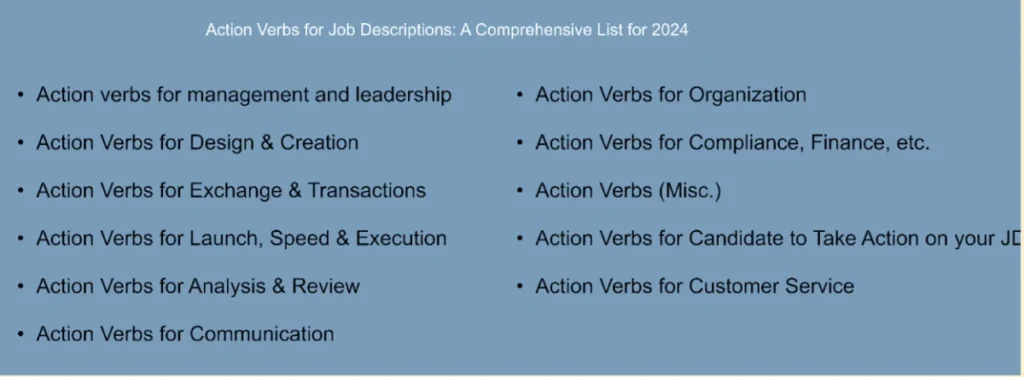
To maximize impact, action verbs are often categorized, allowing recruiters to select language that precisely reflects the nature of the role and the desired competencies. Ongig’s comprehensive list, encompassing hundreds of such verbs, serves as an invaluable resource for this strategic selection.
- Management & Leadership: Verbs like "achieve," "advise," "architect," "delegate," "direct," "manage," "maximize," "orchestrate," and "supervise" convey responsibility for strategy, oversight, and team guidance. These are crucial for roles that involve leading initiatives, people, or significant projects, signaling a need for strategic thinking and decisive action.
- Design & Creation: For roles focused on innovation and tangible output, verbs such as "create," "code," "design," "develop," "devise," "invent," "program," and "streamline" are essential. They highlight the generative and problem-solving aspects of positions in R&D, software development, product design, and content creation.
- Exchange & Transactions: These verbs describe roles involving resource allocation, procurement, and interaction within or outside the organization. "Acquire," "arrange," "budget," "distribute," "negotiate," "procure," "provide," "recruit," and "sell" are critical for finance, sales, purchasing, and logistics roles, emphasizing efficiency and successful exchange.
- Launch, Speed & Execution: In fast-paced environments, verbs like "accelerate," "activate," "deploy," "expedite," "further," and "implement" communicate a need for agility, initiative, and the ability to bring projects to fruition quickly and effectively. These are vital for project management, operations, and growth-oriented roles.
- Analysis & Review: For positions requiring critical thinking and data-driven insights, verbs such as "analyze," "appraise," "ascertain," "calculate," "evaluate," "examine," "forecast," "investigate," "leverage," "measure," and "research" are indispensable. They attract talent capable of deep dives, strategic planning, and continuous improvement.
- Communication: Effective collaboration is paramount in almost any role. Verbs like "author," "clarify," "collaborate," "correspond," "discuss," "inform," "inquire," "notify," "report," and "write" highlight the importance of clear, concise, and persuasive interaction, both internal and external.
- Organization: These verbs focus on structure, efficiency, and systematic arrangement. "Accumulate," "administer," "align," "arrange," "assemble," "commence," "compile," "coordinate," "organize," and "schedule" are key for administrative, operational, and project coordination roles.
- Compliance, Finance, etc.: For roles demanding meticulous attention to rules, financial integrity, and risk management, verbs such as "accrue," "allocate," "audit," "check," "control," "enforce," "ensure," "guarantee," "inspect," "prevent," "regulate," "restrict," and "verify" are crucial. They emphasize accountability and adherence to standards.
- Digital, Data, and AI Integration: Reflecting the modern technological landscape, this category includes verbs like "automate," "configure," "debug," "deploy" (in a tech context), "extract," "integrate," "model," "query," "scrub," and "visualize." These terms are vital for attracting talent in software engineering, data science, cybersecurity, and IT, signaling proficiency with cutting-edge tools and methodologies.
- Customer Service: Focused on client interaction and satisfaction, verbs such as "address," "advise," "assist," "de-escalate," "educate," "empathize," "engage," "facilitate," "handle," "negotiate," "resolve," and "satisfy" are critical. They highlight interpersonal skills, problem-solving, and a commitment to positive customer experiences.
- Candidate Call to Action: Finally, the job description must explicitly guide the candidate. Verbs like "apply" and "join" serve as direct invitations, transforming interest into tangible action.
Broader Impact and Strategic Implications
The diligent use of action verbs extends beyond merely describing a job; it fundamentally shapes the entire recruitment ecosystem and subsequent employee lifecycle.
- Improved Candidate Experience: Clear, engaging action verbs allow candidates to quickly grasp the essence of a role, reducing ambiguity and fostering a sense of confidence in their application. This leads to better self-selection, where only truly interested and qualified individuals apply.
- Enhanced Employer Branding: A job description that uses precise, powerful language projects an image of a professional, organized, and forward-thinking company. This strengthens employer branding, attracting top-tier talent who seek clarity and purpose in their careers.
- Reduced Time-to-Hire: By attracting a higher quality of applicant from the outset and enabling more efficient ATS screening, action verbs contribute to a faster recruitment cycle, ultimately reducing the time and resources expended on hiring.
- Better Quality of Hire: When expectations are crystal clear from day one, new hires are more likely to be a good fit for the role and the company culture, leading to higher job satisfaction and lower turnover rates.
- Diversity and Inclusion: As noted, action verbs can be consciously chosen to be gender-neutral and bias-free, fostering an inclusive environment that welcomes talent from all backgrounds. This shift from gender-coded adjectives to competency-based verbs significantly broadens the appeal of job postings.
- Performance Management and Career Pathing: A job description rich in action verbs provides a tangible framework for performance evaluation. If a role "spearheads new sales strategies," performance can be objectively measured against the development and success of those strategies. This clarity also aids in defining career paths and development goals for employees.
Top Tips for Incorporating Action Verbs Effectively
To truly leverage the power of action verbs, recruiters and hiring managers should adhere to several best practices:
- Be Specific and Industry-Relevant: Tailor action verbs to the specific role and industry. An "architect" in software development implies different skills than an "architect" in construction. For an administrative assistant, "administer" and "organize" are more appropriate than "revolutionize."
- Employ Active Voice and Present Tense: Always use the present tense and active voice to describe ongoing duties. "Oversees new sales projects" is far more immediate and engaging than "new sales projects were overseen." This creates a sense of current responsibility and helps candidates visualize their daily tasks.
- Start Each Bullet Point with a Strong Action Verb: This formatting technique makes job descriptions highly scannable and impactful. Instead of a passive sentence, begin directly with verbs like "Resolve and code backend logic…" or "Analyze quarterly earnings…" This immediately communicates the core responsibility and keeps the candidate engaged.
- Avoid Vague and Generic Language: Eschew weak, overused verbs like "work on," "handle," or "be responsible for." These offer no specific insight into the actual duties. Opt for precise alternatives such as "administer," "arrange," "assemble," or "execute."
- Match Verbs to Seniority Level: The intensity of action verbs should align with the seniority of the role. For entry-level positions, verbs emphasizing learning and collaboration (e.g., "assist," "support," "learn") are suitable. For leadership roles, more impactful verbs like "pioneer," "revolutionize," "strategize," or "transform" convey the expected level of influence and impact.
- Incorporate Measurable Outcomes: Where possible, couple action verbs with quantifiable results. "Boost sales growth by 30%" is significantly more compelling and measurable than simply "boost sales." This attracts achievement-driven candidates and sets clear performance benchmarks.
The evolving landscape of recruitment, characterized by technological advancements, increased competition for talent, and a growing emphasis on diversity and inclusion, solidifies the indispensable role of action verbs in crafting effective job descriptions. As championed by platforms like Ongig, utilizing precise and impactful language is no longer a luxury but a strategic imperative for organizations aiming to attract, engage, and retain top-tier, diverse talent in an increasingly complex global workforce.






